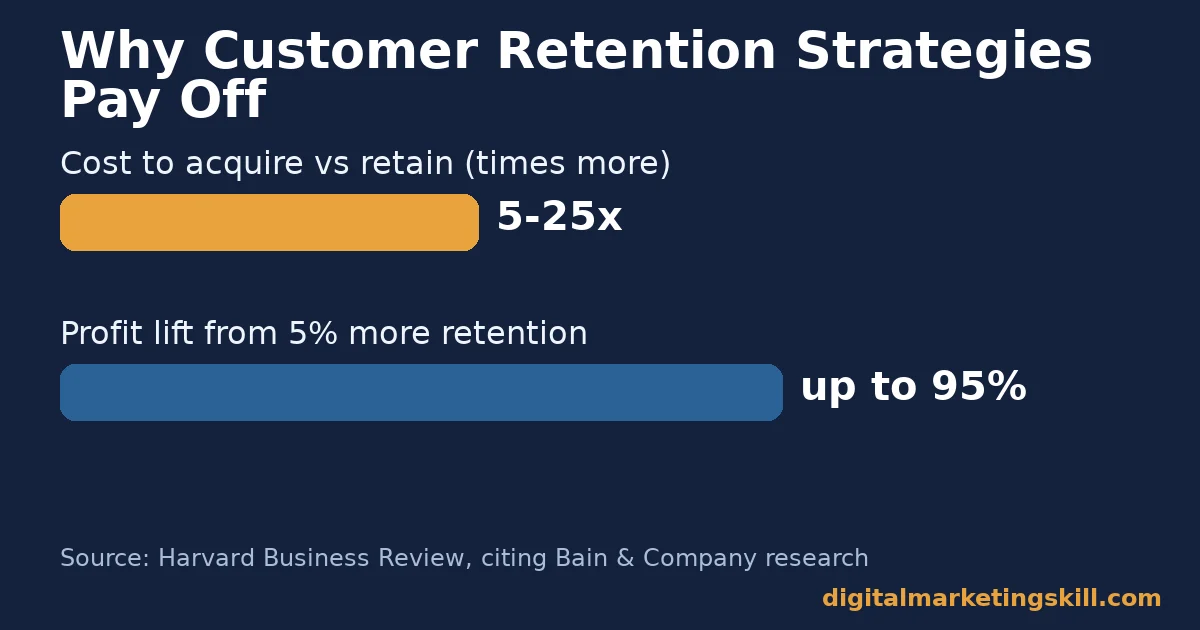
Good customer retention strategies cost less than chasing new buyers, and they pay off faster. Harvard Business Review reports that winning a new customer costs five to twenty-five times more than keeping one. A 5% lift in retention can raise profit by 25% to 95%. This guide compares the four pillars that actually move that number.
Key Takeaways
- Retention is cheaper than acquisition. Harvard Business Review puts the cost of winning a new customer at five to twenty-five times the cost of keeping one, depending on the industry.
- Small gains compound fast. Research by Bain & Company, cited in the same Harvard Business Review article, found that a 5% increase in retention can lift profit by 25% to 95%.
- Trust drives repeat visits. A BrightLocal survey of US consumers found 97% read reviews before choosing a local business. 49% trust those reviews as much as a personal recommendation.
- Loyalty systems measurably cut churn. Bain & Company reports that companies running a disciplined Net Promoter System see up to 20% lower customer attrition and a 15% cost advantage over peers.
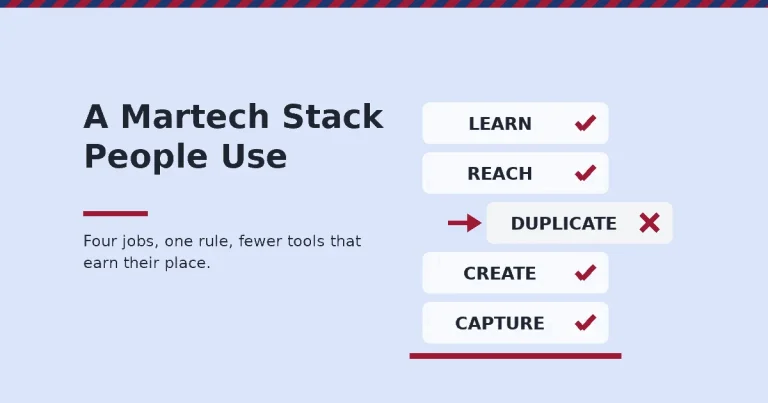
- The four pillars rarely get equal attention. Communication, social proof, incentives, and service recovery each fix a different leak. The right starting point depends on where your customers are actually dropping off.
In this guide
- What Most Customer Retention Strategies Guides Miss
- Why Customer Retention Strategies Work
- Four Customer Retention Strategies, Compared
- How to Put Each Pillar to Work
- How to Measure Customer Retention Strategies
- The One Rule: Fix the Leak Before You Add More Customers
- A Real Case: A European Telecom Provider’s Net Promoter Rebuild
- Frequently Asked Questions About Customer Retention Strategies
- Build Customer Retention Strategies Into Your Marketing Skills
What Most Customer Retention Strategies Guides Miss
Most lists of customer retention strategies read like a checklist. Blog more. Build community. Run promotions. Ask for feedback. None of that is wrong. But most guides treat every tactic as equally urgent. They rarely say which one to fix first when customers are actually leaving.
By the end of this guide, you should be able to name your weakest pillar with reasonable confidence, pick the matching first move, and measure whether it actually worked within a reasonable time frame.
This guide groups the realistic tactics into four pillars. It shows what each one costs and returns, and gives the one rule for deciding where to start. It also shows the measurement that proves whether a change is actually working, not just whether it feels active.
A few ground rules before the data. The Harvard Business Review and Bain figures are industry ranges, not guarantees for any single business. A software company and a corner shop will see different numbers from the same move. The BrightLocal figures describe local consumer behaviour in one national survey, a snapshot rather than a universal law. Every other number below is attributed to the group that published it.
One more ground rule matters here. Good customer retention strategies rarely come from a single tactic. They come from choosing the pillar that matches your actual weakness, then measuring it honestly before moving to the next one.
Why Customer Retention Strategies Work
The maths behind customer retention strategies is simple, even if the execution is not. Acquiring a stranger costs money on ads, discounts, and sales time. Most of those strangers never convert. Keeping an existing customer mostly costs the discipline of not disappointing them.
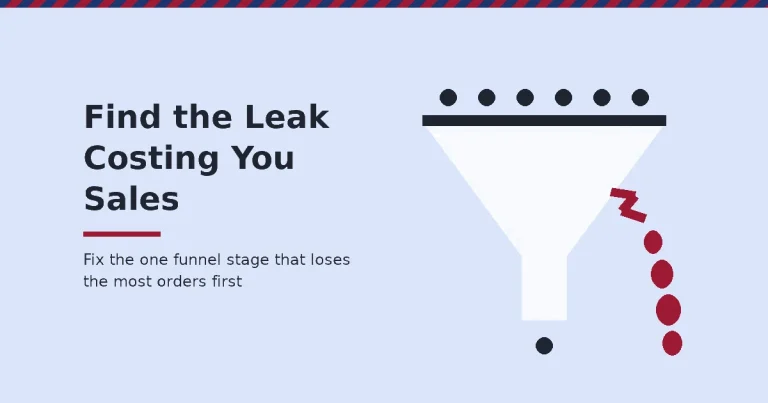
Think of it as a bucket with holes near the bottom. You can keep pouring in new water, which is what most acquisition spending does, or you can find the holes and patch them. Patching the holes is cheaper over time, because water you stop losing stays in the bucket without any further effort.
That gap compounds. Harvard Business Review’s often-cited figure, drawn from Bain & Company research, shows a 5% improvement in retention lifting profit by 25% to 95%, depending on the industry. A small, steady improvement beats one dramatic campaign. The effect builds every month a customer stays, instead of resetting with each new sale.
Once you see retention as a leak to fix, rather than a campaign to run, the rest of this guide shows where to look. Our four-stage system for running retention as an ongoing loop covers the operational side of that process in more depth. Effective customer retention strategies treat this as routine maintenance, not a one-time project you finish and move on from.
Four Customer Retention Strategies, Compared
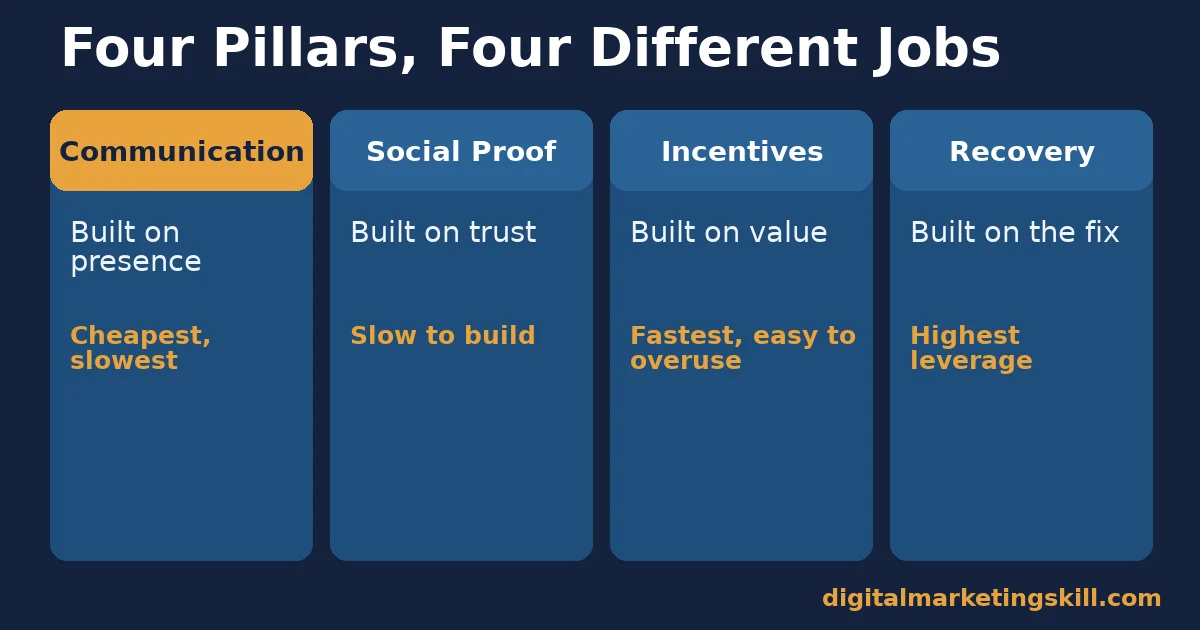
These four pillars cover almost every legitimate way to keep customers coming back. None of them works instantly. All of them need to be kept up, not launched once and forgotten.
Notice that none of the four pillars is a single tool or platform. They are categories of effort, which means a loyalty app, a review widget, or a help-desk system can support a pillar, but none of them replaces the discipline behind it.
Before picking one, be honest about where customers are actually leaving. Common causes are silence between purchases, doubt from other buyers, no reason to return, or a bad experience nobody fixed. People usually fail at retention for a simple reason. They start on the pillar that is easiest to talk about, not the one that is actually leaking.
Communication: Built on Staying Present
This pillar covers blogging, newsletters, and regular updates. It gives customers a reason to think about you between purchases. It is the cheapest pillar to start, because it needs time and a plan more than budget. Most businesses already have enough material for this pillar; the gap is usually a missing schedule, not a lack of things to say.
It is also the slowest to show results. One newsletter rarely changes behaviour. Consistency is what makes this pillar work. A customer who hears from you reliably every month builds a habit that a single campaign cannot.
Community and Social Proof: Built on Trust
This pillar covers reviews, testimonials, and the sense that other real customers are happy. A BrightLocal survey found that 97% of consumers read reviews before choosing a local business. 49% trust those reviews as much as a recommendation from someone they know. Our guide to retaining customers through post-purchase engagement covers how to keep that trust warm after the sale.
Social proof is slow to build and easy to lose. One bad, unanswered review can undo several good ones. This pillar rewards consistent service more than a one-time push for testimonials.
Value and Incentives: Built on a Tangible Reason to Return
This pillar covers loyalty discounts, exclusive offers, and anything that rewards a customer for coming back rather than going elsewhere. It is the fastest pillar to show a short-term bump in repeat visits.
It is also the easiest to overuse. Constant discounting trains customers to wait for a deal. This pillar works best as a periodic reward, not the default reason to return.
Service Recovery and Delight: Built on the Moment That Matters
This pillar covers how you handle complaints, feedback, and the small surprises that turn a satisfied customer into a loyal one. It is the pillar most businesses under-invest in, because it only shows its value when something has already gone wrong.
It is also the highest-leverage pillar per interaction. A well-handled complaint can build more loyalty than an interaction that never had a problem at all. It proves what you do when things are hard, which a smooth transaction never tests.
This is sometimes called the service recovery paradox: a customer whose problem was fixed quickly and well can end up more loyal than one who never had a problem to begin with. The effect is not guaranteed, but it explains why this pillar deserves more attention than most businesses give it.
Of the four, this pillar is also the hardest to plan for in advance, since you cannot schedule when a customer will have a problem. What you can control is how fast and how honestly your team responds once one appears, and that response is what customers actually remember.
How to Put Each Pillar to Work
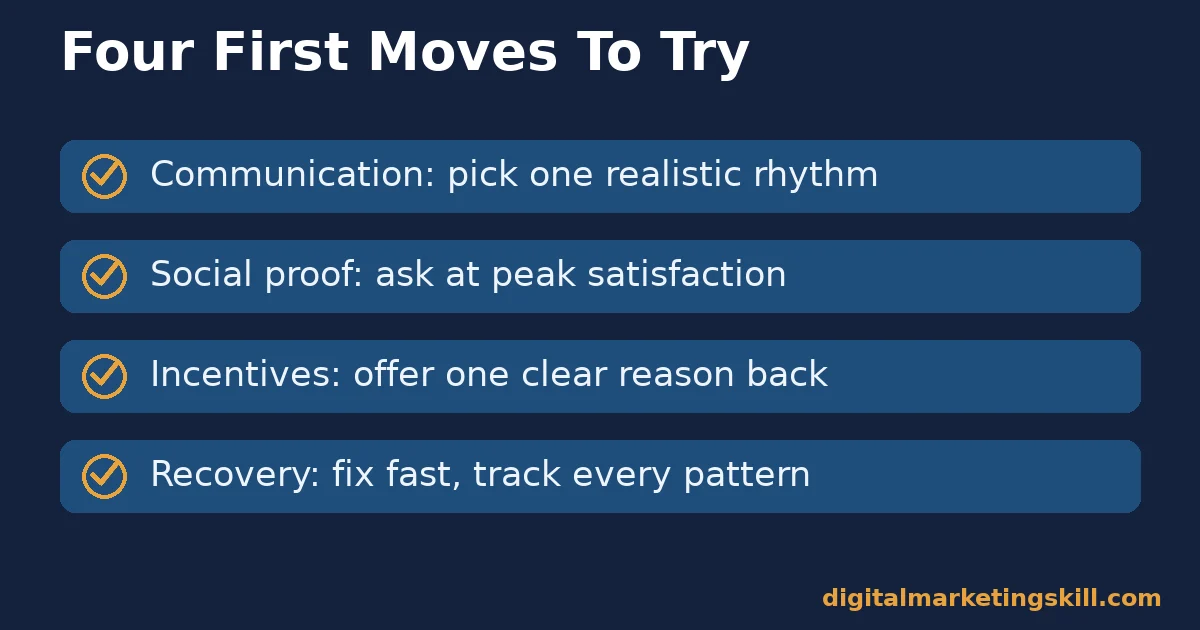
Each pillar above rewards a different first move. Pick the pillar that matches your biggest known weakness, not the one that is most fun to work on.
Communication: Lead With a Simple Content Rhythm
Pick one realistic frequency, such as monthly. Commit to it before adding a second channel. A steady monthly newsletter builds more trust than a burst of five posts followed by silence.
Judge the channel by clicks, not opens. Mailchimp’s email benchmarks put the all-industry average click rate at 2.62%. Mailchimp itself warns that open-rate data is distorted by Apple’s Mail Privacy Protection. Our guide to starting email marketing covers the basics of building that habit without overwhelming your list.
Community and Social Proof: Lead With Real Reviews, Not Claims
Ask every satisfied customer for a review at the specific moment they express satisfaction. Skip the generic follow-up email weeks later. Respond publicly to every review, good or bad. BrightLocal’s own data shows how closely consumers read them before buying, so a thoughtful public reply does real work.
Value and Incentives: Lead With One Clear Reason to Come Back
Offer one specific, well-timed reason to return, such as a reward tied to a second purchase. Skip the constant general discount. Our guide to why most customer loyalty programmes fail to pay off covers the design mistakes that turn this pillar into a cost centre instead of a retention tool.
Service Recovery and Delight: Lead With Fast, Honest Fixes
Resolve complaints quickly and honestly. Treat every piece of feedback as data, not an inconvenience. A small, well-timed surprise, such as acknowledging a loyal customer’s anniversary with your business, costs little and is often remembered longer than a discount of equal value. Write down every recurring complaint, since a pattern across many customers points to a process to fix, not just a single unhappy person to soothe.
For more tactical, order-by-order ideas, see our guide to repeat customer strategies, which covers pricing, delivery and loyalty rewards in more depth.
How to Measure Customer Retention Strategies
Retention work is easy to feel good about and hard to prove, unless you track the right numbers. These are the ones that separate a real improvement from a busy month.
Four Numbers That Tell You the Truth
- Customer retention rate. The share of customers you had at the start of a period who are still customers at the end. Exclude any new customers won during that period. This is the single clearest sign of whether the leak is closing. See our guide to customer retention rate for the exact formula and healthy benchmarks by business type.
- Net Promoter Score. Bain & Company’s own measure, based on asking customers how likely they are to recommend you, scored zero to ten. Subtract the share of low scorers (0-6) from the share of high scorers (9-10) to get a score from -100 to 100.
- Repeat purchase rate. The share of customers who buy a second time within a set window. This shows whether your value and incentives pillar is actually changing behaviour, not just generating clicks.
- Cost-to-serve ratio. What it costs to retain an existing customer against what it costs to acquire a new one. Harvard Business Review’s five-to-twenty-five-times gap is the benchmark to compare your own ratio against.
Reading the Numbers Together
Read these four together, not alone. A rising Net Promoter Score with a falling retention rate often means customers like you but still leave. The reason is usually practical, such as price or availability. A strong repeat purchase rate paired with a weak Net Promoter Score suggests incentives are working harder than genuine loyalty. That kind of loyalty rarely lasts once the incentive stops.
Here is a worked, illustrative example of why reading them together matters. A business with an 85% retention rate and a Net Promoter Score of minus ten looks healthy on paper. But a negative score means detractors outnumber promoters. That combination often means customers stay out of inertia or a lack of alternatives, not loyalty. The retention rate can fall quickly once a competitor makes switching easier.
The One Rule: Fix the Leak Before You Add More Customers
Here is the single most useful rule in this guide. If your retention rate is falling or flat, fix that before spending more on acquisition. New customers poured into a leaking bucket produce the same result as the customers before them.
As an illustrative, invented example: a business spending heavily on ads while its retention rate quietly drops from 80% to 70% is not growing. It is replacing lost customers at a steadily rising cost. The same budget spent closing that ten-point gap would compound every month afterward, instead of resetting to zero with each new customer.
This is why the order matters more than the activity. A business that runs every customer retention strategy in this guide at once, without first checking which pillar is leaking, usually sees smaller gains than one that fixes a single, clearly identified weakness before moving on.
A Real Case: A European Telecom Provider’s Net Promoter Rebuild
Bain & Company published a case study of a European telecommunications provider it refers to as TelecomCo, with the real company name withheld for confidentiality. Bain helped the company build a Net Promoter System across its retail stores and call centres.
The measured results were real and specific. Net Promoter Score gains reached up to 50 percentage points in retail stores. Call-centre scores gained more than 30 points. Sales conversion rates ran nearly 20% higher in pilot stores than in peer stores, alongside a measurable reduction in churn on major products.
Treat this case as evidence that a disciplined, measured approach to customer retention strategies can move real numbers. It is not a guarantee that any one tactic will repeat those exact results in a different business. The pattern is still useful: TelecomCo measured first, trained its people, and tracked the score over months, rather than launching a single campaign and hoping it stuck.
Retention keeps buyers from lapsing in the first place, but some will still go quiet. For that group, see our guide to customer win-back strategies, which covers how to segment lapsed buyers before sending any discount. Not every account deserves the effort, though: our guide to difficult customers explains how to tell a lapsed buyer worth winning back from an account better let go.
Frequently Asked Questions About Customer Retention Strategies
What is the single most effective customer retention strategy?
There is no universal single best tactic, because the right starting pillar depends on where customers are actually leaving. If you do not know, start by measuring your retention rate and Net Promoter Score, then fix the pillar the data points to first. Guessing without that measurement step is the most common reason retention efforts stall.
How much does it cost to keep a customer compared with acquiring one?
Harvard Business Review puts the gap at five to twenty-five times more expensive to acquire than to retain, depending on the industry. The exact ratio varies, but the direction is consistent across the research.
How do customer retention strategies differ for a small business versus a large company?
The four pillars apply at any size, but a small business usually gets more value from the communication and service-recovery pillars, since direct, personal contact is cheap relative to its size. A larger company often needs more structure, such as a formal loyalty programme, to deliver the same personal feel at scale.
A small business owner who personally replies to a complaint within the hour is practising the same service-recovery pillar that a large company tries to replicate with a dedicated support team. The underlying pillar is identical; only the scale and the cost of delivering it differ. Neither size has an inherent advantage in customer retention strategies, only a different cost structure for delivering the same four pillars.
How often should I ask customers for reviews or feedback?
Ask at the moment satisfaction is highest, such as right after a successful purchase or resolved issue, rather than on a fixed schedule unrelated to the customer’s experience. Asking too often, or at the wrong moment, lowers response rates and can feel like pressure rather than genuine interest.
Can discounts alone fix a customer retention problem?
Rarely on their own. Discounts can lift short-term repeat purchases, but they train customers to wait for the next deal rather than building real loyalty. Pair incentives with the communication and service-recovery pillars so customers have a reason to stay once the discount ends. On its own, a discount is a transaction; paired with the other pillars, it becomes part of a relationship.
What is a good Net Promoter Score?
There is no single universal good score, because it varies by industry and by how a company phrases the survey. What matters more than the absolute number is the trend. A Net Promoter Score that is rising over time, alongside a stable or rising retention rate, is a healthier sign than any single snapshot.
Do customer retention strategies work the same way online and offline?
The four pillars apply in both settings, but the tools differ. Online, communication runs through email and content, social proof runs through reviews and ratings, and service recovery runs through support tickets and live chat. Offline, the same pillars often run through in-person service, local reputation, and loyalty cards, so the principle stays constant even as the channel changes.
What is the biggest mistake businesses make with customer retention strategies?
The most common mistake is working on all four pillars a little at once, instead of fixing the biggest leak first. A business with no measurement in place cannot tell which pillar actually needs the work, so effort gets spread thin across tactics that each move the number only slightly.
Build Customer Retention Strategies Into Your Marketing Skills
Every pillar above, from content rhythm to review management to loyalty design, is a skill that compounds the more consistently it is applied, wherever in your country your customers are.
The Digital Marketing Skill Institute’s Master Diploma in Digital & AI Marketing builds exactly these skills, including AI-powered email marketing and automation, AI-powered lead generation, and AI-powered social media marketing and analytics, with unlimited one-on-one mentoring and real project work inside a U.S. partner company from day one. The programme is dual US and UK accredited, recognised in more than 100 countries, and entirely online.
See real outcomes on the student reviews page, explore the Master Diploma programme in full, or browse more guides on the digital marketing blog. Visit digitalmarketingskill.com to see the full range of courses, and when you are ready, apply here to get started from digitalmarketingskill.com.
Every figure in this guide was checked against its original source before publication. Figures marked as illustrative are invented examples, not real results.