A digital marketing consultant is an independent expert who audits a business’s online presence and builds a plan to fix the gaps. Some consultants also run the work themselves. You become one by proving results in a narrow skill first. Then you package that proof into a service a client will pay for.
Key Takeaways
- Demand is real but specific. The Bureau of Labor Statistics projects 7% growth for market research analysts and marketing specialists over the next decade. It also projects about 82,000 openings a year on average. That figure is US-only.
- Small businesses are actively outsourcing. Clutch surveyed 500 small-business decision-makers. 45% plan to outsource marketing, and 47% named AI and automation as a growth area for outside help.
- Most sites never get found, so strategy beats tactics. Ahrefs studied roughly 14 billion pages and found that 96.55% get no traffic from Google. Closing that exact gap is what a consultant gets paid for.
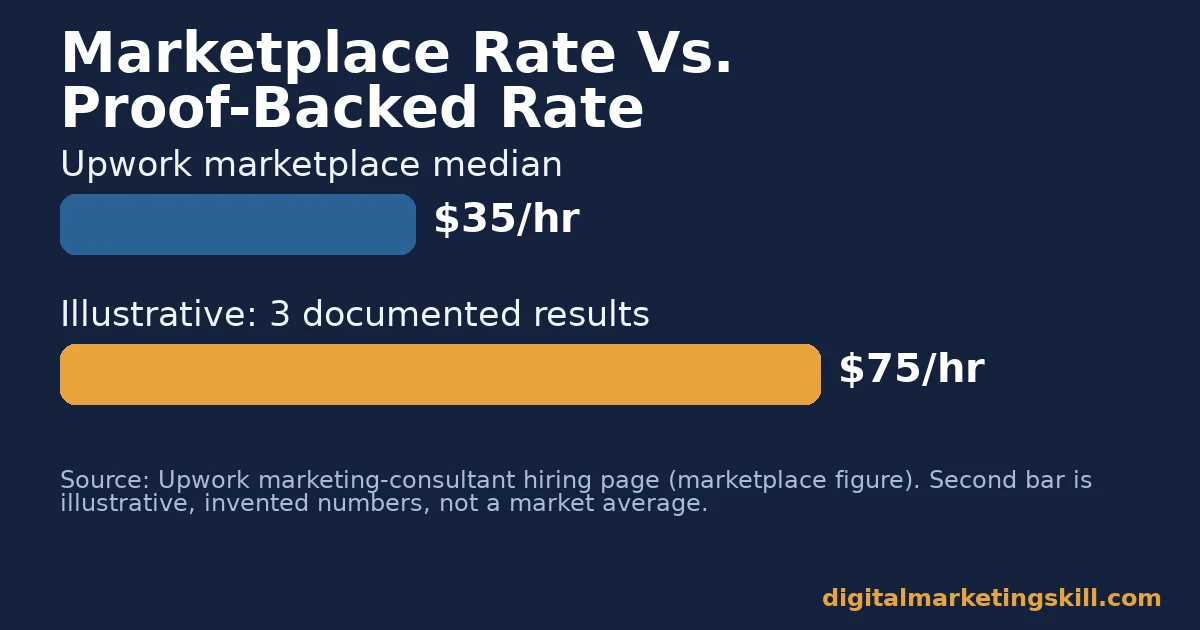
- Marketplace rates understate real pricing. Upwork’s own hiring page lists a $35 median hourly rate on its marketplace. Retainer and project work pays far more once a consultant has proof of results.
- Independent consulting keeps growing. MBO Partners counts 11.5 million independent professional service providers in the US who serve businesses, a 55% increase over just a few years. It is a US figure, but the direction is clear worldwide.
In this guide
- What Most “How to Become a Consultant” Advice Skips
- How a Digital Marketing Consultant Actually Creates Value
- Three Paths Into Digital Marketing Consulting
- How to Build Each Path Into Paying Work
- How to Measure Whether You Are Ready to Charge as a Consultant
- The One Decision Rule: Price the Proof You Have, Not the Skill You Claim
- Common Mistakes That Keep New Consultants Underpaid
- A Real Case: Building a Consulting Income One Client at a Time
- Frequently Asked Questions About Digital Marketing Consultants
- Start With One Documented Result, Then Build the Service Around It
What Most “How to Become a Consultant” Advice Skips
Most guides on becoming a digital marketing consultant list the same three steps. Learn marketing, get experience, find clients. None of that is wrong, but it skips the step that actually gets you paid: choosing one specific, provable skill before you call yourself a consultant.
This guide names three real paths into the work. It shows what to prove for each path, and it gives you a way to measure whether you are ready to charge.
Treat the three-path framework as a useful way to organize a messy market, not as a settled industry standard. Every number below names its source. Where a figure is US-only or self-reported, that is stated plainly. A snapshot from one survey is not a permanent ranking of the whole field.
The gap matters because clients cannot see your training. They can only see your proof. So the rest of this guide treats “proof” as the product you are actually building. Each path below gets its own specific tactics for creating it.
How a Digital Marketing Consultant Actually Creates Value
A business hires a digital marketing consultant for one of two reasons. It lacks a skill in-house, or it lacks the time to apply a skill it already understands. Either way, the job has three parts.
First, diagnose what is actually broken, not what the client assumes is broken. Second, build a plan that fits the client’s budget and team. A generic playbook rarely survives contact with a real business. Third, run the work yourself or train someone else to run it, then show the result in numbers the client already tracks.
That third part separates a consultant from an employee doing similar tasks. A company pays an employee for hours. It pays a consultant for a diagnosis and a result. So your value has to show up in a metric the client already cares about. Qualified leads, cost per acquisition, or organic traffic that actually converts all work.
AI Tools Raise the Floor, Not the Ceiling
Demand for that judgment is rising even as AI tools spread. More than 1,500 marketers surveyed for HubSpot’s State of Marketing report said 86.4% now use AI tools day to day. That raises the floor for execution. It also raises the price of anyone who can still diagnose strategy correctly, because the tools do not decide what to fix first.
The Institute’s guide to job-ready digital marketing skills covers the same shift from a hiring angle. Employers and clients increasingly pay for proof of a result, not a list of tools you claim to know.
Google’s own guidance on creating helpful, people-first content asks a question that works for any consulting engagement. Will the client “leave feeling they’ve learned enough” to act, or did you just hand over a report nobody reads? Consultants who pass that test get asked back. The ones who do not usually get one project and nothing more.
Three Paths Into Digital Marketing Consulting
Not every consultant builds the same business. Three paths show up most often. Each one needs a different first proof point before a client pays for it.
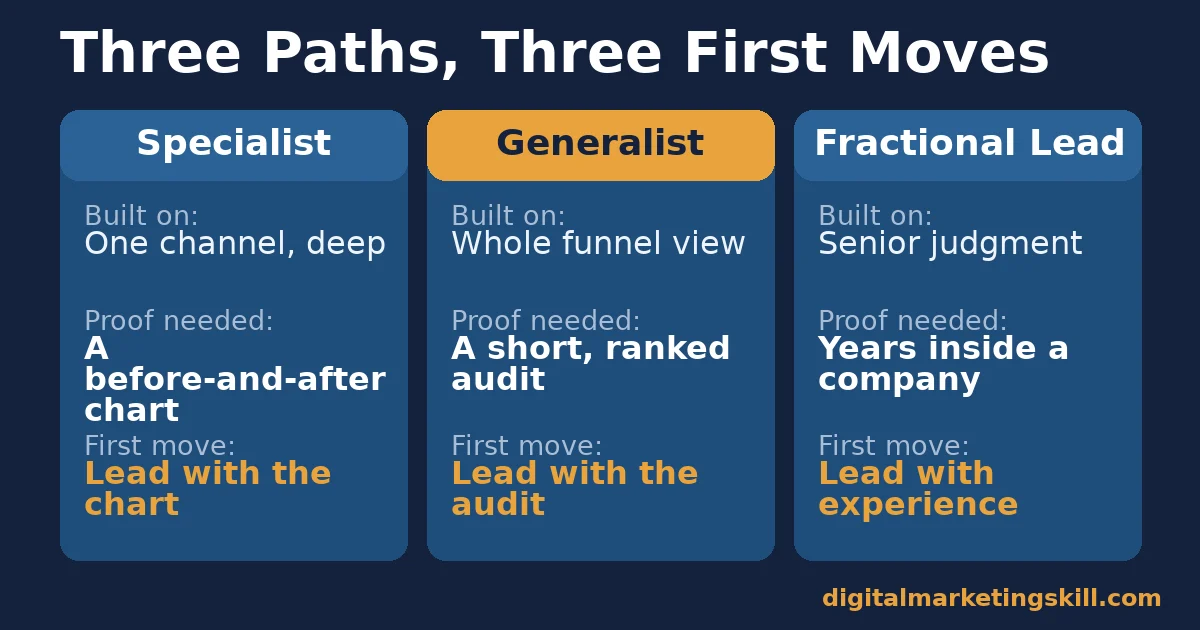
A quick way to pick: if you already have one strong channel skill, start as a specialist. If you have worked across several channels but none at expert depth, start as a generalist. If you have already run marketing inside a company for years, you may be ready to skip straight to fractional work. Match the path to the proof you already have, not to the title you want.
The Specialist Digital Marketing Consultant: Built on One Channel Mastery
The specialist picks one channel, such as search engine optimization, paid search, or email automation. They go deep enough to outperform a generalist on that one channel alone. Clients hire specialists when a marketing plan already exists but one piece needs execution their current team cannot reach.
The advantage here is a short sales pitch: “I fix this one thing, and here is proof.” The limit is the ceiling on the work. A specialist competes on being measurably better at a narrow task. The proof has to be concrete, such as a traffic chart or a cost-per-lead drop. A general claim of expertise will not do.
The Generalist Digital Marketing Consultant: Built on Full-Funnel Strategy
The generalist sees the whole funnel, from the first ad impression to the final sale. Clients hire a generalist to connect pieces that stay disconnected. A social media team and a sales team that never talk to each other is the classic example. This path suits someone who has worked across several channels and can judge which one actually limits growth right now.
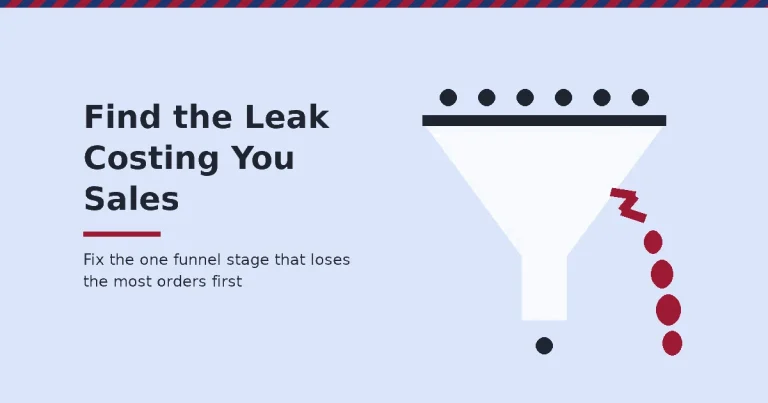
The advantage is a wider market, because most small businesses have no one doing this job at all. The limit is proof. A generalist cannot point to one obvious chart. So the pitch has to be a short, specific audit that names the single biggest leak in the client’s funnel.
The Fractional Lead: Built on Senior Judgment
A fractional marketing lead acts as a part-time marketing director for several businesses at once, each too small to afford a full-time one. This path rests on judgment built from running marketing inside a real company, not from a course alone. It usually comes after several years in an in-house or agency role.
The advantage is the highest day rate of the three paths, because the client buys years of decisions made correctly, not hours of execution. The limit is capacity. A fractional lead can only serve a handful of clients well at once. So the whole model depends on pricing for judgment, not for time.
How to Build Each Path Into Paying Work
Understanding a path is not the same as getting paid for it. Each path needs a different first move. Skipping that move is the most common reason a new consultant stays stuck at a low rate.
The Specialist: Lead With a Documented Before-and-After
Start with one real account. It can be small, a volunteer project, or your own site. Document the starting numbers before you touch anything. Apply one well-defined technique, wait for a measurement period long enough to matter, then record the change. That single before-and-after becomes your pitch: a chart, not an adjective.
If you have not landed that first account yet, start closer to home. The Institute’s guide to getting a first digital marketing job without experience covers how to get in front of a real budget sooner, even inside someone else’s team.
Price your first few engagements lower than you plan to charge long-term, and say so to the client directly. Tell them this rate buys early access while you build a track record. Raise the rate once you have three documented results in the same channel.
The Generalist: Lead With a Short, Specific Audit
Offer a fixed-price audit before any ongoing work. Keep it short. Name the three things most limiting the client’s growth, ranked by how much each one is likely costing them. This gives the client something concrete to judge you on before committing to a retainer. It also gives you the diagnosis you need to scope real work afterward.
Write the audit in plain language a non-marketer can act on without a translator. If a client reads it and immediately understands what to fix first, you have demonstrated the exact skill a generalist consultant sells.
The Fractional Lead: Lead With Senior Experience First
This path is rarely the first one you build. Spend time inside a company or agency first. Ideally, own a budget and a result you can describe precisely. “Grew qualified pipeline by replacing two underperforming channels with one that worked” is the kind of sentence that sells. That sentence, backed by real numbers, is what fractional clients are actually buying.
The Institute’s digital marketing career path guide covers how to build that kind of track record before you go independent. Most fractional work is won on reputation inside an industry, not on a cold pitch.
Once you start taking fractional clients, cap the number you serve at once. Clients paying for judgment notice immediately if you are spread too thin to think about their specific business.
How to Measure Whether You Are Ready to Charge as a Consultant
Four numbers tell you whether you are ready to move from learning to billing. They also show whether your chosen path is actually working once you start charging for it.
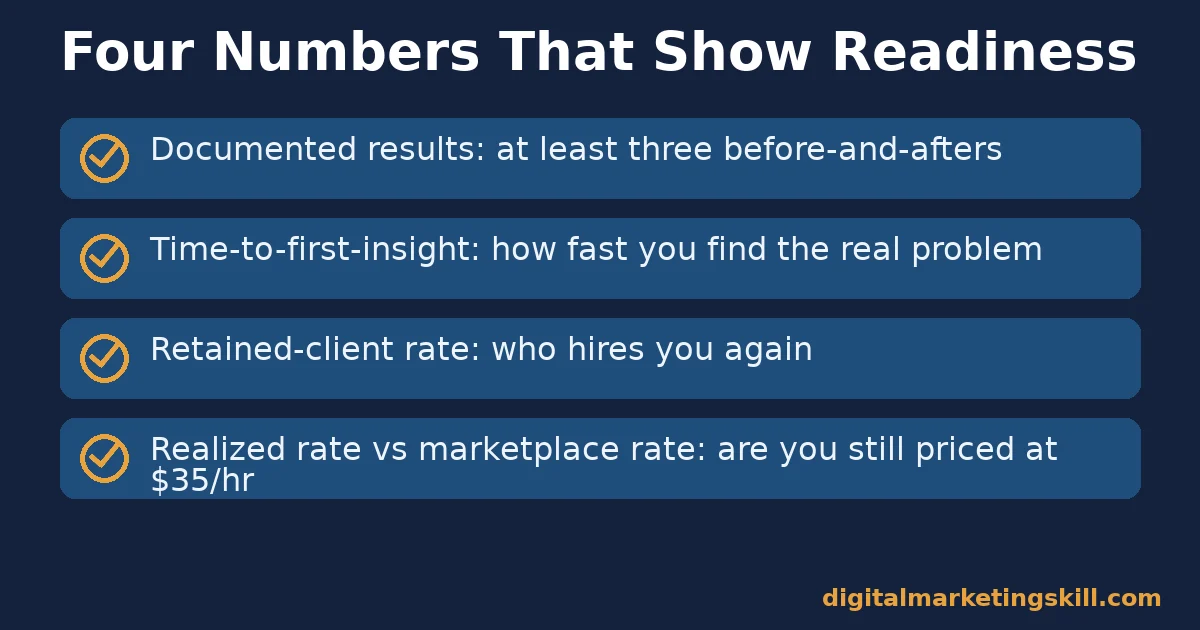
- Documented results count. This is the count of real before-and-after results you can show a stranger. Each one needs a starting number, an ending number, and a time period. Aim for at least three in your chosen channel before pricing yourself as an expert in it.
- Time-to-first-insight. This is how long it takes you to find the one or two things most limiting a new client’s growth. A fast, accurate diagnosis is what clients are really paying for, more than the execution that follows it.
- Retained-client rate. This is the share of first-time clients who hire you again or extend the engagement. A low rate after several projects usually means the diagnosis was wrong, not that you need a better sales pitch.
- Realized rate versus marketplace rate. Upwork’s own data shows a $35 median hourly rate on its open marketplace. If you are still priced at or below that after a handful of documented results, the gap sits in proof and positioning. It is not a skill problem.
Read these four numbers together, not one at a time. A high retained-client rate paired with a low realized rate means you are underpricing proven work. A low retained-client rate paired with a fast diagnosis time usually means your execution needs work, not your judgment.
The One Decision Rule: Price the Proof You Have, Not the Skill You Claim
If you remember one rule from this guide, make it this one. Price yourself according to documented results you can show, not according to how much you know. A consultant who can explain SEO perfectly, but has never shown a traffic chart, should price like a beginner. A consultant with three verified case studies in email automation should price like a specialist, even with only a year of experience.
Illustrative, invented numbers: picture two consultants, both one year into consulting. Consultant A has deep theoretical knowledge and charges $30 an hour, citing their expertise. Consultant B has three documented campaigns, each with a before number, an after number, and a time frame, and charges $75 an hour, citing those three results instead.
Clients who buy outcomes choose Consultant B. The price is backed by evidence they can check, not a claim they have to trust on faith.
Common Mistakes That Keep New Consultants Underpaid
Three mistakes show up again and again in new digital marketing consultant pitches, and all three are fixable within one project cycle.
The first mistake is selling hours instead of a diagnosis. A client who buys hours will always compare your rate to the cheapest alternative. A client who buys a diagnosis is comparing your judgment, which is far harder to shop around for.
The second mistake is skipping the baseline. If you do not record the client’s starting numbers before you touch anything, you have no way to prove the change afterward, no matter how good the work actually was.
The third mistake is pricing from confidence instead of evidence. New consultants often raise their rate because they feel more capable. That feeling is not a result the client can check, so it should not set the price. Clients cannot see confidence. They can only see proof, so let proof set the price every time.
A fourth mistake, less common but costly, is taking on too many clients too early. Each new client without a finished diagnosis dilutes the attention every other client is paying for. Two well-served clients build more referrals than five rushed ones, because referrals come from a specific result a client can describe to someone else.
A Real Case: Building a Consulting Income One Client at a Time
According to a published review on the Digital Marketing Skill Institute’s reviews page, a graduate named Olajire Jacob started by charging around $500 to set up email marketing automation flows for individual clients. That work matched the specialist path described above: one channel, one deliverable, one price. He later expanded his services and scaled his monthly income to about $5,000.
The pattern matters more than the dollar figures. Jacob did not start by claiming to be a full-service consultant. He started with one narrow, well-defined service, priced it, and delivered it for real clients. Only once that first service was proven and repeatable did he broaden his offer.
Results like this are specific to one person’s effort and market. No outcome is typical, and none is guaranteed; see the Institute’s earnings disclaimer for the full context behind any student income figures.
Frequently Asked Questions About Digital Marketing Consultants
How much experience do I need before calling myself a digital marketing consultant?
There is no fixed number of years. What matters is having a few documented results in a specific channel that you can show a prospective client, rather than years spent without any measurable outcome to point to.
Can I become a digital marketing consultant without a degree?
Yes. Clients hire for demonstrated results, not credentials. A documented track record, even from small or volunteer projects, carries more weight than a degree with no proof behind it.
Should a new digital marketing consultant specialize or stay general?
Specializing is usually faster for landing a first paying client, because a narrow, provable claim sells more easily than a broad one. Many consultants start specialized and broaden into generalist or fractional work later, once they have a track record behind them.
How do digital marketing consultants typically price their work?
Pricing usually moves from hourly, to project-based, to retainer, as proof accumulates. Marketplace hourly rates can sit well below retainer or project pricing once a consultant has a track record a client can actually verify; the Institute’s guide to freelancing for beginners covers how to structure that first pricing conversation.
What is the biggest mistake new consultants make?
Leading with a list of skills instead of a documented result. A prospective client cannot verify “I know SEO.” They can verify “I took this metric from X to Y in this time frame,” so the second claim closes far more work than the first.
Do digital marketing consultants need to know AI tools now?
It helps. A recent survey of more than 1,500 marketers by HubSpot found that 86.4% now use AI tools, and the share who say they understand how to use AI in marketing rose to 68.2%, up from 47% a year earlier. Clients increasingly expect a consultant to use these tools well, not just know they exist.
How many clients can a new digital marketing consultant realistically serve at once?
Early on, serve very few clients at once, often just one or two, so each one gets a real diagnosis and a documented result. Capacity can expand once your process is repeatable, but a rushed, undocumented engagement produces no proof to show the next client.
Start With One Documented Result, Then Build the Service Around It
Becoming a digital marketing consultant is less about mastering every channel and more about proving you can fix one real problem for one real client, with numbers to show for it. Pick the path, specialist, generalist, or fractional, that matches the experience you already have. Get your first documented result, then price your next client on that proof instead of a guess.
The Digital Marketing Skill Institute’s Master Diploma in Digital & AI Marketing gives any aspiring digital marketing consultant a faster way to build that proof instead of guessing alone. It pairs courses like AI-Powered Search Engine Optimisation & Content Marketing and AI-Powered Social Media Marketing & Analytics with unlimited one-on-one coaching and mentoring, plus real project work inside a U.S. partner company, so you leave with documented results rather than theory.
The diploma is dual US and UK accredited and recognised in more than 100 countries, delivered entirely online, so you can build your consulting proof from anywhere in your country.
Explore the program at Digital Marketing Skill Institute, browse more guides on the blog hub, or apply directly whenever you are ready, wherever you live. You can start building that first documented result today, and the Digital Marketing Skill Institute team is set up to support that process entirely online.
Every figure in this guide was checked against its original source before publication. Figures marked as illustrative are invented examples, not real results.
![9 Amazing Digital Marketing Skills to Make Money Online [With Proof]](https://digitalmarketingskill.com/wp-content/uploads/2019/07/9-Amazing-Digital-Marketing-Skills-to-Make-Money-Online-With-Proof-17.png)