
Digital marketing career tips only help if you can act on them today. Hiring managers now filter on proof of skill before they look at a degree, and marketing postings advertise remote work far more than the average job. The people who get hired fastest show one real, checkable result, not a long list of courses, wherever they live.
Key Takeaways
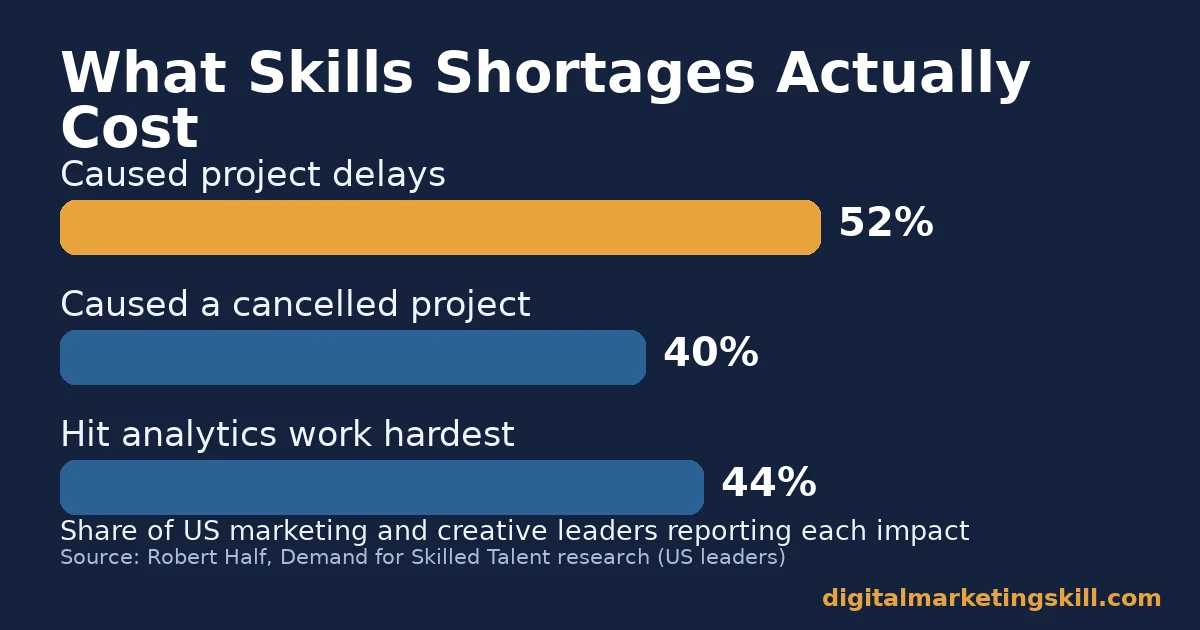
- Skill gaps already cost teams money. In Robert Half’s research on marketing and creative hiring, 52% of US leaders said skills shortages caused project delays in the past year, and 40% said a project was cancelled outright.
- Analytics is the weakest link. The same research found marketing analytics and performance work hit hardest by skills shortages, named by 44% of leaders, ahead of customer experience, automation and AI workflows.
- Measurement skill is rarer than people assume. Content Marketing Institute’s B2B research found that 25% of marketers point to a lack of data skills or talent as the reason they struggle to prove what their content achieved.
- The market is bigger than any one country. DataReportal’s global digital overview puts internet users at more than seven in ten people worldwide, and social media users at close to seven in ten. The audience you are learning to reach is genuinely global.
- Remote marketing roles are common, not rare. Across Indeed Hiring Lab’s multi-country remote-work tracker, the share of job postings advertising work-from-home has roughly quadrupled over a recent multi-year stretch. Marketing is one of the functions most often advertised that way.
In this guide
- What Most Digital Marketing Career Tips Get Wrong
- How Hiring Managers Actually Filter Digital Marketing Candidates
- Three Routes Into a Digital Marketing Career, and What Each One Proves
- How to Lead With Each Route When You Apply
- How to Measure Whether Your Digital Marketing Career Tips Are Working
- The One Decision Rule: Match Your Proof to Your Stage
- A Four-Week Plan to Put These Digital Marketing Career Tips Into Practice
- A Real Case: Turning One Skill Into Recurring Client Work
- Common Digital Marketing Career Mistakes to Avoid
- Frequently Asked Questions About Digital Marketing Career Tips
- Start With One Proof Point, Then Build the Next
- Related Reading on Digital Marketing Careers
What Most Digital Marketing Career Tips Get Wrong
Search “digital marketing career tips” and most lists repeat the same lines. Stay curious. Network more. Keep learning. None of that is false. But none of it is checkable either. It skips the part that actually decides whether you get hired: what a recruiter looks at first, how long the search takes, and what makes them stop reading your resume.
This guide names that gap directly. The advice below reads current hiring research honestly. It is an informed reading, not a guarantee, because hiring practice varies by company, industry and country. Where a figure comes from a US-only survey, that is flagged here, because pay and hiring norms differ sharply by region.
Three things are documented and stable enough to plan around. Employers are measurably short on marketing skills. Proof of applied skill is weighed increasingly ahead of credentials. And marketing work is unusually open to remote and freelance arrangements compared with most other job functions.
Separately, the World Economic Forum’s Future of Jobs research, surveying over 1,000 companies, reports that nearly 40% of core job skills are expected to change over the coming years. It also found that 63% of employers already call the skills gap their top barrier to change.
That scale of shift is exactly why generic advice stops working. The rest of these digital marketing career tips build on these facts, and each piece of advice below traces back to one of them.
How Hiring Managers Actually Filter Digital Marketing Candidates
Picture a hiring manager with 80 applications and one afternoon. They do not read every resume closely. They scan for a small number of signals: a result they can picture, a tool name they recognise, and a credential or project that is easy to verify. This single fact explains why generic digital marketing career tips, like “stay motivated,” rarely change the outcome.
Research from Harvard Business Review, by Joseph Fuller, Christina Langer and Matt Sigelman, traces how employers spent years layering degree requirements onto jobs that had not actually changed. That happened long before “skills-based hiring” became a common phrase.
The history matters here. Today’s shift toward weighing proof of skill over degrees is a correction to an old habit, not a passing trend. That is why a visible result now outperforms a long course list on a resume.
This changes what you should optimise for. A hiring manager cannot verify “hardworking” or “passionate” in thirty seconds. They can verify a published campaign, a named client result, or a certificate number. Every digital marketing career tip below is built around giving them something checkable.
Three Routes Into a Digital Marketing Career, and What Each One Proves
Most people choosing a digital marketing career pick between three realistic routes. You can teach yourself with free resources, take a structured training program, or build a portfolio through client or employer work.
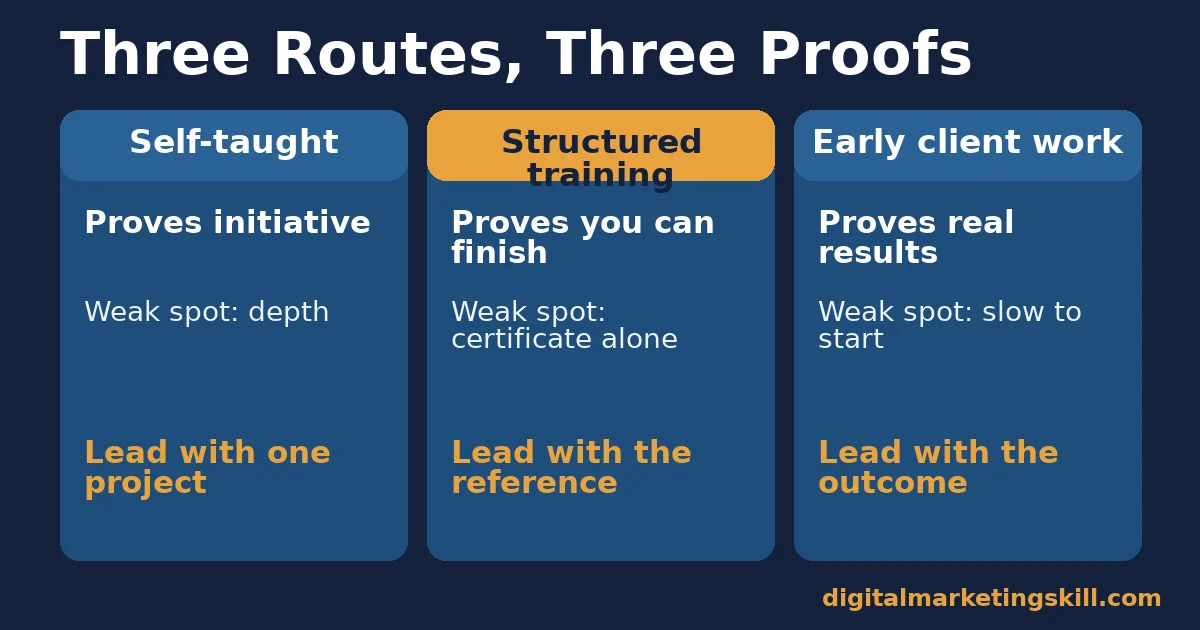
Each route proves something different to a hiring manager. That is exactly why the best digital marketing career tips never recommend just one route for everyone. Mixing the routes up without knowing the difference is the second biggest mistake people make, right after vague advice.
Digital Marketing Career Tip 1: The Self-Taught Route Proves Initiative, Rarely Depth
Free courses, blogs and video channels are genuinely useful for picking up terminology and tool basics. The gap is depth. Without feedback or a structured project, it is easy to learn the vocabulary of SEO, paid media or email marketing without learning how the pieces interact under a real budget or deadline.
A self-taught candidate who shows one complete project, even a personal one, beats a self-taught candidate who lists ten free courses with nothing attached.
Digital Marketing Career Tip 2: Structured Training Proves You Can Finish, Not Just Watch
A structured program with mentoring, deadlines and a real project reference solves the depth problem. Someone else is checking your work along the way. Before enrolling anywhere, check one thing: does the program end with a reference you can point to, or just a certificate of attendance? A completion certificate with no attached work is weak evidence. A verified work reference or a real client project is strong evidence.
Digital Marketing Career Tip 3: Early Client Work Proves Results Under Real Constraints
Working inside a small business, or taking on freelance clients early, proves the hardest thing to fake. It shows your work holds up against a real budget, a real deadline, and a client who will say plainly if it did not work.
This route is slower to start. The first results are usually modest. But one verified client outcome is worth more to a hiring manager than a stack of certificates with no outcome attached.
In the US specifically, the Bureau of Labor Statistics projects market research analyst and marketing specialist roles to grow 7% over its latest ten-year outlook, much faster than the average occupation. Median pay for the role sits at $78,760 a year. Growth like that is exactly where early proof pays off fastest.
How to Lead With Each Route When You Apply
Knowing what each route proves only helps if your application leads with that proof instead of burying it under job history or course names. Here is how to present each one, route by route.
Self-Taught Route: Lead With One Finished Project, Not a List of Courses
Pick the single best thing you built. It can be a mock campaign, an audit of a real website, or a newsletter you grew from nothing. Put it at the top of your application with a one-line result. List tools and courses underneath, as supporting detail only. A list of course names with no attached work reads as unfinished. One project with a before-and-after number reads as capable.
Structured Training Route: Lead With the Project, Not the Certificate Name
Do not lead with “I completed a digital marketing course.” Lead with what you did inside it. Try something like: “I planned and launched an email sequence for a real client project during training, which raised the open rate by a specific amount.” The certificate name becomes a footnote. The work, and the reference letter behind it, is the proof that counts.
In-House or Freelance Route: Lead With the Result, Then the Constraint
State the result first. Then add the constraint that makes it credible: budget size, timeline, or starting point. A line like “grew a client’s email list by a specific number over a defined period, on a limited budget” tells a hiring manager more in one sentence than a full paragraph of job duties ever could.
How to Measure Whether Your Digital Marketing Career Tips Are Working
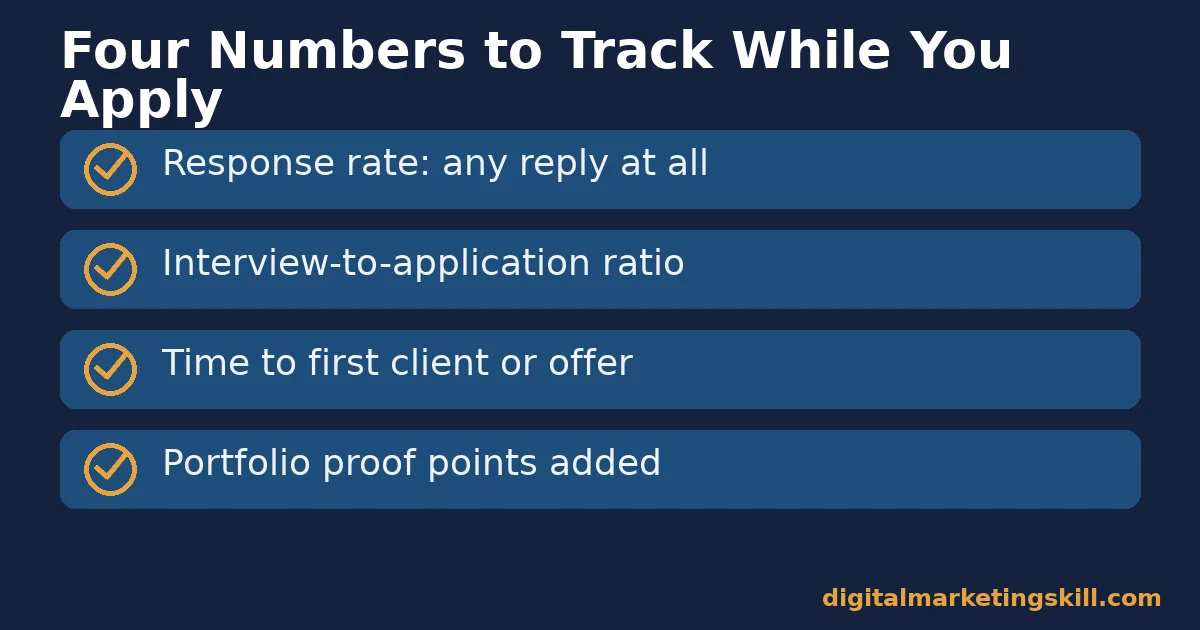
Advice you cannot measure is just opinion. Track these four signals while you apply. They tell you whether to keep going or change tactics.
- Response rate. The share of applications that get any reply at all, including a rejection. A response rate near zero after 15-20 applications usually means the application itself is the problem, not your skill level.
- Interview-to-application ratio. How many applications it takes to land one interview. This tells you whether your proof points are landing, separate from whether you then pass the interview itself.
- Time-to-first-client or time-to-first-offer. How long it takes, from starting your search, to your first paid work or job offer. Compare this against your own plan, not against anyone else’s timeline. Budgets, networks and local markets vary too much for one-size-fits-all benchmarks.
- Portfolio proof points. The count of projects you can describe with a specific number attached, such as a percentage, a dollar figure, or a growth rate. Aim to add one every few weeks. Do not just keep polishing the same single project indefinitely.
Read these four numbers together, not in isolation. A healthy response rate paired with a weak interview ratio usually points to a resume problem. A healthy interview ratio with no offers usually points to an interview-skills problem instead. Fix the stage the numbers actually show is broken, not the stage you assume is broken.
The One Decision Rule: Match Your Proof to Your Stage
If you have zero paid work, finish one real project before you apply anywhere. With one to three client results, lead every application with the strongest one, and stop listing every course you have ever taken. Once you pass three verified results, stop adding proof and start applying faster instead, because at that stage the bottleneck is application volume, not more evidence.
Here is an illustrative, invented example to show the logic, not a real study. A candidate with zero finished projects sends 40 applications and gets two interviews. After finishing one real project and leading with it, the same candidate sends another 40 applications and gets six interviews instead.
So the exact numbers will vary by market, and are not a promise. Even so, the lesson holds: of all the digital marketing career tips in this guide, proof moves the response rate more than extra application volume does at the early stage of a search.
A Four-Week Plan to Put These Digital Marketing Career Tips Into Practice
Reading advice is not the same as acting on it. Here is a simple weekly plan that turns the routes and rules above into a schedule you can actually follow.
Week One: Pick a Route and a Channel
Choose one of the three routes from this guide and one channel inside it, such as email marketing, SEO or paid social. Do not split your time across several channels yet, because depth beats breadth at this stage.
Week Two: Build the One Project
Build the single project you will lead with, whether that is a mock campaign, a client audit, or your first real client task. Keep the scope small enough to finish within the week, since an unfinished project proves nothing to a hiring manager.
Week Three: Write the Proof-First Application
Rewrite your resume or pitch so the project and its result sit at the top, before your course list or job history. Then send it to a small batch of roles or clients, so you have a real response rate to track instead of a guess.
Week Four: Measure and Adjust
Check your response rate and interview ratio from the measurement section above. If both are weak, the proof point itself likely needs a stronger result. If the response rate is fine but interviews go nowhere, the gap is probably in how you present yourself live, not in the project. Either way, you now have a number to act on instead of a feeling.
A Real Case: Turning One Skill Into Recurring Client Work
Olajire Jacob, a graduate of the Digital Marketing Skill Institute, built his business around a single, clearly provable skill: setting up email marketing flows. As published on the Digital Marketing Skill Institute reviews page, he started by charging around $500 per project to build email flows for clients in the US, UK and Canada.
From that one skill, he expanded his services and scaled his monthly income to roughly $5,000. The pattern behind that result matches the decision rule above: one checkable skill, applied for real clients, led to more work than a broad but unproven skill set would have.
Results like this are individual. They are not typical for every graduate or every market, so read the Institute’s earnings disclaimer for the full context before treating any single income figure as a guarantee.
Common Digital Marketing Career Mistakes to Avoid
These mistakes show up again and again in applications that go nowhere, across every channel and every route described above. None of them are about talent. They are about presentation and tracking, which means every one of them is fixable this week.
A few habits quietly slow down almost every search this guide has described, no matter which route you picked. Watch for these four patterns. They undo the other digital marketing career tips in this guide faster than almost anything else.
Collecting Courses Instead of Finishing Projects
It feels productive to enrol in one more free course. It rarely moves your application forward, because a hiring manager cannot verify a course was understood, only that it was started. One finished project replaces ten half-finished courses on a resume. If you only change one habit from these digital marketing career tips, change this one first.
Applying With the Same Generic Resume Everywhere
A resume written for every job at once usually fits none of them well. Match your lead proof point to the specific role: lead with an analytics result for an analytics-heavy role, and a content result for a content-heavy one.
Ignoring Your Own Numbers
Many job seekers never track their own response rate or interview ratio. So they cannot tell whether the problem is their resume, their interview skill, or just a slow market. Track the four measures above from your very first application, not after twenty rejections.
Treating Your Search as Local Only
Because marketing postings are remote-friendly more often than most job functions, limiting your search to one city can mean missing most of the realistic opportunities. Widen the search once your proof point is ready, instead of narrowing it before you have anything to show.
Frequently Asked Questions About Digital Marketing Career Tips
Do I need a degree to start a digital marketing career?
No single degree is required for most digital marketing roles. Research on hiring trends shows employers increasingly weigh demonstrated skill and project work alongside, or ahead of, degree requirements. Some larger companies and specific senior roles still list one as preferred.
How long does it take to get a first digital marketing job or client?
There is no fixed timeline. It depends on your starting skill level, the local job market, and how quickly you finish one provable project. Track your own response rate and interview ratio instead of comparing your timeline to someone else’s.
Which digital marketing skill should I learn first?
Pick one channel you can finish a real project in within a few weeks, such as email marketing, search engine optimisation, or paid social. Depth in one channel with a provable result outperforms a surface-level grasp of five channels.
Is digital marketing a good career for freelancing or remote work?
Marketing roles are advertised as remote or hybrid more often than the typical job posting, based on multi-country tracking of job listings. That makes the field unusually open to working from anywhere, including freelance arrangements, wherever you live.
Do certifications actually help you get hired in digital marketing?
A certificate helps most when it comes with a real project reference attached, not as a standalone resume line. A certificate with no attached work carries far less weight than one real, verifiable project.
What is the biggest mistake people make when starting a digital marketing career?
Collecting course certificates instead of finishing one real project. Hiring managers consistently respond better to one checkable result than to a long list of courses with nothing built from them.
Can these digital marketing career tips work outside the United States?
Yes. The hiring shift toward proof of skill, and the growth in remote-friendly marketing postings, are not limited to one country. Pay levels and hiring norms still vary a great deal by region. So treat the country-specific figures here as context only. The routes, the decision rule and the four measures apply wherever you live.
How many digital marketing career tips in this guide actually matter most?
Two matter more than the rest. Finish one real, checkable project, and lead every application with it instead of a course list. Everything else in this guide supports those two moves.
Start With One Proof Point, Then Build the Next
Pick one route from this guide. Finish one project inside it. Then lead with that result the next time you apply. These digital marketing career tips only work once you act on at least one of them.
Want that first project and a structured path built in from day one? The Master Diploma in Digital & AI Marketing at Digital Marketing Skill Institute pairs practical courses with unlimited one-on-one mentoring. The courses include AI-powered SEO and content marketing, AI-powered email marketing and automation, and AI-powered social media marketing. You also get a real project inside a US partner company, so you graduate with proof, not just a certificate.
The diploma is dual US and UK accredited, and recognised in more than 100 countries. It is delivered 100% online, so you can build that first proof point anywhere in your country, or abroad. See the full program details and apply here when you are ready, or browse more practical guides on the Digital Marketing Skill Institute blog.
Related Reading on Digital Marketing Careers
For deeper reading on related decisions, see our guides on what the data says about pay, demand and skills and why proof beats credentials. Also see which skills actually get you hired, how to land your first role without experience, and what skills-based hiring really takes.
Whatever stage you are at, these digital marketing career tips point to the same path forward: fewer courses, one finished project, and an application that leads with it.
Every figure in this guide was checked against its original source before publication. Figures marked as illustrative are invented examples, not real results.
![9 Amazing Digital Marketing Skills to Make Money Online [With Proof]](https://digitalmarketingskill.com/wp-content/uploads/2019/07/9-Amazing-Digital-Marketing-Skills-to-Make-Money-Online-With-Proof-17.png)






