
Conversational AI is the group of technologies that let computers understand human language and respond in a natural, back-and-forth way, by text or by voice. It powers chatbots, voice assistants and virtual agents. It matters because it lets a business answer people in their own words, on the apps they already use, at any hour.
Key Takeaways
- This is a broad category. A chatbot is one application of it, alongside voice assistants and AI agents.
- It combines natural language processing with machine learning.
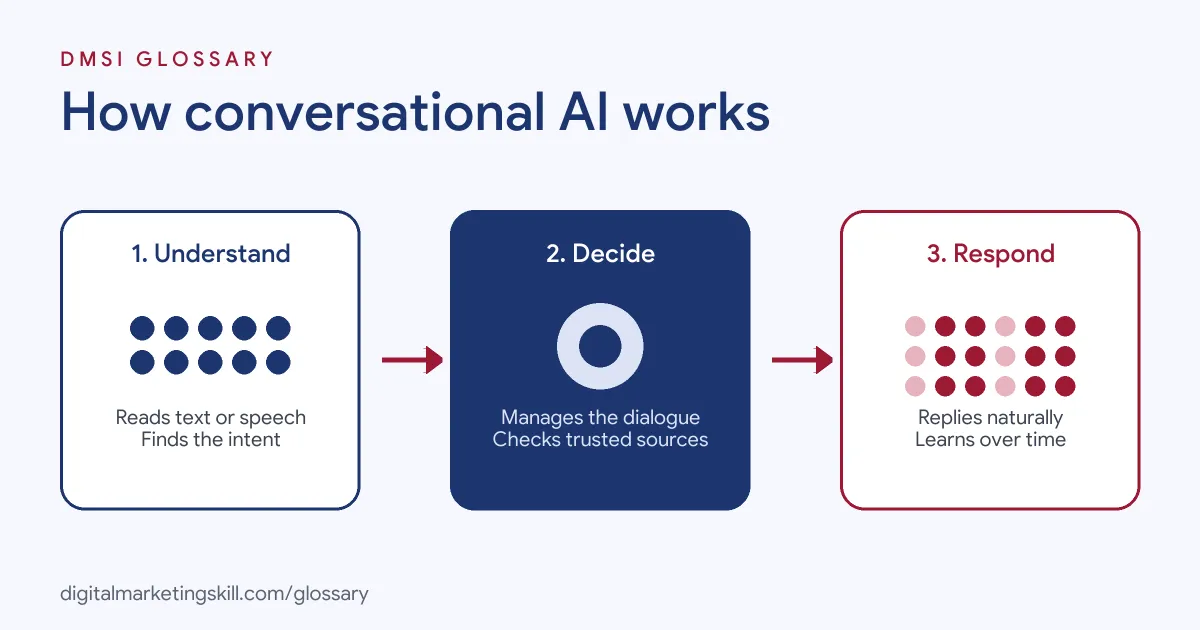
- The core steps are simple: understand the input, decide what to do, then reply.
- Many systems use intents, which describe what a person wants in one turn of the conversation.
- Good systems connect to trusted knowledge and can pass a chat to a human.
What Is Conversational AI?
IBM defines it as “technologies, such as chatbots or virtual agents, that users can talk to.” These tools “use large volumes of data, machine learning and natural language processing to help imitate human interactions.”
It helps to separate the technology from the product. IBM explains that this is “a broad category of technologies,” while “a chatbot is one application of that technology.” In other words, the same core technology can also run an AI agent, a voice assistant on a phone line or a helper inside an app.
For marketers, the main uses are website chat, messaging apps and customer service. For example, a bank’s virtual agent might answer “How do I reset my card PIN?” in a chat window, then pass harder questions to a person.
How Conversational AI Works
Most systems follow a loop. First, they understand what the person said. Next, they decide what to do. Finally, they reply and learn from the result.
Understanding the Input
The first job is to work out what the person means. IBM says the system uses natural language understanding “to decipher the meaning of the input and derive its intention.” If the input is speech, the system first uses automatic speech recognition to turn audio into text. Natural language processing sits at the heart of this step.
Intents and Entities
Many platforms organise conversations around intents. Google Cloud’s Dialogflow documentation says an intent “categorizes an end-user’s intention for one conversation turn.” You give it training phrases, which are examples of what people might say. Then, as the documentation puts it, “you don’t have to define every possible example,” because built-in machine learning expands the list with similar phrases.
Entities, meanwhile, are the details inside a request, such as a date, a product or a city. Dialogflow can collect the details it needs one by one, a process it calls form filling.
Dialogue and Response
Next comes dialogue management. IBM explains that natural language generation “formulates a response.” After that, machine learning refines responses over time. Modern systems may also generate answers from connected knowledge. Microsoft’s Copilot Studio notes that when a request falls outside the topics you designed, an agent “can still generate a conversational answer from its connected knowledge sources.”
Conversational AI Examples
Here are three made-up examples of how a business might use it:
- Retailer (example): A website assistant answers questions about sizes and delivery, then links to the right product page.
- Clinic (example): A phone line uses voice recognition to book, move or cancel appointments, and sends a text to confirm.
- Training school (example): A chat on a messaging app answers course questions in several languages, then books a call with an adviser.
In each case, the system deals with the same simple questions that come up every day. As a result, people on the team have more time for the hard ones. That is the real win: not fewer staff, but better use of their time.
Chatbots, Voice Assistants and AI Agents
These terms overlap, so here is a simple comparison:
| Type | How people use it | Typical marketing use |
|---|---|---|
| Chatbot | Typed chat on a website or app | Answer questions and capture leads |
| Voice assistant | Spoken requests by phone or device | Bookings, orders and support lines |
| AI agent | Chat or voice, plus actions in other tools | Complete tasks, such as updating a CRM |
In short, all three rely on the same core idea. The difference is the channel and how much the system can do on its own.
How to Plan a Conversational AI Project
- Choose one use case. For example, pre-sale questions or appointment booking.
- Collect real questions. Pull them from emails, chats and call notes.
- Group them into intents. List what people want, then add sample phrases for each.
- Connect trusted sources. Link the system to current help pages, prices and policies.
- Design the handover. Decide when a person takes over. Copilot Studio, for instance, lets an agent escalate a chat “to a human representative through a defined path.”
- Label it as AI. The EU AI Act says people must be “informed that they are interacting with an AI system,” unless that is obvious.
- Test, launch and review. Read transcripts each week and fix gaps.
Best Practices
- Start small. One job done well builds trust faster than a tool that tries to do it all.
- Write like a person. Short, friendly replies feel more human and are easy to follow.
- Meet people where they are. Microsoft notes that agents can work across websites, mobile apps and team chat tools, in multiple languages.
- Keep humans close. Make the route to a person easy to find.
- Measure outcomes. Track resolved requests, handovers, leads and bookings.
Common Mistakes to Avoid
A common mistake is launching with too many intents and too few examples. As a result, the system misreads simple requests. Another is hiding the human option. Some teams also connect old or wrong documents, so the system gives out-of-date answers. Finally, many teams never read real transcripts. Instead, set a weekly review and fix what you find.
How to Measure Results
Keep your numbers simple and tie them to a goal. Here are the ones most teams watch:
- Solved chats: how many people got what they needed without a person.
- Handovers: how often the chat went to your team, and why.
- Missed intents: questions the system could not match. These show you what to add next.
- Leads and bookings: how many chats turned into a contact or a call.
Check them each week. If missed intents rise, add new sample phrases. If handovers rise, look at the chats and fix the gaps in your sources. Over time, the system should solve more on its own, while people still step in when it counts.
Where You’ll Use Conversational AI at Work
This skill appears in product, marketing and customer experience roles. For example, real remote job listings ask candidates to:
- “Define and own the conversational AI roadmap across voice and chat, balancing consumer impact, client demand, operational readiness, and platform build-vs-adopt decisions” (Senior Product Manager, Conversational AI).
- Be the person who “brings conversational AI to life inside our platform — across voice, chat, and the messaging channels our consumers and clients already use” (Senior Product Manager, Conversational AI).
- Show “Hands-on experience in AI-powered features (prompt engineering, conversational AI, or adaptive algorithms)” (Senior Product Manager, Engagement and AI Game-Based Learning).
For marketers, the most direct link is lead capture and automation. So a Marketing Automation Specialist or Lead Generation Specialist who can plan and test chat flows has a useful edge.
Learn It in the Lead Generation Track
AI fundamentals, including strategy and planning, are part of every DMSI track. You apply chat and automation most in the AI-Powered Lead Generation and Email Automation track. It covers lead generation, email marketing and automation. Your portfolio project is a lead magnet and an automated email sequence that converts. You also get unlimited 1-on-1 mentoring and a U.S. Project Internship from day one.
Next, read our guide to chatbot marketing and see our glossary entry on the AI chatbot.
Frequently Asked Questions
What is conversational AI in simple terms?
It is technology that lets computers understand what people say or type and reply naturally. Chatbots and voice assistants are common examples.
Is conversational AI the same as a chatbot?
No. It is the wider technology. A chatbot is one product built with it, alongside voice assistants and AI agents.
What technologies does it use?
It mainly uses natural language processing and machine learning. Voice systems also use speech recognition to turn audio into text.
Do customers need to know they are talking to AI?
Under the EU AI Act, people must be told they are interacting with an AI system, unless it is obvious. Elsewhere, clear labelling is still good practice.
How do marketers use conversational AI?
They use it to answer questions before a sale, sort good leads from weak ones, book calls and help customers on websites and chat apps.
Sources: IBM: What is conversational AI?; IBM: What is a chatbot?; Google Cloud: Dialogflow CX basics; Microsoft Learn: Copilot Studio overview; EU AI Act, Article 50; remote job listings on Himalayas.