
Answer engine optimisation (AEO) is the practice of shaping your content so search engines and AI assistants can pull a clear, direct answer from it and show or cite your page. It targets places where people get answers without scrolling, such as featured snippets, “People Also Ask” boxes, voice assistants and AI-written summaries. It matters because more searches now end with an answer on the results page, so being the source of that answer is a new way to be seen.
Key Takeaways
- AEO focuses on answers, not just rankings. The goal is to be quoted, summarised or cited.
- Google says there are no special requirements or optimisations needed to appear in its AI features.
- A page must be indexed and eligible for a snippet before Google can use it in AI Overviews or featured snippets.
- Clear questions as headings, direct answers and well-structured lists or tables make content easier to quote.
- AEO builds on good SEO rather than replacing it.
What Is Answer Engine Optimisation?
An “answer engine” is any tool that responds to a question with an answer, rather than just a list of links. Google’s featured snippets, its related questions box and its AI Overviews all work this way. So do voice assistants and chat-based tools such as ChatGPT search.
Answer engine optimisation is the work of making your content the best source for those answers. In practice, that means writing pages that answer real questions quickly and clearly, then backing those answers with depth and evidence.
The idea grew out of features Google already had. A featured snippet, for example, shows a short extract from one page at the top of results. Google’s documentation says the related questions group, also called “People Also Ask,” is “a cluster of questions that are related to what the user initially searched for.” When someone expands one, “they’re shown a featured snippet.”
Now, AI search has widened the field. Answers can come from AI summaries that draw on several pages at once.
How Answer Engine Optimisation Works
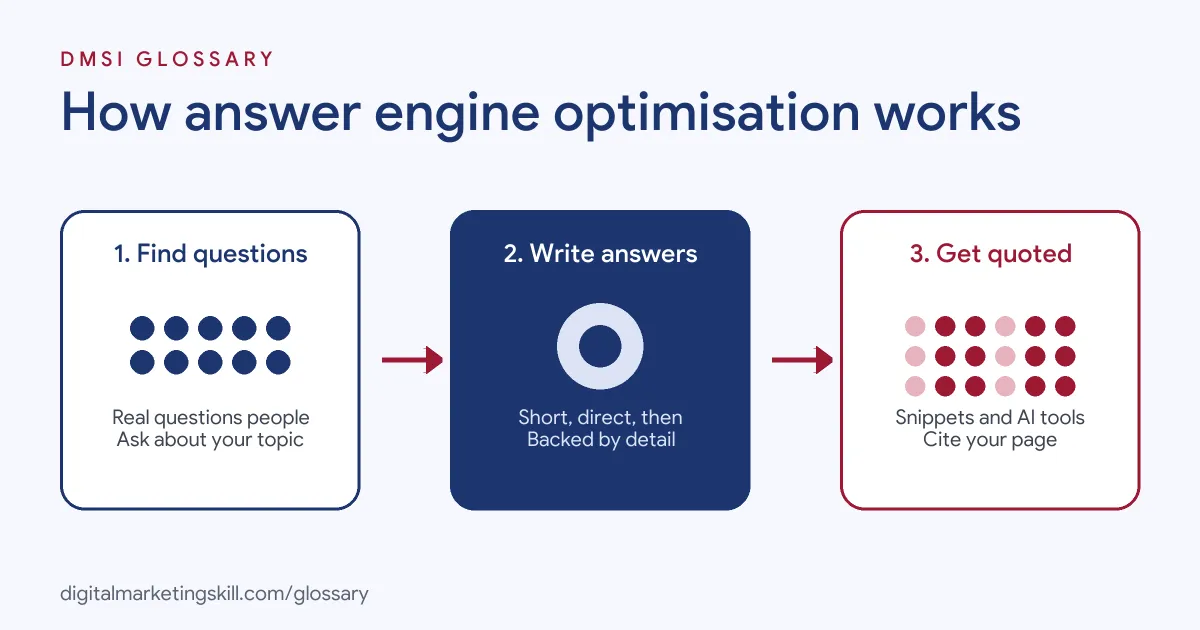
AEO works in three steps. First, you find the questions your audience asks. Next, you write clear, direct answers in a structure machines can use. Finally, answer engines choose, quote or cite those answers when people search.
Eligibility Comes First
No answer engine can use a page it can’t reach. Google says a page must be “indexed and eligible to be shown in Google Search with a snippet” to appear as a supporting link in its AI features. It adds that “there are no additional requirements to appear in AI Overviews or AI Mode, nor other special optimizations necessary.”
Other tools have their own crawlers. OpenAI, for example, says sites that block its OAI-SearchBot “will not be shown in ChatGPT search answers.” So check robots.txt before anything else.
Clear, Quotable Answers
Next comes the writing. Featured snippets are chosen automatically, and Google says you can’t mark a page as one. However, you can make your answer easy to lift. Put the question in a heading, then answer it in the first one or two sentences below. Use numbered lists for steps and tables for comparisons.
Depth and Trust
Finally, the page has to be worth citing. Google’s Search Central blog advises “unique, non-commodity content that visitors from Search and your own readers will find helpful and satisfying.” It also notes that people in AI search are “asking longer and more specific questions,” so pages that cover follow-up questions have more chances to match.
Answer Engine Optimisation Examples
Here are three made-up examples:
- Plumbing business: A plumber adds an FAQ section with questions like “Why is my boiler losing pressure?” Each answer starts with a one-sentence cause, followed by steps. As a result, the page starts appearing in related questions.
- Software company: A start-up rewrites its help pages so every heading is a real customer question. Its answers become easier for AI tools to quote.
- Recipe site: A cookery blog moves the key timing to the first line of each recipe, instead of after a long story. Its cooking times then appear as quick answers.
In each case, the business moved the answer to the top and kept the supporting detail below it. That simple change helps readers and answer engines alike.
AEO vs SEO vs GEO
These three terms overlap. Here is how they usually differ:
| Approach | Main goal | Typical tactics |
|---|---|---|
| SEO | Rank pages high in search results | Keyword research, technical health, links and helpful content |
| AEO | Be the source of direct answers | Question-led headings, short answers, lists and tables, FAQs |
| GEO | Be cited inside AI-generated responses | Evidence, statistics, quotations and clear sources |
In short, AEO sits between classic SEO and newer work on AI answers. All three rely on the same base: content that is useful, accurate and easy to find.
How to Do Answer Engine Optimisation
- Collect real questions. Use Search Console queries, related questions in Google, customer emails and sales calls.
- Group them by topic. Decide which page should answer each group, so you don’t repeat yourself.
- Use the question as a heading. Write it the way people actually ask it.
- Answer in the first sentence. Give a short, complete answer, then add detail, examples and evidence.
- Pick the right format. Use a paragraph for definitions, a list for steps and a table for comparisons.
- Check access and snippets. Make sure crawlers aren’t blocked and you haven’t added nosnippet by mistake.
- Track and refine. Finally, watch impressions and clicks for question queries, and test your key questions in AI tools.
A Before and After Example
Here is a made-up rewrite. Before: a section titled “Our thoughts on pricing” opens with two paragraphs of company history. After: the heading becomes “How long does a website audit take?” and the first line reads “Most small business audits take one to two weeks, depending on site size.” The detail follows below. The second version answers the question straight away, so both readers and answer engines can use it.
Best Practices for Answer Engine Optimisation
- Write for people first. Clear answers help readers as much as machines.
- Keep answers short, then go deeper. Lead with one or two sentences, then expand.
- Stay accurate and current. Wrong answers lose trust quickly.
- Use structured data honestly. If you add it, Google says the content in your markup must be visible on the page.
- Measure more than clicks. Some answers satisfy people on the results page, so also track engaged visits and leads.
Common Mistakes to Avoid
A common mistake is burying the answer under a long introduction. Another is writing vague headings that don’t match any real question. Some sites also stuff FAQs with near-identical questions, which adds nothing for readers. Others block AI crawlers without checking the effect on visibility. Lastly, many treat AEO as a trick, when it is really about clear, helpful writing.
Where You’ll Use Answer Engine Optimisation at Work
AEO now appears by name in SEO and content job listings. For example, remote roles ask for:
- “Growing AEO fluency: You understand how AI-driven search is changing content visibility” (Senior Content Marketer, SEO).
- Someone who will “own technical, on-page, off-page, AEO, analytics, and reporting work” (Senior SEO Specialist).
- A “Working knowledge of schema markup and structured data for AEO” (Remote SEO Content Editor, AI Search and AEO).
So if you want to work as an SEO Specialist, Website Manager or Content Creator, expect to plan content that answers questions directly.
Learn It in the WordPress and SEO Track
You can practise AEO in the AI-Powered WordPress and SEO Specialist track. It covers AI fundamentals, SEO and content marketing, and you build a WordPress site or store and rank it with an SEO content plan. You also get unlimited 1-on-1 mentoring and a U.S. Project Internship from day one.
For more, read our tips on voice search optimisation and our guide to generative engine optimisation.
Frequently Asked Questions
What is answer engine optimisation in simple terms?
It is writing and structuring content so search engines and AI tools can use it as a direct answer to people’s questions.
Is AEO different from SEO?
It’s a focused part of SEO. SEO aims to rank pages, while AEO aims to be the source of the answer itself.
Do I need special markup for AEO?
Google says there is no special schema.org structured data needed for its AI features. Clear content matters most.
Which answer formats work best?
Short paragraphs for definitions, numbered lists for steps and tables for comparisons are the most common snippet formats.
How do I measure AEO?
Track impressions and clicks for question searches in Search Console. Then test your key questions in AI tools and note when you’re cited.
Sources: Google Search Central: AI features and your website; Google Search Central: Featured snippets; Google Search Central: Visual elements gallery; Google Search Central Blog: Succeeding in AI search; OpenAI: Overview of OpenAI crawlers; remote job listings on Himalayas.