
Helpful content is Google’s term for content made mainly to help people, rather than to rank in search engines. It answers a real need, shows first-hand knowledge and leaves readers feeling they learned enough to reach their goal. It matters because Google’s ranking systems aim to reward this kind of people-first content, so it sits at the heart of modern SEO.
Key Takeaways
- Helpful content is “people-first” content, made for a real audience, not to manipulate rankings.
- Google used to run a separate “helpful content system”. It has since become part of Google’s core ranking systems.
- Google offers self-assessment questions, such as whether a page is something you’d “bookmark, share with a friend, or recommend.”
- Warning signs include mass-producing pages on many topics, changing dates without real updates, and writing to a word count.
- AI is allowed. However, using automation mainly to manipulate rankings breaks Google’s spam policies.
What Is Helpful Content?
Think of helpful content as the answer a trusted friend would give you. It is clear, honest and based on real knowledge. It doesn’t pad the page or chase keywords. Instead, it solves the problem you came with.
Google’s guide to creating helpful, reliable, people-first content sets out the idea. It asks creators to focus on a clear audience, show first-hand expertise and make sure readers leave satisfied. By contrast, it warns against content that is “primarily made to attract visits from search engines.”
For example, imagine two pages about fixing a leaking tap. One was written by a plumber, with photos of each step and a list of tools. The other repeats the phrase “how to fix a leaking tap” ten times but never explains the job. Clearly, the first page is helpful, while the second is made for search engines.
How Helpful Content Works
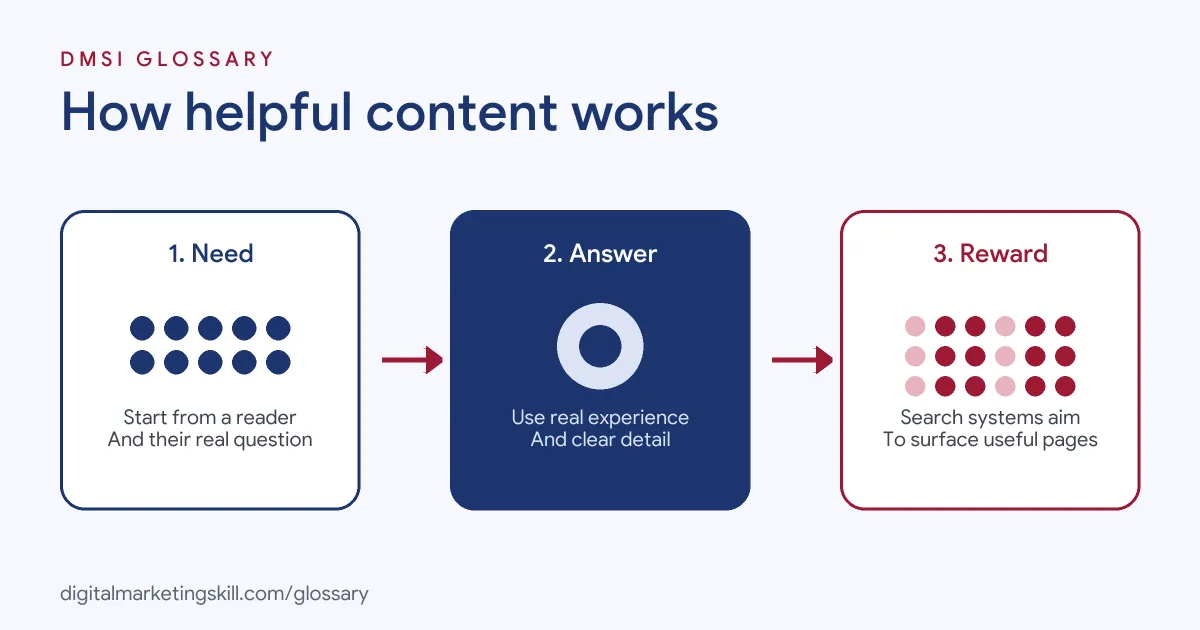
Helpful content works in three steps. First, you start from a real reader’s question. Next, you answer it with real experience and clear detail. Finally, Google’s ranking systems look for signals that a page is useful and reliable, and they aim to reward it.
From a Separate System to Core Ranking
Google once described a standalone “helpful content system”. Its guide to ranking systems now lists it under retired systems and says it “evolved and became part of our core ranking systems.” In other words, there is no longer a separate switch to pass. Helpfulness is part of how Google ranks pages in general.
People-First Signals
Google lists signs of people-first content. For instance, you have an existing or intended audience who would find the content useful. Your content clearly shows first-hand expertise. Your site has a primary purpose or focus. And after reading, people feel they have learned enough about a topic to help achieve their goal.
Search-Engine-First Warning Signs
Google also lists warning signs. These include producing lots of content on many topics in the hope that some of it ranks, and changing the date of pages to seem fresh when the content hasn’t really changed. Writing to a particular word count is another sign, since Google says it has no preferred length.
Helpful Content and AI
Google is clear that AI is not banned. Its Search Central blog says, “Appropriate use of AI or automation is not against our guidelines.” It also says, “Using AI doesn’t give content any special gains. It’s just content.” However, “Using automation—including AI—to generate content with the primary purpose of manipulating ranking in search results is a violation of our spam policies.”
Helpful Content Examples
Here are three made-up examples of helpful content in action:
- Product review (example): A reviewer tests three vacuum cleaners at home for a month, then shares photos, measurements and clear pros and cons.
- Local guide (example): A café owner writes a guide to the best walks near the café, with real routes, timings and where to park.
- Software tutorial (example): A support team turns its most common customer questions into short guides with screenshots and plain steps.
In each case, the page comes from real experience and answers a real need.
Helpful Content vs Search-Engine-First Content
Here is how the two approaches differ, based on Google’s guidance:
| Question | People-first content | Search-engine-first content |
|---|---|---|
| Who is it for? | A clear audience with a real need | Anyone who might search a keyword |
| What does it show? | First-hand experience and expertise | A summary of what others already said |
| How is it updated? | When facts really change | Dates changed to look fresh |
| How long is it? | As long as the topic needs | Written to hit a word count |
| How do readers feel? | They learned enough to reach their goal | They need to search again |
In short, if you would make the page even without search engines, you are probably on the right track.
How to Create Helpful Content
- Pick a real audience. Decide who the page is for and what problem they have.
- Start from their questions. Use customer emails, sales calls and support tickets, not just keyword tools.
- Add first-hand experience. Include your own tests, photos, data or examples.
- Show who made it. Add a byline and a short bio, so readers know who is behind the page.
- Explain how you made it. For reviews, describe your testing. If AI helped, say so where readers might wonder.
- Answer fully, then stop. Cover what the reader needs, without padding.
- Review it with Google’s questions. Ask whether you’d want to bookmark or share it.
- Update when facts change. Make real improvements instead of just changing the date.
Auditing Pages You Already Have
You don’t have to start from scratch. Instead, review your existing pages one by one. For each page, ask three questions. Does it answer a real question better than other pages do? Does it show who wrote it and why they know the topic? Would a reader need to search again after reading it? Then decide whether to improve the page, merge it with a stronger one or remove it. For example, five thin posts on the same topic often work better as one complete guide.
Best Practices for Helpful Content
- Stay in your lane. Google values sites with a clear primary purpose, so cover topics you know well.
- Use E-E-A-T as a guide. Our entry on E-E-A-T explains experience, expertise, authority and trust.
- Write plainly. Short sentences and clear headings help readers find answers fast.
- Check your facts. Link to original sources for numbers and rules.
- Prune weak pages. Improve or remove thin pages that no longer help anyone.
Common Mistakes to Avoid
A common mistake is publishing many short pages on loosely related topics, hoping some of them rank. Another is copying what already ranks and adding nothing new. Some sites also refresh dates without making real changes, which Google lists as a warning sign. Others publish large amounts of AI text with no human review. Finally, many write to hit a word count, so pages become long but not useful.
Where You’ll Use Helpful Content at Work
These principles guide daily work in SEO and content roles. For example, real remote job listings ask for:
- “Understanding of E-E-A-T and helpful content principles” (SEO Content Strategist).
- Content that is “clinically reviewed where appropriate and aligned with E-E-A-T principles” (Senior SEO Specialist).
So if you want to work as an SEO Specialist, content writer or Website Manager, employers will expect you to plan pages that genuinely help readers, not just pages that target keywords.
Learn It in the WordPress and SEO Track
You can learn to plan and write people-first content in the AI-Powered WordPress and SEO Specialist track. It covers WordPress website and eCommerce development, search engine optimisation and content marketing. Your portfolio project is a WordPress site or store that you build and rank with an SEO content plan. You also get unlimited 1-on-1 mentoring and a U.S. Project Internship from day one.
Next, read our guide to SEO content writing, which puts these ideas into practice.
Frequently Asked Questions
What is helpful content in simple terms?
It is content made mainly to help people, based on real knowledge, rather than content made just to rank on Google.
Does Google still have a helpful content update?
Google’s ranking systems guide says the helpful content system became part of its core ranking systems. It is no longer listed as a separate system.
Can AI-written content be helpful?
Yes, if it is accurate, original and reviewed by people. Google says appropriate use of AI is not against its guidelines.
Is there an ideal word count?
No. Google says it doesn’t prefer a word count. Write as much as the topic needs, and no more.
How can I check if my content is helpful?
Use Google’s self-assessment questions. For example, ask whether readers would bookmark, share or recommend the page.
Sources: Google Search Central: Creating helpful, reliable, people-first content; Google Search Central: A guide to Google Search ranking systems; Google Search Central Blog: Google Search’s guidance about AI-generated content; remote job listings on Himalayas.