
Public relations (PR) is the work of managing how an organisation is seen by the people who matter to it, by earning coverage, building relationships and communicating clearly. Digital PR applies the same ideas online, aiming for mentions and links on news sites, blogs, podcasts and social media. It matters because trusted third-party coverage builds credibility, reaches new audiences and, online, can also help your search rankings.
Key Takeaways
- The CIPR says PR “is about reputation – the result of what you do, what you say and what others say about you.”
- The PRSA defines it as “a strategic communication process that builds mutually beneficial relationships between organizations and their publics.”
- Traditional PR focuses on press, events and stakeholders. Digital PR focuses on online coverage, links and mentions.
- Earned links from real coverage can support SEO, but Google treats buying links for rankings as spam.
- Good PR starts with a genuine story, data or expert view that journalists and audiences actually want.
What Is Public Relations?
Advertising is space you pay for. Public relations, by contrast, is mostly about attention you earn. When a journalist quotes your founder, a blogger reviews your product or a podcast invites your expert, that is PR at work.
The UK’s Chartered Institute of Public Relations (CIPR) defines it as “the discipline which looks after reputation, with the aim of earning understanding and support and influencing opinion and behaviour.” It adds that PR “is the planned and sustained effort to establish and maintain goodwill and mutual understanding between an organisation and its publics.”
Those “publics” are the audiences that matter to the organisation. According to the CIPR, they include customers, both existing and potential, as well as employees and other groups.
How Public Relations Works
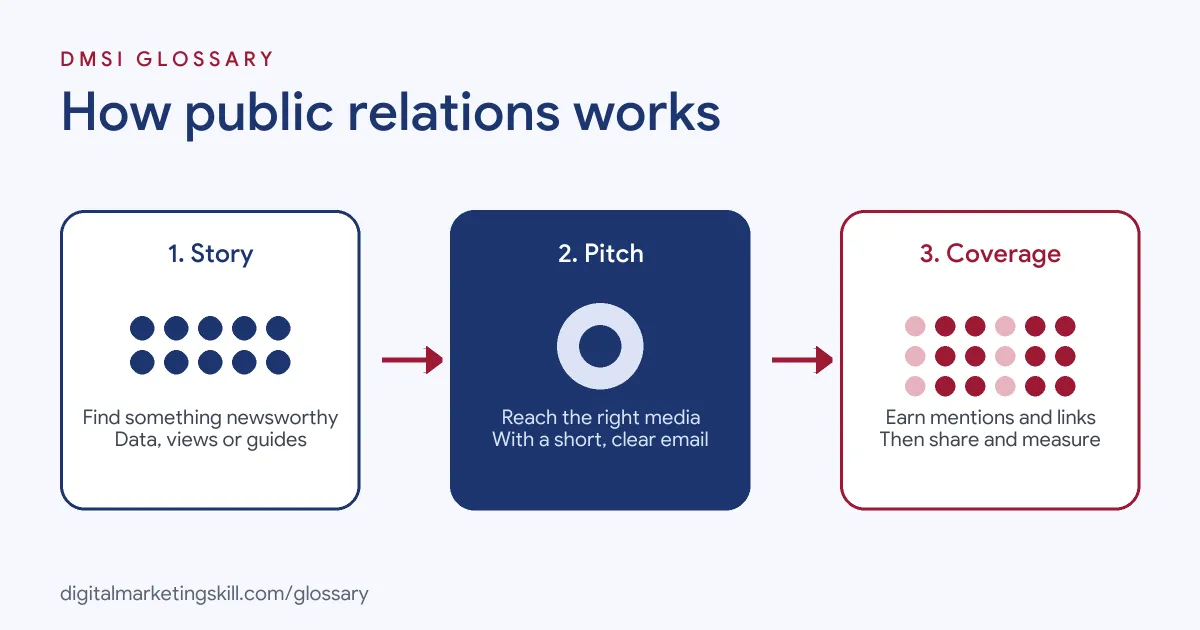
Most PR campaigns follow three steps. First, you find a story worth telling, such as new research, an expert opinion or a useful guide. Next, you pitch it to the right journalists, editors and creators. Finally, you earn coverage, then share it and measure the results.
Traditional PR
Traditional PR covers press releases, media interviews, events, crisis communication and stakeholder relations. The PRSA says that “at its core, public relations is about influencing, engaging and building a relationship with key stakeholders across numerous platforms in order to shape and frame the public perception” of an organisation.
Digital PR
Digital PR takes the same skills online. Instead of aiming only for print or broadcast, you aim for coverage on news sites, blogs, newsletters and podcasts. In addition, online articles can include links back to your website. Those earned links can send visitors and support your SEO. For more on links, see our glossary entry on the backlink.
The Rules on Links
There is a clear line to respect. Google’s spam policies list “buying or selling links for ranking purposes” as link spam. They also mention “links with optimized anchor text in articles, guest posts, or press releases distributed on other sites.” However, Google says such links are not a violation “as long as they are qualified with a rel=”nofollow” or rel=”sponsored” attribute value.” So digital PR should earn links through genuine coverage, not pay for them.
Public Relations Examples
Here are three made-up examples of PR campaigns:
- Data story: A recruitment firm surveys 1,000 workers about remote jobs and shares the findings with business journalists. Several sites cover the results and link to the full report.
- Expert comment: A cyber security consultant responds to journalist requests for comment. As a result, her quotes appear in trade publications.
- Local launch: A new café invites local bloggers and the community paper to an opening event, earning articles and social posts.
In each case, the business offers something genuinely useful or interesting to the media and its readers.
Traditional PR vs Digital PR
Here is how the two approaches compare:
| Feature | Traditional PR | Digital PR |
|---|---|---|
| Main outlets | Print, TV, radio and events | News sites, blogs, podcasts and social media |
| Typical goals | Awareness, reputation and stakeholder trust | Awareness, links, referral traffic and search visibility |
| How you measure it | Coverage, reach and sentiment | Coverage, links, referral visits and rankings |
| Common tactics | Press releases, interviews and launches | Data studies, expert comment and online campaigns |
In practice, most teams blend both, because a strong story works across every channel.
How to Run a Digital PR Campaign
- Set a clear goal, such as coverage in five trade sites or links to a key page.
- Find a story angle: original data, a strong opinion, a useful tool or a timely reaction.
- Build an asset, such as a short report or a page that holds the full story.
- Make a focused media list of journalists who cover your topic.
- Write a short, personal pitch for each, with the headline finding up front.
- Follow up once, politely, and answer questions quickly.
- Track coverage, links and referral traffic, then share the best results on your own channels.
Public Relations Best Practices
- Lead with news value. Ask why a reader would care before you pitch.
- Target carefully. A short list of the right journalists beats a mass email.
- Keep pitches short. Put the main point in the first line.
- Be easy to work with. Offer clear facts, images and quick replies.
- Earn, don’t buy. Paying for links that pass ranking credit breaks Google’s spam policies.
How to Measure PR
PR is easier to judge with a few clear numbers. Track how many pieces of coverage you earn and where. For digital PR, also count the links you gain and the visits they send. Then check whether your target pages move up in search. Finally, watch brand searches, since more people may search your name after strong coverage. Together, these show whether the work is paying off.
What Makes a Story Newsworthy
Journalists get many pitches each day. So your story needs a clear reason to exist. Good stories often have one or more of these:
- New data: numbers no one has shared before.
- A strong view: a clear, expert take on a hot topic.
- Timing: a link to something people are already talking about.
- Local interest: a story that matters to one town or region.
- Human interest: a real person with a real story.
Writing a Public Relations Pitch
Here is a made-up pitch email. It is short and gets to the point fast:
“Hi Alex, we asked 1,000 UK freelancers how they find work. Six in ten said they found their last client on LinkedIn. I can share the full data and a quote from our founder. Would this suit your small business section?”
It names the finding first. It offers more, and it asks one clear question. That is often all a pitch needs.
Common Mistakes to Avoid
Many teams send the same press release to hundreds of journalists, which rarely works. Others pitch stories that only matter to the company itself. Some buy links or sponsored posts without the right link attributes, which can breach Google’s policies. Finally, many forget to share and reuse their coverage, so the impact fades quickly.
Where You’ll Use Public Relations at Work
PR skills appear in communications, marketing and agency roles. For example, recent remote job listings ask candidates to:
- “Builds and maintains strong media relationships with print, online, and broadcast outlets” (Account Coordinator, Public Relations).
- “Develop and execute proactive media relations strategies that drive high-impact earned coverage” (Senior Manager, Media Relations).
- “Partner with account, strategy, creative, analytics, and public relations teams to ensure media supports the broader campaign strategy” (Media Supervisor).
So as a Digital Marketing Manager, Growth Marketer or Agency Owner, you may plan PR campaigns or work with PR teams to support SEO and brand goals.
Learn It in the Full Stack Programme
Digital PR connects content, SEO, social media and reputation. That’s why it fits the Full Stack (all four tracks) option, which covers all ten courses, with one portfolio project from each track. Every track is about 90% hands-on, with unlimited 1-on-1 mentoring and a U.S. Project Internship from day one.
For the SEO side, read our glossary entry on link building.
Frequently Asked Questions
What is public relations in simple terms?
It is the work of shaping how people see an organisation, mainly by earning coverage and building good relationships.
What is digital PR?
It is PR focused on online coverage, such as articles, podcasts and social posts, often with links back to your site.
Is PR the same as advertising?
No. Advertising is paid space you control. PR is mostly earned coverage that someone else chooses to publish.
Does digital PR help SEO?
It can. Genuine coverage can earn links and brand mentions. However, Google treats buying links for ranking purposes as spam.
Do I need a press release?
Not always. A short, personal pitch with a strong story often works better than a formal release.
Sources: CIPR: About PR; PRSA: About public relations; Google Search Central: Spam policies; remote job listings on Himalayas.