
A competitor analysis is a structured look at the businesses that compete for your customers. It covers what they sell, how they price it, how they market it and where they are weak. You use what you find to sharpen your own offer, messages and channels. It matters because you cannot position a product well until you know what buyers are comparing it with.
Key Takeaways
- It compares rivals by product line, market segment, strengths, weaknesses and market share.
- Include indirect competitors, too. These are other ways customers solve the same problem.
- Free tools give you real data. Google Ads auction insights and Google Trends are two good starting points.
- The goal is a decision, not a document. Each finding should change your offer, message, price or channel.
- Repeat it regularly, because competitors change their ads, prices and content all the time.
What Is Competitor Analysis?
The U.S. Small Business Administration (SBA) puts it simply: “Competitive analysis helps you learn from businesses competing for your potential customers.” In practice, marketers use the terms competitive analysis and competitor analysis to mean the same thing.
The SBA also says your analysis “should identify your competition by product line or service and market segment.” For example, a bakery might compete with a supermarket on bread, but with a local café on cakes. Each one is a different competitor with different strengths.
This work sits alongside target audience research. In other words, one tells you who your buyers are. The other tells you who else is selling to them.
How Competitor Analysis Works
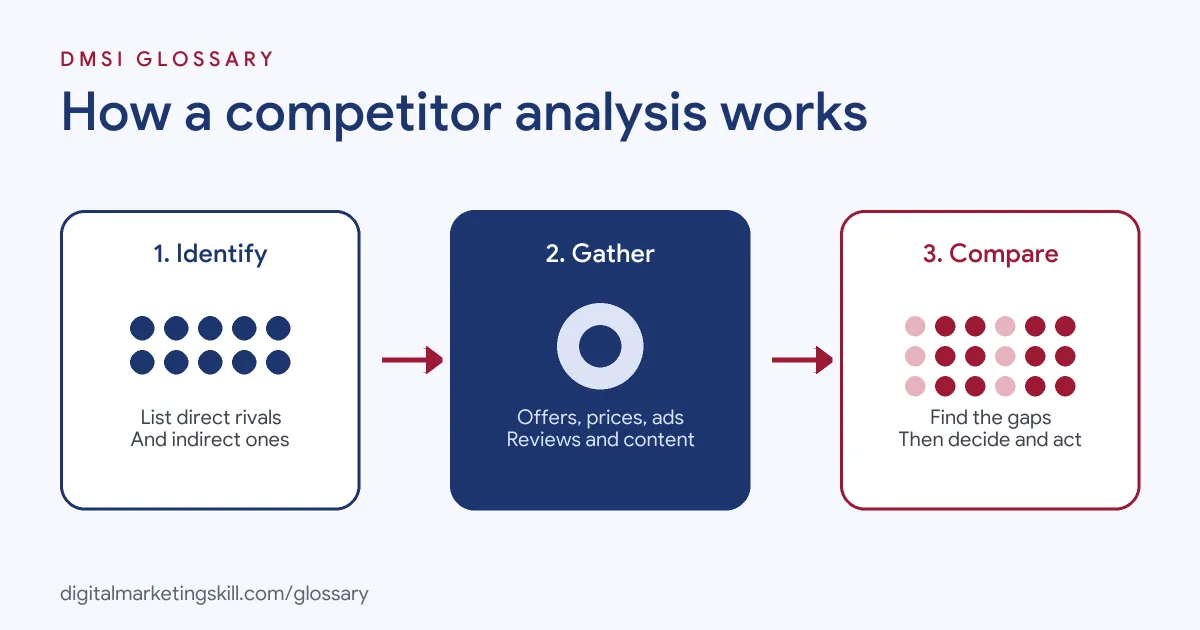
Every competitor analysis follows the same three stages. First, you identify who you compete with. Next, you gather evidence about how they sell and market. Finally, you compare that evidence with your own business and decide what to change.
Direct and Indirect Competitors
Direct competitors sell a similar product to the same buyers. Indirect competitors solve the same problem in a different way. The SBA tells you to include “indirect or secondary competitors who may impact your success.”
For instance, an online yoga course competes directly with other online yoga courses. However, it also competes with local studios, free videos and fitness apps. Leaving those out gives you a false picture of the market.
What to Compare
The SBA lists the characteristics to assess for each rival:
- Market share.
- Strengths and weaknesses.
- Your window of opportunity to enter the market.
- How important your target market is to them.
- Any barriers that may hinder you as you enter the market.
- Indirect or secondary competitors.
For digital marketing, you can add their website content, search rankings, ad messages, social channels, offers and reviews.
Where the Data Comes From
Much of the evidence is public. You can read competitors’ websites, pricing pages, reviews and social posts. On top of that, a few free tools add hard numbers. Google Ads auction insights, for example, shows how often your search ads appear alongside other advertisers. Google Trends shows how search interest in brands or topics changes, which helps you see who is gaining attention.
Competitor Analysis Examples
Here are three examples of how a business might use one:
- Online shop: An example skincare brand reviews five rivals’ product pages. It notices that none of them show ingredient sources, so it makes that a key selling point.
- Google Ads account: A plumber checks auction insights and sees one rival appears on most of the same searches. As a result, it tests ads that stress its same-day service, which the rival does not mention.
- SEO plan: A training provider lists the topics its competitors rank for. Then it plans articles on the questions they answer poorly.
In each case, the analysis leads to one clear action rather than a long report.
Competitor Analysis Tools Compared
You do not need expensive software to start. This table compares common sources:
| Source | What it shows | Watch out for |
|---|---|---|
| Google Ads auction insights | Six Search statistics, including impression share, overlap rate and outranking share | No insights when your impression share is below 10% |
| Google Trends | Relative search interest on a 0 to 100 scale | Shows relative interest, not actual search volume |
| Competitor websites and reviews | Offers, prices, messages and customer complaints | Needs careful notes, since pages change often |
| SEO tools | Estimated rankings, keywords and backlinks | Figures are third-party estimates |
Reading Auction Insights
Google’s help centre lists six statistics in the auction insights report for Search. They are impression share, overlap rate, outranking share, position above rate, top of page rate and absolute top of the page rate. You can run it for keywords, ad groups or campaigns, as long as they meet a minimum activity threshold. Because of this, it is one of the few sources that shows real auction data about your rivals.
Turning Findings into Action
The hardest part is not the research. Instead, it is deciding what to do next. A simple way is to sort every finding into one of three boxes: copy, avoid or beat.
- Copy: things buyers now expect, such as free returns or a clear price page. If every rival offers it, you probably need it too.
- Avoid: things that cause complaints in rival reviews, such as slow replies or hidden fees.
- Beat: gaps that no rival fills well. These are your best chances to stand out.
Here is a made-up example. A small online tutor finds that all rivals offer group classes, many reviews complain about late replies, and no one offers a free first lesson. So the tutor keeps group classes, promises replies within a working day, and leads every ad with a free first lesson. Each action ties back to one finding, which makes the plan easy to explain to a client or manager.
How to Do a Competitor Analysis
Follow these steps to review your rivals in a simple, useful way:
- Set one question. For example, “Why do rivals win more leads from search?” A clear question keeps the work focused.
- List three to five competitors. Include at least one indirect competitor.
- Build a comparison sheet. Add columns for offer, price, main message, channels, strengths and weaknesses.
- Collect evidence. Visit their sites, read reviews, check their ads and note the content they publish.
- Add hard data. Use auction insights for paid search and Google Trends for interest over time.
- Find the gaps. Look for needs that no rival covers well.
- Decide and act. After that, turn each gap into one change to your offer, copy or channel plan.
Best Practices for a Competitor Analysis
- Read the reviews. Customer complaints about rivals often point to your best selling points.
- Focus on buyers, not features. Ask why a customer would choose them over you.
- Keep evidence. Save screenshots and links, so others can check your findings.
- Link it to positioning. Use what you learn to sharpen your unique selling proposition.
- Review it on a schedule. Set a regular check, so the picture never goes stale.
Common Mistakes to Avoid
Many first attempts go wrong in the same ways. First, people only look at the biggest brand and ignore smaller, closer rivals. Second, they copy a competitor instead of finding a gap. Third, they treat tool estimates as facts. Finally, they write a long report that nobody acts on. A short sheet with three clear actions is usually more valuable.
Where You’ll Use Competitor Analysis at Work
This skill appears in many marketing job listings. For example, recent remote roles ask for:
- “5+ years of experience in keyword research and competitor analysis” (Technical SEO Manager).
- “Skilled in Amazon keyword research using Helium 10, including competitor analysis and keyword prioritization” (Amazon Agency Listing Copywriter and Catalog Associate).
- Product listings built “using keyword research and competitor analysis” (Amazon Brand Development and Launch Manager).
So this skill matters for Digital Marketing Managers, Growth Marketers and Freelance Digital Marketers alike. Clients and employers will expect you to research rivals and then turn the findings into a plan.
Learn It in the Full Stack Programme
You can practise competitor analysis across every channel in the Full Stack programme, which covers all four tracks and all ten courses. Along the way, you complete one portfolio project from each track, so you can show how research shaped real campaigns. In addition, you work on a U.S. Project Internship from day one, with unlimited 1-on-1 mentoring.
For a search-focused walkthrough, read our guide to SEO competitor analysis.
Frequently Asked Questions
What is a competitor analysis in simple terms?
It is a structured comparison of the businesses competing for your customers. You look at their offers, prices, marketing, strengths and weaknesses, then decide how to stand out.
What should a competitor analysis include?
The SBA suggests market share, strengths and weaknesses, and your window of opportunity. It also lists how much your market matters to them, barriers to entry and indirect rivals.
Is competitive analysis the same as competitor analysis?
Yes. Marketers use both terms for the same task of studying rivals and comparing them with your own business.
How many competitors should I analyse?
Three to five is a practical start. Include at least one indirect competitor, so you see every option your buyers consider.
Which free tools help with a competitor analysis?
Google Ads auction insights shows how you compare with other advertisers in the same auctions. Google Trends shows relative search interest over time.
Sources: U.S. Small Business Administration: Market research and competitive analysis; Google Ads Help: Use auction insights to compare performance; Google Trends Help: FAQ about Google Trends data; remote job listings on Himalayas.