
Instagram influencer marketing works by renting trust, not buying an ad slot. An audience already trusts a creator, and that trust transfers to whatever the creator features. Instagram now has 3 billion monthly active users, so the real decision is not whether to use influencers. It is which tier to pick, since a nano creator and a celebrity sell very different things.
Key Takeaways
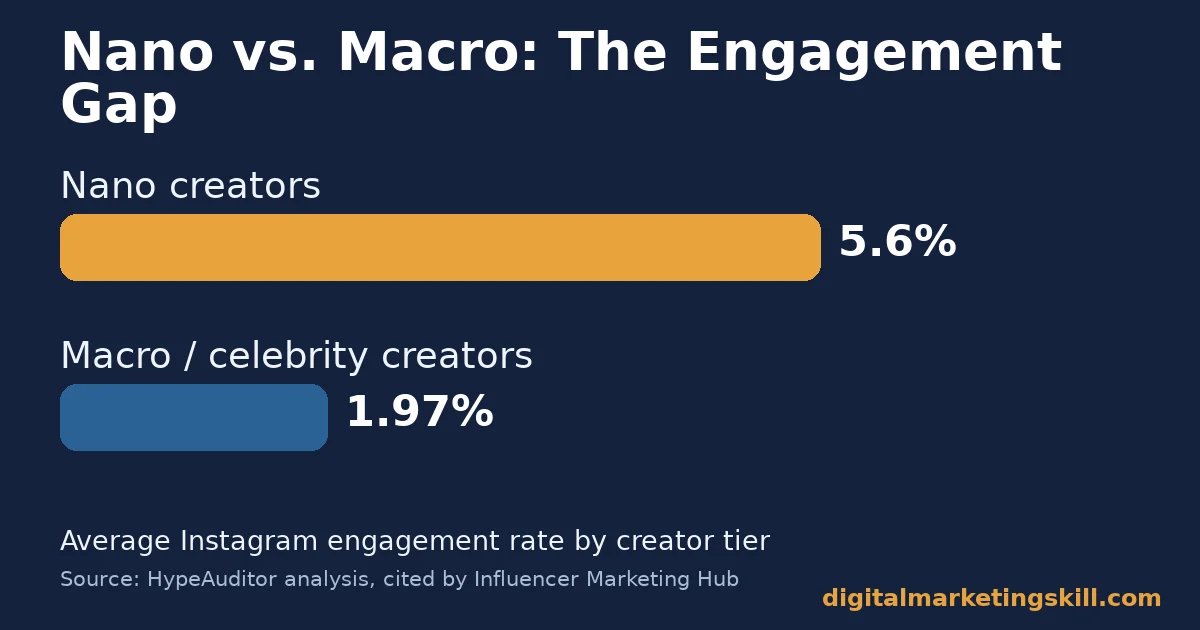
- Size cuts against engagement. HypeAuditor’s analysis, cited by Influencer Marketing Hub, found nano-influencer posts average about 5.60% engagement against roughly 1.97% for mega-influencers and celebrities.
- Purchases follow influencer posts often. Sprout Social surveyed 2,000 consumers and 300 influencers across the US and UK. It found 49% of consumers buy at least monthly because of influencer posts (US/UK data).
- Disclosure is a legal requirement, not a courtesy. The FTC requires any paid or gifted partnership to be disclosed with the endorsement itself, in plain words like “ad” or “sponsored.”
- Reach is not the scarce resource. With 3 billion monthly active users on Instagram, reach is abundant. What is scarce is an audience that actually trusts the person talking to it.
- A real case shows the ceiling. An academic case study found roughly 40% of Gymshark’s early sales came through Instagram, with about 6.6 times return on that spend.
In this guide
- What Most Instagram Influencer Marketing Advice Misses
- How Instagram Influencer Marketing Actually Works
- Three Creator Tiers Change How Instagram Influencer Marketing Performs
- How to Brief Each Tier for Instagram Influencer Marketing
- Choosing the Right Format for Instagram Influencer Marketing
- How Much Instagram Influencer Marketing Costs
- How to Build an Instagram Influencer Marketing Strategy
- Common Instagram Influencer Marketing Mistakes to Avoid
- How to Measure Instagram Influencer Marketing
- The One Rule: Match the Tier to the Goal, Not the Budget to the Fame
- A Real Case: How Gymshark Used Early Creator Partnerships
- Frequently Asked Questions About Instagram Influencer Marketing
- Start With One Tier, Measure It, Then Expand
What Most Instagram Influencer Marketing Advice Misses
Most guides treat Instagram influencer marketing as one tactic. Find an influencer, send free product, wait for sales. That skips the part that decides results: different creator tiers sell completely different things to completely different audiences.
This guide treats Instagram influencer marketing as a tiered system, not one tactic. The engagement figures below come from a single analytics vendor’s dataset. Read them as an informed snapshot, not a universal law, since they shift as platforms change. The Sprout Social purchase data is US/UK only. Treat every number here as a planning signal, not a guarantee for your niche.
It also treats disclosure as a core part of the strategy, not a legal footnote. An undisclosed partnership that gets noticed can undo months of trust-building in a single comment thread, which makes the FTC’s rules a practical safeguard as much as a legal one.
How Instagram Influencer Marketing Actually Works
A creator’s audience follows them for a reason: taste, expertise, humor or identity. When that creator features a product, the endorsement borrows trust the audience already gives the person, not the brand. That borrowed trust is the entire mechanism behind Instagram influencer marketing.
It only works if the audience still believes the creator is honest. That is why the FTC requires disclosure of any material connection. It must sit with the endorsement itself, in plain language such as “ad” or “sponsored,” not a vague hashtag like “#collab.” Skip this step and you risk the trust the strategy depends on, plus real regulatory exposure.
Reach used to be the limiting factor in marketing. It no longer is. With 3 billion monthly active users on Instagram, almost every brand can reach a relevant audience somewhere on the platform. What is scarce now is an audience that believes the person talking to it. That is exactly what Instagram influencer marketing supplies.
Three Creator Tiers Change How Instagram Influencer Marketing Performs
Not every creator sells the same thing. A nano account, a micro account and a macro or celebrity account each test differently with an audience. Picking a tier is a strategy decision, not a budget afterthought.
Many brands default to whichever tier their competitors seem to use, without checking if that tier matches their own goal. That habit explains a lot of wasted Instagram influencer marketing spend, because a tier chosen by imitation rarely matches the actual audience a brand is trying to reach.
Nano Creators: Built for Trust and High Engagement
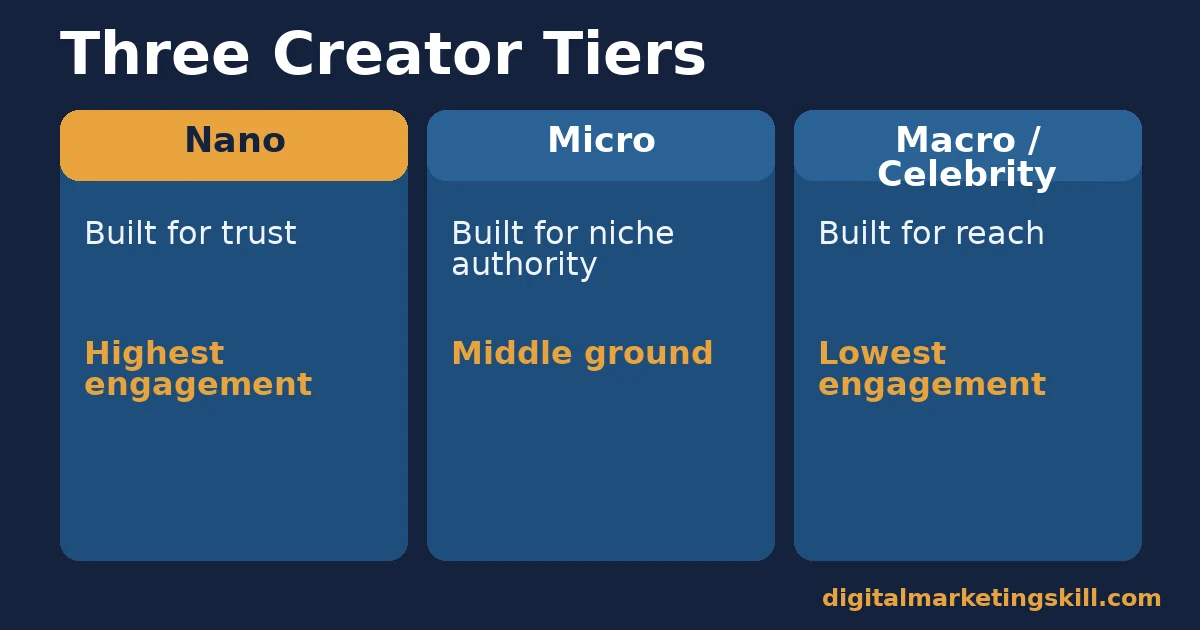
Nano creators, roughly under 10,000 followers, read to their audience as a friend rather than a media channel. HypeAuditor’s data shows this tier posting the highest average engagement of any size, around 5.60%, because a smaller audience is easier to respond to personally.
The trade-off is reach. One nano creator moves a small, tight audience. Instagram influencer marketing at this tier usually means working with many creators at once, not one.
Micro Creators: Built for Niche Authority
Micro creators, roughly 10,000 to 100,000 followers, have usually built a specific reputation: a cooking niche, a fitness style, a software review channel. Their audience arrived for that expertise, so their endorsement carries a topical authority a bigger generalist account cannot match.
This tier sits in the middle on both reach and engagement. That makes it the most common starting point for brands testing Instagram influencer marketing for the first time.
Macro and Celebrity Creators: Built for Reach and Status
Macro creators and celebrities, from roughly 500,000 followers into the millions, sell visibility and cultural association rather than personal trust. HypeAuditor’s data puts this tier’s average engagement around 1.97%, the lowest of any size, because a mass audience cannot get a personal reply.
What this tier buys is a different asset: a brand appearing next to someone widely recognised. That works for awareness campaigns more than for direct response.
How to Brief Each Tier for Instagram Influencer Marketing
Once you know which tier fits your goal, the brief you hand a creator should change with it.
Nano Creators: Lead With Product and Genuine Freedom
For nano creators, lead with the product itself and a light brief. Their value is personal voice, not production value. Over-scripting a nano creator’s post usually destroys the exact authenticity their small audience trusts.
Work with a batch of nano creators at once rather than one. Each one only moves a small slice of your audience, so volume is part of the strategy at this tier.
Micro Creators: Lead With a Specific, Checkable Claim
For micro creators, lead with one specific claim their niche audience can verify, such as a real before-and-after or a direct comparison. Vague enthusiasm reads as an ad to this audience. A specific, checkable claim reads as a genuine recommendation instead.
This tier also rewards a longer relationship. An ongoing ambassador deal tends to build more credibility over time than a single post ever can.
Macro and Celebrity Creators: Lead With a Simple, Memorable Hook
For macro and celebrity creators, lead with one simple, visual, memorable hook. A mass audience sees the post once and scrolls on, so complex claims or multi-step instructions get lost at this scale.
Budget for reach here, not direct conversion. This tier builds the awareness that smaller tiers can convert later.
Choosing the Right Format for Instagram Influencer Marketing
The format a creator posts in changes what the partnership can realistically achieve, so pick the format to match the goal, not just the trend.
- Feed posts. A single image or carousel that stays on a profile long-term, useful for a detailed before-and-after or a product breakdown a follower might revisit.
- Reels. Short video with the widest potential reach beyond a creator’s own followers, suited to a quick demo or a hook-driven moment rather than a detailed explanation.
- Stories. Fast, casual and temporary, good for a time-limited offer or a day-in-the-life mention. The FTC requires any disclosure here to stay on screen for the full duration, not flash by in one frame.
- Live video. Real-time and unscripted, best for an actual Q&A or a live unboxing where audience questions build credibility that a produced post cannot.
Matching format to goal also protects budget. Paying macro rates for a Reel when the message needs a detailed carousel wastes the format’s strength, and vice versa. Ask a shortlisted creator which format their own audience engages with most before you lock in a brief. They usually know this better than any outside benchmark, because they watch it happen in real time.
How Much Instagram Influencer Marketing Costs
Influencer pricing is not standardised. Public rate cards vary widely across agencies and regions, so treat any specific number you see quoted online, including the one below, with caution. What consistently moves price is follower count, engagement rate, content format, niche and how many deliverables one partnership includes.
Many nano creators also accept product gifting instead of a cash fee, which is one reason this tier is such a common entry point for brands with a limited budget. As engagement grows and a relationship becomes ongoing, most creators move toward a cash rate rather than product alone.
Illustrative, invented numbers: picture a brand with a $5,000 monthly budget for Instagram influencer marketing. Spent on one macro creator, it might buy a single post with broad but shallow reach.
Spent across fifteen nano and micro creators, that same budget could buy fifteen posts from accounts whose audiences already trust them on the topic, often with a higher combined engagement. Neither approach is automatically correct. It depends on whether the goal is broad awareness or one specific, trackable action.
How to Build an Instagram Influencer Marketing Strategy
A working Instagram influencer marketing strategy follows a short, repeatable sequence, not one clever campaign.
- Set one measurable goal. Decide upfront whether you are buying awareness, traffic, leads or direct sales, because the tier and the brief both follow from this choice.
- Define your audience precisely. Use your existing customer data, not guesswork, to describe who you want a creator’s followers to resemble.
- Shortlist creators on fit, not just follower count. Check their actual engagement, the quality of their captions and comments, and whether their audience already overlaps with yours.
- Set a budget tied to the goal. A reach goal justifies spending on fewer, bigger creators. A conversion goal usually performs better spread across more, smaller creators.
- Brief for authenticity, not a script. Share the product, the key message and any disclosure requirement, then let the creator keep their own voice.
- Launch on a real schedule. Agree posting windows with each creator so results land close enough together to compare fairly.
- Track and report. Pull engagement, reach, referral traffic and conversions after the campaign, and write down what you would change next time.
Run this sequence as a loop, not a one-off project. Each round of Instagram influencer marketing should teach you something specific about which tier, format and message works for your audience, so the next round costs less effort for a better result.
Common Instagram Influencer Marketing Mistakes to Avoid
A few habits quietly waste most Instagram influencer marketing budgets, and all of them are easy to check for before you spend.
- Chasing follower count over audience fit. A huge, mismatched audience converts worse than a small, relevant one. Check who actually follows a creator before you check how many.
- Skipping disclosure. Beyond the legal risk, an audience that discovers an undisclosed partnership trusts that creator, and your brand, noticeably less afterward.
- Setting no clear objective. Without a defined goal, you cannot tell whether a campaign worked or just felt busy.
- Never reviewing performance. Brands that skip post-campaign review repeat the same tier and brief mistakes on every new partnership.
- Treating every tier the same. A script built for a celebrity post reads as fake coming from a nano creator, and a loose, casual brief can waste a costly macro placement.
How to Measure Instagram Influencer Marketing
Four numbers tell you whether an Instagram influencer marketing campaign is actually working, beyond how busy it feels while it is live.
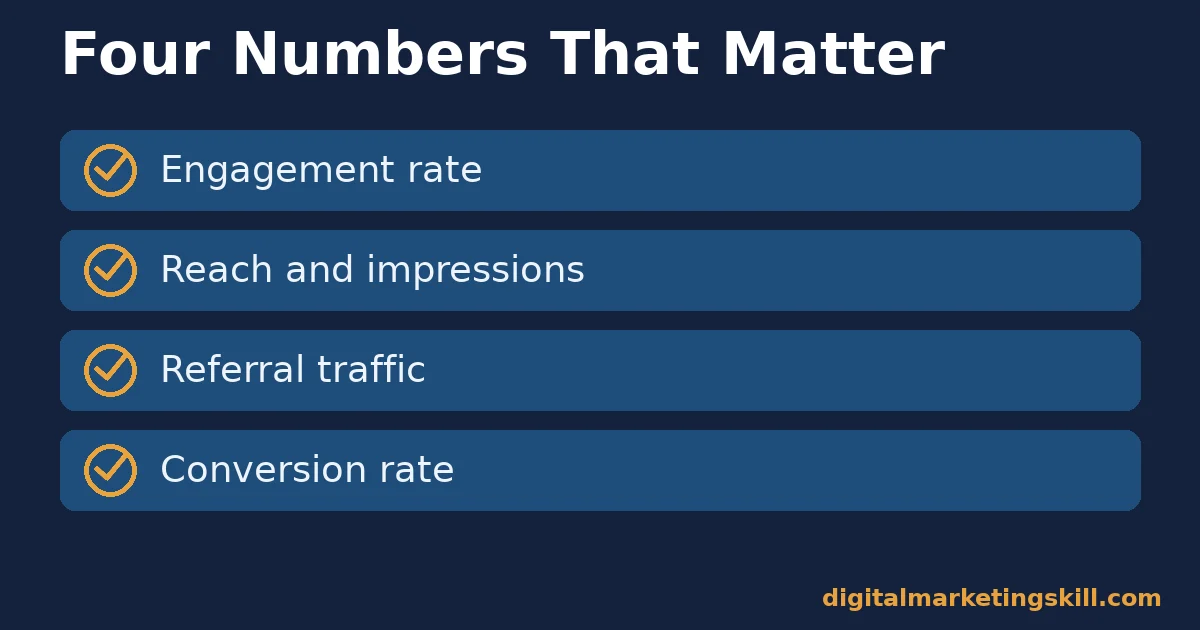
- Engagement rate. Likes, comments and saves divided by followers, or by reach if available. It shows how actively an audience responded, not just how many saw the post.
- Reach and impressions. How many unique accounts saw the content, and how many times it was shown. This separates true audience size from repeat views.
- Referral traffic. Visits to your site traced back to a specific creator or post, usually with a unique link or code per creator.
- Conversion rate. The share of that referral traffic that completes your goal action. This is the number that ultimately justifies the spend.
Read these together, by tier. A nano campaign with strong engagement but weak referral traffic is doing its job: building trust, not driving clicks. A macro campaign with huge reach but a low conversion rate may still be working, if the goal was awareness rather than immediate sales.
Give any campaign enough time before judging it. A single post rarely tells the full story, since trust built through a nano or micro partnership often shows up in conversions weeks later, not on the day the post goes live.
The One Rule: Match the Tier to the Goal, Not the Budget to the Fame
If you take one decision rule from this guide, make it this one. Pick your creator tier based on what you are trying to achieve, not on which creator feels the most impressive to work with. Awareness goals pull toward macro and celebrity reach. Trust and conversion goals pull toward nano and micro engagement.
Most Instagram influencer marketing budgets underperform for one reason: they get spent on the tier that looks best in a deck, not the tier that matches the actual goal. Fix that mismatch before you spend more on any single tier.
A Real Case: How Gymshark Used Early Creator Partnerships
Gymshark is a real, published case, not an illustrative one. An academic case study on its Instagram marketing found that roughly 40% of its early sales came through Instagram, with about 6.6 times return on that ad spend. The brand built this on early partnerships with fitness creators rather than celebrity endorsements.
What made it work was tier fit. Fitness creators with real, engaged training audiences carried a believable message to the exact audience Gymshark needed, which mass-reach celebrities could not.
The brand went on to grow from a small operation into a company valued over a billion pounds. However, plenty of other factors beyond influencer marketing contributed to that growth too, so treat the return multiple as directional, not a guarantee for any other brand.
Frequently Asked Questions About Instagram Influencer Marketing
How do I start Instagram influencer marketing with a small budget?
Start with nano and micro creators, because their rates are lower and their engagement rates are typically higher than larger tiers. A small budget spread across several niche-relevant creators usually outperforms the same budget spent on one expensive post from a single large account.
How many followers do you need to be an influencer?
There is no official minimum. Creators are generally grouped as nano (roughly under 10,000 followers), micro (roughly 10,000 to 100,000), macro (roughly 100,000 to 1 million) and mega or celebrity (over 1 million). Content quality and audience fit matter more than the raw follower count in any tier.
Do I legally have to disclose a paid Instagram partnership?
Yes, in the US. The FTC requires any material connection, including paid posts and free or discounted products, to be disclosed clearly within the endorsement itself, using plain language rather than vague hashtags. Check your own country’s advertising standards body for equivalent local rules.
Is Instagram influencer marketing still effective with so much content on the platform?
Yes. Reach is no longer the scarce resource on Instagram, since the platform has 3 billion monthly active users, but trust still is. Instagram influencer marketing remains effective precisely because it supplies that trust, which a paid ad alone cannot.
Should I work with one influencer or many at once?
It depends on the tier and the goal. A handful of macro creators can deliver broad reach for an awareness goal. A larger batch of nano and micro creators usually performs better for trust-driven conversion goals, because the combined engagement across many small, relevant audiences tends to beat one large, less personal one.
Many brands run both at once. They use macro reach for awareness while nano and micro partnerships handle the conversion work underneath it, so each tier does the job it is actually good at.
What is the biggest mistake brands make with Instagram influencer marketing?
Picking a tier based on how impressive a creator looks, rather than what the campaign is trying to achieve. An awareness goal and a conversion goal call for different tiers, and using the wrong one is the most common reason a campaign underperforms.
Can a brand run Instagram influencer marketing without any ad budget?
Not entirely for free, but it can be low-cost. Many nano creators work for product gifting alone rather than a cash fee, which keeps the entry cost to testing Instagram influencer marketing low. You still need time to vet creators, brief them and track results properly, and that time is a real cost even when no money changes hands.
Start With One Tier, Measure It, Then Expand
Instagram influencer marketing works when the tier matches the goal. Nano and micro creators drive trust and conversion. Macro and celebrity creators drive broad awareness. Pick one tier, run one measurable campaign, track engagement, referral traffic and conversion rate, then expand what actually worked.
If you want structured training in running campaigns like this, the Master Diploma in Digital & AI Marketing includes an AI-Powered Social Media Management and Advertising track inside its four AI-powered tracks, with a Full Stack option covering all four.
It also includes unlimited 1-on-1 mentoring and coaching, a U.S. Project Internship with a verified U.S. Work Reference Letter, and dual US and UK accreditation recognised in more than 100 countries, 100% online from anywhere in your country.
Browse the blog for more on specific channels, and read real outcomes on the reviews page. When you are ready, apply here. Wherever you live, Instagram influencer marketing starts with one well-matched creator, not a celebrity budget. Learn more at Digital Marketing Skill Institute, and see how it fits your own digital marketing plan.
Every figure in this guide was checked against its original source before publication. Figures marked as illustrative are invented examples, not real results.
