Most guides tell you to monetize a Facebook Page with ads and stop there. That is one stream, not a strategy. This guide covers six real income streams. It shows what each one actually pays, and the checks that tell you which one fits your page right now.
Key Takeaways
- Reach is real, but it is shared. Facebook ads reach about 2.28 billion people worldwide, per DataReportal. Your page competes inside a huge, crowded audience, not a guaranteed one.
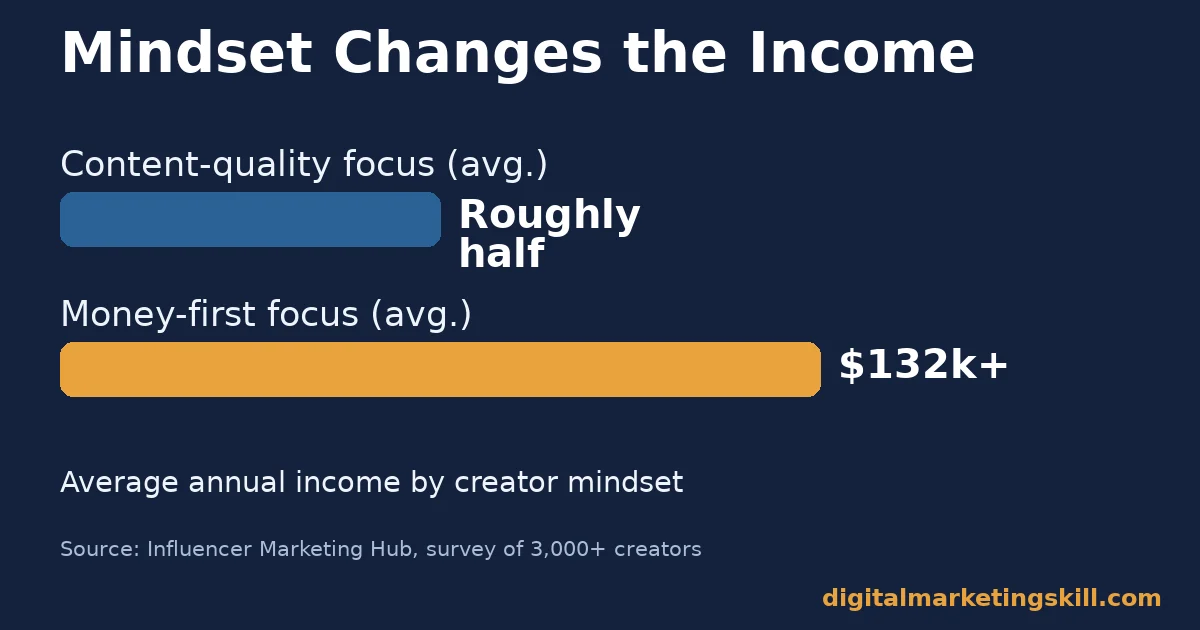
- Most creators earn little from content alone. In a survey of over 3,000 creators by Influencer Marketing Hub, 50% earned under $15,000 a year from their content.
- Mindset changes the number. Creators who treat content like a business, prioritising income directly, averaged over $132,000 a year in the same survey. That is roughly double the figure for those who did not.
- Diversifying beats relying on one stream. The same survey found full-time creators depending on a single income source struggled more often. They were far more likely to fall below a living wage than those running several streams at once.
- Platform demand data backs the audience. Meta reported average price per ad up double digits year over year. Ad impressions also grew by double digits, per its most recent quarterly results.
In this guide
- Why Most Advice to Monetize a Facebook Page Falls Short
- How Facebook Page Monetization Actually Works
- What Differs by Income Stream
- Match the Stream to Your Page, Not the Other Way Around
- How to Get the Most From Each Stream
- Three Streams, Side by Side
- Red Flags That Predict You Will Not Get Paid
- The Six Streams, Briefly
- How to Measure Whether Monetization Is Working
- The Rule That Makes It Easy to Monetize a Facebook Page
- Common Mistakes That Slow This Down
- A Real Case: Why One Skill Outweighed Location
- Frequently Asked Questions About How to Monetize a Facebook Page
- Where to Go Next
Why Most Advice to Monetize a Facebook Page Falls Short
Most articles list six or seven monetization options and move on. They rarely say which ones actually pay a meaningful amount, or what you need before you qualify. That gap wastes creators’ time on options that will not work for their page yet.
Two ground rules before you read further. First, published payout figures are informed estimates, not guarantees for your specific page. Second, eligibility requirements for ad programs, stars and bonuses change over time and by country. Always confirm current terms directly on the platform’s own monetisation page before counting on a number.
This guide sits inside the wider world of digital marketing income strategies, not apart from it. The same discipline that builds a good content calendar or an ad campaign also builds a page worth monetising.
How Facebook Page Monetization Actually Works
Every stream to monetize a Facebook Page depends on the same input: an audience that stays, watches and returns. Meta’s own ad business shows why reach matters so much. In its most recent quarterly results, the company reported ad impressions rising by double digits. Average price per ad also rose by double digits, year over year.
In other words, the money flowing through Facebook’s ad ecosystem keeps growing. However, that growth benefits pages with real, engaged audiences far more than pages chasing raw follower counts.
A page with fewer, more loyal followers often converts better into stars, subscriptions or product sales. That beats a larger page with passive followers. Every stream below asks a version of the same question: does your audience actually act, not just scroll past?
For context, Facebook’s own global audience is enormous. Meta’s family of apps reported roughly 3.60 billion daily active people, according to the same quarterly results, so even a tiny, loyal slice of that audience can support a real income stream.
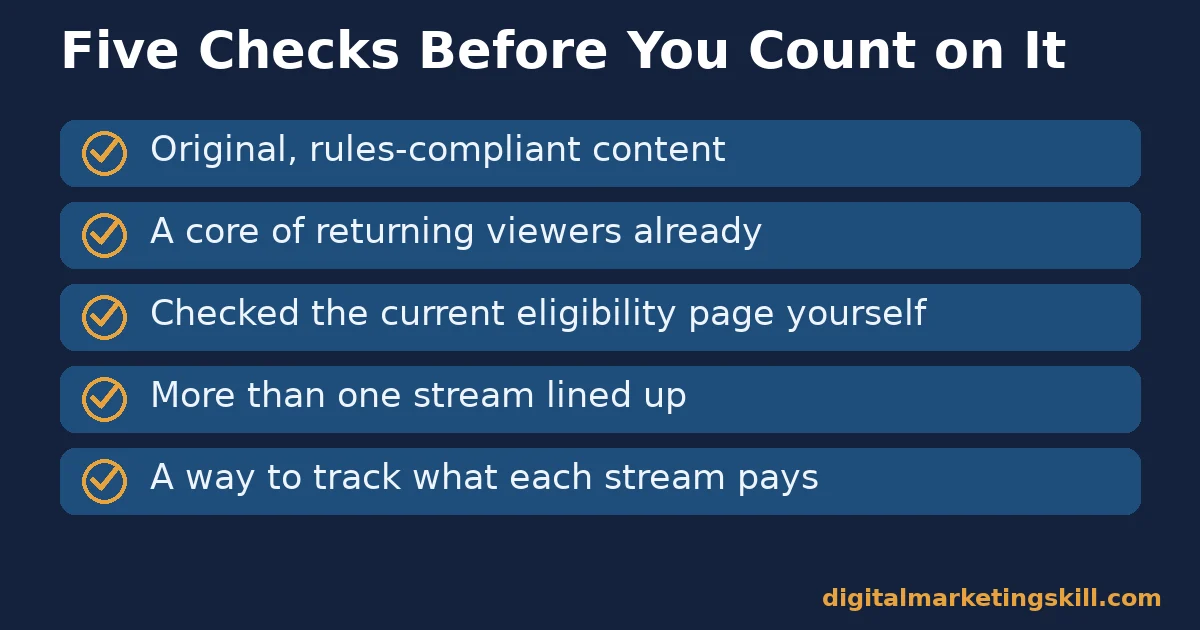
Five Checks Before You Count on This Income
- Is your content original and rules-compliant? Reused or policy-violating content gets demonetised fast, regardless of its reach.
- Do you already have a core of returning viewers? New pages rarely qualify for ad or bonus programs immediately.
- Have you checked the current eligibility page yourself? Thresholds for followers and watch time change, so confirm them directly rather than trusting an old blog post.
- Do you have more than one stream lined up? A single income source is fragile if a program’s rules change.
- Can you track what each stream actually pays you? Without tracking, you cannot tell which stream to grow next.
A Two-Minute Self-Check Before You Pick a Stream
Ask yourself these five short questions, in order, before you choose where to focus.
- “Does my content already get real watch time, not just impressions?”
- “Do I have a small group of fans who comment or message regularly?”
- “Have I read the platform’s current eligibility page myself, recently and directly?”
- “Am I relying on exactly one income source right now?”
- “Could I name my top-earning piece of content from memory?”
Honest answers here point you toward scale-based or loyalty-based streams faster than any generic checklist.
What Differs by Income Stream
Ad and Platform Payouts: Built for Scale
In-stream ads, bonuses and other platform-paid programs reward reach and watch time. They work best for pages publishing video regularly to a growing audience. The trade-off is control: Meta sets the rules, the rates and the eligibility bar, and all three can change without much notice.
Direct Fan Support: Built for Loyalty
Stars, subscriptions, tipping and direct product sales reward a smaller, closer audience instead of scale. A page with a thousand engaged fans can out-earn a page with a hundred thousand passive followers through this route.
The trade-off here is effort. Direct support usually requires you to ask for it, repeatedly and specifically, rather than letting a platform algorithm hand you the payout. Selling your own product, or promoting someone else’s through affiliate marketing, both fall into this category, since both depend on trust with a specific audience rather than reach alone.
Match the Stream to Your Page, Not the Other Way Around
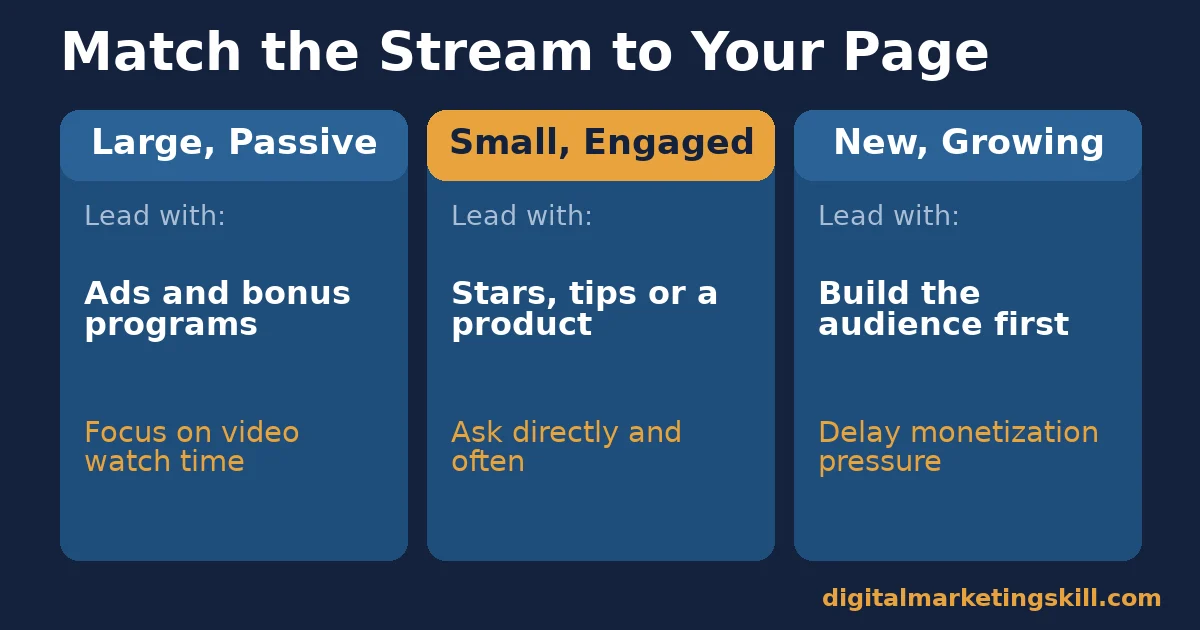
Choosing where to focus is the real skill when you try to monetize a Facebook Page. It is not the technical setup of any one program. Three page types come up again and again, and each points toward a different first move.
A Large, Mostly Passive Page
If your page has strong reach but low direct engagement, ad and bonus programs are the natural first stream. Focus on video and watch time, since that is what these programs reward most directly.
A Small, Highly Engaged Page
If your page has a smaller but vocal audience, lead with stars, tips or a simple product. These followers already trust you, so a direct, specific ask usually converts well.
A New or Still-Growing Page
If your page is new, skip monetization pressure for now and build real watch time and repeat visitors first. Chasing a payout before you have an audience usually wastes effort that would grow the page faster.
How to Get the Most From Each Stream
Ad and Platform Payouts: Grow Reach With Video
If you lean on platform payouts, publish video consistently, since watch-time thresholds drive most ad and bonus eligibility. Track which videos hold attention longest, not just which get the most views.
Then make more of exactly that format, since consistent watch time is what keeps a page eligible once it qualifies. A deeper online video strategy built around what each platform actually rewards will do more for this stream than any single viral post.
Direct Fan Support: Ask Directly and Often
If you lean on fan support, mention how followers can support you in almost every post, not just once. Furthermore, give a specific reason tied to real content, such as funding a particular video series, rather than a generic request. A specific ask reliably outperforms a vague one across creator platforms.
Three Streams, Side by Side
Here is how three common approaches might compare for the same page. These specific figures are illustrative, invented numbers, built from the stream categories above, not one real page’s results.
- Ad payouts only, large passive audience: 50,000 monthly views, low repeat-viewer rate, modest ad revenue that tracks views closely.
- Fan support only, small loyal audience: 2,000 followers, high repeat-viewer rate, income concentrated in a handful of highly engaged fans.
- Mixed streams, moderate audience: 15,000 followers split across video and posts, income spread across ads, stars and one digital product.
The mixed approach is usually the most resilient of the three, since no single platform policy change can remove the entire income stream at once. It also tends to grow faster over time, because each stream can feed the others: an engaged fan from a direct sale often becomes a repeat viewer too.
Red Flags That Predict You Will Not Get Paid
A few warning signs repeat across Facebook monetization advice. First, any guide promising a fixed payout per follower is wrong, because payouts depend on engagement and watch time, not follower count alone. Second, a course or guide that will not name which Meta program it is describing is probably working from outdated or invented numbers.
Third, be wary of anyone encouraging bought followers or engagement pods to hit eligibility thresholds faster. Meta’s monetisation policies penalise inauthentic engagement, so shortcuts here can cost you your page’s standing, not just one payout.
None of these red flags are automatically fatal if you catch them early. Dropping a bad habit, like buying followers, and rebuilding with real engagement usually recovers a page’s standing over time.
The Six Streams, Briefly
Before the deeper checks, here is a short, honest summary of each stream you can use to monetize a Facebook Page.
- In-stream ads. Pays based on video views and watch time. Needs consistent video output and an existing audience.
- Stars and tips. Fans send small payments during live or on-demand content. Needs a loyal, responsive audience more than scale.
- Paid subscriptions. Followers pay monthly for extra content or access. Works best once you already post consistently.
- Branded content and partnerships. Brands pay to reach your audience directly. Needs a clear niche and real engagement data to pitch.
- Affiliate links. You earn a share when followers buy through your link. Needs trust and a relevant product fit.
- Your own product or service. You keep the full margin, but you also do all the selling yourself. Often the most resilient stream long term.
No single stream suits every page. Most pages that earn well to monetize a Facebook Page end up running two or three of these at once, not just one.
How to Measure Whether Monetization Is Working
Five Numbers Worth Tracking
- Revenue per 1,000 views. Lets you compare ad and bonus payouts across videos fairly, regardless of total reach.
- Repeat viewer rate. The share of your audience who return for a second piece of content. A higher rate predicts stronger fan-support income.
- Conversion rate on direct asks. The share of viewers who actually tip, subscribe or buy after you ask. Even a low rate compounds at scale.
- Income per stream, tracked separately. Lets you see which stream is actually growing versus which one is flat or shrinking.
- Time invested per stream. Pairing this with income per stream tells you your real hourly return, not just your total payout.
Together, these five numbers replace guesswork with an answer you can act on. Review them on a regular cadence, since a single strong or weak stretch rarely tells the full story. A page that looks flat over one short window can still be building toward a real breakthrough, and a page that spikes once can just as easily fade back down.
A Simple Ninety-Day Starting Plan
If you are starting from zero, a short, staged plan beats trying every stream at once. Spread the work across three phases instead.
- Phase one: build the audience. Post consistently, track watch time and repeat visitors, and resist the urge to monetize before you have data.
- Phase two: add one direct stream. Turn on stars or tips once you have a visible core of regular commenters, and ask for support specifically, not generically.
- Phase three: layer in scale. Once you likely meet ad or bonus thresholds, apply, and keep publishing the video formats that already hold attention longest.
This order matters. Trying to scale ad revenue before you have real watch-time data usually wastes the early months you could have spent building the audience itself. Patience in phase one almost always pays back faster than it feels like it will at the time.
The Rule That Makes It Easy to Monetize a Facebook Page
Build your largest stream around your actual audience behaviour, not around whichever option looks easiest to set up. A page with high watch time but low direct engagement should lean into ad and bonus programs first. A page with a small, vocal audience should lean into stars, subscriptions or direct sales first.
Worked example: a page earning $40 in ad payouts from 50,000 passive monthly views, versus $400 from stars and tips among 2,000 highly engaged followers, shows the same lesson the data above supports. Engagement, not raw reach, is usually the stronger predictor of what a page can actually earn.
This rule also explains why two pages with similar follower counts can report very different income. The page built around a specific, trusted niche usually out-earns the page built around broad, generic content, even at the same size.
Common Mistakes That Slow This Down
Beyond the red flags above, a few ordinary mistakes slow down almost every page trying to monetize a Facebook Page. Posting inconsistently is the most common one. Audiences reward pages they can predict, and algorithms tend to favour pages that publish on a steady rhythm.
A second mistake is copying a competitor’s exact format without adapting it to your own audience. What works for one niche or one country rarely transfers directly, since audience expectations differ by community, not just by platform.
A third mistake is checking income daily instead of weekly or on a longer cycle. Daily numbers are noisy and can discourage you before a real trend has had time to show up. Pull back to a slower view, and the signal becomes much clearer, which matters most for anyone trying to monetize a Facebook Page for the long term rather than chase one lucky week.
A Real Case: Why One Skill Outweighed Location
The Digital Marketing Skill Institute publishes named student outcomes on its reviews page. Graduate Kofi B. described the deciding factor in a remote hiring process this way: “What won me the remote role in Canada was my AI marketing knowledge. I could do the work of a 3-person team. My location became irrelevant.”
This is one real, named testimonial, not a representative sample, and it carries no income figure or guarantee. Still, it illustrates a wider pattern that runs through this whole guide: demonstrated skill, not geography or follower count alone, is what employers and audiences actually reward in the end. No course or guide can honestly guarantee income, consistent with the Institute’s own earnings disclaimer.
Frequently Asked Questions About How to Monetize a Facebook Page
What is the fastest way to monetize a Facebook Page?
Direct fan support, such as stars or tips, is usually fastest to set up, since it needs less scale than ad programs. However, it only pays well once you already have a core of engaged followers willing to support you directly. Building that core first, even slowly, tends to beat chasing ad eligibility on a brand-new page.
How many followers do I need to monetize a Facebook Page?
Requirements vary by program and change over time, so check Meta’s current creator monetisation page directly before planning around any specific number. Focus on watch time and engagement, not only follower count, since both affect eligibility.
Can I monetize a Facebook Page without posting video?
Yes, through direct product sales, affiliate links or paid subscriptions tied to posts rather than video. That said, in-stream ads and video bonus programs specifically require video content, so they are closed to a page that only posts text and images.
Is Facebook monetization still worth it with so much competition?
For a page with a real, engaged audience, yes, since Meta’s own results show ad spend and impressions still growing. For a page with passive, disengaged followers, direct fan support or product sales will likely outperform ad-based options regardless of competition.
Should I focus on one income stream or several?
Several, where you can manage them well. The creator survey cited earlier found that full-time creators relying on a single stream were more likely to fall below a living wage than those running more than one.
Do bought followers help me monetize a Facebook Page faster?
No. Meta’s policies penalise inauthentic engagement, and bought followers rarely convert into real watch time, tips or sales. They can also put your whole page’s monetisation standing at risk.
Do I need a large following to monetize a Facebook Page at all?
No, not for every stream. Direct product sales and affiliate links need trust more than scale, so a small, loyal audience can monetize a Facebook Page this way long before it qualifies for ad or bonus programs.
Where to Go Next
Use the five checks and five metrics in this guide on your own page before you commit to a stream. That short audit takes minutes and saves months of effort on the wrong one.
If you want to build the underlying skill set, not just one page’s income, the Digital Marketing Skill Institute’s Master Diploma in Digital & AI Marketing covers social media management and advertising as one of its ten courses across four AI-powered tracks.
It also includes unlimited 1-on-1 coaching and mentoring, and real project work inside a U.S. partner company from day one. It is dual US and UK accredited, recognised in more than 100 countries, and delivered 100% online, so you can study wherever you live.
Read more on the digital marketing blog, see real outcomes on the reviews page, and when you are ready, check the Master Diploma program page or apply. Everything the Institute publishes about itself is on digitalmarketingskill.com, so you can verify any claim here before you rely on it.
Every figure in this guide was checked against its original source before publication. Figures marked as illustrative are invented examples, not real results.
![9 Amazing Digital Marketing Skills to Make Money Online [With Proof]](https://digitalmarketingskill.com/wp-content/uploads/2019/07/9-Amazing-Digital-Marketing-Skills-to-Make-Money-Online-With-Proof-17.png)