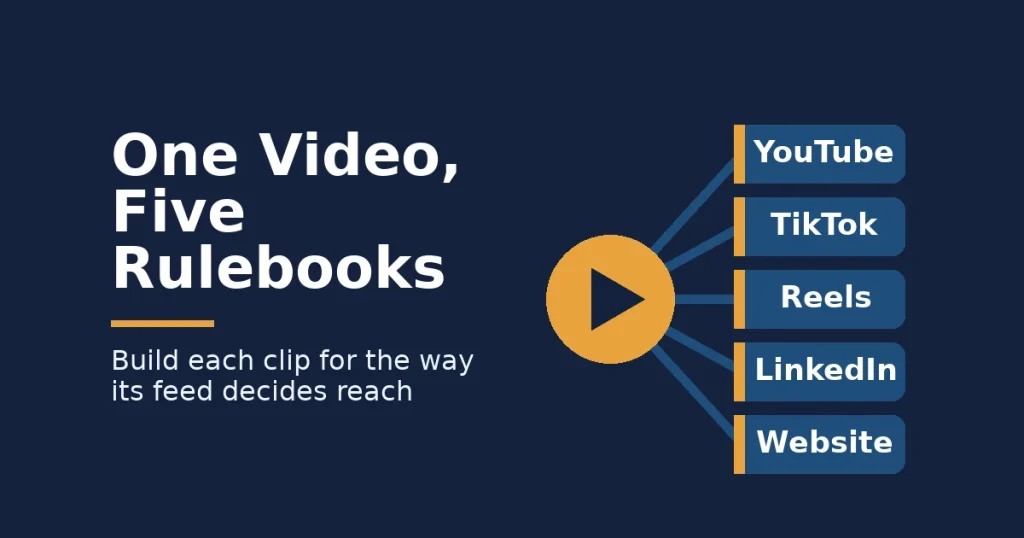
An online video strategy works when each video is built for the way its platform decides who sees it. YouTube rewards viewers who stay satisfied. TikTok and Instagram Reels reward clips people finish and share, and your website rewards fast pages Google can index.
Key Takeaways
- Online video is close to universal. GWI data in DataReportal’s global overview shows that 91.1% of adult internet users watched online video in the past week. So an online video strategy starts with where your buyers watch.
- Teams make more than they distribute. In Wistia’s State of Video survey of over 900 professionals, 57% spend more time creating videos than promoting them.
- Each platform uses a different reach signal. YouTube moved from clicks to watch time to survey-based “valued watchtime”. TikTok says finishing a longer video is a strong signal, while follower count is not a direct factor.
- Click-through has a documented normal range. YouTube Help says half of all channels and videos have an impressions click-through rate between 2% and 10%. That gives you a first benchmark for titles and thumbnails.
- Your website needs its own rules. Google Search Central asks for a dedicated watch page for each video. It also says Google has to index that page before it can index the video.
In this guide
- Why Most Online Video Strategy Advice Misses the Platform
- How Platforms Decide Who Sees Your Video
- What Differs by Platform: Five Rulebooks for One Video
- How to Adapt Your Online Video Strategy for Each Platform
- How to Measure an Online Video Strategy
- The Decision Rule: Build One Home Platform Before You Spread
- Real Case: A YouTube Ad That Paid Off Years Later
- Frequently Asked Questions About Online Video Strategy
- Build Your Online Video Strategy With Expert Support
Why Most Online Video Strategy Advice Misses the Platform
Most guides treat video as one channel. They tell you to post consistently, keep it short and add captions, then stop. But YouTube, TikTok, Instagram Reels, LinkedIn and your website each decide reach in a different way. As a result, the same clip can thrive in one feed and stall in the next.
The data shows where the effort goes instead. Wistia’s State of Video report combines a survey of over 900 professionals with platform data. That data covers more than 13 million videos and 79 million hours of viewing. In that survey, 57% of teams spend more time creating videos than promoting them. Only 20% spend more time on promotion, while 23% split their time evenly.
This guide fills that gap by building your online video strategy in a fixed order. First, it explains how platforms decide reach. Then it shows what differs by platform, what to do differently on each one, and how to measure the result. After that, you get one decision rule, a real case with its limits, and short answers to common questions.
Three ground rules keep the advice honest. First, platform signals come from each company’s own public documentation. Those pages describe the system in broad terms and never publish the full formula. Second, where this guide connects those signals to tactics, treat it as an informed inference, not a settled fact. Third, platform figures change often, so every number here is a snapshot, not a permanent ranking.
How Platforms Decide Who Sees Your Video
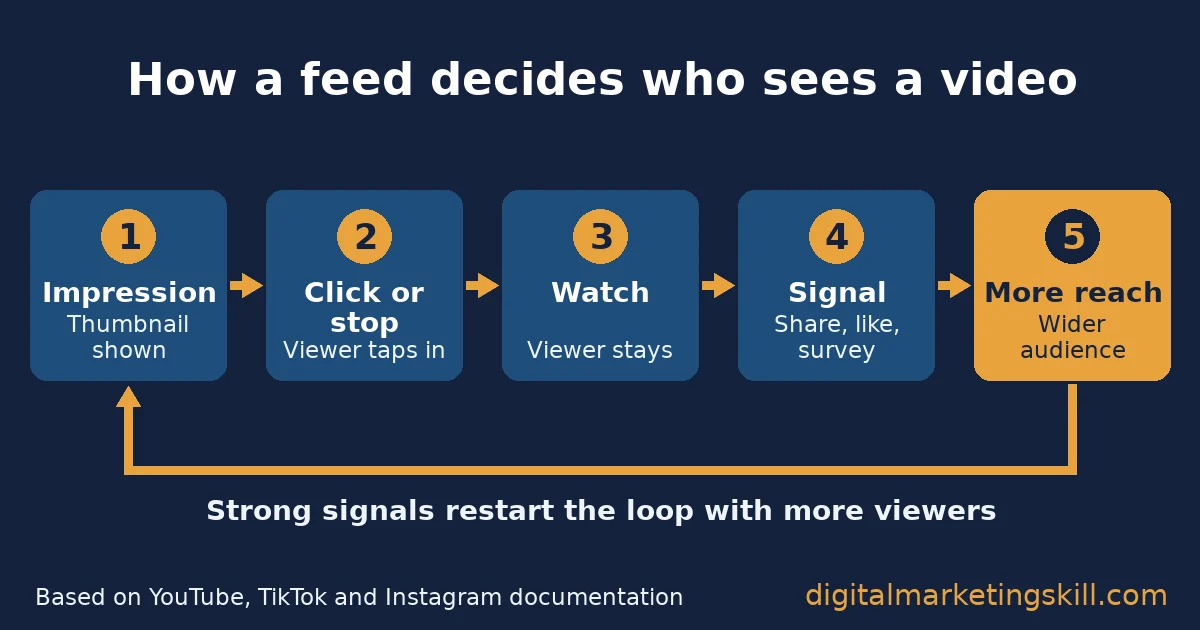
Every feed that an online video strategy targets runs a similar loop, even though the details differ from app to app. A recommendation system is software that predicts which video each viewer is most likely to enjoy next. It shows your video to a small group and reads how they react. When the reactions are strong, it shows the video to more people.
- Impression: the platform shows your thumbnail or first frame to a viewer.
- Click or stop: the viewer taps the video or stops scrolling instead of moving on.
- Watch: the viewer stays for part or all of the video.
- Satisfaction signal: the viewer likes, shares, comments, follows, or answers a survey.
- More reach: strong signals earn the video a wider audience, and the loop repeats.
YouTube explains how this loop grew up. On the YouTube Blog, Cristos Goodrow, YouTube’s vice president of engineering, describes how YouTube’s recommendation system first leaned on clicks. However, clicks rewarded misleading thumbnails, because people clicked and then left after a few seconds. So YouTube added watch time. Later it added “valued watchtime”, which counts time on videos that viewers rate four or five stars in surveys.
The lesson travels across platforms. A click only opens the door, but the watch and the reaction decide whether the platform keeps showing your work. That is why a strong online video strategy plans the opening, the middle and the ending, not just the thumbnail.
What Differs by Platform: Five Rulebooks for One Video
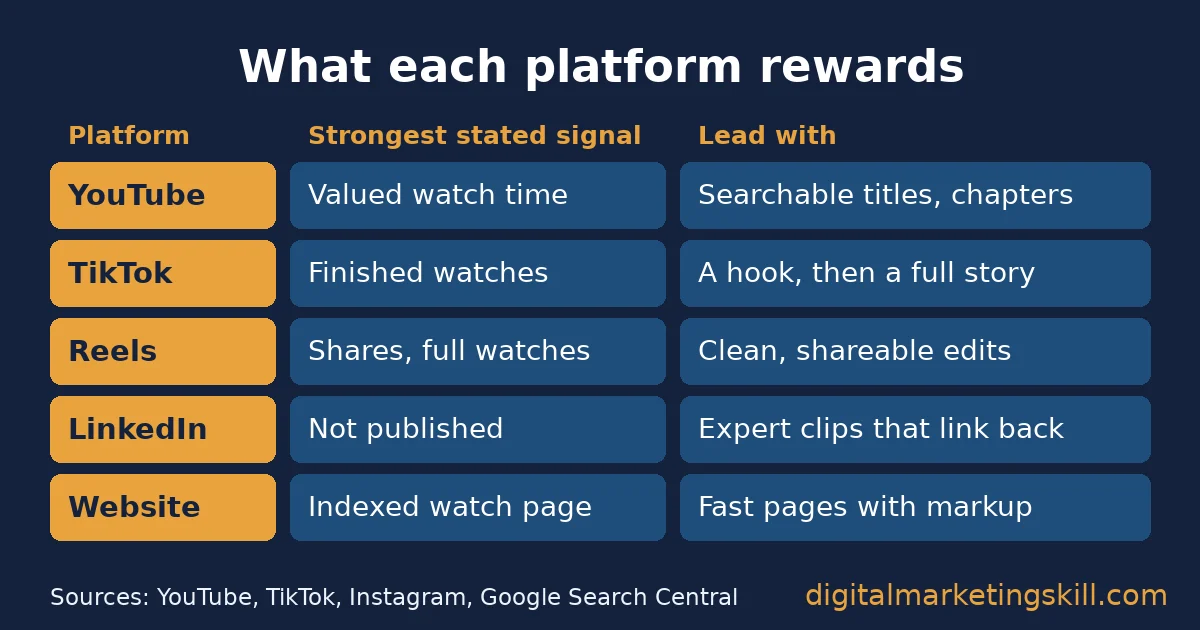
The loop is shared, but the strongest signal changes from feed to feed, so an online video strategy that ignores those differences wastes good footage. Therefore, the table below and the five sections after it summarise what each platform says about itself. Where a platform is silent, the text says so.
YouTube: Built for Search and Satisfied Watch Time
YouTube works like a search engine and a TV channel at once. People type questions into it, and they also sit back and let recommendations play. In the United States, Pew Research Center’s social media survey of 5,022 adults found that 84% use YouTube. That is more than any other platform in the study. That figure is US-only, so treat it as a reach signal, not a global share.
Scale on the short-form side is just as large. In his annual letter, YouTube’s chief executive, Neal Mohan, wrote that YouTube Shorts averages 200 billion daily views. As a result, one channel can serve people searching for a full tutorial and people swiping through short clips.
TikTok: Built for Interest, Not Followers
TikTok’s For You feed ranks videos by predicted interest. The company’s newsroom post on how TikTok recommends videos lists three groups of signals. They are user interactions, video information such as captions, sounds and hashtags, and device and account settings. It also says that finishing a longer video from beginning to end is a strong signal.
The same post says follower count is not a direct factor, and neither is a history of past hits. So a new account can reach strangers with its first strong video. Time spent is high, too. Similarweb data cited in DataReportal’s global digital overview shows the typical TikTok user spends 1 hour and 37 minutes a day in the Android app.
Instagram Reels: Built for Shares and Original Clips
Instagram describes Reels ranking in a post by Adam Mosseri, the head of Instagram. According to Instagram’s ranking explainer, the most important predictions cover four actions. They are how likely a viewer is to reshare a reel, watch it to the end, like it, and visit the audio page.
The same explainer lists what makes a reel less visible. That includes low-resolution or watermarked clips, muted reels, reels with borders, reels that are mostly text, and reels already posted on Instagram. In practice, this means a clip exported from another app with its logo still on it starts with a handicap.
LinkedIn: Built for Professional Reach
LinkedIn does not publish a detailed video ranking explainer like TikTok or Instagram. Even so, business teams lean on it heavily. In Wistia’s survey, 81% of teams share videos on LinkedIn and 76% share on YouTube. Those are the two most used platforms by a wide margin.
Clips follow the same pattern. Wistia found that 67% of teams share short social clips on LinkedIn, ahead of Instagram at 49% and YouTube at 41%. My reading is that LinkedIn rewards expertise that busy professionals can absorb in under a minute. However, LinkedIn has not confirmed its signals in public.
Your Website: Built for Intent and Conversion
Your website is the only part of an online video strategy where you own both the audience and the data. Visitors on your pages are already interested, so the job is to answer their question and move them to the next step. Wistia’s benchmarks show that homepages, video galleries and product pages get the highest play rates. That makes sense, because visitors there are actively exploring.
Search visibility follows Google’s rules, not a social feed’s. Google Search Central’s video guidelines recommend a dedicated watch page for each video, whose main purpose is to show one video. In addition, Google says the watch page itself must be indexed and doing well in Search first. Only then can Google consider the video for indexing.
How to Adapt Your Online Video Strategy for Each Platform
The five sections below mirror the five rulebooks above. Each one turns a documented signal into a first action you can take on your next upload. Wistia found that 76% of teams already change the aspect ratio for each platform. However, a good online video strategy changes the hook and the ending too.
YouTube: Lead With Searchable Titles, Chapters and Retention
Start with the question your buyer types into the search bar. Put that phrase in the title, say it in the first sentence, and deliver the answer early. Our YouTube SEO guide for beginners covers keyword research for titles in more detail. Because YouTube values satisfied watch time, a title that over-promises can win the click and still lose the recommendation.
- Title and thumbnail: promise one clear outcome, then show it on screen within the first minute.
- Chapters: add timestamps in the description so viewers can jump to the part they need instead of leaving.
- Retention check: open the audience retention report after a week and fix the section where the line drops most steeply.
TikTok: Lead With the First Seconds and a Complete Story
On TikTok, the first second decides whether people keep watching. Open with the result or the problem, not your logo or a greeting. Then finish the story inside the clip, because a viewer who watches to the end sends the strong signal that TikTok describes. If you are setting up an account from scratch, start with our step-by-step guide to using TikTok for your business.
- Hook: show the outcome in the opening frame, then explain how you got there.
- Captions and sound: write clear on-screen captions, since TikTok reads captions and sounds as video information.
- Series: number related clips so viewers who finish one have a reason to find the next.
Instagram Reels: Lead With Shareable, Native Edits
Design each reel so that someone wants to send it to a friend. Useful checklists, before-and-after results and short explanations tend to fit that test. Then export a clean file without another app’s watermark, since Instagram says it shows watermarked reels to fewer people.
- Share trigger: end with one line that names who the reel would help, such as “send this to your team”.
- Original upload: post the source file, not a screen recording or a reel you already posted.
- Audio: keep sound on and clear, because muted reels are one of the formats Instagram limits.
LinkedIn: Lead With Expertise Clips That Link Back
On LinkedIn, lead with a single insight from your work, delivered by a real person in under a minute. Then point to a longer resource. Wistia found that 60% of teams use social clips to link back to their website. That turns a short view into a visit you can measure.
- Source material: cut clips from a webinar, a customer call you have permission to use, or a longer tutorial.
- Text post: write the key point in the post itself, so the message still lands for anyone watching with the sound off.
- Next step: add one link in the comments or post to the full video on your site.
Your Website: Lead With Fast Watch Pages Google Can Index
Give every important video its own page with a clear title, a written summary and a transcript. Then add VideoObject structured data, which is code that tells Google the video’s name, description and thumbnail. Google also supports Clip markup, which marks each key moment so searchers can jump straight to it.
Speed matters as much as markup, because a heavy video player can slow the whole page. Jeremy Wagner and Barry Pollard cover this in web.dev’s guide to lazy-loading video. They recommend using preload=”none” and a poster image, so the browser skips video data until a visitor asks for it. For more on why page speed matters for mobile buyers, see our guide to improving your mobile conversion rate.
How to Measure an Online Video Strategy
Views alone tell you almost nothing about an online video strategy, because a single view can last just one second. Instead, read a short chain of metrics in order, from first glance to action. Each metric below has a one-sentence definition and a note on how to read it.
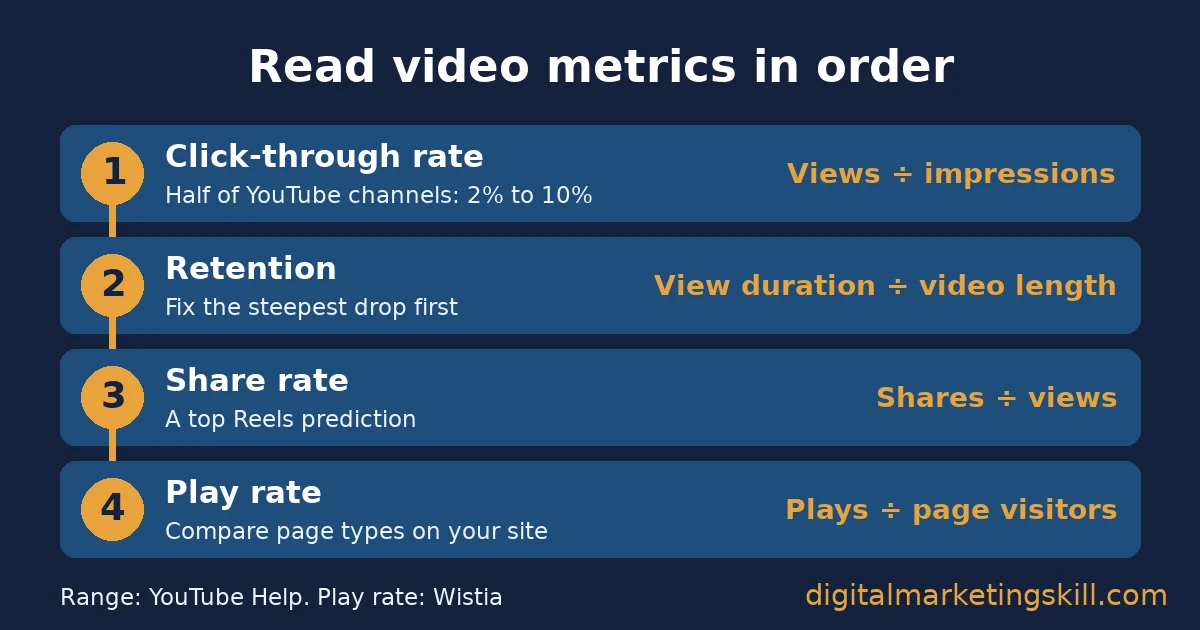
- Impressions click-through rate: the share of people who watched after seeing your thumbnail. YouTube Help says half of all channels and videos fall between 2% and 10%. So a video far below 2% usually needs a new title or thumbnail.
- Average view duration: the average minutes watched by people who stayed to watch. Compare it with the video’s length, because three minutes means more on a four-minute video than on a twenty-minute one.
- Audience retention: a curve that shows how well each moment held attention. Look for steep drops, then fix the sentence or scene just before them.
- Completion rate: the share of viewers who watched to the end. On TikTok and Reels this matters most, because both platforms name full watches as a strong signal.
- Share rate: shares divided by views. It shows whether people found the video worth passing on, which Instagram treats as a top prediction.
- Play rate: the share of website visitors who pressed play. Wistia defines it this way and uses it to compare page types on your own site.
- Assisted conversions: sales or sign-ups where a video visit appeared earlier in the path. This keeps you from judging video only on last-click sales.
Compare Videos of Similar Length
Length needs one caution. Wistia’s data shows that shorter videos have higher engagement rates. Yet a ten-minute video with a lower rate can still earn more total watch time than a one-minute clip. So judge each video against others of similar length.
If you are new to production itself, our video marketing guide for beginners covers equipment and scripting. To see how video sits beside your other channels, read our guide to choosing and funding your marketing channel mix.
The Decision Rule: Build One Home Platform Before You Spread
The most useful point in this guide is a simple rule that keeps your online video strategy focused while you learn what works. Pick one home platform that matches how your buyers look for answers, and publish at least ten videos there. Then add a second platform only when your retention has improved over your first three uploads.
To choose the home platform, ask one question. Do your buyers search for this answer, or do they discover it while scrolling? If they search, build on YouTube and your own watch pages. When they discover things while scrolling, build on TikTok or Reels. For professional buyers, add LinkedIn clips that link to your full videos.
Here is a worked example with illustrative, invented numbers. A bookkeeping freelancer publishes ten short tutorials on YouTube. The first three hold viewers for an average of 38% of their length. Over the next seven, the freelancer moves the answer into the first twenty seconds and adds chapters. Average retention then climbs to 52%.
That improvement is the signal to spread. Next, the freelancer cuts the three best tutorials into six vertical clips for Reels. Each clip ends with a link to the full video. Because the long videos already hold attention, the clips send viewers to content that keeps them. In short, the rule protects you from spreading weak videos across five feeds at once.
Real Case: A YouTube Ad That Paid Off Years Later
An online video strategy often pays off slowly, and our own reviews show it. On the reviews page of the Digital Marketing Skill Institute, Toyin Adegoke says in a Google review that they first saw a DMSI ad on YouTube. They then stayed unsure for years. Later, despite discouraging comments, they enrolled and wrote that they were impressed.
A second review on the same page, by Kate Badero, says they found the Institute while watching a YouTube video. Within a month of registering for the Master’s Programme, Kate Badero reports building a website and scheduling social media ads. They also optimised a page for Google search.
These cases have clear limits. They are two self-selected reviews published on our own site, and they carry no click or attribution data. Still, they show a pattern that short attribution windows miss. A video can shape a decision long before the final click. So add a “How did you hear about us?” field to your forms, and read video results over months, not days.
Frequently Asked Questions About Online Video Strategy
What is an online video strategy?
An online video strategy is a plan for which videos you make, where you publish them and how you measure them. A good plan matches each video’s format, length and ending to the platform’s main signal. Examples are watch time on YouTube and full watches on TikTok.
Which platform should a small business start with?
Start where your buyers look for answers, because an online video strategy only works where your audience already spends its time. If they search for solutions, begin with YouTube and a watch page on your website. If they discover products while scrolling, begin with TikTok or Instagram Reels, then add a second platform once your retention improves.
How long should marketing videos be?
Make each video as long as the answer needs and no longer. Wistia’s data shows shorter videos have higher engagement rates. But longer videos can earn more total watch time, so compare videos of similar length.
Can I post the same video on every platform?
You can reuse the same idea, but edit it for each platform. Change the aspect ratio, the hook and the ending, then export a clean file. Instagram says it limits reach for watermarked reels and reposted reels.
Do I need a large following to get views?
No. TikTok says follower count is not a direct factor in its For You feed. YouTube also recommends videos based on viewer behaviour and satisfaction. A strong first video can reach new viewers, although a larger following still gives you an audience at launch.
Which video metric matters most?
Retention matters most for most goals, because it shows whether people stay. Read it together with click-through rate, which shows whether people start watching, and with assisted conversions, which show whether video helps sales.
Build Your Online Video Strategy With Expert Support
Start with one home platform, publish ten videos, read the retention curve, and then expand. Want structured practice and feedback along the way? The Digital Marketing Skill Institute can help you build these skills from anywhere in your country.
The Master Diploma in Digital and AI Marketing includes nine practical courses. Of those, the most relevant here are AI-Powered Content Creation: Graphics and Video, AI-Powered Social Media Marketing and Analytics, and AI-Powered Google Analytics. You also get unlimited 1-on-1 coaching and mentoring, plus real project work inside a U.S. company.
The diploma is dual US and UK accredited and recognised in more than 100 countries, and the program runs 100% online, wherever you live. You can explore more guides on the Digital Marketing Skill Institute blog, or apply for the Master Diploma when you are ready.
Every figure in this guide was checked against its original source before publication. Figures marked as illustrative are invented examples, not real results.
![9 Amazing Digital Marketing Skills to Make Money Online [With Proof]](https://digitalmarketingskill.com/wp-content/uploads/2019/07/9-Amazing-Digital-Marketing-Skills-to-Make-Money-Online-With-Proof-17.png)