
A website content writer earns anywhere from a few cents a word to well over two dollars. The gap comes down to experience, niche, and proof of results. This guide shows what the job actually pays, what separates content that ranks from content that gets ignored, and the fastest realistic path from beginner to paid writer.
Key Takeaways
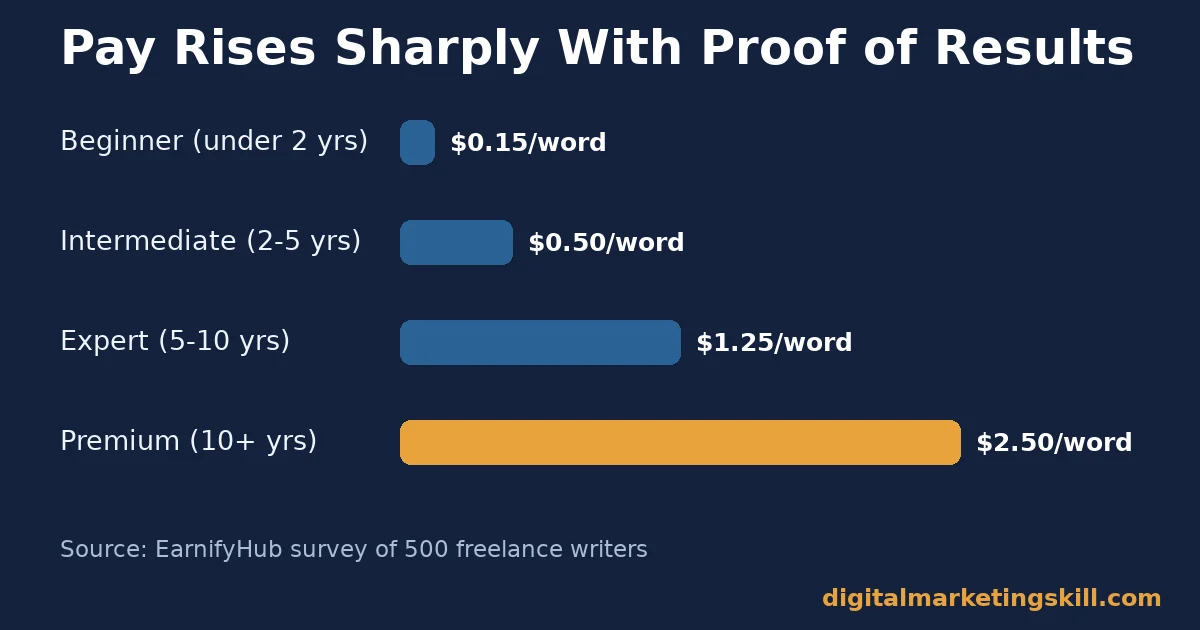
- Pay varies by a factor of 16. EarnifyHub’s survey of 500 freelance writers found beginners average $0.15 a word, while writers with a decade of experience average $2.50 or more.
- 97% of B2B marketers now run a formal content strategy, according to the Content Marketing Institute’s survey of 1,015 marketers, so demand for the skill is not the bottleneck.
- US median pay for writers and authors is $76,910 a year, per the Bureau of Labor Statistics, though this figure blends staff and freelance roles and is US-only.
- Length alone does not win rankings. Backlinko’s analysis of 11.8 million search results put the average Google top-10 page at 1,447 words, far short of the “10,000-word guide” advice repeated online.
- Google’s own quality guidance names four things that separate ranking content from the rest: effort, originality, skill, and accuracy, not word count.
In this guide
- The Income Gap Nobody Mentions
- How Website Content Writer Pay Actually Gets Set
- What Differs by Content Type
- How to Produce Each Type Well
- Measuring Progress as a Website Content Writer
- Mistakes That Slow Down New Website Content Writers
- The One Decision Rule for Picking a Writing Niche
- Is This a Real Career, or Just Gig Work?
- A Real Case: What a Growing Writing Business Looks Like
- Frequently Asked Questions About Becoming a Website Content Writer
- Where to Build the Skills Behind Website Content Writing
The Income Gap Nobody Mentions
Search “become a website content writer” and you will find two extremes. One says you can earn a full income within a month. The other says writing never pays enough to live on. Both ignore the real driver: experience and specialization, not the job title itself.
EarnifyHub’s survey of 500 freelance writers found beginners under two years of experience average $0.15 a word. Writers with five to ten years average $1.25. Premium writers with a decade or more average $2.50 or higher. That is not a motivational gap, because the opportunity is real for both groups. It is a skills and proof gap instead, and it closes the same way in every writing niche: real published work that generated a measurable result. Our guide on how to build a freelance writing career covers that proof-building process step by step.
How Website Content Writer Pay Actually Gets Set
Demand for the skill is not the problem. The Content Marketing Institute’s survey of 1,015 B2B marketers found that 97% now run a formal content strategy, and 61% report their content marketing has gotten more effective over the past year. The bottleneck for most new writers is not finding clients who want content. It is proving you can deliver it well enough to be worth a competitive rate.
Three factors set the rate for any content writing job: subject complexity, proof of results, and who is paying. A general blog post pays less than a technical explainer in finance or software, because fewer writers can do the second one credibly. Clients pay a premium for that scarcity.
Proof of results matters more than years in the job. A writer with two published case studies showing traffic growth usually out-earns a writer with five years of unproven output, because clients cannot see years of experience directly. They can, however, see a result. Clients are buying an outcome, not a word count.
Rejection is part of the early stage for almost every website content writer, and it rarely reflects writing quality. Most unanswered pitches come down to timing or budget, not the quality of the sample sent. Treat a string of no-replies as a numbers problem to solve with more outreach, not a signal to second-guess the writing itself.
A short, specific pitch beats a long, generic one almost every time. Name the exact page or section you would write, mention one concrete idea for it, and keep the whole message under 150 words. A client scanning a full inbox will read a short, relevant pitch before a long one that could apply to any business.
Who pays also shifts the number. A small local business and a venture-backed software company both need a website content writer, but their budgets differ by an order of magnitude, even for similar work. Positioning yourself for clients who can actually afford expert rates is part of the job, not separate from it. If you are weighing platforms to find those clients, see our comparison of freelance marketplaces.
What Differs by Content Type
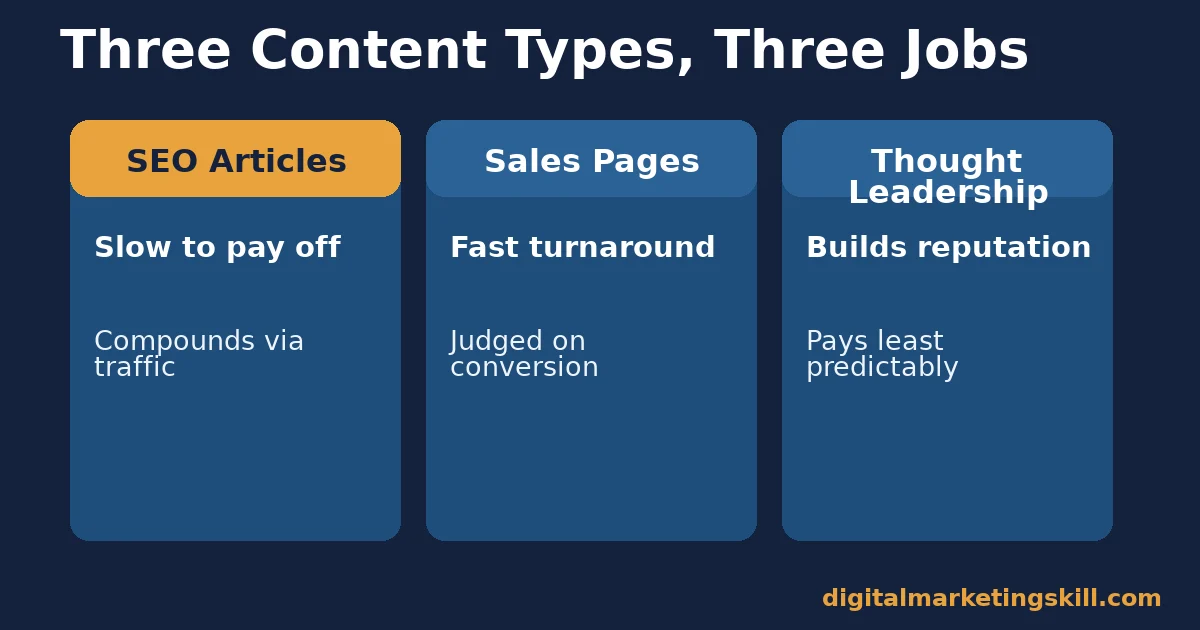
Not all website content pays or performs the same way. Three formats cover most of the work available to a website content writer, and each rewards a different skill. Picking the wrong format for your strengths is a common reason a skilled writer still struggles to land work, even while a less polished writer in a better-matched format gets hired repeatedly.
SEO Articles: Built For Search Traffic, Not Speed
SEO articles target a specific search query and aim to rank in Google. They take the longest to show results, often months. The content has to be crawled, indexed, and judged against competitors before it earns any traffic.
This format rewards research and structure over clever phrasing. A plain, well-organized answer to the reader’s actual question usually outperforms persuasive writing that buries the answer. It also keeps paying long after publication: HubSpot’s own attribution data shows 76% of its monthly blog views and 92% of its monthly leads come from posts published before that month, not new ones.
Sales Pages: Built For Conversion, Not Traffic
Sales and landing pages do not need to rank. Instead, they need to convert a visitor who already arrived through an ad, email, or referral. Speed to publish matters more here, since a campaign often launches on a deadline, and a page that is a week late can miss the entire promotional window it was written for.
This format rewards clear calls to action and specific claims over generic enthusiasm. A reader deciding whether to buy responds to a concrete reason, not an adjective.
Thought Leadership: Built For Trust, Not Immediate Sales
Thought leadership content, like opinion pieces and original research write-ups, builds an author or brand’s reputation over time. It rarely drives an immediate action. It pays less predictably but compounds the most for a writer who sticks with one niche.
This format rewards an actual point of view and named evidence over neutral summarizing. A piece that just restates common advice has little reason to be shared or cited.
How to Produce Each Type Well
Knowing the formats is not the same as writing them well. Here is what separates content that performs in each category.
SEO Articles: Lead With the Direct Answer
Answer the reader’s question in the first two sentences, then back up that answer with specifics. Google’s guidance names originality and accuracy as two of its four main quality signals. Every claim needs a reason behind it, not just a statement. Length does not need to chase a target. Backlinko found the average top-10 page runs 1,447 words, far shorter than most “ultimate guide” advice suggests.
Sales Pages: Lead With a Specific, Checkable Claim
Replace vague claims with numbers, names, or timeframes wherever you can. “Fast shipping” says nothing. “Ships within 24 hours” gives the reader something to evaluate and trust. Write the call-to-action button text to name the action and the benefit together, not just “Submit” or “Learn More.”
Thought Leadership: Lead With a Real Position
State an actual opinion, instead of a balanced summary of everyone else’s opinion. Readers and editors can tell the difference. A writer repeating common wisdom reads differently from one who has formed a specific view from direct experience or original research, because the second version contains detail nobody else would think to include.
Measuring Progress as a Website Content Writer
Four numbers tell you whether your content writing work is actually improving, beyond how it feels to write.
- Rate per word or per hour: track this over time against your own history, instead of a generic benchmark. A rising rate on repeat clients is the clearest sign your proof of results is working.
- Client retention: the share of clients who hire you again without being asked. Repeat work is cheaper to win than new work, so a high retention rate also means less time spent pitching.
- Published portfolio growth: the count of live, public pieces you can point a new client to. A portfolio of three strong, diverse pieces usually outperforms a portfolio of twenty thin ones. Our guide to building a marketing portfolio with no experience covers how to get those first pieces published.
- Reader or ranking outcome: traffic, conversion, or ranking movement on pieces where you have access to that data. This is the number that justifies a rate increase, so ask clients for it even when they do not offer it proactively.
Mistakes That Slow Down New Website Content Writers
Three mistakes account for most of the slow starts in this field. The first is pitching every client the same generic message. It reads as mass-produced, and most clients can tell within a sentence.
The second is pricing by guesswork instead of checking actual market data. A writer who sets a rate purely on what feels comfortable often leaves money on the table, or prices themselves out of work entirely without realizing which direction the error runs. The third is avoiding niches that pay well because they sound intimidating. Finance, software, and healthcare content pay more precisely because fewer writers are willing to learn the subject matter well enough to write it accurately.
The One Decision Rule for Picking a Writing Niche
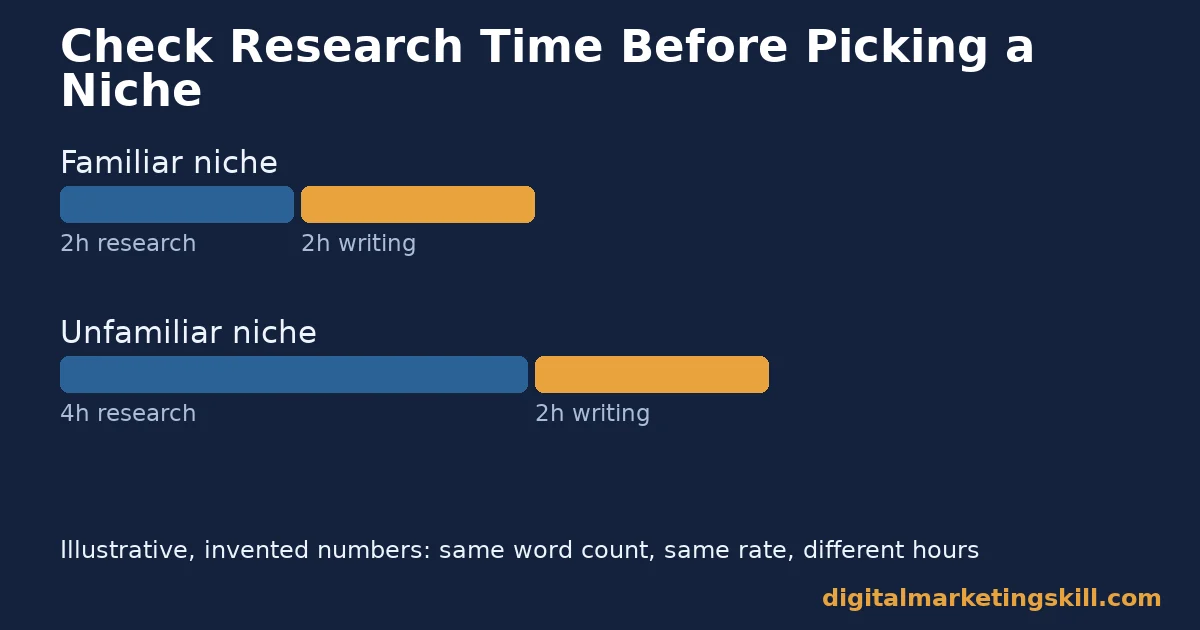
Before committing to a niche, check one thing: can you write about it accurately without research taking longer than the writing itself? If every sentence requires a new search to verify a basic fact, the niche is not yet a fit. That is true no matter how well it pays on paper.
Illustrative, invented numbers: a writer fluent in digital marketing can draft a 1,200-word article in about two hours. The same writer attempting a medical explainer might spend four hours on research alone before writing a word. The word count and rate stay about the same. The marketing piece pays more per hour worked, even at a lower headline rate, because the expertise is already there.
Is This a Real Career, or Just Gig Work?
Both, depending on how you structure it. In the US, the Bureau of Labor Statistics puts the median annual wage for writers and authors at $76,910, a figure that blends staff roles, freelance income, and part-time work, and is US-only. About 11,900 openings get projected each year, mostly from people leaving the field rather than new growth, since overall employment in the category is projected to stay flat.
That flat growth number undersells the actual opportunity for a website content writer, because most of this work happens outside traditional employment. A business that would never post a job listing for “staff writer” will still pay a freelancer to write its website pages, and that demand does not show up in BLS employment figures at all. Treat the freelance route and the staff route as two different paths to the same skill, not competing options.
A staff role trades flexibility for stability: steady pay, benefits in some countries, and usually a narrower scope of writing tied to one brand. Freelancing trades that stability for control over your clients, your niche, and your rate. Neither path is strictly better. The right choice depends on whether you value predictable income or the ability to raise your own rate as your proof of results grows.
A Real Case: What a Growing Writing Business Looks Like
Illustrative, invented numbers, not a real result: picture a writer starting at $0.15 a word on general blog posts. After six months of consistent delivery, the writer has two published pieces that visibly grew a client’s organic traffic. They raise their rate to $0.35 and start turning away low-budget requests. The jump is not a lucky break. It is the direct result of having concrete, checkable proof to show a new client. That is exactly the gap between beginner and intermediate rates in the EarnifyHub data above.
Frequently Asked Questions About Becoming a Website Content Writer
Do I need a degree to become a website content writer?
No. Clients care about published, checkable work and results, not credentials. A strong portfolio of three to five pieces carries more weight than a writing degree on its own, especially with some evidence of performance attached.
How long does it take to start earning as a website content writer?
Expect your first paid piece within a few weeks if you actively pitch. A livable rate usually takes six months to a year of consistent work. The EarnifyHub data shows the real jump happens between beginner and intermediate experience, not overnight.
Is SEO knowledge required to be a website content writer?
It is not required for every writing job, but it significantly expands which jobs you qualify for. Most clients hiring for website content specifically want pages that can also rank. Basic keyword research and on-page structure are expected skills now, not bonus ones.
How many words should a typical web page or article be?
There is no fixed target. Backlinko’s data shows the average Google top-10 result runs 1,447 words. Word count is a byproduct of covering the topic completely, not a goal in itself. Write until the reader’s question is fully answered, then stop.
Should I specialize in one niche or write generally?
Specializing almost always pays better once you have enough work to sustain it. A specialist can write faster, charge more, and build a stronger portfolio in less time than a generalist covering unrelated topics. Expertise compounds within a niche and resets with every new one you add.
Do I need to write every day to improve as a website content writer?
Consistency matters more than daily volume. Three focused, well-researched pieces a week will improve your writing faster than seven rushed ones. Quality feedback on a smaller volume of work teaches you more than quantity alone, especially early on when you are still building core habits.
What tools do professional website content writers actually use?
A grammar checker, a keyword research tool, and a simple way to track drafts and feedback cover most of the job. If sales pages are part of your work, our guide to copywriting fundamentals is worth pairing with this one. The tools matter far less than the research and structure habits behind the writing. A writer with strong habits and basic tools consistently outperforms one with expensive tools and weak research.
Can I update old content instead of always writing new pieces?
Yes, and it is often a better use of time than it sounds. HubSpot’s own data shows most of its traffic and leads come from posts published months or years earlier, not new ones, and updating those older posts lifted their organic views by over 100% on average. Offering a content audit and refresh service is a realistic way for a website content writer to add value beyond writing from scratch.
Where to Build the Skills Behind Website Content Writing
Website content writing works best paired with the SEO and strategy skills that make the writing actually perform. The Digital Marketing Skill Institute’s Master Diploma in Digital & AI Marketing teaches this directly through its AI-Powered WordPress and SEO Specialist track, or through the Full Stack option covering all four AI-powered tracks and ten courses.
Every track includes unlimited 1-on-1 coaching and mentoring, plus a U.S. Project Internship with a verified U.S. Work Reference Letter. The diploma is dual US and UK accredited, recognised in more than 100 countries, and studied 100% online wherever you live in your country. If you want a structured path instead of learning the skill alone, apply to the Master Diploma program. You can also review the full program structure, browse more guides on the digital marketing blog, or read real outcomes on the reviews page. Learn more at digitalmarketingskill.com, or start your application at digitalmarketingskill.com today.
Every figure in this guide was checked against its original source before publication. Figures marked as illustrative are invented examples, not real results.
