
AI in digital marketing means using machine learning, natural language processing and automation to forecast customer behavior, personalize messages, and speed up content and ad production. Most teams already use it somewhere. But recent survey data shows a wide gap between using AI and actually getting value from it. This guide shows where that gap opens, and how to close it.
Key Takeaways
- 75% of marketers have adopted AI for marketing tasks such as personalizing content, predicting performance or generating visuals. Yet 84% admit their campaigns are still generic, one-way sends (Salesforce State of Marketing, 4,450 marketers).
- Among B2B marketers who already use AI for content, 87% report higher productivity using AI for content, and 58% say the quality improved too. But getting that content to prompt real action is still their top challenge (Content Marketing Institute / MarketingProfs).
- Pages where AI wrote most of the text rank about as often among top results as fully human pages. Still, pages that leaned less on AI earned 2-3x more search impressions for less AI-heavy pages, in Ahrefs’ analysis of 331,000 pages (Ahrefs).
- About 18% of sampled Google searches now show an AI Overview. People click a standard blue link less often once one shows up (Pew Research Center, US-only panel).
- 94% of marketers plan to use AI in content creation (HubSpot State of Marketing). That is exactly why editors who can catch and fix bad AI output are becoming more valuable than the tools themselves.
In this guide
- Why Most AI In Digital Marketing Advice Misses The Point
- How AI Actually Works Inside A Marketing Stack
- What Differs By Marketing Function
- How To Lead With AI In Each Function
- How To Measure Whether AI Is Actually Helping
- The One Decision Rule For Where To Start With AI
- A Real Case: Learning AI Marketing Skills Before Buying Tools
- Common Mistakes When Adopting AI In Digital Marketing
- Frequently Asked Questions About AI In Digital Marketing
- Where To Build Real AI In Digital Marketing Skills
Why Most AI In Digital Marketing Advice Misses The Point
Most articles about AI in digital marketing are tool roundups. They name twenty apps, promise a shortcut, and stop there. What they skip is the part the newest survey data keeps surfacing: adoption is not the same thing as value.
Salesforce’s Tenth Edition State of Marketing report, built from 4,450 marketing decision-makers across North America, Latin America, Asia-Pacific and Europe, found that 75% of marketers have adopted AI. They use it to personalize content, predict campaign performance, or generate visuals. Despite that, 84% of those same marketers admit they still send generic, one-way campaigns. The tool arrived before the workflow that makes it useful.
So treat everything below as an informed inference from named studies, not a settled playbook. Survey figures here are self-reported. Several lean toward larger organizations. A platform’s own usage numbers describe its customers, not the whole market. Where a figure is US-only or vendor-funded, this guide says so, because that changes how much weight it deserves.
How AI Actually Works Inside A Marketing Stack
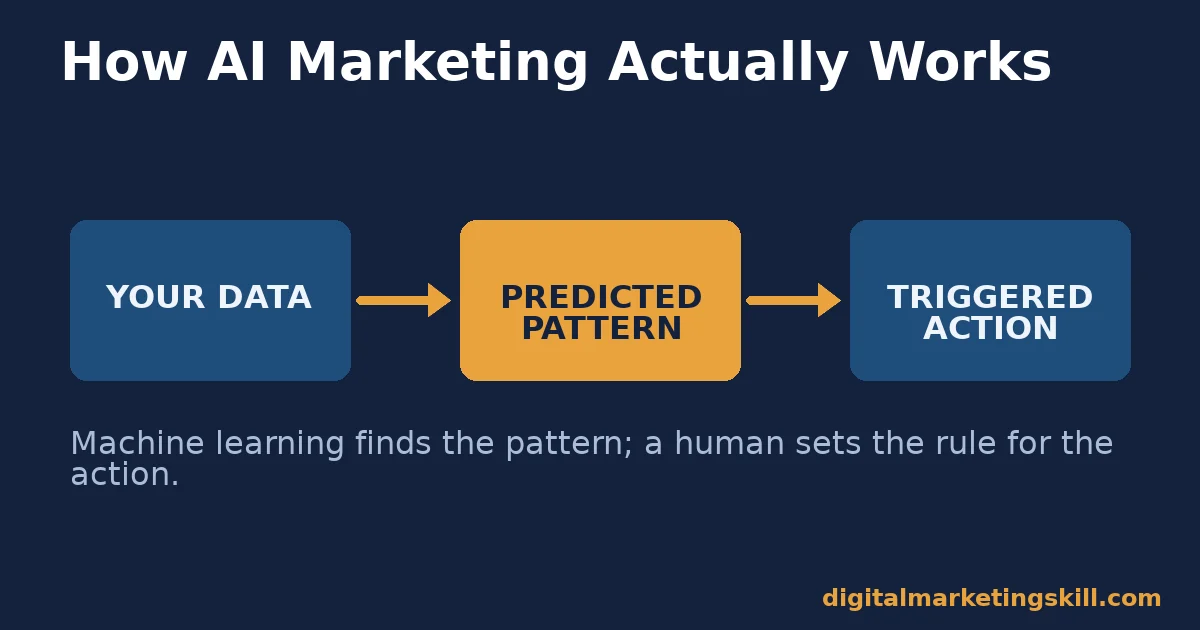
Strip away the branding, and AI in marketing does three things. It reads patterns in data you already have. It predicts an outcome from those patterns. Then it triggers an action based on that prediction. Each part has a plain-word name worth knowing.
The Three Moving Parts
Machine learning is software that improves its predictions as it sees more examples. It does not just follow a fixed set of rules you wrote by hand.
Natural language processing, or NLP, is the branch that lets software read or write ordinary sentences. That is what powers chatbots, subject-line suggestions and auto-generated ad copy.
Predictive analytics is the step that turns pattern-reading into a forecast. One common example is scoring which leads are likely to convert this month.
None of these three parts replace strategy. A model can tell you which 500 leads look most like your best past customers. It cannot tell you whether your product actually solves their problem. And it will confidently rank the wrong 500 leads if the historical data it learned from was biased or thin.
Why Automation Still Needs A Human Decision Rule
Automation without a rule just repeats whatever the model learned, mistakes included, at scale. A marketer who sets the rule keeps control of the outcome. One useful example: “pause any AI-written ad variant that drops conversion rate more than 15% for three straight days.” That single sentence turns a black box into something a human can audit.
What Differs By Marketing Function
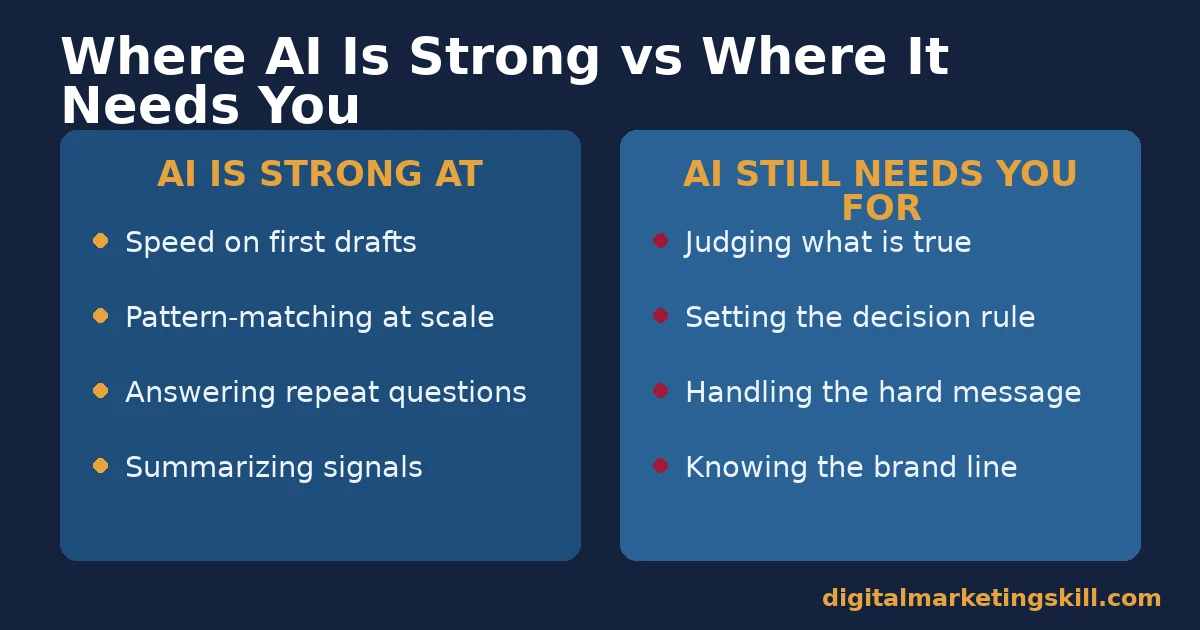
AI does not help every function the same way. Five areas show the clearest split between where AI in digital marketing is strong, and where it still needs a human hand.
Content Production: Built For Speed, Not Judgment
AI is genuinely fast at first drafts, subject lines, meta descriptions, and repurposing one piece of content into five formats. Among B2B marketers who already use AI for content, Content Marketing Institute and MarketingProfs found that 87% report higher productivity, and 58% say quality also improved.
But the same research lists prompting the reader to actually act as the top content challenge for 40% of these marketers, ahead of resources or measuring results. Speed does not fix a weak argument. It just produces the weak argument faster.
Paid Media: Built For Pattern-Matching At Scale
Ad platforms use AI to test creative variants, shift budget toward winning combinations, and bid in real time across thousands of auctions a minute. That is a scale no manual bidder can match. What it cannot do on its own is know your margin, your brand red lines, or which “winning” variant is actually attracting the wrong customer. That judgment still sits with the marketer who built the campaign.
Ahrefs’ search traffic study, covering roughly 14 billion pages, found that 96.55% of pages get zero traffic from Google. Raw automation without a strategy behind it still produces mostly ignored output, whether that output is an ad or a page.
Customer Service: Built For Coverage, Not Empathy
Chatbots and AI-assisted support mainly exist to answer repetitive questions instantly, any hour, in multiple languages. That lets a small team cover a global inbox. They are weaker at the handful of messages that need patience, judgment, or an apology that sounds genuinely human. That is exactly where a fast handoff to a person protects the relationship.
SEO And Search: Built For Signals, Not Ranking Guarantees
Search engines increasingly summarize answers directly in the results. Pew Research Center’s panel found AI summaries appeared on roughly 18% of the sampled Google searches it tracked. People clicked a traditional result less often once a summary showed up.
That is a US-only, self-reported panel, not a global census. But the direction matches what most SEO teams already see: fewer guaranteed clicks even when a page ranks well. That raises the value of being the cited source inside the AI summary, not just the tenth blue link below it.
Email And Lifecycle: Built For Personalization At Scale
Email platforms now use AI to pick send times, write subject-line variants, and sort subscribers into lifecycle stages automatically. That is useful because a human cannot realistically hand-segment a list of fifty thousand people every week. The risk is that AI-personalized email can still feel mass-produced if every message leans on the same three content templates behind the scenes.
How To Lead With AI In Each Function
Once you know where AI is strong and where it is not, the fix in each function is usually a sequencing change. It rarely needs a new tool.
Content Production: Lead With Editing, Not Drafting
Let AI produce the first draft, the outline, or ten headline options. Then put a skilled editor in charge of the version that actually publishes. Ahrefs’ review of about 331,000 pages and 100,000 search results found no ranking penalty for AI-assisted content. Pages where AI wrote 80% or more of the text still showed up among top results at a similar rate to the rest.
The same analysis found that pages leaning less on AI earned 2-3x more search impressions on average. That points to depth and originality mattering more than how the first draft got written.
Paid Media: Lead With The Decision Rule, Not The Algorithm
Write the pause, scale and kill rules before you turn on automated bidding, not after a budget has already run out. Decide in advance what “working” means in numbers, such as cost per qualified lead rather than just clicks. That way the algorithm optimizes for the outcome you actually want, instead of the easiest metric to move.
Customer Service: Lead With Escalation Paths
Design the handoff to a human before you launch the bot, not after customers start complaining. One simple rule works well: escalate after one failed resolution attempt, or any message containing a refund or complaint keyword. That keeps the speed of automation, without letting a frustrated customer get passed between bots.
SEO And Search: Lead With The Signals AI Can’t Fake
Google’s own guidance on helpful content warns that heavy, automated production across many unrelated topics is a warning sign, not a strategy. Original data, named case studies, and a clearly stated methodology are signals a generic AI summary cannot reproduce from a thin page.
Those signals are worth the extra time, even as AI writes more of the first draft. Google also now lists “optimizing for generative AI” as a standard service an SEO specialist can offer. That shows how fast AI in digital marketing has moved from a side skill to a core one.
Email And Lifecycle: Lead With Segment Rules, Not Send-All
Set the segmentation rule before you turn on AI send-time optimization, not after open rates start sliding. Decide which three or four lifecycle stages matter most, such as new subscriber, active buyer, and lapsed customer, and let AI fine-tune timing and subject lines inside each stage rather than across your whole list at once. That keeps personalization specific instead of cosmetic.
How To Measure Whether AI Is Actually Helping
Four numbers tell you more than a dozen vanity metrics about whether AI in digital marketing is actually paying off inside your stack.
Content lift. This is the change in organic traffic or engagement on AI-assisted pages, compared with your historical average for similarly scoped pages. Measure it over at least one full quarter, so seasonal noise does not distort the picture.
Deflection rate without a CSAT drop. This is the share of support conversations a bot resolves without human help, tracked next to customer satisfaction. A rising deflection rate paired with falling satisfaction means the bot is closing tickets, not solving problems.
Cost per qualified lead over time. Do not track cost per lead alone. AI targeting can cut cost per lead while quietly lowering lead quality, so track the two side by side.
Zero-click impact on organic KPIs. Watch brand searches, direct traffic, and citations inside AI answers. A page can lose clicks to an AI summary while still doing its job, if it is the source the summary actually names.
The One Decision Rule For Where To Start With AI
If you can only adopt AI in one place first, start wherever a task is both high-volume and low-judgment. Do not start wherever a vendor demo looked most impressive. High volume means you do the task often enough that small time savings add up. Low judgment means a wrong output is cheap and easy to catch before it ever reaches a customer.
Illustrative, invented numbers: picture a 10-person marketing team that writes 40 social captions a week. That task is high volume and low judgment, since each caption is quick to check.
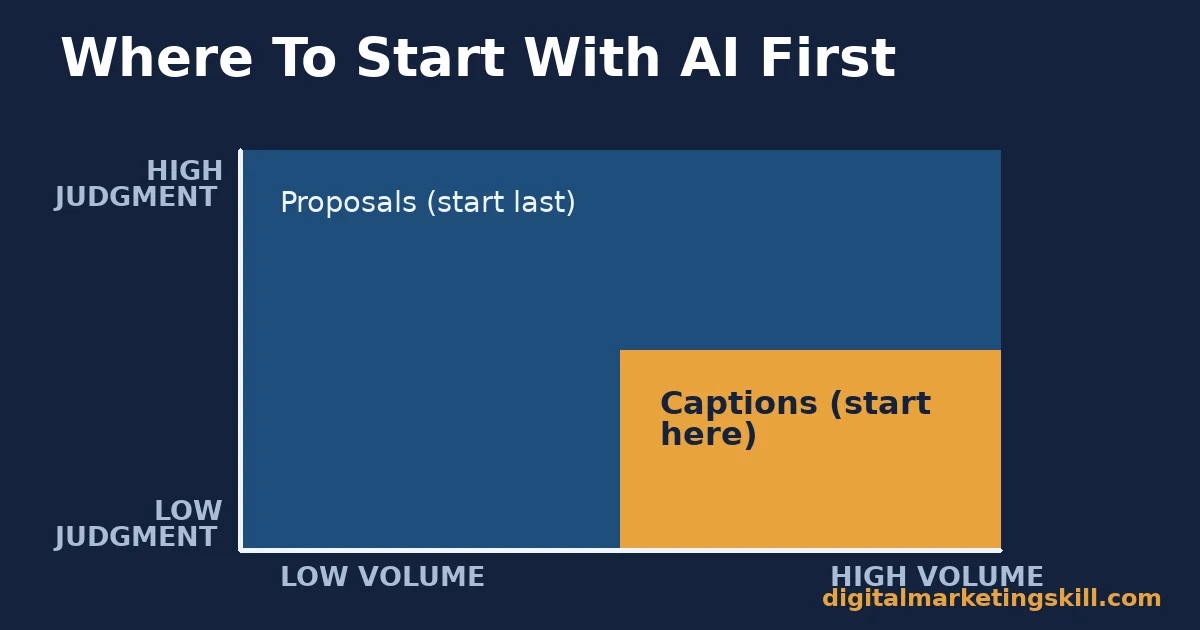
The same team also handles 40 enterprise sales proposals a quarter. That task is low volume and high judgment, since one mistake there is costly. The captions are the better first project for AI in digital marketing. The proposals are the worse one, even though AI could technically draft both.
A Real Case: Learning AI Marketing Skills Before Buying Tools
Tool subscriptions are not the only way into AI marketing. Skills matter just as much, sometimes more. One Digital Marketing Skill Institute graduate, Kofi B., put it this way about landing a remote marketing role in Canada: “What won me the remote role in Canada was my AI marketing knowledge. I could do the work of a 3-person team.”
That is one published, individual account, not a guaranteed outcome. Results vary by market, effort and employer; see the earnings disclaimer for full context. The pattern worth noting is simple: the advantage came from knowing how to direct AI tools inside real marketing tasks, not from owning more of them.
Common Mistakes When Adopting AI In Digital Marketing
Three mistakes show up again and again once a team starts using AI in digital marketing, and each one is avoidable with a small process change.
Mistake: Skipping The Decision Rule
Teams turn on automation first and write the rules later, usually after something has already gone wrong. Write the pause, escalate and review rules before launch, not after a customer complains or a budget overspends.
Mistake: Measuring Volume, Not Quality
It is tempting to celebrate “we published three times as much content” without checking whether any of it ranks, converts, or gets read past the first paragraph. Pair every volume metric with a quality metric, such as the content lift or deflection rate described above.
Mistake: Treating Every Task The Same Way
Not every task deserves the same level of AI involvement. A high-judgment task, like responding to a major client complaint, needs a different balance of AI and human input than a low-judgment task, like generating ten subject-line options to test.
Frequently Asked Questions About AI In Digital Marketing
What is AI in digital marketing?
AI in digital marketing is the use of machine learning, natural language processing and automated decisioning to analyze customer data, personalize messages, and speed up tasks like content drafting, ad bidding and customer support. It usually works best alongside a person who sets the rules and checks the output.
Will AI replace digital marketers?
Not based on current adoption data. Salesforce’s survey found that most marketers already use AI, yet still run generic campaigns. That suggests the bottleneck is strategy and data quality, not a shortage of AI tools, and that is work a person still has to direct. A deeper look at task-level evidence is in our AI and digital marketing jobs breakdown.
Which marketing tasks benefit most from AI right now?
High-volume, low-judgment tasks benefit first. Think first drafts, subject-line testing, basic customer questions, and real-time ad bid adjustments. Tasks that need judgment, empathy or brand risk assessment still need a person reviewing the output before it goes live.
Does Google penalize AI-written content?
No ranking penalty showed up in Ahrefs’ review of roughly 331,000 pages. Pages where AI wrote most of the text ranked at a similar rate to other pages. The same data found less AI-heavy pages earned more search impressions on average, which points to depth and originality as the deciding factor, not how the first draft was produced.
How do I start using AI in a small marketing team?
Pick one high-volume, low-judgment task first. Set a written decision rule for when a human reviews the output. Then measure the real KPI, whether that is cost per qualified lead, deflection rate against CSAT, or content lift, for a full quarter before you expand to a second task.
What tools are used for AI in digital marketing?
Common categories include AI writing assistants for first drafts, AI design tools for quick visuals, chatbot platforms for customer questions, and predictive analytics features built into most major ad and email platforms. The category matters more than the specific brand, since most tools inside a category run on similar underlying models.
How is AI changing search engine optimization?
Search results increasingly show an AI-generated summary before the normal list of links, which can reduce clicks even to well-ranked pages. The practical response is to earn a place as the cited source inside that summary, through original data and clear methodology, while still following the fundamentals in our search engine optimization guide.
Is it expensive to start using AI in digital marketing?
No. Many starting points are free or nearly free, such as a chatbot’s free tier or the AI features already built into your existing email or ad platform. The real cost is usually time, since someone has to set the decision rules and review the output, not the software subscription itself.
Do I need a data scientist to use AI in digital marketing?
No, not for most of the tasks in this guide. Writing assistants, chatbot builders, and the AI features inside ad and email platforms are built for marketers, not engineers. A data scientist becomes useful once you want to build a custom model from your own raw data, which is a later, more advanced step for most teams running AI in digital marketing day to day.
Where To Build Real AI In Digital Marketing Skills
AI changes faster than any single tool tutorial can keep up with. That is why the more durable skill is knowing how to direct it inside a real marketing function, not memorizing today’s interface. Pair that skill with the fundamentals of content creation and email marketing, and AI becomes a force multiplier instead of a shortcut that quietly produces weak work.
What The Master Diploma Covers
The Digital Marketing Skill Institute’s Master Diploma in Digital & AI Marketing is built around that idea. It offers four AI-powered tracks: AI-Powered Social Media Management and Advertising, AI-Powered Lead Generation and Email Automation, AI-Powered Google Specialist, and AI-Powered WordPress and SEO Specialist. All four are drawn from ten execution-first courses, with a Full Stack option for completing all four tracks.
The program adds unlimited 1-on-1 coaching and mentoring, plus a U.S. Project Internship with a verified U.S. Work Reference Letter. It carries dual US and UK accreditation, recognised in more than 100 countries. It also runs 100% online, so you can build these skills anywhere in your country.
Explore the full curriculum on the Master Diploma program page. You can also browse more breakdowns like this one on the digital marketing blog, or read graduate outcomes on the reviews page. When you are ready, apply here.
Wherever you live, the skill that compounds fastest is directing AI well, not just having access to it. You can start building that skill today at Digital Marketing Skill Institute.
Every figure in this guide was checked against its original source before publication. Figures marked as illustrative are invented examples, not real results.
