Free SEO tools can replace most paid software for a small or mid-sized site. This guide names the free SEO tools worth using for keyword research, technical audits and speed checks, explains what each one actually catches, and shows how to read the data instead of just collecting numbers.
Key Takeaways
- Most content is never found. Ahrefs analysed about 14 billion pages. It found that 96.55% get zero traffic from Google. A free keyword research tool is not optional; it is the first job.
- Google defines “fast” in exact numbers. Its Core Web Vitals standard sets three thresholds: Largest Contentful Paint at 2.5 seconds or less, Interaction to Next Paint at 200 milliseconds or less, and Cumulative Layout Shift at 0.1 or less. Google checks each one at the 75th percentile of visits.
- A free crawler goes a long way. Screaming Frog’s free licence crawls up to 500 URLs. It still includes broken-link checks, duplicate-content detection and integrations with Google Analytics, Search Console and PageSpeed Insights.
- Search Console is the direct channel to Google. Google’s own support documentation calls it a free service for monitoring indexing, mobile usability, Core Web Vitals and manual actions on your site.
- Free tools solved a real traffic drop. After a major content update hurt rankings, the recipe site The Kitchn used Search Console data alone to find 200 underperforming pages. It then prioritised the 40 with the most historical traffic.
In this guide
- What Most “Best Free SEO Tools” Lists Get Wrong
- Where Free SEO Tools Fit in Your Workflow
- Free SEO Tools Do Four Different Jobs
- How to Use Each Tool Type Well
- How to Measure Whether Your SEO Tools Are Working
- The One Decision Rule: Fix What the Data Already Shows You
- A Real Case: How The Kitchn Used Search Console Alone
- Frequently Asked Questions About Free SEO Tools
- Start With the Tool That Answers Today’s Question
- Turn This Skill Into a Career
What Most “Best Free SEO Tools” Lists Get Wrong
Most roundups of free SEO tools are just long lists. Twenty names, one line each. No sense of which tool solves which problem. That approach treats every tool as interchangeable. In fact, each one answers one narrow question.
This guide groups free SEO tools by the job they do, not by category labels. It names where each tool’s free tier stops, so later you are not surprised. It also walks through a real case where free tools alone solved a traffic problem, then gives one decision rule for choosing what to use first.
A few ground rules first. The Ahrefs figure below comes from the company’s own study of its index, with its own stated limits attached. The Core Web Vitals numbers are Google’s published standard, not a one-off study, so they do not expire. Free tools change their limits often, though, so check each pricing page before you build a workflow around one.
One more ground rule matters here. A tool’s free tier today is not a permanent promise. Companies change free-plan limits, sometimes without much notice, when pricing strategy shifts. Build your workflow around the job a tool does, not the brand name. Switching later then costs you far less.
Where Free SEO Tools Fit in Your Workflow
SEO work breaks into four repeatable jobs. Find what people search for. Check that search engines can crawl and index your pages. Make pages fast enough to keep visitors. Measure whether any of it worked. Free SEO tools cover all four jobs reasonably well for a single site.
Free tools struggle at scale and depth. Crawling thousands of URLs, tracking competitor backlinks over time, or automating reports across many clients: that is where paid software earns its price. For one site, though, a stack of free SEO tools can carry almost the entire workflow.
What a Free Plan Usually Leaves Out
Free tiers tend to cap one of three things: how many URLs you can crawl, how much historical data you can see, or how often you can run a check. Screaming Frog’s free licence, for example, stops at 500 crawled URLs. That is plenty for a small site and too little for a large one.
Knowing the cap in advance saves wasted time. If your site has 2,000 indexed pages, plan to crawl it in sections, or accept that you will only ever audit your most important pages. Either plan beats discovering the limit mid-audit.
Free SEO Tools Do Four Different Jobs
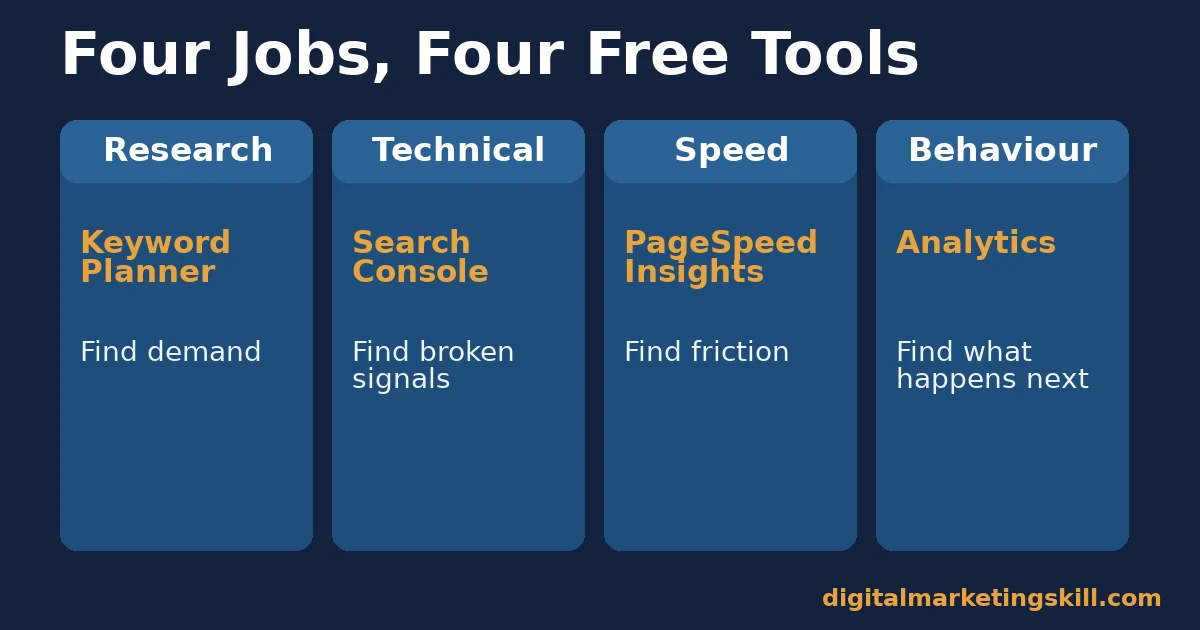
Four jobs account for most of what a small site needs: finding what to write about, finding what is broken, finding what is slow, and finding what happens after someone clicks through. A specific tool handles each job well. Ask that tool to do a different job, and it usually fails.
Keyword Research Tools: Built to Find Demand
Google’s own Keyword Planner surfaces search volume ranges and related terms, straight from Google’s own search data, for anyone with a free Google Ads account. Advertisers built it for ad campaigns, so volume ranges can be wide and some terms get grouped together. Even so, as a free starting point for topic demand, nothing else quite replaces it.
Google Trends does a narrower job. It shows whether interest in a topic is rising, flat or falling, and lets you compare two or more terms over time. It does not report raw volume, though, so pair it with Keyword Planner rather than using it alone.
Both tools matter because most published content never gets found at all. Ahrefs studied roughly 14 billion pages in its search traffic study. It found that 96.55% get zero monthly traffic from Google. Another 1.94% get ten visits or fewer.
The study names its own limits. Its sample skews toward higher-quality pages already in Ahrefs’ index. Traffic estimates come from a database of roughly 651 million keywords, so very obscure searches likely go undercounted. Even with those limits, the gap is wide enough to make keyword research a first step, not an afterthought.
Technical Audit Tools: Built to Find Broken Signals
Screaming Frog’s SEO Spider crawls a site the way a search engine does. It surfaces broken links, duplicate titles, missing meta descriptions and redirect chains. The free licence covers most of this for up to 500 URLs, with JavaScript rendering and built-in links to Google Analytics, Search Console and PageSpeed Insights.
Google Search Console shows what Google itself sees: which pages it has indexed, why it excluded others, whether it detected your structured data, and whether it issued a manual action against your site. A crawler shows you your site. Search Console shows you Google’s view of your site. The two views do not always match.
Speed Tools: Built to Find Friction
PageSpeed Insights scores a single URL against Google’s Core Web Vitals and lists the specific fixes behind a low score, such as oversized images or render-blocking scripts. It combines lab data (a simulated test) with real visitor data from the Chrome User Experience Report, wherever enough visits exist.
Google’s own definition of Core Web Vitals sets three thresholds. Largest Contentful Paint should sit at 2.5 seconds or less. Interaction to Next Paint should sit at 200 milliseconds or less. Cumulative Layout Shift should sit at 0.1 or less. Google judges each one at the 75th percentile of a page’s visits, and every free or paid speed tool ultimately checks your page against these same three numbers.
Analytics Tools: Built to Find What Happens After the Click
Google Analytics rounds out the free SEO tools stack by picking up where the other three leave off. It is built to show what a visitor does once they land, not just whether they land at all. Google Analytics counts a session as engaged when it lasts longer than 10 seconds, includes a key event, or includes two or more page views. Engagement rate then becomes a direct read on whether a page delivers on its promise.
Pair Analytics with the other free SEO tools rather than reading it alone. Search Console shows demand and visibility; Analytics shows what visitors did once they arrived. A page with rising impressions and a falling engagement rate is winning the click and losing the reader, which is a content problem, not a visibility problem.
How to Use Each Tool Type Well
A tool only helps once you point it at the question it was built to answer. The sections below mirror the four tool types above. Each one names the single change that matters most.
Keyword Research: Lead With Search Intent
Before you trust a volume number, open the actual search results for that term. If the top results are all product pages, a how-to guide will struggle to rank there, no matter how healthy the volume looks. Keyword Planner and Trends tell you demand exists. The results page tells you what format actually wins it.
Group related terms into one page instead of writing a thin page for each. Search engines already treat many close variants as the same intent, so splitting them usually dilutes a page rather than multiplying your reach.
Technical Audits: Lead With Crawlability
Run the crawl before you touch content. A page with a broken canonical tag or an accidental noindex gains nothing from better writing, because it was never going to rank in the first place. Fix crawl and indexing errors first. Move to on-page detail only after that.
Cross-check your crawler’s list against Search Console’s indexing report. A page can look fine to a crawler and still sit outside Google’s index for a reason only Search Console names, such as a canonical pointing elsewhere or a duplicate with no user-selected canonical.
Speed Checks: Lead With the Slowest Page
Test your highest-traffic page first, not your homepage out of habit. A slow page that already gets visits costs you more lost engagement every day than a slow page nobody reaches yet.
Fix the specific item PageSpeed Insights names, in the order it lists them, since the tool ranks suggestions by estimated impact. Then re-test after each change rather than guessing. Compressing one image rarely moves a score that is failing for a different reason, such as a render-blocking script.
Analytics: Lead With Engaged Sessions, Not Pageviews
Judge a page by its engagement rate before its raw pageview count. A page with heavy traffic and a weak engagement rate is usually winning clicks it cannot keep, often because the headline oversells the content or the first screen buries the answer.
Compare engagement rate across your top pages monthly, not daily; small swings are normal and daily checking mostly adds noise. When a page’s engagement rate drops after a content refresh, that is the clearest signal the rewrite moved the wrong lever.
How to Measure Whether Your SEO Tools Are Working
A tool only earns its place if it changes a number you can see. Track the handful below. Each is defined in one sentence, so you know what counting actually means before you judge progress.
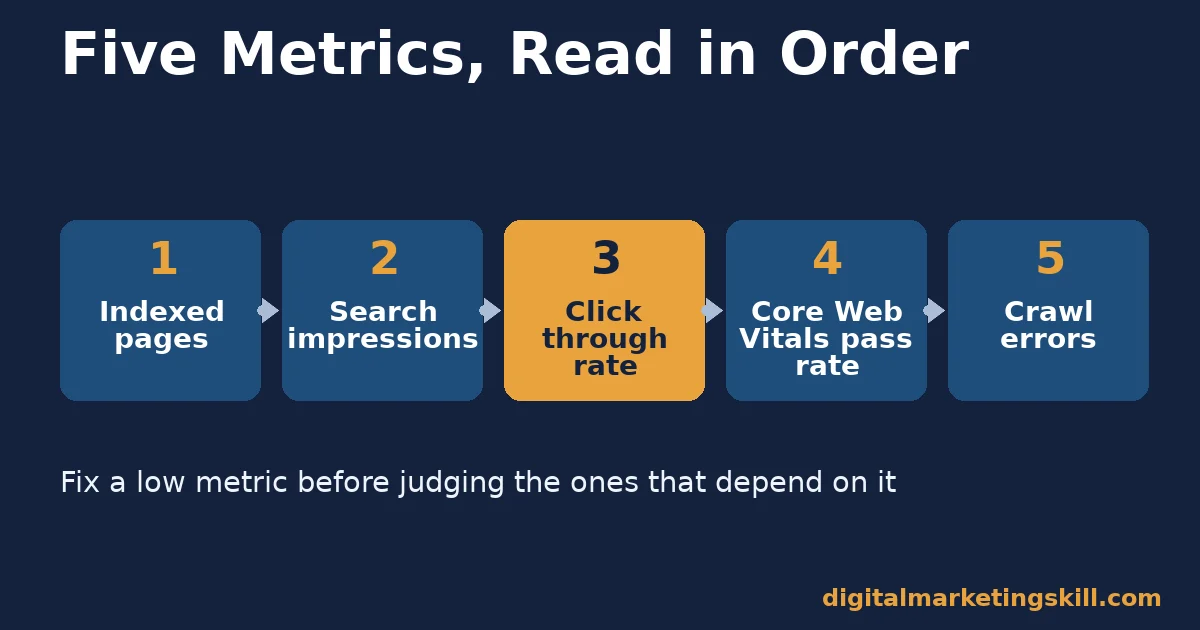
- Indexed pages. Search Console’s coverage report shows how many of your submitted pages it actually indexed, versus excluded, and names the exclusion reason for each one.
- Search impressions. This counts how many times any of your pages appeared in Google’s results, whether clicked or not. A rising count shows your keyword targeting is starting to match real searches.
- Click-through rate. Search Console divides clicks by impressions for each query. This shows whether your title and meta description persuade, once a page is already visible.
- Core Web Vitals pass rate. PageSpeed Insights reports whether a page clears all three Core Web Vitals thresholds at the 75th percentile. A failing page can still rank, but it fights itself to do so.
- Crawl errors. A free crawler’s error count (broken links, redirect chains, missing titles) should trend toward zero after each cleanup pass, not stay flat.
How to Read These Numbers Together
Read them in order of dependency. When indexed pages run low, nothing else on this list matters yet; the page is not even competing. When indexed pages look healthy but impressions sit flat, fix the targeting or the content. And when impressions look healthy but click-through rate is weak, rewrite the title and description first.
Check Core Web Vitals and crawl errors on a monthly cadence rather than after every edit. Both metrics move slowly, so checking more often just adds noise. For the content side of this same diagnose-first approach, our guide to building and measuring a content marketing strategy walks through the same order of operations.
The One Decision Rule: Fix What the Data Already Shows You
If you take one rule from this guide, make it this one. Open the free tool that already covers your site. Read what it is already telling you. Fix that before you add another tool. Most sites sit on unread warnings in Search Console, or an unresolved crawl error list, rather than missing a tool entirely.
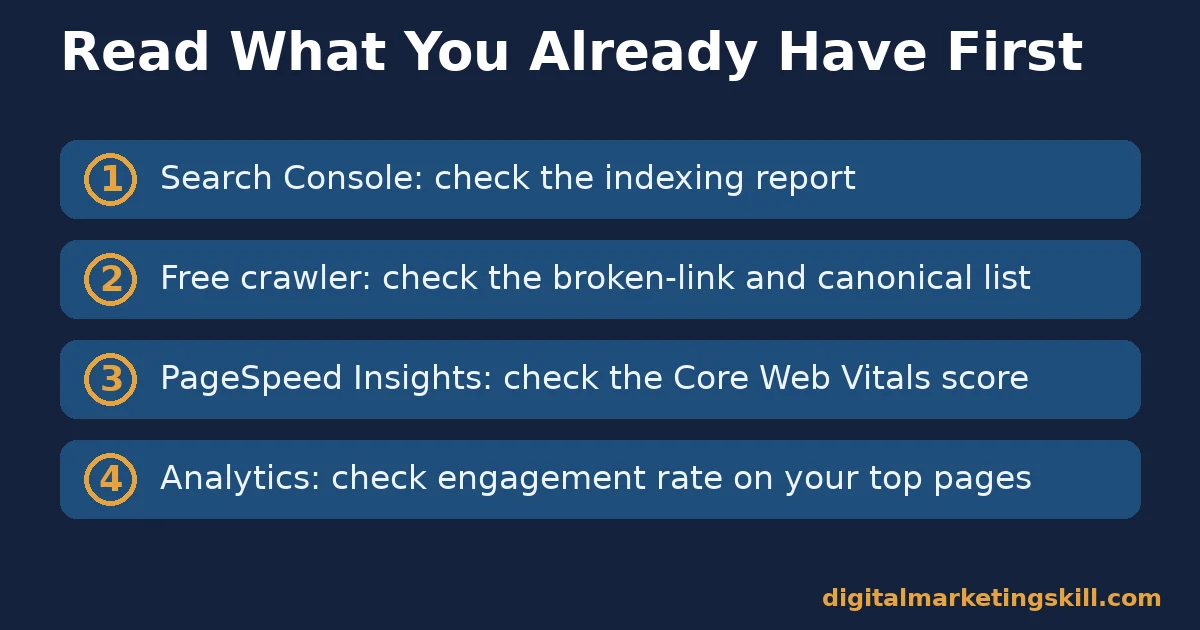
Here is an illustrative example, with invented numbers. A ten-page local-service site has never opened Search Console. A first look finds 3 pages excluded from the index, each flagged “duplicate, Google chose a different canonical.”
The same look finds a Core Web Vitals report showing the booking page failing Largest Contentful Paint at 4.1 seconds. The owner fixes the canonical tags and compresses one hero image, using tools that were already free and already installed. Both issues close inside a single afternoon.
The lesson is about order, not tooling. Buying a new tool before you read the one you already have usually just adds a second dashboard of unread warnings.
A Real Case: How The Kitchn Used Search Console Alone
The Kitchn, a recipe and food site, needed to recover traffic after one of Google’s broad content-quality updates cut visibility across the web. According to a write-up on the diagnosis published by Passionfruit, the site’s team used Search Console data alone to find around 200 pages underperforming against their own history.
The team did not try to fix all 200 pages at once. Instead, they prioritised the 40 pages with the highest historical traffic, on the logic that improving well-trafficked pages returns the most visibility per hour of work. That prioritisation step, choosing where to spend limited time, mattered as much as the audit itself.
Treat this as a model for the approach, not a guaranteed outcome. The write-up describes the diagnostic method, not a verified visitor count after the fix, and content updates affect different sites differently. The part worth copying is the method: use the free data you already have to rank problems by size before you fix any of them.
Frequently Asked Questions About Free SEO Tools
Are free SEO tools good enough for a small business?
Yes, for a single site. Google Search Console, Google Keyword Planner, PageSpeed Insights and a free-tier crawler cover keyword research, indexing, speed and technical errors without a subscription. Paid tools mainly add scale, competitor tracking over time and automated reporting.
What is the best free SEO tool for keyword research?
Google Keyword Planner is the most direct source, since it uses Google’s own search data and needs only a free Google Ads account. Pair it with Google Trends to see whether interest in a term is rising or falling.
Does Google have its own free SEO tools?
Yes. Google Search Console, Google Keyword Planner, PageSpeed Insights, Google Trends and Google Analytics are all free and built directly by Google, which also makes them a close read of how Google itself evaluates a site.
How many pages can I crawl for free?
Screaming Frog’s free licence crawls up to 500 URLs per site, which covers most small sites in a single run. Larger sites need either the paid licence or a crawl split across sections.
What do free SEO tools not do well?
Free tools rarely track competitor backlink growth over time, automate client-ready reports, or crawl sites with many thousands of pages in one pass. Those gaps are usually what paid SEO software is actually priced to close.
How often should I run a technical SEO audit?
A monthly crawl catches most new broken links and indexing issues before they compound. Check Core Web Vitals on the same cadence, since both move slowly and daily checks mostly add noise rather than insight.
Can I run an entire SEO strategy on free tools alone?
For one small or mid-sized site, largely yes. Google Search Console, Keyword Planner, PageSpeed Insights, Google Trends and Google Analytics cover research, technical health, speed and measurement. Agencies managing many sites, or sites needing deep competitor backlink tracking, are where paid tools start to pay for themselves.
Start With the Tool That Answers Today’s Question
Free SEO tools cover keyword research, technical audits, speed and measurement well enough to run an entire small-site SEO programme without a subscription. Pick the one question in front of you today. Open the free tool built for it. Fix what it already shows before you add another tool to the stack.
For the links that often follow stronger content, see our guide to quality backlinks without buying links. For the fundamentals, see our step-by-step SEO guide for beginners.
Turn This Skill Into a Career
If you want guided practice turning this kind of audit into a repeatable skill, Digital Marketing Skill Institute teaches it hands-on inside the Master Diploma in Digital & AI Marketing. Four AI-powered tracks make up the programme: AI-Powered Social Media Management and Advertising, AI-Powered Lead Generation and Email Automation, AI-Powered Google Specialist, and AI-Powered WordPress and SEO Specialist. Together they total ten courses, with a Full Stack option for completing all four.
It comes with unlimited 1-on-1 coaching and mentoring, plus a U.S. Project Internship with a verified U.S. Work Reference Letter. The diploma carries dual US and UK accreditation, recognised in more than 100 countries.
The programme runs fully online, so you can study from anywhere in your country. Browse more guides on the Digital Marketing Skill Institute blog, read real outcomes on the reviews page, or apply for the Master Diploma when ready.
Every figure in this guide was checked against its original source before publication. Figures marked as illustrative are invented examples, not real results.