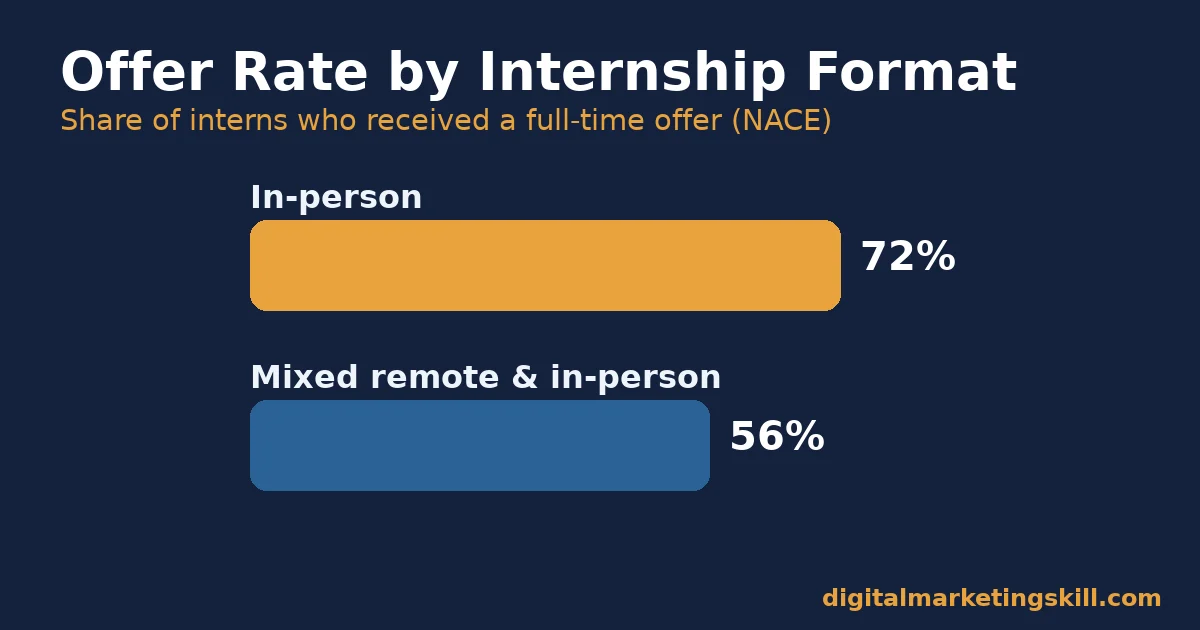
A digital marketing internship turns classroom knowledge into real campaign experience. It is often the fastest route to a first full-time offer. Employers who ran in-person internships extended offers to 72% of their interns, versus roughly 56% for mixed remote setups. Where and how you intern matters as much as landing one at all.
Key Takeaways
- Conversion rates are rising. The average intern-to-full-time conversion rate reached 63.1% for the latest cohort surveyed. That is a sharp climb from the year before, according to a US-based survey of 284 employers by the National Association of Colleges and Employers.
- Format changes your odds. In-person internships averaged a 72% offer rate. Mixed remote-and-in-person setups averaged around 56%, in the same survey.
- Offers get accepted more often now. The acceptance rate for internship-to-job offers reached 88.3%, up from 82.8% the year before.
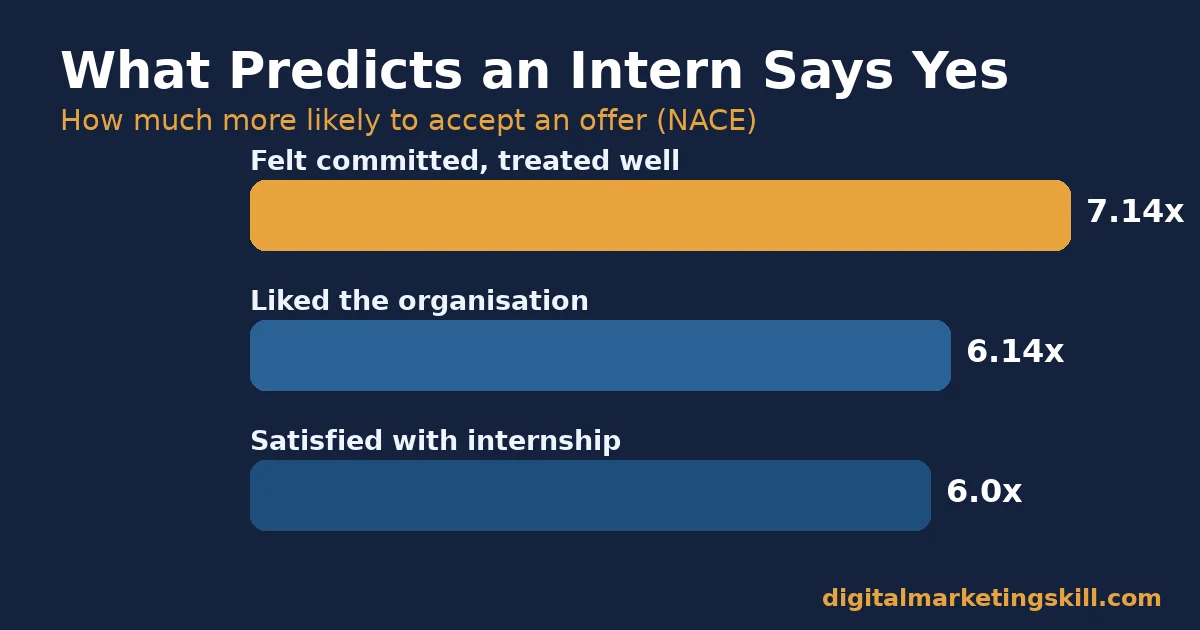
- Feeling valued predicts acceptance. Interns who felt genuinely committed to the organisation were 7.14 times more likely to accept a full-time offer than those who did not.
- A listing is not a strategy. Scrolling internship boards without a clear targeting and application plan wastes the advantage a strong internship search can give you.
In this guide
- What Most Internship-Hunting Advice Gets Wrong
- Why a Digital Marketing Internship Still Matters
- What Actually Converts an Internship Into a Job Offer
- How to Maximise Your Chances at Each Stage
- Three Mistakes That Quietly Undo a Strong Application
- How to Judge Whether an Internship Offer Is Worth Taking
- The One Rule: Treat the Internship as an Extended Interview From Day One
- What to Expect Once the Digital Marketing Internship Starts
- A Real Case: Why Offer Rates Moved So Much in One Year
- Frequently Asked Questions About Digital Marketing Internships
- Treat the Search Like the Job It Leads To
What Most Internship-Hunting Advice Gets Wrong
Search for digital marketing internship advice and most results give you a long list of websites to check. Some of those lists age badly. Job boards shut down, merge or change focus within a couple of years. A list alone also does not tell you what actually converts an internship into a real job offer.
This guide treats the internship search as a decision process, not a scavenger hunt. The conversion and offer-rate figures below come from a named, US-based employer survey. Treat them as a snapshot of that market, not a universal guarantee. The application advice is built from what consistently predicts a strong outcome, not a settled formula.
Why a Digital Marketing Internship Still Matters
A digital marketing internship closes the gap between what you learned and what a real campaign demands. Course material teaches the concepts. A real internship adds the messy parts: a client who changes the brief, a budget that gets cut, a launch date that does not move.
It also works as an extended interview. An employer who already trained you has more confidence hiring you than one reading a resume cold. They watched you handle real pressure. They saw your actual output. That confidence shows up directly in the data: most organisations that run internship programmes use them specifically to fill entry-level roles, according to the National Association of Colleges and Employers.
What a Digital Marketing Intern Actually Does
Day-to-day work usually spans several disciplines, not just one. A typical digital marketing intern supports social media scheduling and reporting, helps draft and proofread content, and assists with basic SEO tasks. They also pull data for campaign reports and sit in on strategy discussions.
The breadth is intentional. Most programmes want a digital marketing intern to discover which specialism fits them, rather than box them into one task for months. If you already know you prefer one discipline, say so early; a good manager will still aim most of your work there, even inside a broad programme.
What Actually Converts an Internship Into a Job Offer
Landing the internship is only step one. What happens during it decides whether it turns into a real offer. The data points to a few consistent factors, not luck.
Internship Format: Built to Shape Your Odds Before You Start
The format of the internship changes your odds before you do anything else. In-person internships converted to offers at a 72% rate in the NACE survey. Mixed remote-and-in-person arrangements averaged about 56%. Being physically present for informal moments, quick corrections and relationship-building appears to matter more than any single skill.
This does not mean a remote internship is worthless. It means you have to work harder to create the visibility an in-person intern gets automatically. Ask for more check-ins. Volunteer for visible projects. Over-communicate your progress.
Feeling Valued: Built to Predict Whether You Say Yes
The data is specific here. NACE’s research on intern conversion factors found that interns who felt genuinely committed to the organisation, because they were treated well, were 7.14 times more likely to accept a full-time offer. Liking the organisation and feeling satisfied with the internship each raised the odds by around six times.
This cuts both directions. Employers who invest in interns keep more of them. Interns who experience that treatment are clearly signalling which company to prioritise if more than one offer appears.
Pay attention to how you are treated during the internship itself. It is not just a nice-to-have. It is the single strongest predictor in the data of whether you will want to stay.
How to Maximise Your Chances at Each Stage
The sections below map onto the two factors above: the format you choose, and what you do once you are in. Each stage has a specific, concrete action, not general encouragement. Apply the same focus to the search itself that you would bring to any digital marketing internship project, since a scattered search produces scattered results.
Choose In-Person or Hybrid Whenever You Realistically Can
Given the sizeable gap in offer rates, prioritise an in-person or mostly-in-person internship over a fully remote one, when you have a genuine choice. If relocation or circumstances make remote your only option, say so honestly in applications. Plan to over-invest in visibility once you start.
Build Visibility Deliberately If You Are Remote
Ask your manager for a short weekly check-in from week one, rather than waiting to be noticed. Volunteer for one task that produces a visible result, like a report or a draft campaign, instead of only handling background admin work. Document what you shipped, in your own words, every two weeks.
Turn your camera on for team calls when you reasonably can, and speak up at least once in every meeting, even just to ask a clarifying question. A remote digital marketing intern who is a familiar, present voice is remembered very differently from one who is a silent name in a participant list.
Apply to Fewer Roles, With a Sharper Pitch
A generic application sent to twenty internship listings usually converts worse than five applications tailored to a specific company and role. Name the company’s actual campaigns or recent work in your cover letter. Mention one specific skill from the listing you can demonstrate, with a real example from a course project or personal campaign.
Networking still matters here too. LinkedIn’s own data found that nearly half of early-career US professionals say not having the right network is their biggest barrier to a first role, ahead of experience or qualifications. A short, genuine message to someone at the company, asking a real question rather than requesting a favour, often does more than another cold application.
Your cover letter still earns its place in this tighter approach. Indeed’s own guidance on internship cover letters recommends naming the specific role and how you found it in your opening line, then pointing to a class project or independent work that taught you a skill the listing asks for.
Three Mistakes That Quietly Undo a Strong Application
Most weak applications were not weak on paper. They were weak in the small decisions around them. These three mistakes come up often, and each is easy to fix once you notice it.
Sending the Same Letter to Every Company
A cover letter that could be sent to any company, with only the name swapped, reads that way to the person screening it. Reference one specific thing about the company’s actual marketing: a campaign, a product launch, a tone of voice. Do this before you talk about yourself at all.
Listing Skills Instead of Proving Them
Writing “strong SEO skills” on a resume proves nothing on its own. Instead, name one specific result: a keyword you researched, a page you optimised, a ranking change you tracked, even from a course project or a personal website. A specific, small result beats a vague, large claim every time. This is exactly what a digital marketing internship application should demonstrate before the interview even starts.
Waiting to Be Told What to Do
An intern who only completes assigned tasks looks identical, on paper, to one who is quietly coasting. Ask your manager once a week what the team’s current priority is, and offer to help with it directly. That single habit does more for your reputation than any individual skill.
This matters even more in a short digital marketing internship, where there is little time for a manager to notice quiet, steady effort on their own. Visibility has to be built actively, in weeks rather than months, or the internship can end with your manager barely able to describe what you actually did.
How to Judge Whether an Internship Offer Is Worth Taking
Not every internship that accepts you is worth accepting in return. Weigh the signals below before you commit your time to one.
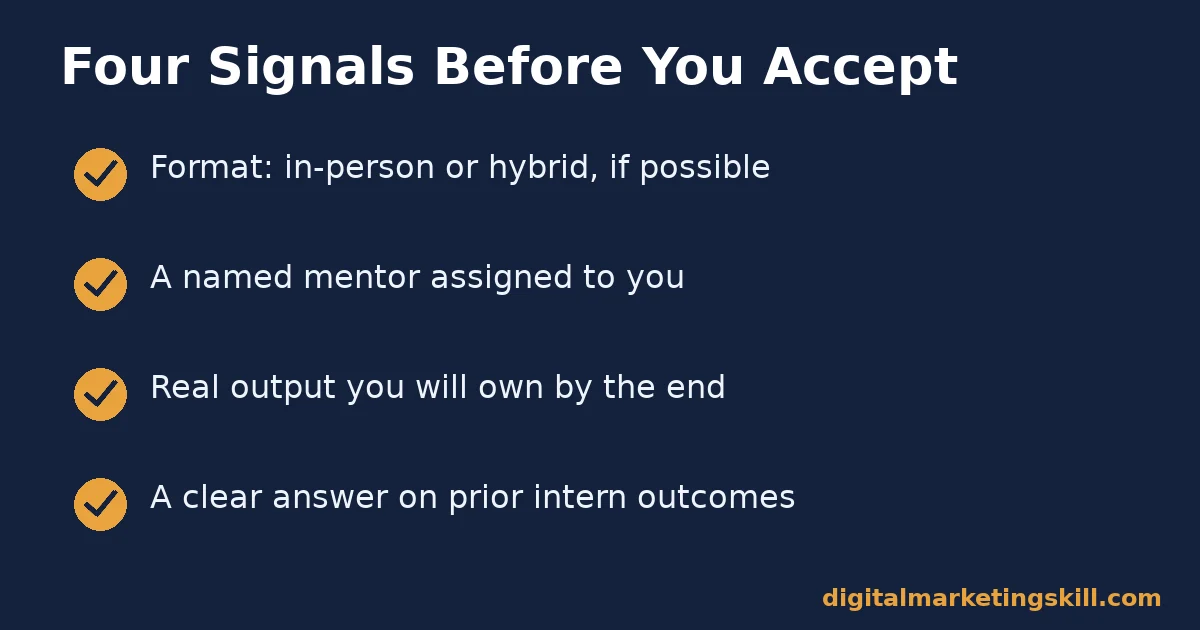
Four Signals Worth Checking Before You Accept
Ask about each of these directly in your final interview for the role, rather than guessing. A company confident in its digital marketing internship programme will usually answer all four without hesitation.
- Format. In-person or hybrid roles carry a meaningfully higher historical conversion rate to a full-time offer than fully remote ones.
- Mentor assignment. A named person responsible for your development, rather than a vague “you’ll work with the team,” signals the company has run this programme before and takes it seriously.
- Real output ownership. Ask directly what you will have produced by the end, such as a campaign report or a published piece of content, not just “exposure” to the team.
- Prior intern outcomes. Ask how many interns from the last cohort received a full-time offer. A company that cannot or will not answer this is a weak signal.
Reading These Signals Together
No single signal guarantees an outcome. Weigh them together, rather than picking one and ignoring the rest. A remote role with a named mentor and real output ownership can still beat an in-person role with no structure at all. The absence of any clear answer to the four questions above is itself informative.
If you are choosing between two offers, rank each one against all four signals rather than defaulting to the bigger company name or the higher stipend. A smaller, well-run digital marketing internship often teaches more and converts to a real offer more reliably than a prestigious name with no real structure behind it.
The One Rule: Treat the Internship as an Extended Interview From Day One
If you remember one decision rule from this guide, make it this one. Act every week as if you are being evaluated for a permanent role. In most programmes, you genuinely are.
Here is an illustrative example, with invented numbers. Two interns start the same twelve-week programme. One treats it as a temporary task list, showing up, completing assigned work and leaving on time.
The other asks for a short check-in each week. They track and share what they shipped. They ask for one additional project by week six.
By week twelve, the manager has a detailed record of the second intern’s actual output and growth. They have almost nothing specific about the first, beyond “did fine.” When one full-time role opens, the choice is not close, even though both interns technically completed the same assignments.
What to Expect Once the Digital Marketing Internship Starts
The first two weeks of most digital marketing internships look similar, regardless of the company. Expect onboarding on internal tools, shadowing a current team member, and a light early workload while your manager gauges your comfort level. Use this period to ask questions freely, since expectations around questions usually tighten once you are seen as settled in.
By the midpoint, the pace usually picks up. You should be handling at least one task with real ownership, not just supporting someone else’s. If that has not happened by the halfway mark, ask directly for one. A digital marketing internship that never hands you ownership of anything is a weak signal worth raising before it ends, not after.
A Real Case: Why Offer Rates Moved So Much in One Year
The National Association of Colleges and Employers tracks these figures across member organisations every year, specifically because they move. Its most recent report recorded the intern conversion rate at 63.1%, described as a steep climb of nearly 13% from the year before, alongside a similar rise in the offer rate itself.
The survey also recorded acceptance climbing to 88.3%, up from 82.8%. Read together, these numbers describe a tighter, more competitive match between employers and interns. More interns who are offered a role are choosing to accept it. Employers are extending more offers in the first place.
Keep the limits of this case in mind. The survey covered 284 organisations, mostly through NACE’s own US-based membership. Treat it as a strong signal in that market, not a global constant. Markets outside the US may show different patterns, and the figures will keep shifting year to year.
Frequently Asked Questions About Digital Marketing Internships
What skills do I need before applying for a digital marketing internship?
Basic familiarity with one or two areas, such as social media scheduling, simple SEO concepts or email marketing platforms, is usually enough to apply. Most programmes expect to teach you the rest. What they are screening for is genuine interest and a willingness to learn quickly.
Is an unpaid digital marketing internship worth taking?
It depends heavily on what you get in return. An unpaid internship with real output ownership, a named mentor and a credible path to a reference or offer can be worth it for someone early in their career. One that offers only vague “exposure” with no structure rarely is, paid or not.
How long does a typical digital marketing internship last?
Most run somewhere between eight and sixteen weeks, often aligned with a school term or a company’s quarterly planning cycle. Ask directly during the interview, since the listing itself does not always state it clearly.
Should I apply to remote or in-person internships first?
Prioritise in-person or hybrid roles if you can realistically take one, since they carry a meaningfully higher historical conversion rate to a full-time offer. If remote is your only realistic option, plan from day one to build the visibility an in-person intern gets automatically.
What is the single best predictor that an internship will lead to a job offer?
How genuinely valued and committed you feel during the internship is the strongest predictor in the available data, well ahead of any single task or skill. That makes how a company treats its interns a real signal worth weighing before you accept an offer.
How many internships should I apply to?
Fewer, more tailored applications generally outperform a high volume of generic ones. Five applications with a specific, researched pitch to each company usually land more interviews than twenty identical cover letters sent everywhere.
Where should I actually search for a digital marketing internship?
General job platforms like LinkedIn and Indeed carry the widest range of current listings, and both let you filter specifically for internships. University career centres and direct outreach to companies you admire often surface roles that never get publicly listed at all.
Treat the Search Like the Job It Leads To
A digital marketing internship is worth more than a line on your resume when you treat it as an extended interview from the first week. Prioritise in-person or hybrid formats where you can. Apply with a sharp, tailored pitch rather than a long generic list, and track your output for the offer conversation ahead.
See our guides on digital marketing interview mistakes to avoid and why you should study digital marketing.
If you want hands-on training before you apply, Digital Marketing Skill Institute builds real campaign experience into its programme itself. Its Master Diploma in Digital & AI Marketing is built around four AI-powered tracks covering ten execution-first courses, with a Full Stack option to complete all four.
It includes unlimited 1-on-1 coaching and mentoring, and a U.S. Project Internship with a verified U.S. Work Reference Letter, so the internship experience is already part of the training. The diploma is dual US and UK accredited and recognised in more than 100 countries.
The programme is fully online, so you can study from anywhere in your country. Browse more guides on the Digital Marketing Skill Institute blog, check real outcomes on our reviews page, and whenever you are ready, wherever you live, apply for the Master Diploma or start from the Digital Marketing Skill Institute homepage.
Every figure in this guide was checked against its original source before publication. Figures marked as illustrative are invented examples, not real results.