

Should you learn digital marketing? It depends on how you learn it. Digital marketing pays off fastest when you pair one core skill with real proof of a result, not a long list of tools. This guide gives you a framework, not just a list of reasons.
Key Takeaways
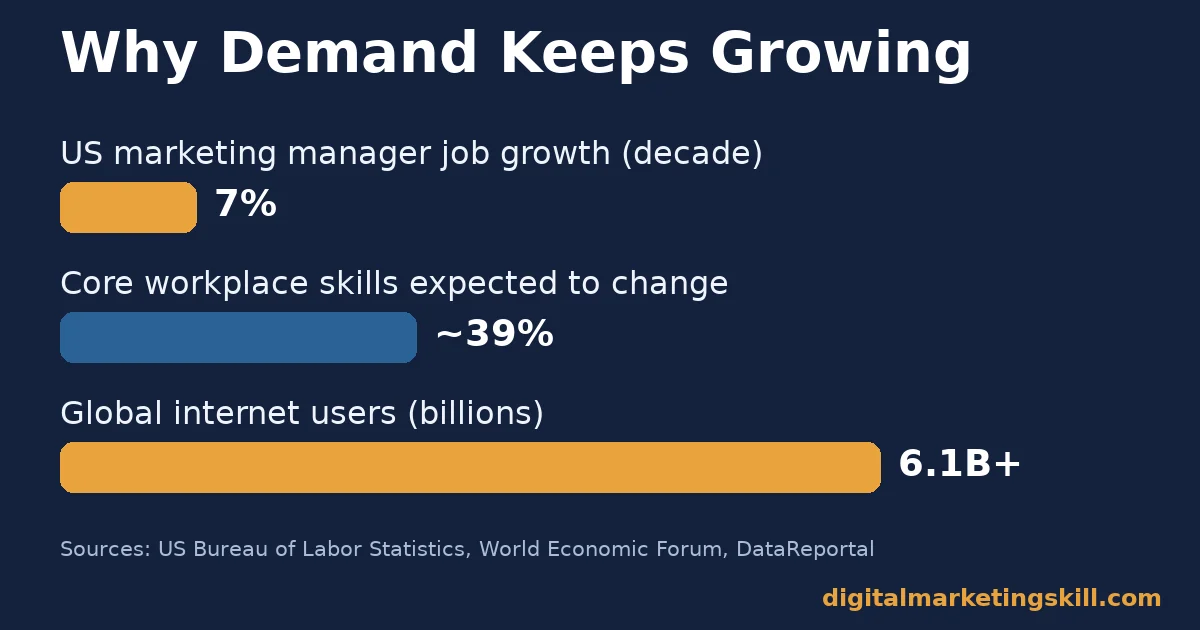
- US marketing manager roles are projected to grow about 7% over the coming decade, well above the average for all jobs, per the Bureau of Labor Statistics (US-only figure).
- More than six billion people now use the internet worldwide, per DataReportal. The audience for digital skills is not a regional bet anymore.
- The World Economic Forum finds nearly four in ten core workplace skills are expected to change within a few years. Fast learners now beat credentialed generalists.
- US salary data from Payscale and Indeed puts entry-level digital marketing pay in the mid-$40,000s to high-$60,000s (US-only figures). Pay rises fast once you can prove a result.
- One real DMSI graduate scaled a single email-marketing service from $500 per client to $5,000 per month. He did it by stacking proof, not by collecting certificates.
In this guide
- Why “Should I Learn Digital Marketing” Is the Wrong First Question
- How Learning Digital Marketing Actually Converts Into Income
- What Differs by Learning Path
- Cost, Time and Payback: A Side-by-Side View
- How to Measure Whether You Are Actually Ready
- The One Decision Rule Before You Apply or Pitch
- A Real Case: From $500 Per Client to $5,000 a Month
- Frequently Asked Questions About Learning Digital Marketing
- Your Next Step
Why “Should I Learn Digital Marketing” Is the Wrong First Question
Most articles that answer whether you should learn digital marketing just list reasons. Good pay. Flexible hours. Remote work. Those reasons are true. But they are not a decision tool.
A reasons list will not tell you which skill to start with. It will not tell you how long real competence takes. It will not tell you how a hiring manager actually checks that you can do the work.
Ground Rules for This Guide
This guide treats learning digital marketing as a decision with real trade-offs. Here are the ground rules. Every figure below names its source and its report, not a calendar year, because digital marketing moves fast. A number that is accurate today can be stale within a season.
For context, one widely cited estimate from IMARC Group puts the global digital marketing market in the high hundreds of billions of dollars. Most forecasts point toward continued double-digit annual growth. Treat that as a snapshot, not a settled fact, because market-size estimates like this one tend to shift as new data arrives. The direction, not the exact number, is what matters if you are deciding whether to learn digital marketing: demand for the skill set is not shrinking.
Nothing here is a guarantee of income or a job. This is a framework, not a promise. Your results depend on effort, market and starting skill.
The real gap in most “reasons to learn” content is simple. It skips the part where you pick a path, measure your own progress, and decide when you are ready to apply or pitch. That is the gap this guide closes.
How Learning Digital Marketing Actually Converts Into Income
Digital marketing is not one skill. It is a stack of channel skills, such as search, social, email, paid ads and content, sitting on top of two universal skills: clear writing and reading data.
When you learn digital marketing, you are really doing three things at once. All three have to happen before the learning turns into money or a job offer.
First, you build channel competence. In other words, you can run a campaign on one or two channels well enough to repeat the result, not just win once by luck.
Second, you build proof. For example, a portfolio, a case study, or a real client outcome that someone outside your own head can verify.
Third, you build positioning. Specifically, that is a short way of describing what you do that maps onto a problem a client already has. As a result, “I can lower your cost per lead” beats “I know social media” every time.
Employers and clients cannot see inside your head. Learning that produces no visible proof looks, from their side, exactly like no learning at all. This is the biggest reason people study digital marketing for months and still struggle to get hired: they skipped step two.
A Worked Example: Two People, Same Course
Here is what that looks like in practice, with an illustrative, invented example. Imagine two people who both spend three months learning search engine optimization. The first reads articles and watches videos, then stops. The second reads the same material, then starts a small personal site and tracks its organic traffic every week.
After three months, both people can define “backlink” and “keyword intent.” Only the second person can point to a specific page that climbed from position 40 to position 12 for a real search term, with a screenshot of the ranking change. When a hiring manager compares the two, the second candidate is not smarter. They simply have evidence instead of claims, and evidence is what gets interviews turned into offers.
What Proof Looks Like, by Channel
The same logic applies to every channel. Email marketing proof looks like a measured open-rate or recovered-revenue change. Paid-ads proof looks like a cost-per-click or return-on-ad-spend number from a real or closely simulated campaign. Content proof looks like a traffic or engagement chart with dates removed but the shape intact. In every case, the proof is a number that moved, attached to an action you took.
Why Watching Alone Does Not Convert
This is also why “I learn digital marketing by watching videos” rarely converts into paid work on its own. Watching builds vocabulary. Doing, measuring and writing up the result builds the proof that actually gets hired or hired again. If you remember one thing from this guide, make it this: to learn digital marketing in a way that pays, always pair the lesson with a measured action.
What Differs by Learning Path
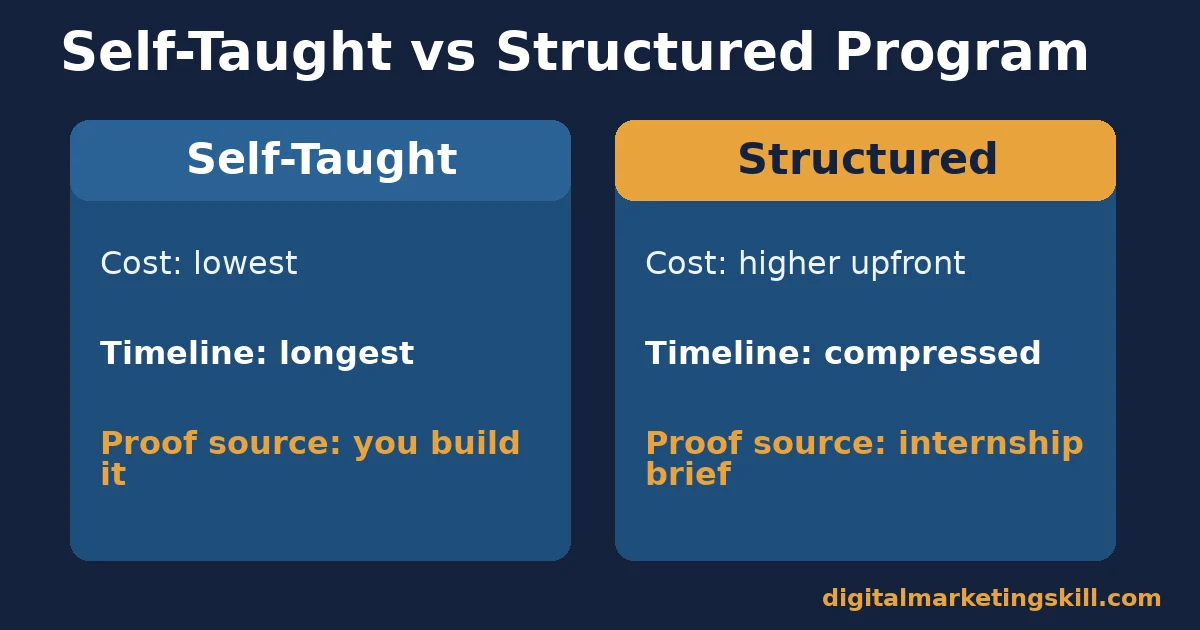
There are two broad routes into digital marketing. You can teach yourself with free and paid resources, or you can follow a structured program with a coach and a cohort. Both routes work to help you learn digital marketing. However, they differ in what they do well, and in what you must supply yourself.
Self-Taught: Built for Low Cost and Full Control
The self-taught route costs the least money. It costs the most time and discipline. You choose the order of topics. That means you can go deep on one channel fast.
But no one checks whether your practice campaign would survive a real client’s budget. Free documentation from platforms like Google, Meta and LinkedIn is accurate. It is also written for people who already understand marketing basics, which creates a steep early climb.
This route rewards people who are comfortable building their own structure. You need a study schedule, a practice project and a way to get feedback. None of that is provided automatically.
Structured Program: Built for Speed and Accountability
A structured program trades money for a shorter timeline. You get a sequenced curriculum and someone checking your work. However, the value is not the content itself; most fundamentals are public and free.
The real value is the order, the deadlines, and direct feedback on whether your output would pass a real client’s review. A program with live coaching and a real internship also solves the proof problem directly. Instead of inventing a practice project, you work on one with a real budget and a real brief.
Self-Taught: Lead With a Portfolio, Not a Certificate
If you choose the self-taught path, build your own proof. Try a mock campaign for a local business, with their permission. Grow a personal blog with measurable search traffic. Offer a small business a free audit in exchange for a case study.
Lead every application with that portfolio link. Do not lead with a list of free courses you finished. Course completion is not proof of skill.
Structured Program: Lead With Mentorship and Internship Proof
If you choose a structured program, lead with your internship or capstone project. Lead with direct feedback from a coach who has real industry experience. Do not lead with the diploma title alone.
A reference letter that names a specific result carries far more weight with a hiring manager than the name of the program that produced it.
Cost, Time and Payback: A Side-by-Side View
Money and time trade off differently on each path, so it helps to look at both together before you choose. Neither path is automatically cheaper once you count your own time as a cost, not just your cash.
On the self-taught path, your direct cash cost is often close to zero. If you stick to free resources, you may spend nothing at all. Add one or two paid courses and the cost is usually a few hundred dollars. Your real cost is time, not money. Expect several months of trial and error before your first portfolio piece is strong enough to show a stranger. That is because you are building the structure around your learning, not only the skill itself.
On the structured-program path, your direct cash cost is higher upfront. It often involves tuition or a payment plan. In exchange, your timeline compresses. The sequencing, feedback and a real internship brief are supplied for you, instead of self-assembled from scratch. Many learners reach their first verifiable proof point inside a single term. Compare that to the trial-and-error year a fully self-directed path can take, and the time saved often offsets the upfront cost.
Which Path Is Actually Cheaper for You
Neither number tells you which path is “better” in general. The question to ask yourself is narrower: do you already have, or can you build, the structure, feedback and accountability a program would otherwise supply? If yes, a self-taught plan to learn digital marketing can be the cheaper route to the same proof. If no, paying for structure is often cheaper than the months lost to false starts.
How to Measure Whether You Are Actually Ready
In short, three simple, checkable measures tell you whether learning digital marketing has turned into a skill you can sell, instead of a feeling of confidence.
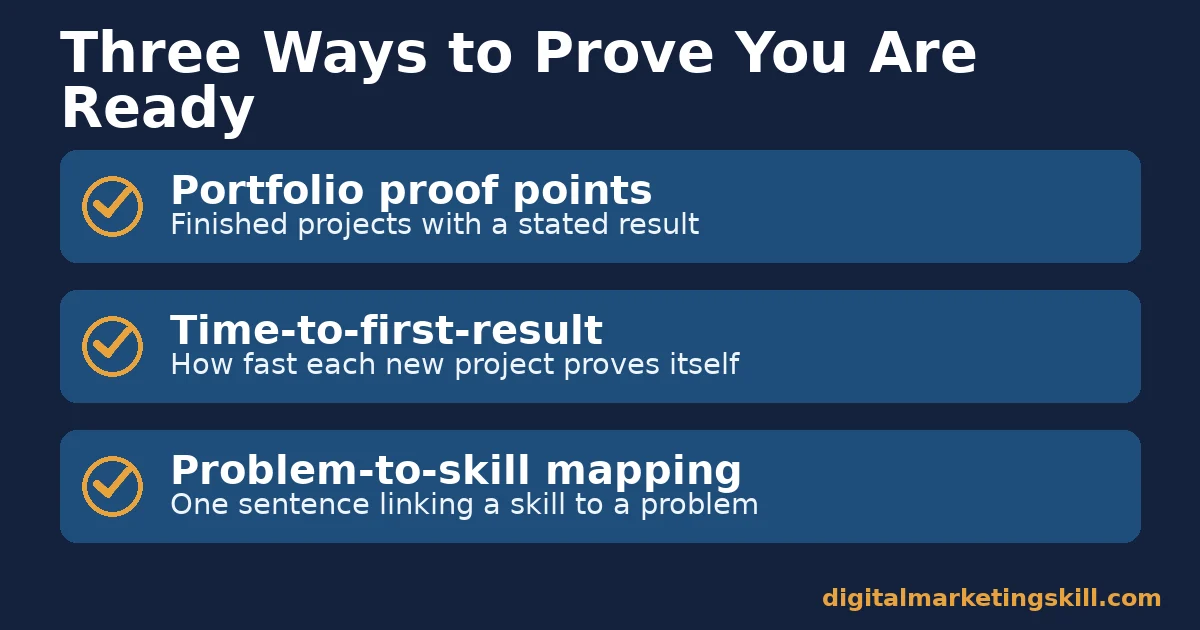
Portfolio proof points. Count the finished, reviewable projects you can link to, each with a stated goal and a stated result. For example: “grew email open rate from 18% to 31% over six weeks.” Read this as a count, not a grade. Three strong, specific proof points beat ten vague ones.
Time-to-First-Result
Time-to-first-result. This is how long it took you to produce one verifiable outcome after you started learning. It might be a published article that ranks, a small ad test that lowered cost per click, or a client’s first payment. Read it as a trend. If your second project took less time than your first, your learning is compounding.
Problem-to-skill mapping. Can you state, in one sentence, which business problem each skill solves? SEO solves discoverability. Email solves repeat revenue. Paid ads solve speed to traffic. Read it as a checklist. If you cannot map a skill to a problem, a hiring manager cannot either, and that skill will not help you in an interview.
Write the mapping down for every skill you learn, even if it feels obvious while you are learning it, because that same sentence becomes your interview answer and your pitch line later.
Track all three measures together, not one at a time. A strong proof point with no clear problem mapping still falls flat in an interview, and a clear problem mapping with no proof point is just a claim. When you learn digital marketing with all three building at once, readiness tends to arrive faster than when you focus on only one.
The One Decision Rule Before You Apply or Pitch
Apply this rule before you send any application or client pitch: if you cannot name one specific business problem you solve, and attach one real or realistic example with before-and-after numbers, you are not ready yet. Keep building proof instead.
Here is an illustrative, invented example. Say you have learned email marketing and want to pitch a small online store. Do not write “I know email marketing.” Instead, name the problem: “your store has no abandoned-cart emails, so recovered revenue is left on the table.” Then attach a worked example from a practice project to make the claim concrete: “in a test shop, a three-email abandoned-cart sequence recovered an estimated 9% of abandoned carts in one month.” That sentence is pitchable. “I know email marketing” is not.
Notice that the pitchable version names a problem, states a method, and attaches a number. Build that habit once, for one skill, and it transfers to every channel you learn digital marketing in afterward.
A Real Case: From $500 Per Client to $5,000 a Month
Olajire Jacob, a Digital Marketing Skill Institute graduate, started by charging an average of $500 to set up email-marketing flows for individual clients, as shared in the Institute’s published student reviews. He then expanded that same core skill into a $5,000-a-month service as he added clients and broadened what he offered within that one channel.
The dollar figure is not the point; it will differ for every person, market and effort level. The pattern is the point: one well-proven skill, charged for early, then scaled by adding clients and adjacent services once the core skill was already paying for itself. In a separate review on the same page, another graduate, Eunice Bolaji, described earning back more than her course fees from a single client within weeks of registering, which echoes the same pattern: narrow skill, fast first proof, then expansion.
Results like these are not typical and are not guaranteed; they depend on the person’s market, effort and starting point, and plenty of learners take much longer to land a first paying client. Read the Institute’s earnings disclaimer for full context before treating any single story as a predictor of your own outcome.
Frequently Asked Questions About Learning Digital Marketing
Is it too late to learn digital marketing?
No. The channels keep changing, so everyone in the field keeps relearning parts of it. Starting later mainly means you pick up current tools and AI-assisted workflows from day one, instead of unlearning older habits first.
How long does it take to learn digital marketing well enough to get hired?
It depends on your hours and whether you build proof alongside theory. People who pair structured lessons with a real project or internship usually reach a hireable portfolio faster, because the proof and the learning happen at the same time.
Do I need a degree to learn digital marketing?
No specific degree is required. Hiring managers and clients care far more about demonstrated results and a clear explanation of your methods than the credential that taught you those methods.
Which digital marketing skill should I learn first?
Pick the channel that matches your available budget and time. Email and content marketing need little paid budget but more time. Paid ads need a budget, but they give faster, more measurable feedback while you learn.
Whichever you choose, map it to a specific business problem using the decision rule above. Then the skill is pitchable as soon as you finish one project.
Can I learn digital marketing while working full time?
Yes. Most people who switch careers do it part time. They use evenings or weekends for a structured curriculum or self-directed study, plus one practice project. A realistic pace is a few focused hours most weeks, protected on a calendar like any other commitment, rather than squeezed in only when there happens to be spare time. Then they apply or pitch once they hit the readiness measures above.
Is freelancing or an in-house job the better way to start?
Neither is always better. Freelancing gets you client-facing proof faster, with less mentorship. An in-house or agency role gives you more structured feedback, but a slower path to owning a named result. Many people who learn digital marketing do both at different career stages.
Will AI tools replace people who learn digital marketing?
AI tools are changing the work. They are not removing the need for a person who understands strategy. Someone who can brief, check and improve AI-generated campaigns stays employable. The same is true for someone who can still explain why a decision was made. A tool used without that judgment cannot do either of those things on its own, which is exactly why human oversight of AI output has become a skill worth listing on its own.
Do content marketing budgets actually support new digital marketers?
Yes, broadly. Across several recent annual surveys, Content Marketing Institute research has found that roughly half of B2B marketers expect their content budgets to rise or hold steady, which keeps steady demand open for people who can write and measure content well.
Your Next Step
If you want the structured-program route described above, with direct coaching, a real internship rather than a simulated one, and a verified work reference letter at the end, look at the Master Diploma in Digital & AI Marketing at the Digital Marketing Skill Institute.
It is built around four AI-powered tracks: AI-Powered Social Media Management and Advertising, AI-Powered Lead Generation and Email Automation, AI-Powered Google Specialist, and AI-Powered WordPress and SEO Specialist. Together they total ten courses, with a Full Stack option for learners who want all four.
The program includes unlimited one-on-one coaching and mentoring, a U.S. Project Internship with a verified U.S. Work Reference Letter, and dual US and UK accreditation recognised in more than 100 countries. It is delivered 100% online, so you can study from anywhere in your country.
Review real outcomes on the student reviews page. Compare the tracks on the Master Diploma program page. Browse more guides on the blog. When you are ready, apply here. Wherever you live, the skills in this guide transfer to any market with an internet connection, and you can start building your own proof points today at the Digital Marketing Skill Institute.
Every figure in this guide was checked against its original source before publication. Figures marked as illustrative are invented examples, not real results.
