
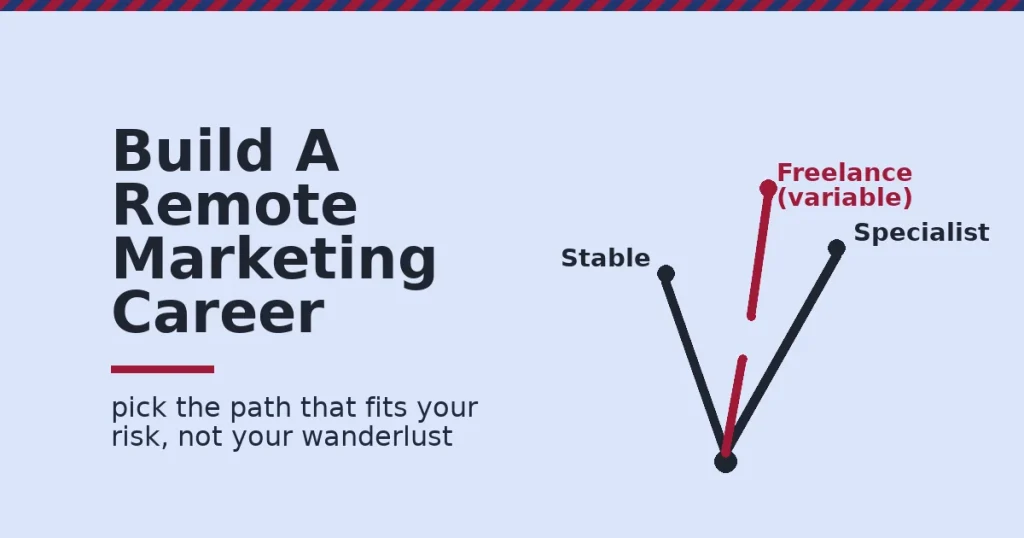
A digital nomad earns a living online while living and travelling wherever they choose. They use a laptop and internet instead of a fixed office. For a digital marketer, that means freelance client work, a fully remote job, or specialist contract work. Each path trades income stability for freedom in a different way.
Key Takeaways
- Most digital nomads now have a regular job, not a freelance hustle. MBO Partners found 56% of US digital nomads now hold traditional full-time positions, up from the freelance-dominated nomad stereotype of a decade ago.
- The lifestyle has grown fast. MBO Partners counted 18.5 million American digital nomads, a 153% increase in recent years, equal to about 12% of the US workforce.
- Governments have caught up. MBO Partners reports that 64 countries, roughly two-thirds of the world, now issue a dedicated digital nomad visa.
- Remote work satisfies people, but not without cost. In Buffer’s survey of 3,000 remote workers, 98% would recommend remote work to others, yet 33% said staying home too often without a reason to leave was a real struggle, and 23% cited loneliness.
- Skill, not location, decides who gets hired. Google’s own guidance on helpful content judges work by whether it leaves people “feeling they’ve learned enough,” which is exactly the bar remote clients and employers apply to a marketer’s portfolio.
In this guide
- What Most “Become a Digital Nomad” Guides Skip
- How Digital Marketers Actually Get Paid on the Move
- Three Paths Into the Digital Nomad Lifestyle
- How to Start Down Each Path
- How to Tell Your Nomad Setup Is Actually Working
- The One Rule: Match Your Path to Your Risk Tolerance, Not Your Wanderlust
- A Real Case: Buffer’s All-Remote Team
- Frequently Asked Questions About Becoming a Digital Nomad
- Where to Build the Skills a Digital Nomad Career Needs
What Most “Become a Digital Nomad” Guides Skip
Most guides describe one kind of digital nomad. Picture a solo freelancer with a backpack, piecing together small gigs between flights. That picture is out of date. MBO Partners’ Digital Nomads Trends Report shows most digital nomads now hold a traditional job. They travel around it, not instead of it. Treating freelancing as the only route sends people down the hardest financial path first, when a steadier option usually exists.
A few ground rules before the detail. The workforce figures below come from MBO Partners’ annual US survey. Read them as US-specific, self-reported estimates, not a precise worldwide count, since no government tracks digital nomads directly.
The three-path framework used in this guide is an informed way to organise the options that exist today. It is not a settled industry classification. Treat every number here as a snapshot from one recent survey, not a permanent ranking of the lifestyle.
This distinction matters most for digital marketers. Marketing is one of the few careers where every one of the three paths is genuinely open. A graphic designer, a lawyer or a nurse rarely gets to switch freely between an employer, a freelance client list and a specialist contract. A digital marketer usually does. That is why this guide treats the choice of path as the real first decision, not travel logistics.
How Digital Marketers Actually Get Paid on the Move
Before picking a path, look at how money and work actually flow once you leave the office behind. A remote-friendly marketing career runs on three things. First, a skill that clients or employers will pay for. Second, a way to prove that skill without being in the room. Third, a system for staying reachable across time zones.
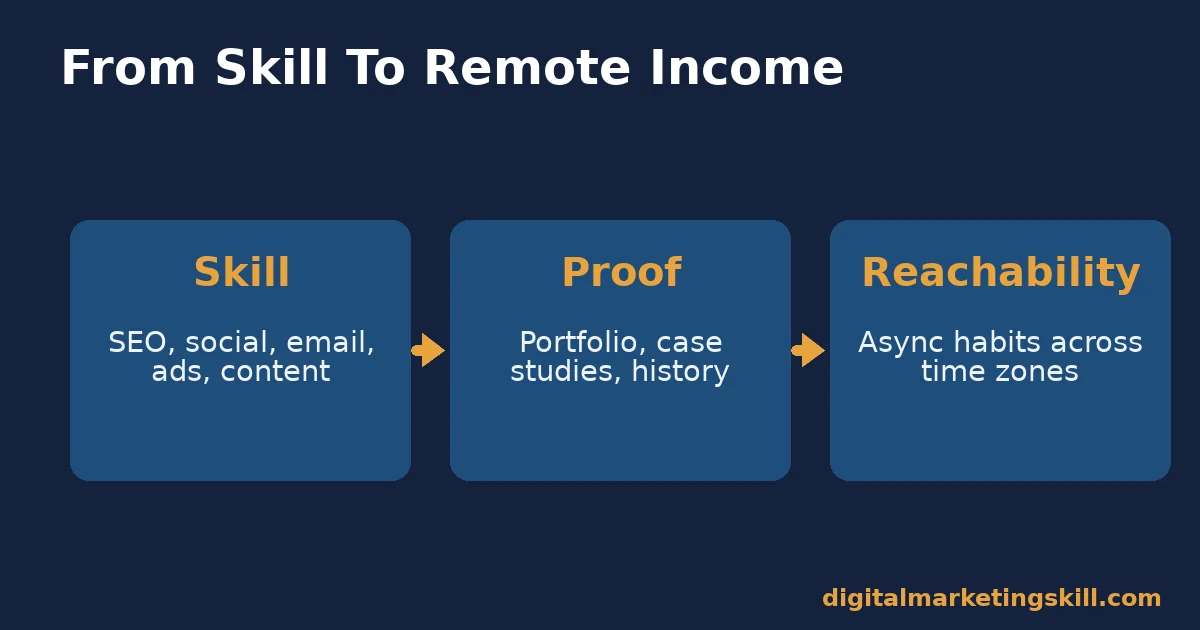
The skill comes first. Social media management, SEO, email marketing, paid advertising and content creation can all run entirely through a browser. That is why they dominate remote job boards and freelance platforms alike.
Our guide on how to become a content creator covers one of the fastest-growing versions of this path in detail. Each of these roles has its own learning curve, but all of them share one advantage over a trade that needs physical tools or a licensed location: a browser and a stable connection are enough to start.
Proof comes next. A portfolio, documented case studies, or a verified work history stand in for the interview small talk that used to build trust face to face. Without that proof, a remote pitch is just a claim with nothing behind it. Busy clients rarely take time to check if a claim is true; they simply move to the next applicant.
Reachability is the part new nomads underestimate most. Clients do not mind where you physically are. But they do mind when a reply takes two days because you crossed six time zones with no plan. GitLab runs its entire company remotely, and its public all-remote handbook is blunt about this: written updates and clear async norms matter more than anyone’s location once a team spreads across time zones.
Tools matter less than habits here. A shared project board, a short weekly written update, and one agreed overlap window with each client solve most of the reachability problem. The mistake to avoid is assuming goodwill will cover the gap. A client who hears nothing from you for three days in transit will assume the worst long before you land to explain.
Three Paths Into the Digital Nomad Lifestyle
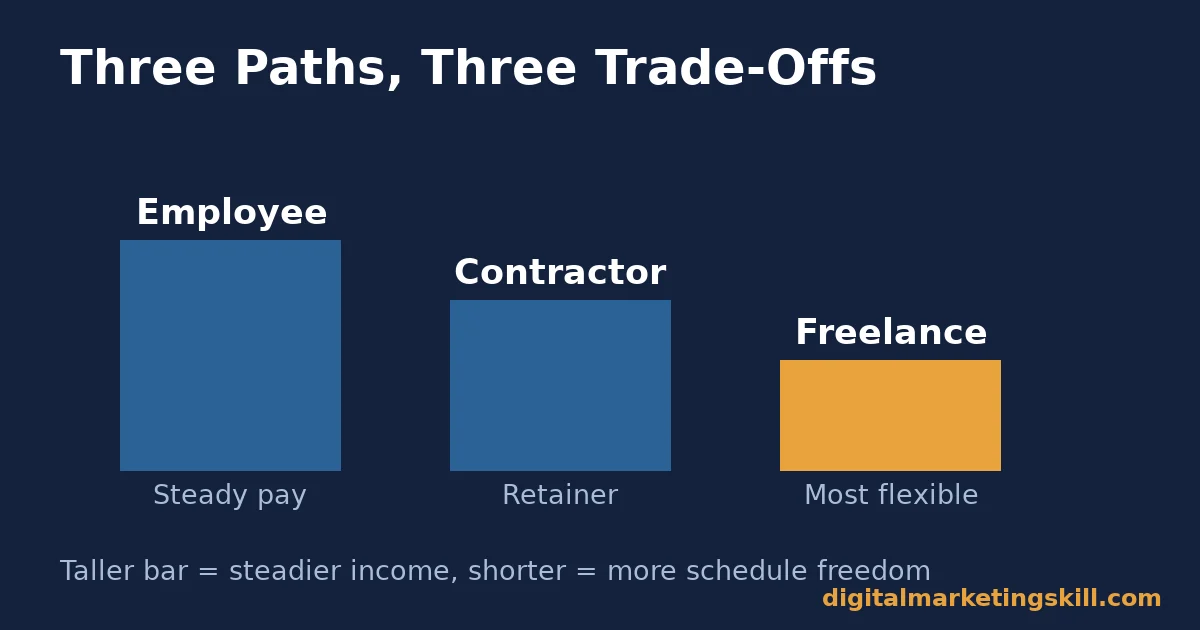
Almost every working digital nomad fits one of three paths. Each trades stability for freedom in a different way. The right starting point depends on how much income volatility you can absorb, not on how badly you want to travel.
The Remote Employee: Built For Stability
A remote employee works a normal job for one employer, paid on a regular schedule, just without a fixed office. MBO Partners’ data suggests this is now the majority path. Among its surveyed US digital nomads, 11.2 million held traditional employment, up from 10.2 million previously.
The trade-off is less control over your calendar. Usually there is also a company policy limiting which countries you may legally work from, for tax and compliance reasons.
The Freelance Marketer: Built For Flexibility
A freelance marketer serves several clients at once. They set their own rates, hours and client mix. This path gives the most control over your schedule and travel plans.
But income varies month to month, and you carry your own admin: invoicing, contracts, taxes, and finding the next client when one leaves. It suits people who can tolerate a quiet month without panicking, in exchange for answering to no one’s office hours.
The Remote Contractor: Built For Specialization
A remote contractor sits between the two. They keep one or two longer-term clients or agencies, often paid on a retainer, but without full employee status or benefits. This path suits marketers with a narrow, in-demand specialty, such as technical SEO or paid media management. It offers steadier income than pure freelancing, without a full-time commitment to one employer.
A Fourth Factor That Cuts Across All Three Paths
Cost of living and legal compliance sit underneath whichever path you pick. Moving to a lower-cost country can make a modest freelance income feel comfortable. The same income in an expensive city might feel tight.
But cheaper destinations are not automatically better. Visa rules, tax residency thresholds and health cover vary by country and change often. What worked for someone else previously is not a guarantee for you now. Treat this as homework for every destination, not a one-time check.
How to Start Down Each Path
Each path rewards a different first move. Trying all three at once usually slows every one of them down. Pick the section that matches the path you chose above. Treat the other two as useful context for when you want to switch later.
Remote Employee: Lead With a Portfolio and a Targeted Application
Build a portfolio before you apply, not after. Include two or three real projects that show the exact skill the job needs. A content calendar you ran, a campaign report you wrote, or an audit you performed on a real website all count.
Then apply through remote-first job boards and company career pages, rather than general listings. Fully remote roles are a small share of all postings, and they get buried fast inside generic job search results. A clear, specific application beats a vague one almost every time, because hiring managers read dozens of vague ones a day.
Freelance Marketer: Lead With a Narrow Niche
Pick one service and one type of client, instead of marketing yourself as a general digital marketer. “Email marketing for online course creators” wins more work than “digital marketing services.” A narrow promise is easier for a stranger to trust, and easier for you to price confidently.
Our guide on how to get digital marketing clients as a beginner walks through outreach that works well for a narrow niche. Your first five clients can come from your own network or a single freelance platform. Expand to new channels once you have real case studies to show, not before.
Remote Contractor: Lead With a Specialized Skill
Go deep on one in-demand skill, such as conversion rate optimisation, SEO migrations, or paid search management. Do not offer the full marketing mix. Agencies and growth teams hire specialist contractors precisely because they do not want to manage another generalist on top of their own staff. A sharply defined skill, backed by results you can point to, is what earns the retainer and the renewal after it.
How to Tell Your Nomad Setup Is Actually Working
Wanderlust is not a metric, and neither is how good your photos look. Track a few numbers each month. That way you catch problems early, before they turn into a crisis in an unfamiliar country with no savings left.
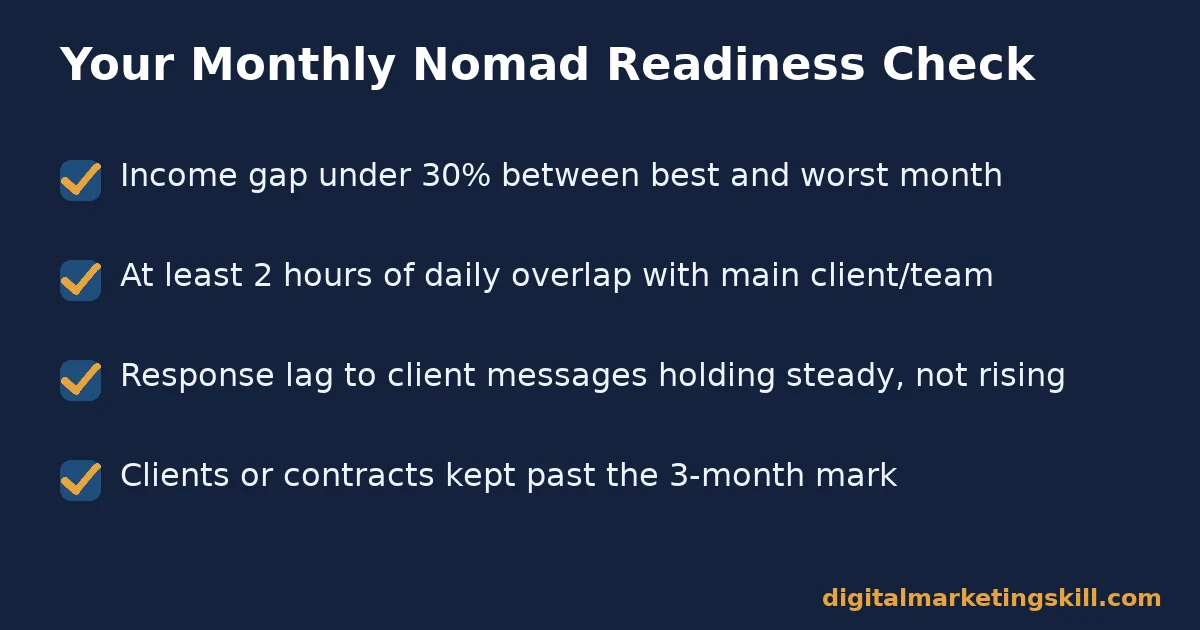
- Income stability. The gap between your best and worst month over the last quarter. A gap under 30% suggests a sustainable setup; a wider gap means you need a second client, a second income stream, or a larger cash buffer before you travel further.
- Time-zone overlap hours. How many hours each day genuinely overlap with your main client or team. Under two hours makes live collaboration difficult and pushes almost everything into asynchronous messages, which is manageable but needs planning.
- Response lag. The average time between a client message and your reply. Rising lag is often the first sign that travel is quietly eating into your reliability, well before a client says anything about it.
- Client or employer retention. How many clients or contracts you keep past three months. Low retention usually points to a mismatch between your niche and the clients you take on, not simple bad luck.
Review these four numbers monthly, not just when something already feels wrong. A small drift in response lag or overlap hours is easy to fix early. It is expensive to fix after a client has already left.
How to Read These Numbers Together
No single number tells the whole story alone. Rising response lag alongside falling retention warns that your travel pace is costing you clients, not just annoying them.
Stable income with shrinking overlap hours usually means you can afford to move further away, since the work holds up despite less live contact. Read the four numbers as a set each month, not as isolated scores. The pattern across them will usually tell you which one to fix first.
The One Rule: Match Your Path to Your Risk Tolerance, Not Your Wanderlust
If there is one decision rule for becoming a digital nomad, it is this: choose the path that fits how much income volatility you can absorb. Then adjust your travel plans to that path, not the other way round.
Here is an illustrative, invented example. Someone with three months of savings and a stable remote job should keep the job. They should travel within their paid leave and time-zone limits, before ever quoting freelance clients of their own.
Someone with twelve months of savings and a specialist skill already in demand can reasonably start as a contractor, since a short dry spell will not force them home early. Someone with no savings and no track record yet should build a portfolio and a small client base from a fixed base first, and travel once income is proven, not before.
A Real Case: Buffer’s All-Remote Team
Buffer, the social media scheduling company, has run as a fully distributed team since its founders gave up their shared office. Staff have worked from dozens of countries ever since.
The company publishes its remote working practices, pay approach and culture openly, rather than keeping them internal. That openness is unusual among software companies of its size. Its public State of Remote Work research grew directly out of running a distributed team at scale, not from studying one as an outsider.
The lesson for an individual digital marketer is the same one Buffer applied as a company. Remote work holds together when communication norms and time-zone expectations are written down and agreed in advance, not assumed and discovered the hard way.
A single nomad can borrow that same habit. Agree response-time expectations with every client up front, the same way Buffer agrees them across its own team. A written agreement also protects you: when the expectation is clear, a quiet week during a long flight is a planned exception, not a surprise that damages trust.
Frequently Asked Questions About Becoming a Digital Nomad
Do you need savings before becoming a digital nomad?
A buffer of three to six months of expenses is a reasonable starting point, more if you plan to freelance rather than keep a salaried job. It protects you from rushing home if a client pauses work or a trip costs more than planned, which happens more often than most new nomads expect.
Can you become a digital nomad with no experience?
Yes, but start by building real, visible proof of a skill first. A few portfolio projects or a short freelance track record work well. Our guide on how to improve your digital marketing skills for career growth is a useful starting point if you are building that foundation from scratch. Experience and travel are easier to build one at a time than together.
What is the biggest downside of the digital nomad lifestyle?
Buffer’s survey points to the same struggles most remote workers report: staying home too often without a reason to leave, loneliness, and difficulty unplugging from work. Travel does not remove these problems. It can make the loneliness and routine problems worse while you also adjust to an unfamiliar place.
Do digital nomads need a special visa?
Many countries now offer one. MBO Partners counts 64 countries with a dedicated digital nomad visa, and our own breakdown of digital nomad visa countries lists many of them. Rules, income thresholds and tax treatment vary by country and change often. Always check each destination’s current official requirements before you travel, rather than relying on older guides. Many visas also set a minimum income threshold and require proof of health cover, so budget time for paperwork before you book a flight.
Which digital marketing skills travel best?
Skills that are fully digital and do not need in-person presence travel best. Social media management, SEO, email marketing, paid advertising and content creation all qualify. Roles built around local relationships, such as field sales or in-person events, are harder to run as a nomad.
Is it better to freelance or keep a remote job as a digital nomad?
Keep the job if income stability matters most to you right now. Freelance if schedule control matters more than a steady paycheque. Many digital marketing nomads start as a remote employee and move into freelancing later, once they have savings and a client network to fall back on. Our guide on how to transition from a full-time job to a freelance career covers that move step by step.
How do digital nomads avoid burnout while travelling and working?
The same way remote workers anywhere do: fixed working hours, a real end to the workday, and breaks that are not spent scrolling the same devices used for work. Our guide on how to avoid burnout as a freelancer covers routines that apply just as well on the road as at home.
How much does it cost to become a digital nomad?
There is no fixed figure. It depends on your destination choices and the path you take. A digital nomad who keeps a salaried job and travels to lower-cost countries can often live on the same budget as at home, or less.
A freelancer building a client base from zero should plan for several months of thin income before costs are covered. The honest starting point is your own savings and monthly expenses, not a number from someone else’s blog post.
Where to Build the Skills a Digital Nomad Career Needs
Whichever path you choose, the skills behind it are learnable in a structured programme, rather than picked up through years of trial and error. The Master Diploma in Digital & AI Marketing at Digital Marketing Skill Institute is built around four AI-powered tracks: AI-Powered Social Media Management and Advertising, AI-Powered Lead Generation and Email Automation, AI-Powered Google Specialist, and AI-Powered WordPress and SEO Specialist.
Together they total ten courses, with a Full Stack option for completing all four. The programme includes unlimited one-on-one coaching and mentoring, and a U.S. Project Internship with a verified U.S. Work Reference Letter. You build a real portfolio alongside the skills themselves, rather than finishing with certificates and nothing to show a client or employer.
The programme is dual US and UK accredited, recognised in more than 100 countries, and delivered 100% online. That matters if your plan is to study from wherever in your country you happen to be that month. There are no income or job guarantees attached to any of this; see the Institute’s earnings disclaimer for the full context behind any student outcome you read elsewhere.
For the full course breakdown, visit the Master Diploma programme page, browse more guides on the blog, or go straight to the application page when you are ready to build a marketing career you can run from anywhere in your country.
Every figure in this guide was checked against its original source before publication. Figures marked as illustrative are invented examples, not real results.
