
Customer relations is the ongoing, proactive work a business does to build trust with customers. It is separate from reacting to support tickets. It pays off directly. Research cited by Harvard Business Review found that a 5% rise in retention lifts profits by 25% to 95%. Here is what actually moves that number.
Key Takeaways
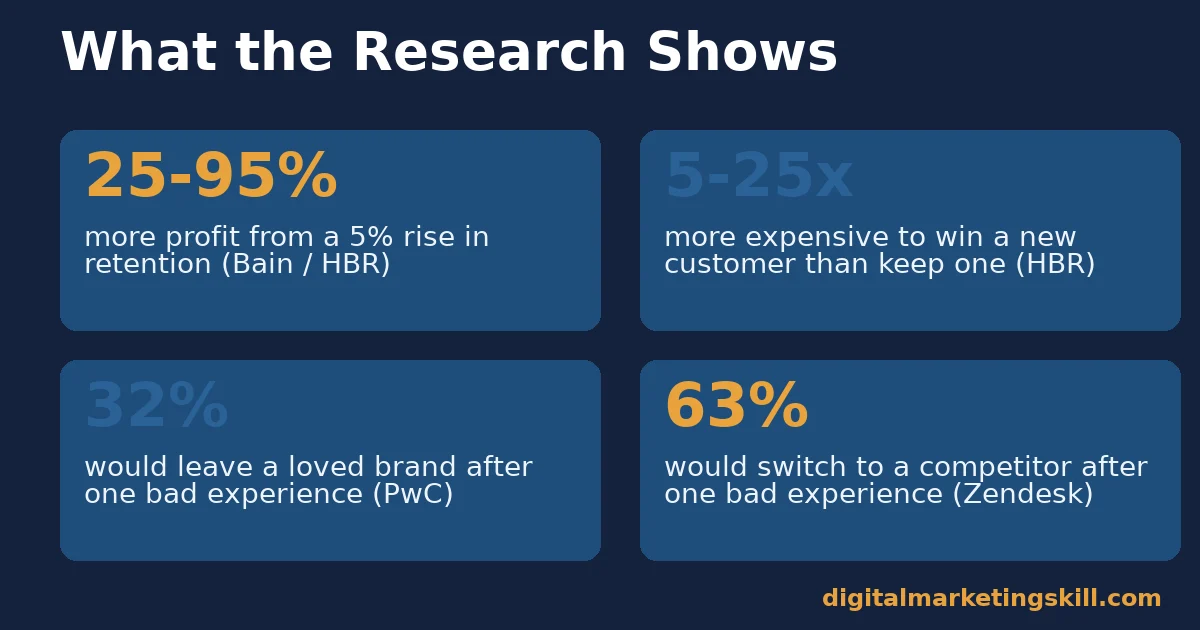
- Retention pays off disproportionately. Bain’s Frederick Reichheld did the research. Harvard Business Review cited it. A 5% increase in customer retention raises profits by 25% to 95%.
- Keeping customers costs far less than finding new ones. The same analysis found something else too. Acquiring a new customer costs 5 to 25 times more than retaining an existing one.
- One bad experience can cost a loved brand. PwC’s Experience is Everything study surveyed 15,000 consumers across 12 countries. It found that 32% would walk away from a brand they love after a single bad experience.
- Good experience has real value. The same PwC study found something else. Customers will pay up to a 16% price premium for a great experience.
- Patience is shrinking. Zendesk’s CX Trends Report found that 63% of consumers would switch to a competitor after one bad experience. That is up nine percentage points year over year.
In this guide
- What Most Customer Relations Advice Gets Wrong
- How Customer Relations Actually Works
- Customer Relations Comes in Three Types
- How to Strengthen Each Relationship Type
- How to Measure Customer Relations
- The Most Useful Rule: Reach Out Before a Problem Forces You To
- A Four-Week Plan to Strengthen Customer Relations
- A Real Case: How HeidelbergCement Follows Up With Unhappy Customers
- Frequently Asked Questions About Customer Relations
- Start With Your Highest-Value Customers
What Most Customer Relations Advice Gets Wrong
Most customer relations advice is a long list of tips. Reply fast. Be friendly. Collect feedback. None of that is wrong. But a list does not explain why some companies build real loyalty while others, doing similar things, do not.
This guide focuses on that gap. It separates customer relations from customer service, and explains the three kinds of relationship a business can build. It also shows how to measure whether the work pays off.
Here are the ground rules. The Harvard Business Review analysis, the PwC study and the Zendesk figures below come from large surveys or researcher analysis. Each has its own scope. Read them as industry evidence, not universal laws. The HeidelbergCement case later in this guide is one company’s own reported programme, not a controlled study. Treat every number as a snapshot, not a permanent ranking.
How Customer Relations Actually Works
Customer relations is every deliberate action a business takes to build trust with a customer. It happens before any problem. It differs from customer service in one key way: direction. Customer relations reaches out. Customer service waits to be contacted.
Both matter. But only one is fully within your control on a normal day. Most customers never file a support ticket at all. So customer relations is where loyalty is actually built, long before anyone needs help.
Why the Proactive Difference Matters
A proactive message costs little. It reaches customers who were never going to complain. A reactive reply only reaches the customer who already had a problem and chose to raise it. Most unhappy customers simply leave instead.
That is the core risk in relying on customer service alone. Zendesk’s research found that 63% of consumers would switch to a competitor after a single bad experience. Many of them never tell you why.
Why Reactive Service Alone Is Not Enough
Customer service is reactive by design, and that is fine. It exists to fix a specific problem for a specific person, quickly and well. But it cannot build the kind of trust that prevents problems from mattering as much in the first place.
PwC found that 32% of consumers would leave a brand they love after just one bad experience. A strong customer relations programme gives a brand the credit to survive that one bad moment.
Customer Relations Comes in Three Types
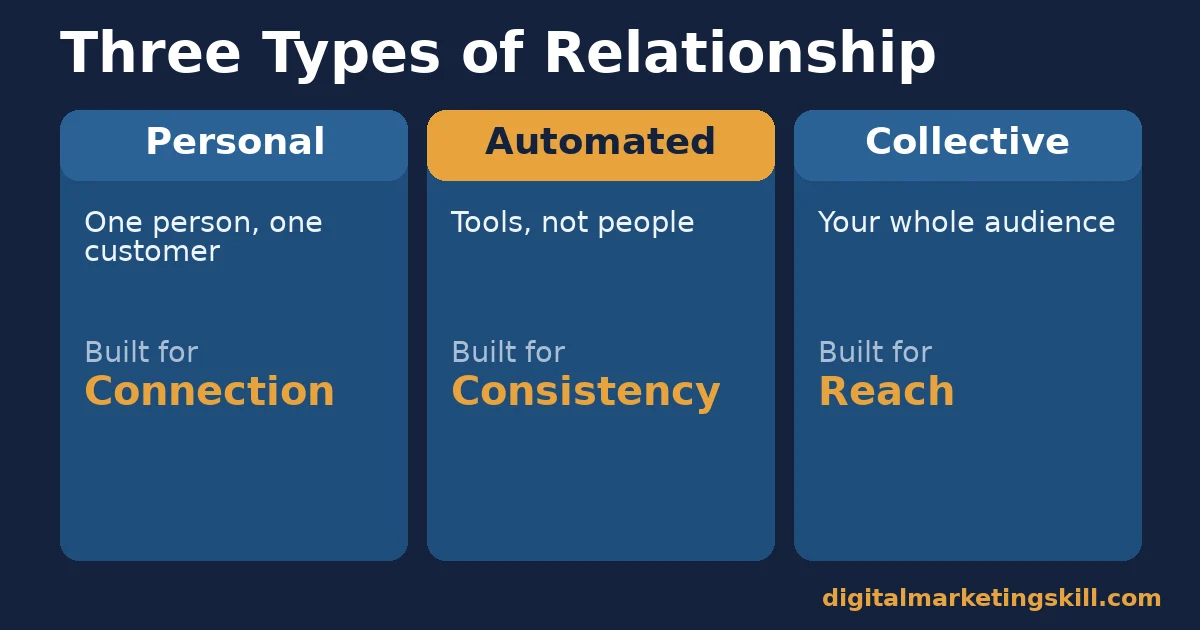
Every customer relationship a business builds falls into one of three categories: personal, automated or collective. Each works differently. So each needs its own approach, not one blanket strategy.
Personal Relationships: Built on Individual Contact
A personal relationship happens between one customer and one person at your company. It might be a direct phone call, a reply to an email or a conversation at checkout. These exchanges are the most convincing form of customer relations, because the customer feels individually recognised.
Personal relationships do not scale on their own. So they work best for your highest-value customers. They also suit moments that need a human voice, such as a serious complaint or a major purchase.
Automated Relationships: Built on Consistency
An automated relationship uses tools, not a person, to respond to a customer’s action. First, a welcome email after signup counts. So does a reminder before a renewal, or a chatbot answering a common question. The CRM or help desk software behind these messages does the repetitive work instead.
Automation cannot replace judgement. But it can guarantee that no customer is simply forgotten. A consistent automated touch, sent at the right moment, prevents a kind of silence. That silence makes customers assume you do not care.
Collective Relationships: Built on Shared Identity
A collective relationship is the one a brand builds with its whole audience, not with any one person. Newsletters, social media updates and public community spaces all contribute to it, after all. No individual customer is addressed directly. Yet the relationship still shapes how they feel about the brand.
Still, this is the slowest relationship to build, and the hardest to fake. It depends on consistency over a long period. A single clever post rarely changes how an audience feels about a brand.
How to Strengthen Each Relationship Type
Knowing the three types only helps if you act differently for each one. The sections below mirror the types above, with one practical move for each.
Personal Relationships: Lead With Real Context
First, give the person handling a personal interaction real context before they respond. Purchase history, past conversations and stated preferences all help here. A conversation feels continuous instead of starting from zero every time.
Also train for empathy, not just speed. Our guide to identifying your target audience helps clarify who these high-value, high-context conversations should prioritise first.
Automated Relationships: Lead With Timing, Not Volume
Instead, resist the urge to automate everything at once. A single, well-timed message beats five generic ones sent on a fixed schedule. Map the moments that matter most to a customer, such as a renewal date or a first purchase. Automate those first.
Keep automated messages honest about being automated when it matters. A customer who feels tricked by a fake-personal message trusts the brand less. A clearly automated, useful reminder works better.
Collective Relationships: Lead With Consistency Over Cleverness
Publish on a schedule your audience can learn, even a modest one. The content itself matters less than the reliability of showing up. Our guide to content distribution covers how to get that consistent output in front of people in the first place.
Also invite two-way participation where you can, through comments, polls or community spaces. A collective relationship that only broadcasts, and never listens, rarely feels like a relationship at all.
How to Measure Customer Relations
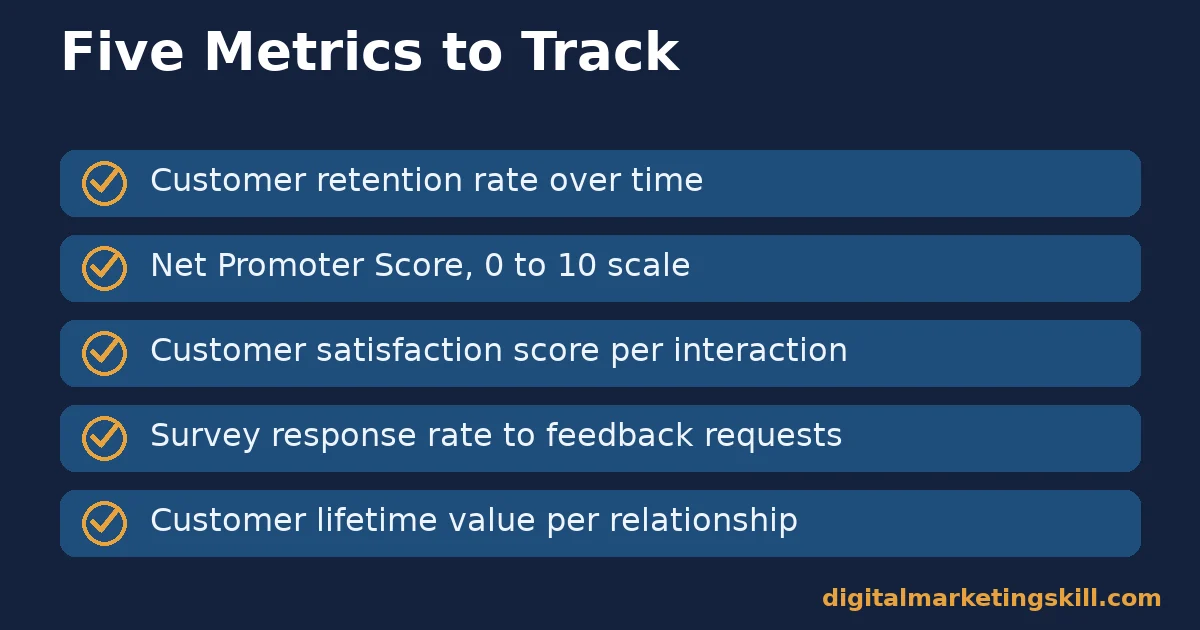
Customer relations succeeds when customers stay longer and cost less to keep happy. So measure retention and sentiment together, not either alone. Each metric below is defined in one sentence, with a note on how to read it.
Five Metrics That Show Real Customer Relations
- Customer retention rate. This is the share of customers who stay over a given period. So a rising rate is the clearest sign that proactive relations work is paying off.
- Net Promoter Score. This measures how likely customers are to recommend you, usually on a 0-10 scale. It is the metric behind the Bain research on the profit impact of retention.
- Customer satisfaction score. This captures how a customer rated a single, specific interaction, a figure tracked widely in customer service benchmarking. Use it alongside retention. A satisfied single interaction does not guarantee a loyal customer.
- Survey response rate. This is the share of customers who actually answer when you ask for feedback. In turn, a higher rate usually signals that customers believe you will act on what they say.
- Customer lifetime value. This estimates the total revenue a customer brings over the whole relationship, in other words. It is the number that proactive customer relations is ultimately trying to grow.
How to Read These Numbers Together
Read retention and sentiment side by side. A high satisfaction score with falling retention is a warning sign. Something outside individual interactions is driving customers away, such as price or a competitor. A low response rate with stable retention suggests customers are quietly tolerant, not genuinely loyal.
Instead, track the numbers by segment, not only as one company-wide average. Your highest-value customers can be quietly unhappy while the overall average still looks healthy.
The Most Useful Rule: Reach Out Before a Problem Forces You To
If you remember one decision rule from this guide, make it this one. Before investing more in customer service response times, check whether you are reaching customers proactively at all. A faster reply to a complaint helps less than a complaint that never needed to happen.
Here is an illustrative example, with invented numbers. A small software company has 500 customers. Its support team replies within an hour. Even so, 8% of customers leave every month.
So the team adds one proactive check-in email after 30 days of use. It also adds a short call to any customer who has not logged in for two weeks. Over three months, monthly churn falls to 5%, without a single change to the support process itself.
The lesson is about where the effort goes. Fast replies fix problems that were already reported. Proactive contact catches the ones that were never going to be.
A Four-Week Plan to Strengthen Customer Relations
You do not need new software to start. This plan takes about an hour a week.
- Week one: map your customer journey. List the key moments a customer experiences, from signup to renewal. Note which ones get no proactive contact today.
- Week two: add one personal touch. Pick your highest-value customer segment and send one genuinely personal message this week, not a template.
- Week three: fix one automated gap. Set up a single well-timed automated message for a moment identified in week one, such as a renewal reminder.
- Week four: ask for feedback properly. Send a short survey after a recent interaction. Commit to acting visibly on at least one piece of feedback you receive.
At the end of the month, compare retention rate and survey response rate with the month before. Keep whatever moved the numbers, and repeat the plan for the next customer segment.
Not every touchpoint deserves to stay. If a proactive email gets ignored for three months straight, cut it or rework the timing instead of sending it on habit. If a call script keeps getting the same tired response, rewrite it. Treat each touchpoint as a hypothesis to test, not a permanent fixture.
A Real Case: How HeidelbergCement Follows Up With Unhappy Customers
HeidelbergCement, the building materials company, built a customer relations programme around proactive follow-up rather than waiting for complaints. A case study published by the customer feedback platform CustomerGauge describes the programme. The company appointed “experience champions” at each local business unit to own the work.
The company reports response rates of over 70% on its customer surveys, well above typical industry benchmarks for unprompted feedback. Detractors and passives, the customers least likely to stay loyal, receive a personalised phone call. The call discusses their problem and how to recover their satisfaction.
The case is limited. It is one company’s own reported programme, in a single industry. The source does not quantify the resulting change in retention or revenue. Treat the response-rate figure as specific to HeidelbergCement. Still, the underlying principle generalises well. A dedicated owner and a direct call to the least satisfied customers get far more engagement than a generic survey.
Frequently Asked Questions About Customer Relations
What is the difference between customer relations and customer service?
Customer relations is proactive: a business reaches out before a problem happens. Customer service is reactive: it responds after a customer contacts you with an issue. Both matter, but customer relations is where most loyalty actually gets built.
Why does customer relations matter for profit, not just satisfaction?
Because the effect is large and measurable. Research cited by Harvard Business Review found that a 5% increase in retention raises profits by 25% to 95%. Loyal customers buy more and cost less to serve than new ones.
What are the three types of customer relationships?
There are three types: personal, automated and collective. Personal relationships involve one person and one customer. Automated relationships use tools to respond consistently. Collective relationships are built with your whole audience through content and community.
How much does it cost to acquire a new customer compared to keeping one?
Harvard Business Review’s analysis found that acquiring a new customer typically costs 5 to 25 times more than retaining an existing one. That is why proactive customer relations usually pays for itself.
Which metric best shows whether customer relations is working?
Customer retention rate is the clearest single signal, because it reflects actual behaviour rather than a stated opinion. Pair it with Net Promoter Score and customer lifetime value for a fuller picture.
Can small businesses build strong customer relations without a big team?
Yes. A single well-timed automated message matters more than headcount. So does a handful of genuinely personal calls to your best customers. Consistency over time beats a large but inconsistent effort.
How often should a business check in with customers proactively?
There is no universal schedule. But mapping key journey moments is a reasonable starting point, such as 30 days after signup or shortly before a renewal. Match the frequency to how often the customer actually interacts with you.
Does customer relations matter as much in B2B as in consumer businesses?
Yes, often more. A B2B customer usually represents a larger, concentrated amount of revenue, so losing one hurts more. Personal relationships carry extra weight in B2B, because fewer people make the buying decision and each one remembers how they were treated.
Start With Your Highest-Value Customers
Customer relations improves fastest when you reach out before a problem forces you to. First, pick your highest-value customer segment. Add one proactive touchpoint this month, and track retention rate for a quarter before expanding further. Our guide to earned media is a useful next stop. Loyal customers are often the source of the mentions and reviews that earned media depends on.
If you want guided practice building customer relationships professionally, Digital Marketing Skill Institute teaches these skills hands-on. The Master Diploma in Digital & AI Marketing is built from four AI-powered tracks, totalling ten courses. These include AI-powered lead generation and email automation, with a Full Stack option for completing all four.
It also comes with unlimited 1-on-1 coaching and mentoring, plus a U.S. Project Internship with a verified U.S. Work Reference Letter. The diploma is dual US and UK accredited and recognised in more than 100 countries. The programme is fully online, so you can study from anywhere in your country.
Find more guides on the Digital Marketing Skill Institute blog. When you are ready, apply for the Master Diploma or start from the Digital Marketing Skill Institute homepage.
Every figure in this guide was checked against its original source before publication. Figures marked as illustrative are invented examples, not real results.
