
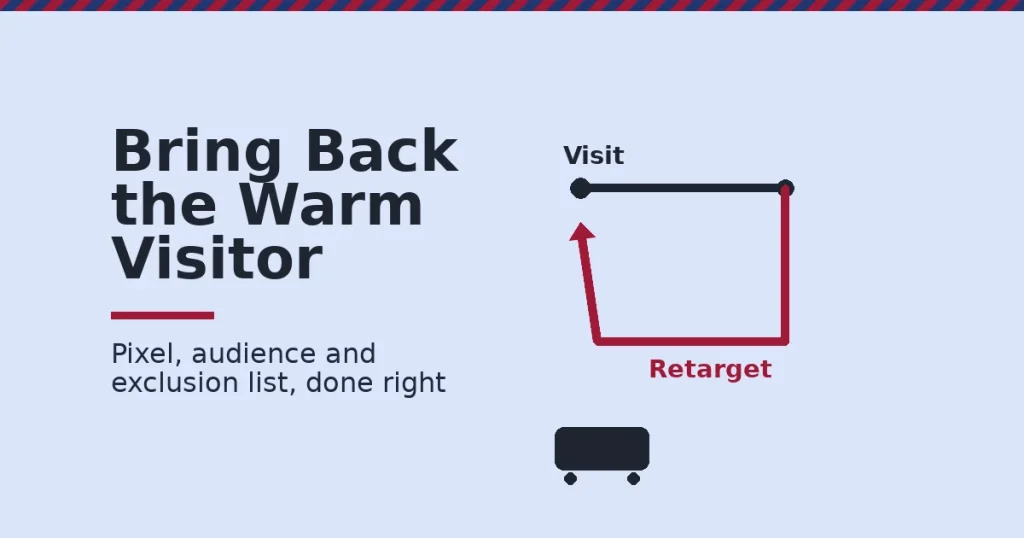
Facebook retargeting shows ads to people who already visited your site, app or page but did not complete an action. A pixel records the visit, a custom audience groups those visitors, and a campaign brings them back with a relevant ad. Used well, it recovers revenue that a first visit alone would have lost, without the cost of reaching a completely cold audience.
Key Takeaways
- The opportunity is large. The Baymard Institute’s meta-analysis of 50 studies puts average cart abandonment at 70.22%. Most site visitors who show buying intent still leave without purchasing.
- The top fixable reason is cost surprise. In the same Baymard research, 40% of shoppers who abandoned a cart, excluding those just browsing, cite extra costs at checkout. Shipping, tax and fees are the usual culprits.
- The potential audience is enormous. DataReportal counts more than 5.6 billion social media user identities worldwide. Even a narrow retargeting segment can reach a meaningful number of people.
- The mechanism is simple but has two required parts. Meta’s own documentation on website custom audiences confirms it: retargeting needs a working pixel and a defined custom audience before any ad can target past visitors.
- A real, published case shows the scale possible. Criteo reports that UK retailer New Look saw a 93% year-over-year revenue increase using dynamic retargeting. Its cost of sale also fell, from 19% to 14%.
The same narrow-audience, fast-launch logic carries over to LinkedIn retargeting, if your buyers are more active there than on Facebook.
In this guide
- What Most Facebook Retargeting Advice Skips
- How Facebook Retargeting Actually Works
- What Differs by Audience Type
- How to Lead Each Audience Type
- How to Measure Facebook Retargeting
- The One Rule: Always Exclude Converters
- A Real Case: How New Look Scaled Dynamic Retargeting
- Frequently Asked Questions About Facebook Retargeting
- Start With One Exclusion List and One Audience
What Most Facebook Retargeting Advice Skips
Most guides explain how to click through the ad setup screens. They rarely explain why most retargeted visitors still do not convert. They rarely explain how to avoid annoying the people you are trying to win back, which is the fastest way to turn a warm audience cold.
This guide covers the mechanism first. Then it covers what differs between a cart-abandoner audience and a past-customer audience. It shows how to measure results, and the one rule that keeps retargeting from working against you.
A ground rule first. The Baymard figure is a meta-analysis across many studies and store types. Treat it as an industry-wide pattern, not a prediction for your store. The New Look case is one retailer’s result from a long vendor relationship with Criteo, reported by the vendor. Read it as a demonstration of scale, not a guaranteed outcome.
How Facebook Retargeting Actually Works
Retargeting runs on a simple loop. A visitor reaches your site. A pixel records what they did. That data builds a custom audience of people who showed interest but did not finish. Ads are then shown to that audience as they continue browsing Facebook and Instagram.
The loop only works if each part is built correctly. A missing pixel means no data, a badly defined audience means the wrong people see the ad, and a generic ad means even the right audience ignores it. Each weak link breaks the whole chain, not just its own step.
The Mechanism: Pixel, Audience, Campaign
Meta’s own documentation on website custom audiences confirms two required building blocks. The first is a working pixel installed on your site. The second is a custom audience built from specific events, such as page views, add-to-cart actions or completed purchases.
Once both exist, a campaign can target that audience with ads shaped by what they did. Someone who viewed a product but did not buy sees a different message than someone who already purchased. The second group might be shown something new, not a repeat of what they already own.
Setting up the pixel is a one-time technical step, usually handled by whoever maintains the website. Building the audience and writing the ad is the ongoing marketing work, and it is where most of the difference between a weak and a strong campaign shows up.
Most audience definitions use a lookback window, a set number of days during which a visit still counts. A short window, such as seven days, keeps the audience focused on recent, fresher intent. A longer window, such as thirty or ninety days, grows the audience but dilutes how warm it is on average.
Why Cart Abandonment Is the Core Opportunity
Retargeting earns its budget mainly by recovering abandoned intent. Baymard’s meta-analysis of 50 independent studies found an average cart abandonment rate of 70.22%. That figure has held roughly steady for over a decade.
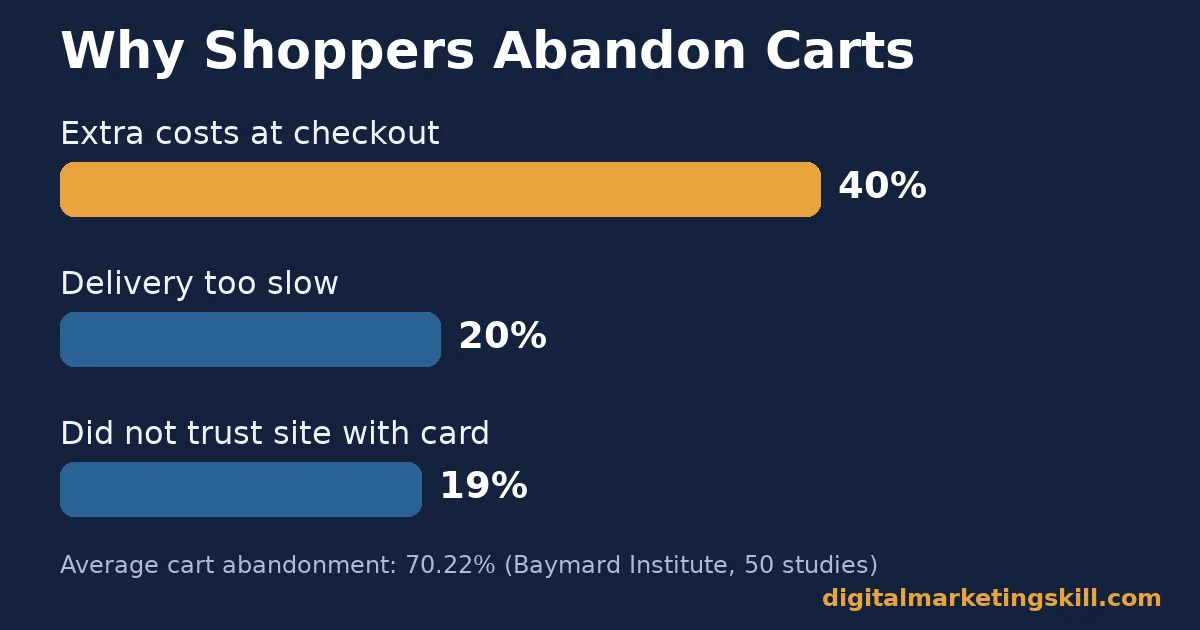
The same research breaks down why shoppers leave. Among those not just browsing, 40% cite extra costs appearing at checkout. 20% cite slow delivery. 19% cite not trusting the site with card details. Retargeting cannot fix a slow checkout on its own, but it can bring a visitor back once the underlying problem is addressed.
Five Facebook Retargeting Mistakes That Waste Budget
Most weak Facebook retargeting campaigns share a small set of avoidable problems. Checking a campaign against this list before launch catches most of them early, and revisiting it monthly catches problems that develop after launch.
- No exclusion list. Without one, converters stay in the audience and keep seeing ads for something they already bought.
- One audience for everyone. Treating a cart abandoner the same as a past customer wastes the relevance that made retargeting worth doing.
- Creative left unchanged for months. The same image and copy, shown to the same people for too long, is a common cause of rising frequency without rising results.
- A lookback window that is too long. A ninety-day window on a fast-moving product category fills the audience with people who have lost interest.
- No separate budget tracking. Blending retargeting spend into a single account-wide number hides whether this specific tactic is paying for itself.
What Differs by Audience Type
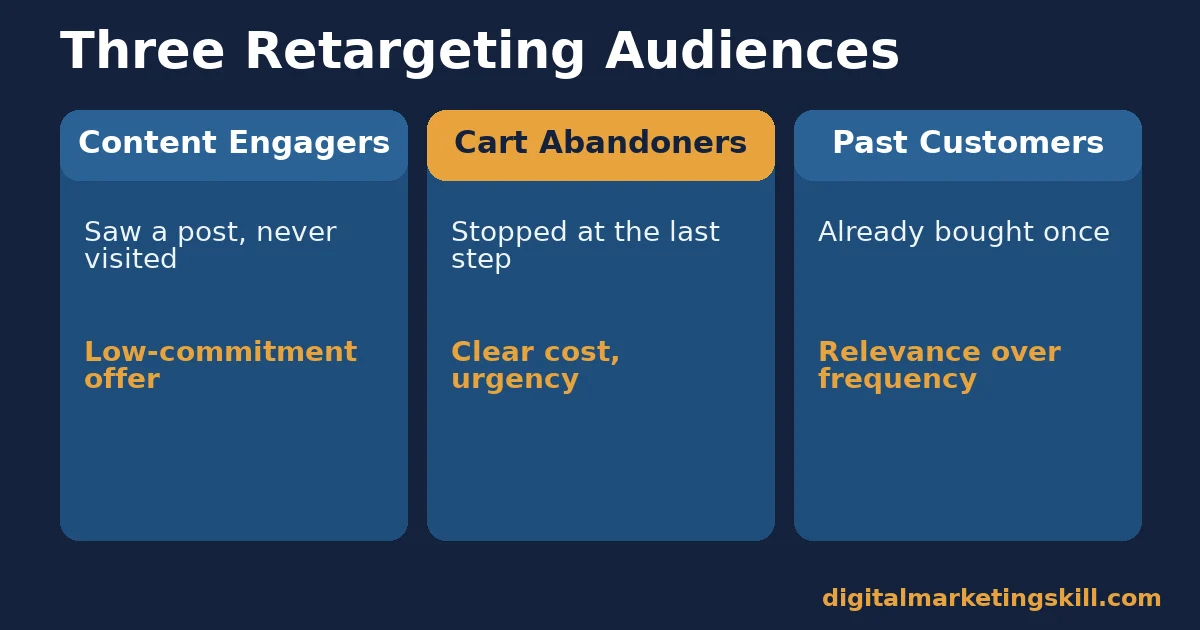
Not every retargeting audience wants the same message. A cart abandoner and a past customer are both warm, but they need different creative and a different offer.
Cart Abandoners: Built for a Quick Nudge
This audience showed strong intent and stopped at the last step. They usually need a small push: a reminder of what they left, a clear total cost, or a modest, time-limited incentive. Of the three audience types covered here, this one tends to convert fastest, since the gap between interest and action is already smallest.
Patience matters less here than speed. A cart abandoner’s intent fades fast. The first retargeting ad should appear within a day or two of the visit, while the product is still fresh in their mind.
Past Customers: Built for Repeat Purchase
This audience already trusts you enough to buy once. The goal shifts from closing a single sale to building a habit. Related products, replenishment timing and loyalty offers all serve that goal better than a repeat of the same ad. Timing the offer to when the first purchase is likely to run out, or to when a complementary product becomes useful, usually beats a fixed weekly schedule.
Speed matters less here, and relevance matters more. A past customer ignored at the wrong moment, right after a purchase, is more likely to feel pestered than tempted.
Content Engagers: Built for an Earlier Nudge
This audience watched a video, liked a post or opened an Instant Experience, but never actually visited the website. They are warmer than a cold stranger, but colder than a cart abandoner, since nothing on their end confirmed buying intent yet.
The job here is to move them one step closer to the site, not to ask for a purchase outright. A softer offer, a product guide or a first-visit discount, usually works better than a hard sales message aimed at this group.
How to Lead Each Audience Type
The two audiences above need different campaign habits once you are ready to launch. Match the habit to the audience, not the other way round.
Cart Abandoners: Lead With Clarity and Urgency
Show the exact product left behind. State the full cost clearly. Give one reason to act now. Cost surprise is the single biggest cited reason for abandonment, so a message that removes that surprise, free shipping over a threshold, or a clear total, often outperforms a generic ad. Our guide to copywriting formulas and headlines covers how to write that short, clear ad message.
Keep the window short. Most of this audience’s intent is gone within a week. A campaign built to run for months on the same message wastes spend on people who have already moved on.
Past Customers: Lead With Relevance Over Frequency
Segment by what they bought. Show something genuinely related rather than the same product again. A repeat-purchase audience responds better to a new idea than to a reminder of something they already own. Group past customers by product category rather than treating them as one block, so a buyer of one item sees a genuinely relevant suggestion rather than a generic catalogue ad.
For the product and messaging side of this, our guide to Facebook marketing strategy covers how retargeting fits into the wider organic-and-paid mix. Our guide to landing page optimization covers the page the ad sends people to.
Content Engagers: Lead With a Low-Commitment Offer
Give this audience a reason to visit the site for the first time, rather than asking them to buy on the spot. A free guide, a short quiz or a first-order discount all lower the bar enough for a curious but unconfirmed visitor to click through.
Treat this as a feeder audience for the other two. Once a content engager visits the site and takes an action the pixel can see, they graduate into the cart-abandoner or past-customer audience, where more direct messaging belongs. Budget for this audience should stay modest relative to the other two, since the conversion path is longer and less certain.
How to Measure Facebook Retargeting
A retargeting campaign produces specific numbers worth tracking beyond the usual click metrics. Each term below is defined in one sentence, with a note on how to read it.
- Click-through rate. The share of people shown the ad who clicked it. Retargeting audiences typically click more than cold audiences, since they already know the brand.
- Frequency. The average number of times one person saw the ad over a set period. Rising frequency with flat results is an early sign of ad fatigue.
- Cost per acquisition. Total spend divided by the number of resulting purchases or sign-ups. Compare it against the value of the original abandoned action, not just against other campaigns.
- Return on ad spend. Revenue generated for every dollar spent on the retargeting campaign specifically. Keep it separate from prospecting campaigns, so the two do not get credit for each other’s results.
- View-through conversions. Purchases that happened after someone saw but did not click the ad. Counting these alongside click conversions gives a fuller, though less certain, picture of impact.
How to Read These Numbers Together
Watch frequency and cost per acquisition together. If frequency climbs while cost per acquisition also climbs, the audience is seeing the ad too often without acting. It is time to refresh the creative or shrink the audience. A frequency of two or three over a week is usually comfortable; much higher than that, and even a good ad starts to feel like a nuisance.
Read return on ad spend for retargeting on its own, not blended with prospecting campaigns. Retargeting usually shows a stronger return, since the audience was already close to buying. Blending the two numbers hides how much each campaign type actually contributes.
The One Rule: Always Exclude Converters
If you remember one decision rule from this guide, make it this one. Every Facebook retargeting campaign needs an exclusion list that removes anyone who already completed the action the ad is asking for. This setting is available directly inside custom audience creation, so there is no technical reason to skip it.
Here is an illustrative example, with invented numbers. A store runs a cart-abandoner campaign without an exclusion list. Over a month, 18% of its ad spend goes to people who already purchased the item shown, since they remain in the audience after converting. Adding a simple exclusion rule cuts wasted spend by roughly that same share. The freed budget then goes to people who have not converted yet.
The same principle applies beyond purchases. An email sign-up form, a newsletter subscription or a completed contact request are all actions worth excluding once someone has taken them, so the campaign always targets people who still have a reason to see the ad.
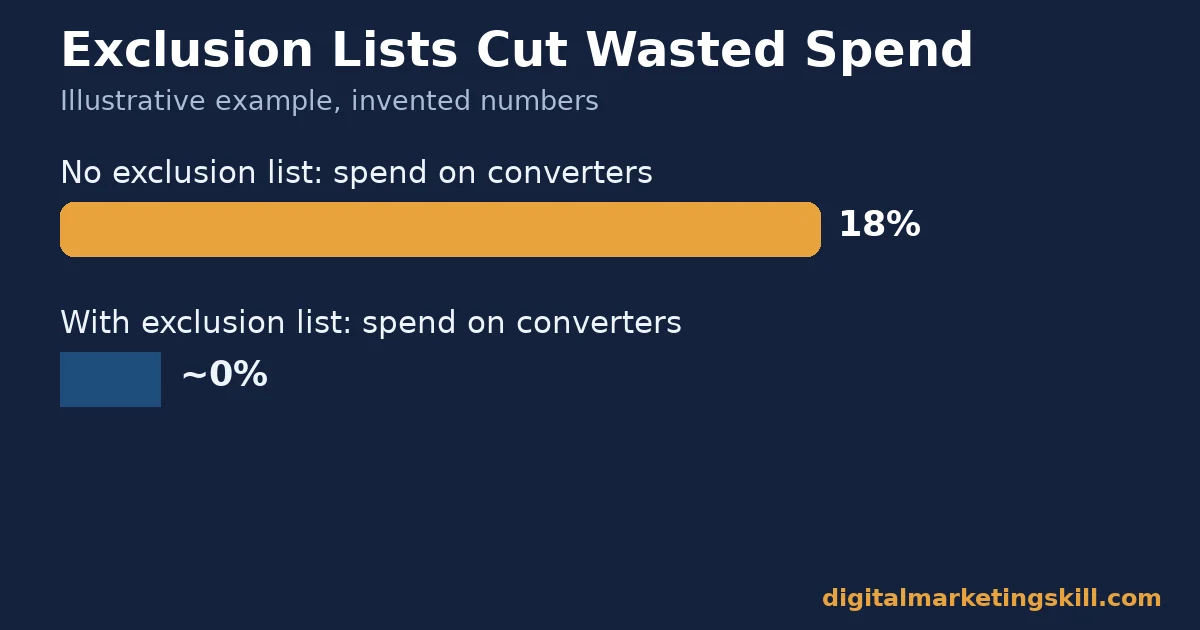
The lesson is about hygiene, not creativity. An exclusion list is one setting, checked once at campaign setup and revisited occasionally. Yet it is one of the few changes that reduces wasted spend without touching the ad itself.
A Real Case: How New Look Scaled Dynamic Retargeting
New Look, a UK fashion retailer, worked with the retargeting platform Criteo over several years. Together they refined a dynamic retargeting approach across online and mobile advertising, showing shoppers ads built from the specific products they had viewed. The same core idea, matching the ad to the exact product a visitor looked at, applies equally to a Facebook retargeting campaign built directly in Meta Ads Manager.
Criteo reports that the partnership delivered a 93% year-over-year increase in revenue and a 23% increase in traffic. Cost of sale fell from 19% to 14%, a relative drop of about 26%. Dynamic retargeting, ads automatically built from the exact products a visitor viewed, was central to that result.
Treat these figures as one retailer’s result, published by the vendor that ran the campaign. They come from a multi-year relationship, not one isolated test. The transferable part is the method: ads built from specific product views tend to perform better than one generic retargeting message, and they perform best the more precisely they match what a visitor actually looked at.
Scale is also part of the story. New Look is a large, established retailer with years of accumulated visitor data feeding its audiences. A smaller site will not reach the same volume of retargeting traffic, but the underlying principle, specific creative beaten generic creative, holds at any size.
Frequently Asked Questions About Facebook Retargeting
What is Facebook retargeting?
Facebook retargeting shows ads to people who already visited your website, app or Facebook page but did not complete an action. It uses a pixel to track the visit and a custom audience to group those visitors for future ads.
How do I set up Facebook retargeting?
Install the Meta Pixel on your site. Create a custom audience based on website events, such as page views or add-to-cart actions. Then build a campaign that targets that audience with relevant ads.
Does Facebook retargeting automatically happen?
No. An advertiser must install the pixel, define a custom audience and launch a campaign. Without these steps, no retargeting ads are shown, no matter how many people visit the site. The setup takes time once, then runs in the background for every future visitor.
How soon should a retargeting ad appear after a visit?
For cart abandoners, within a day or two, while intent is still fresh. For past customers being offered something new, timing matters less than relevance to what they already bought.
How do I stop retargeting ads from annoying past customers?
Exclude anyone who already completed the action the ad is asking for. Cap how often one person sees the same ad, and rotate creative so the same message does not repeat for weeks.
Is Facebook retargeting worth it for a small business?
Often yes. The audience is smaller but already warm, which usually means a lower cost per result than cold prospecting. Start with a single cart-abandoner campaign before adding more audience segments.
What budget do I need to start Facebook retargeting?
There is no fixed minimum, since the audience is usually much smaller than a cold prospecting audience. Start small, with enough budget to reach your cart-abandoner audience a few times over a week, then scale once cost per acquisition looks healthy.
How long should a lookback window be for Facebook retargeting?
It depends on how fast your product’s buying decision usually happens. A short window, around seven days, suits fast purchases like everyday retail. A longer window, around thirty to ninety days, suits considered purchases like furniture or travel, where the decision naturally takes longer.
Start With One Exclusion List and One Audience
Facebook retargeting works best when the mechanism is set up correctly, the audience is split by intent, and converters are excluded before the budget is wasted on them. Install the pixel, build one cart-abandoner audience, add the exclusion list, and measure cost per acquisition against your prospecting campaigns before expanding further. Add the past-customer and content-engager audiences only once that first campaign is reliably profitable.
If you want structured practice building campaigns like this, Digital Marketing Skill Institute teaches these skills hands-on. The Master Diploma in Digital & AI Marketing is built from four AI-powered tracks. They cover social media management and advertising, lead generation and email automation, Google specialism, and WordPress and SEO. Together they total ten courses, with a Full Stack option for completing all four.
The diploma comes with unlimited 1-on-1 coaching and mentoring, plus a U.S. Project Internship with a verified U.S. Work Reference Letter. It is dual US and UK accredited and recognised in more than 100 countries. The programme is fully online, so you can study and run real ad campaigns from anywhere in your country.
Browse more guides on the Digital Marketing Skill Institute blog, and when you are ready, apply for the Master Diploma or start from the Digital Marketing Skill Institute homepage.
Every figure in this guide was checked against its original source before publication. Figures marked as illustrative are invented examples, not real results.
