
Database marketing turns scattered customer records into campaigns that fit the person reading them. Done well, it means fewer wasted emails and more offers people act on. This guide covers how database marketing works. It explains what separates consumer from business approaches. It also shows how to measure whether it is paying off.
Key Takeaways
- Companies that grow faster than their peers get 40% more of their revenue from personalization built on customer data (McKinsey research, reported by Martech).
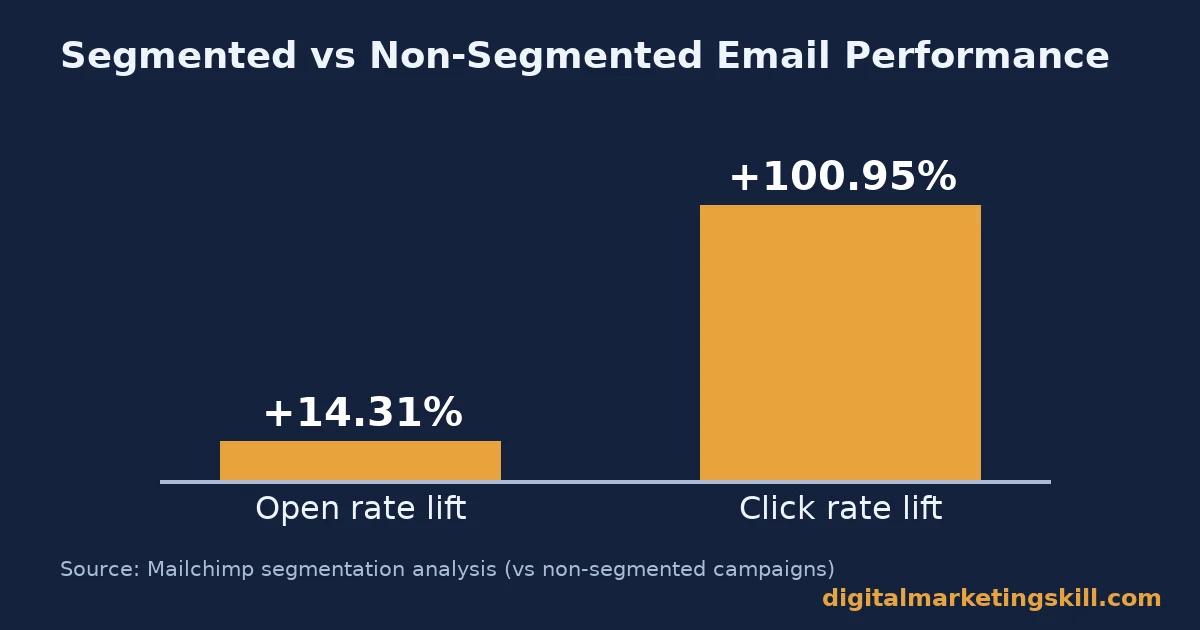
- Segmented email campaigns, a core database marketing tactic, see a 14.31% higher open rate and a 100.95% higher click-through rate than non-segmented sends (Mailchimp data).
- 73% of customers expect companies to understand their individual needs, based on a global study of over 13,000 consumers (Salesforce research).
- Poor data quality costs the average organization an estimated $12.9 million a year, based on a Gartner survey of data-quality software customers.
- Cumulative GDPR fines have passed €7.1 billion since the regulation took effect, a reminder that database marketing carries real compliance stakes.
In this guide
- What Most Database Marketing Guides Skip
- How Database Marketing Actually Works
- What Differs By Database Marketing Type
- How To Get More From Each Database Marketing Type
- The Data Foundation Both Types Depend On
- Measuring Whether Database Marketing Is Working
- The One Decision Rule Worth Highlighting
- What Doing This Right Looks Like
- Frequently Asked Questions About Database Marketing
- Turn Your Customer Data Into Campaigns People Act On
What Most Database Marketing Guides Skip
Most guides list benefits and stop there. They skip the harder question. Which data should you collect first? How do you know your database marketing is actually working, not just running? This guide answers both.
Ground rules: every figure below names its source and sample, because that lets you judge how far to trust it. A benchmark from one vendor’s customer base is a useful signal, but it is not a law for your business. Treat every number here as a comparison point, not a promise. A small retailer and a global brand can read the same report and still get different results, since list size, product category and starting data quality all change the outcome.
That is not a reason to ignore the numbers. It is a reason to treat them as a starting estimate you confirm with your own results, not a target you assume you will hit automatically.
How Database Marketing Actually Works
Database marketing is the practice of using stored customer data to build targeted campaigns. You collect information, such as purchases, browsing and demographics. You organize it in a system. Then you use it to decide who gets which message.
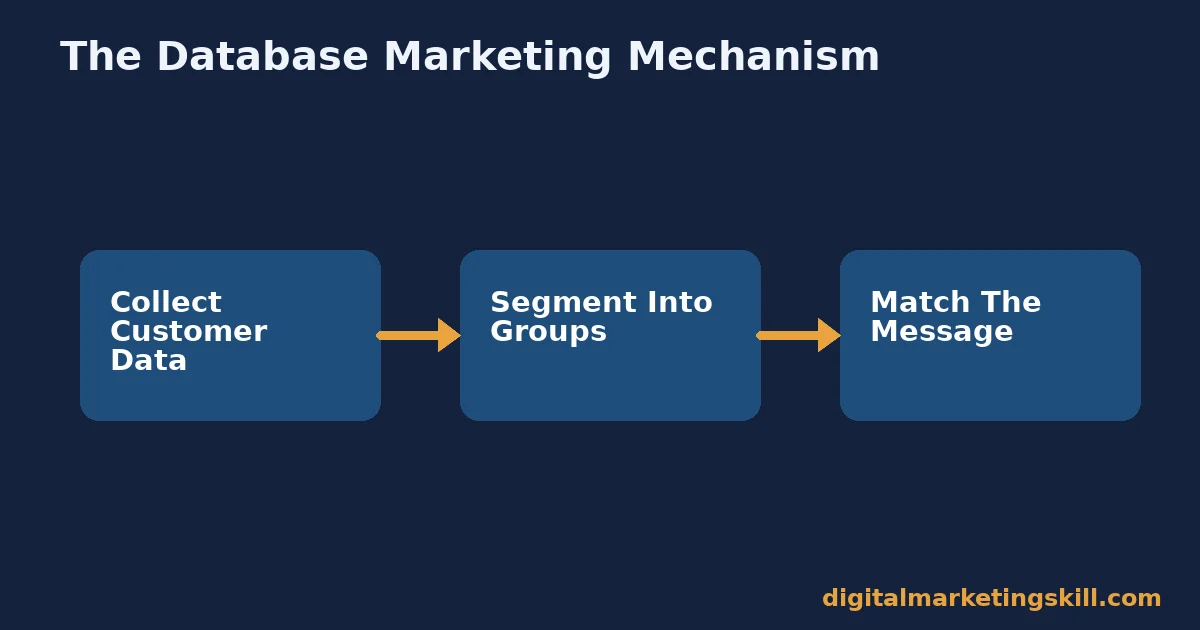
The mechanism has three steps. First, you collect data through forms, purchases and site behavior. Second, you segment customers into groups with something meaningful in common, such as purchase frequency or product category. Third, you match each segment to a message built for its specific situation, not a generic blast.
Each step depends on the one before it. Weak data collection means weak segments. You cannot group customers by a signal you never captured. Weak segments mean generic messaging, even when the campaign technically uses database marketing tools. The quality of the first step sets a ceiling on everything after it. That is why teams who buy software before fixing collection usually end up disappointed. The tool cannot create a signal nobody captured.
Done across every touchpoint at once, this becomes part of a wider omnichannel marketing approach. The database keeps the message consistent whether the customer is on email, on-site or in an app. Every channel reads from the same underlying record, instead of guessing independently.
A customer relationship management (CRM) system usually holds the data. Database marketing is the tactic that uses it. Think of the CRM as the filing cabinet. Database marketing is what you do with the files: pulling the right one out at the right moment, not just storing it.
What Differs By Database Marketing Type
Consumer Database Marketing: Built For Volume
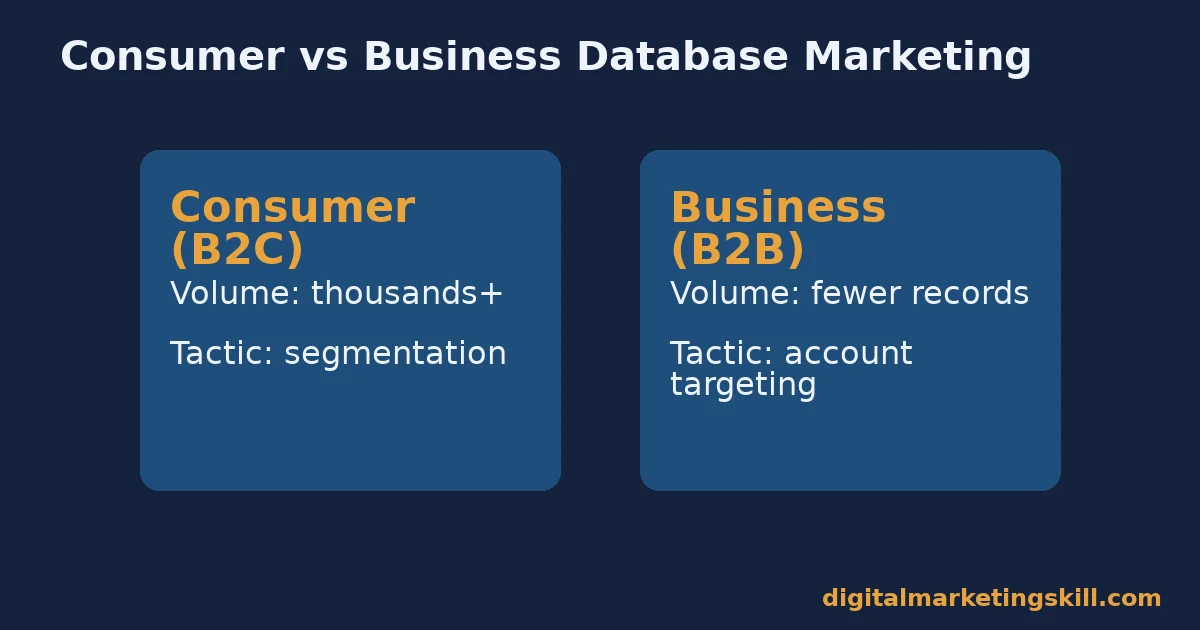
Consumer database marketing targets individual buyers (B2C), usually at high volume. You work with demographics, shopping habits and site activity across thousands or millions of records. The goal is relevant messaging at scale, not a one-to-one relationship with every single buyer.
Typical tactics include segmented email offers, loyalty rewards and triggered messages. An abandoned-cart reminder sent a few hours after someone leaves your site is a common example. Segmentation is what makes these work, because a broadcast email to your whole list performs worse than the same offer sent only to people who already showed interest in that category. That is not a small difference in theory; it shows up directly in the open and click numbers you track later. The message matches something the recipient actually did, instead of a guess about who they might be.
Fast-growing companies lean on this harder than slower ones. Companies that grow faster than their competitors generate 40% more of their revenue from personalization built on this kind of data, as reported in Martech’s roundup of McKinsey’s personalization research. That gap did not happen by accident. It is the compounding effect of many small, correctly targeted messages, not one broad one.
Business Database Marketing: Built For Depth
Business database marketing (B2B) targets companies, not individuals, and trades volume for depth. A B2B database tracks fewer records. Each one carries more detail: company size, buying committee, past deals and renewal dates.
Account-based marketing is the clearest example of this depth in action. Instead of segmenting thousands of people into broad groups, you build a campaign around one named account. The content is often built specifically for that company’s situation. It references a real initiative rather than a generic industry pain point.
The tactic only works because the database holds enough detail to make that level of customization worthwhile. A thin record with just a company name and a generic email address cannot support account-based marketing. The approach needs depth, not just a name. It pairs naturally with a broader B2B marketing strategy, since account-based campaigns need the same sales and marketing alignment that B2B programs already require.
How To Get More From Each Database Marketing Type
Consumer Database Marketing: Lead With Segmentation
Start by splitting your list into a handful of groups, not dozens. Purchase recency, product category and engagement level are enough to begin. Too many segments slow you down without adding much accuracy. Each extra segment needs its own message, and small segments rarely have enough volume to tell you anything reliable.
Segmented campaigns consistently outperform generic ones on open and click rates. Mailchimp’s own analysis of segmentation found segmented sends get a 14.31% higher open rate and a 100.95% higher click-through rate than non-segmented ones. That gap grows further when the segment reflects an actual behavior, such as “bought once, never returned,” rather than a demographic guess like age range alone. Behavior predicts future behavior better than demographics do.
Business Database Marketing: Lead With Account Targeting
Pick a short list of named accounts before building any content. Research each one enough to reference their actual situation, not a generic industry pain point. A campaign that names a real initiative or event the account cares about converts better than a generic one. The reader can tell within one sentence whether you actually looked at their business.
Keep the account list small enough that your team can research each one properly. Ten well-researched accounts usually outperform a hundred generic ones, because the depth of the research is what makes the personalization believable rather than cosmetic. A longer list with shallow notes just produces more emails that sound the same.
The Data Foundation Both Types Depend On
Every database marketing tactic above depends on data that is accurate, current and legally collected. Skip this step and even a well-designed campaign sends the wrong message to the wrong person. Or it triggers a compliance complaint. The tactics get the attention. The foundation decides whether they work at all.
Three practical habits protect the foundation:
- Clean on a schedule. Remove duplicates and fix obvious errors monthly, not once a year. Stale data compounds, and the fix gets harder the longer you wait. Every campaign you run on bad data adds new errors on top of the old ones.
- Collect only what you will use. Every extra field is a privacy liability with no marketing payoff if nobody ever segments on it. A long sign-up form does not build a better database. It just makes people abandon the form.
- Document your consent basis. Record how and when each person opted in. Under GDPR in the EU and CCPA in California, among other regional data laws, you need to show this on request, not reconstruct it after the fact.
Good data-driven marketing practice and good database hygiene are the same discipline, applied at different stages. One decides what to do with the data. The other keeps the data worth acting on. Neither works well without the other.
Poor data quality is not a minor inconvenience. Gartner’s research, reported by Actian, puts the average cost of bad data at $12.9 million a year. That figure comes from a survey of 154 customers of data-quality software, so the sample skews toward companies already serious about the problem. A smaller team’s cost will differ, but the direction is the same: dirty data is expensive, not harmless.
Compliance adds another layer of cost to getting this wrong. Cumulative GDPR fines have passed €7.1 billion since the regulation took effect, according to enforcement tracking reported by Kiteworks. Most of those fines trace back to sloppy consent records, not exotic new violations. The fix is boring paperwork. That is exactly why it gets skipped.
Measuring Whether Database Marketing Is Working
Track a small set of KPIs that show whether segmentation is actually changing outcomes, not just whether campaigns go out on schedule:
- Segment lift: the difference in open, click or conversion rate between a segmented send and a generic one to the same list. No lift means the segment is not meaningfully different from the whole list, and the extra work of splitting it was wasted.
- Customer retention rate: the share of customers who are still active after a set period. Database marketing should move this number, since its core promise is stronger relationships, not just more clicks on a single email.
- Cost per acquired record: what it costs to add one new, usable contact to the database. Compare this across channels to see which one is actually worth the spend. A good marketing automation tool can track most of these numbers once your segments are set up.
- Data accuracy rate: the share of records that pass a basic validity check, such as a valid email format with no obvious duplicates. A falling accuracy rate warns you early that campaigns built on that data will underperform.
Customer expectations make this measurement step non-optional. 73% of customers expect companies to understand their individual needs. That figure comes from a global study of more than 13,000 consumers and nearly 4,000 business buyers, reported in Salesforce’s research on customer needs. Running database marketing without measuring whether it meets that expectation means you cannot tell whether you are closing that gap, or just adding noise.
Worked example (illustrative, invented numbers): a team segments its list into “recent buyers” and “lapsed buyers” instead of sending one broadcast. The recent-buyer segment converts at 6%. The lapsed segment converts at 1.2%. By comparison, the old broadcast had converted at 2.5% blended.
The blended number hid a real split. One segment was underperforming; the other was overperforming. Acting on the blended average alone would have led the team to the wrong fix: probably a generic rewrite of the whole email, when the real issue was sending one message to two very different audiences.
The One Decision Rule Worth Highlighting
If you fix one thing, fix this: never add a new data field to your database unless you can name the specific segment or campaign it will power. Data collected “just in case” sits unused. It adds privacy risk. It slows down the system, without ever improving a single campaign. Every field should trace to a decision you will actually make.
Illustrative example (invented numbers, not a real campaign): a team adds a “favorite color” field to its sign-up form because a competitor has one. Six months later, nobody has built a single campaign that uses it, but every new sign-up still has to fill it in, and the field sits in every data export, every backup and every compliance audit for no marketing reason. The fix is not a better database tool. It is deleting the field and asking the same question of every field already there.
What Doing This Right Looks Like
A few public examples show the mechanism at scale. Amazon’s product recommendations draw on purchase history, browsing behavior and items left in a cart. They suggest what a shopper is likely to want next, which is database marketing applied right at the point of purchase.
Spotify uses listening data to build personalized playlists and timed messages, including birthday-linked recommendations. Raw listening history becomes a reason to open the app again.
Netflix analyzes viewing behavior and ratings to recommend what to watch next, which is one of the reasons the platform gives for keeping subscribers engaged over time. None of these companies guess at what a customer wants, because they read the database first.
That is the pattern worth copying, not the specific recommendation engine or the exact playlist feature. None of these companies started with a perfect dataset either; they started by capturing one signal, acting on it, then adding the next one once the first proved useful. Start with the question “what does this record already tell me,” before you decide what to build on top of it.
Frequently Asked Questions About Database Marketing
What is database marketing?
Database marketing is the practice of collecting, organizing and analyzing customer data to build targeted marketing campaigns, instead of sending the same message to everyone on a list.
What is the difference between CRM and database marketing?
A CRM system stores and manages customer interactions across sales, service and marketing. Database marketing is a specific tactic that uses the data inside a CRM, or any customer database, to build targeted campaigns. In short, the CRM is the system of record, while database marketing is one of the things you do with what that system holds.
What are the two main types of database marketing?
Consumer database marketing (B2C) targets individual buyers at volume, using demographics and behavior. Business database marketing (B2B) targets named companies in smaller numbers, with more depth per record.
How do you start a database marketing program with no existing data?
Start by collecting only what powers one specific campaign, such as an email address and a product category interest. Grow the fields you collect as you prove each one changes a decision, rather than gathering everything up front. A spreadsheet with ten clean rows beats a database with ten thousand messy ones, because you can actually trust and act on every row in the small, clean version.
Is database marketing the same as email marketing?
No. Email is one channel database marketing can use. Database marketing also drives personalized ads, loyalty offers, account-based outreach and on-site recommendations. Email is just one delivery method among several, and the same underlying segment can power all of them at once if your systems are connected.
How often should a marketing database be cleaned?
Monthly is a reasonable default for an active list. Waiting longer lets errors and duplicates compound, which means the eventual cleanup gets more expensive, and the campaigns running on bad data stay less effective in the meantime. A quick monthly pass, by contrast, keeps the fix small and routine instead of a quarterly fire drill.
Does database marketing work for small businesses?
Yes. A spreadsheet with purchase history and basic segments is a legitimate starting database. The mechanism, matching a message to a real pattern in the data, works the same way at any size, even before you need dedicated software.
What is the biggest mistake teams make with database marketing?
Collecting data without a plan for using it. A database full of fields nobody segments on adds privacy risk and storage cost without improving a single campaign, so the biggest fix is usually subtraction, not addition. Audit your fields the same way you would audit a budget line: if nobody can say what decision it informs, it should not still be collected.
Turn Your Customer Data Into Campaigns People Act On
Pick one segment this month. Build one campaign specifically for it. Compare its performance to your usual broadcast. Measure the lift, not just whether it went out on time. Write down what you expected before you see the results, so next month’s review has a clear baseline instead of a vague memory of what you hoped would happen.
If you want structured practice building and measuring real database marketing campaigns, the Master Diploma in Digital & AI Marketing runs four AI-powered tracks built from ten execution-first courses, including AI-Powered Lead Generation and Email Automation, with a Full Stack option to complete all four.
Every track includes unlimited 1-on-1 coaching and mentoring, plus a U.S. Project Internship with a verified U.S. Work Reference Letter. The diploma is dual US and UK accredited and recognised in more than 100 countries, 100% online. You can study and apply it anywhere in your country.
Explore the full program and apply here. Browse more guides on the Digital Marketing Skill Institute blog, or start wherever you are at digitalmarketingskill.com. Student outcomes are shared on the reviews page for a closer look. Learn more at digitalmarketingskill.com.
Every figure in this guide was checked against its original source before publication. Figures marked as illustrative are invented examples, not real results.
