
Brand advertising builds recognition, trust and memory structures for a brand over time, rather than asking for an immediate click or sale. It works alongside performance advertising, not instead of it. Most businesses under-invest in it, because its payoff shows up slowly and is harder to track than a last-click conversion.
Key Takeaways
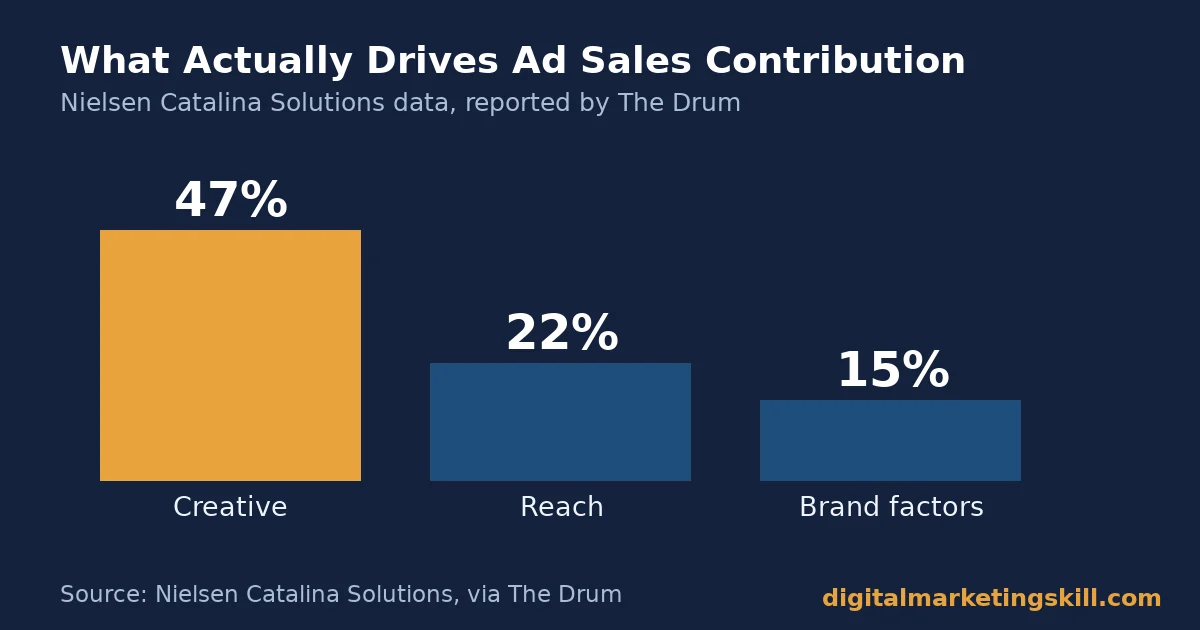
- Creative quality drives most of the result. Nielsen Catalina Solutions research, reported by The Drum, found creative accounts for 47% of a campaign’s sales contribution, ahead of reach at 22% and brand factors like price and penetration at 15%.
- The right split is roughly 60:40. Les Binet and Peter Field’s IPA effectiveness research, built from the IPA’s long-running case databank, points to a 60:40 split: about 60% of budget on long-term brand building, 40% on short-term activation.
- Brands still pay a premium for mass reach. A 30-second Super Bowl spot now costs around $8 million, a figure the broadcast network confirmed, showing how much weight brand advertisers still put on reaching a mass audience at once.
- A well-known case shows the pattern. John Lewis reported 6.9% overall Christmas sales growth in the period around its “bear and hare” advert, which drew more than 11.5 million YouTube views and sold out related merchandise.
In this guide
- What Most Brand Advertising Advice Gets Wrong
- How Brand Advertising Actually Earns Its Return
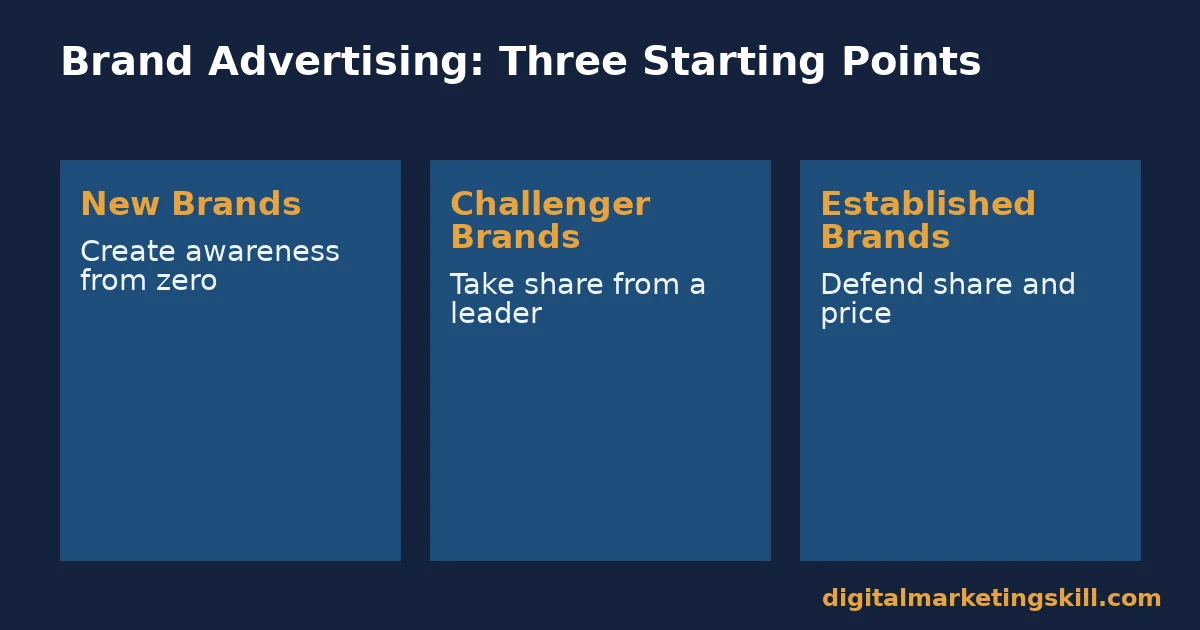
- Brand Advertising Serves Three Different Starting Points
- How to Build the Right Brand Advertising Approach
- Five Reasons Brand Advertising Budgets Get Wasted
- How to Measure Whether Brand Advertising Is Working
- The One Rule: Fund Brand Building Like It Compounds, Not Like a Campaign
- A Real Case: John Lewis and a Single Memorable Idea
- Frequently Asked Questions About Brand Advertising
- Turn Brand Advertising Into a Skill You Can Prove
What Most Brand Advertising Advice Gets Wrong
Most brand advertising guides describe it as “building awareness” and stop there. That description is not wrong. But it hides the actual decision businesses face.
The real question is how much budget to spend on brand building versus immediate sales activity, and for how long. A generic awareness checklist never answers that question.
This guide answers it with evidence, not opinion. It explains how brand advertising actually earns its return, and what changes depending on your brand’s position. From there, it covers the most common reasons brand budgets get wasted.
A few ground rules first. The figures below come from named studies and reported filings, each with its own scope and sample. Read them as evidence, not universal law.
Treat every number here as a snapshot, not a permanent ranking. Advertising effectiveness research keeps evolving as new case data comes in.
How Brand Advertising Actually Earns Its Return
Brand advertising works by building what marketers call memory structures. These are the associations a person forms between a brand and a category, a feeling, or a moment of need.
Think of it as pre-selling the decision before the moment of need arrives. By the time someone is ready to buy, a strong brand has already shaped which options come to mind first.
Those associations do not convert anyone on the spot. They raise the odds a brand gets considered the next time a need arises, which is a slower and harder thing to measure than a click.
That lag is exactly why brand advertising gets underfunded. A budget owner under pressure for this quarter’s numbers naturally favours the channel that reports a result today over the one that pays off later.
Creative quality carries more of that weight than most budgets reflect. Nielsen Catalina Solutions research, reported by The Drum, found creative drives 47% of a campaign’s sales contribution.
Reach came in at 22%, and brand factors such as price and distribution at 15%. That is a striking split. It means two campaigns with the same media budget can produce very different results, purely based on the strength of the creative running inside them.
It also means a common budgeting habit works backwards. Many teams cut creative development costs first when a budget tightens, then protect the media spend. The research above suggests that order should usually be reversed.
Why the 60:40 Ratio Keeps Coming Up
Separately, Les Binet’s research for the IPA points to a 60:40 ratio as a useful starting guide. It is drawn from the IPA’s long-running effectiveness case databank.
Roughly 60% of budget goes to long-term brand building, and 40% to short-term activation. That split is not fixed, though.
Reported category variations run from around 80:20 in financial services to closer to even in some B2B categories. The point is not the exact number. It is that most reported case studies skew too far towards short-term activation, relative to what actually drove the best long-term results.
Brands that spend around $8 million for a single 30-second Super Bowl spot are making exactly this bet: that mass reach for a distinctive idea pays off later, not immediately.
Brand Advertising Serves Three Different Starting Points
The biggest mistake in generic brand advertising advice is assuming every brand needs the same ratio and the same message. In practice, the right approach depends on where your brand stands today.
A brand’s history, category and competitive position all change what the next pound or dollar of brand spend should actually do. The three situations below cover most of what businesses face in practice.
New Brands: Creating Awareness From Zero
A brand nobody has heard of has no memory structures to draw on yet. Their biggest risk is spending like an established brand, chasing short-term conversions.
Almost nobody searching the category knows the brand exists yet, so a performance-only budget has very little awareness to convert in the first place.
Challenger Brands: Taking Share From a Leader
A challenger brand has some awareness but competes against a leader with deeper memory structures and more distribution. Their biggest risk is a message that blends in instead of standing apart.
When that happens, the advertising spend simply reinforces the category leader by association, since viewers remember the category, not the challenger’s name.
Established Brands: Defending Share and Price
An established brand already has strong awareness. Their biggest risk is cutting brand spend during a quiet quarter.
The drop in memory structures and price power shows up months later, well after the budget decision that caused it, which makes the mistake easy to miss at the time.
How to Build the Right Brand Advertising Approach
The three fixes below mirror the three starting points above. Match your approach to where your brand actually stands, not where you wish it stood.
Picking the wrong fix is a common and costly mistake. An established brand copying a challenger’s disruptive tone can confuse the loyal customers it already has.
New Brands: Lead With Reach and Memorability
Prioritise reach and a distinctive, repeatable creative idea over precise targeting. A new brand needs as many people as possible to encounter the same memorable idea more than once, so it starts to register.
Resist the urge to narrow targeting too early. A tightly targeted campaign reaches fewer people, which slows down the repeated exposure that memory structures actually need.
Keep the message simple enough to repeat without the audience tiring of it quickly. Our guide on measuring brand awareness covers how to confirm the message is actually sticking before you scale the spend.
The same principle Google applies to written content applies here: genuinely helpful, people-first creative earns attention honestly, instead of relying on volume alone to force a message through.
Challenger Brands: Lead With a Clear Point of Difference
State plainly what you do differently from the category leader. Repeat that one difference across every format and channel you use.
A challenger that tries to say everything usually ends up saying nothing memorable at all. Pick the single sharpest difference and let the rest go. Save the secondary benefits for your website and sales conversations instead.
Build that difference into a consistent identity, not just a single campaign. Our guide to brand identity strategy covers how to keep that distinctiveness consistent as you grow.
Established Brands: Lead With Consistency Over Novelty
Protect the brand-building share of the budget even during a quarter under pressure to cut costs. The cost of rebuilding lost memory structures is usually far higher than the short-term saving from pausing brand spend.
Refresh the creative execution regularly. Keep the underlying brand assets, the colours, sounds and codes people recognise, consistent for years.
Changing those too often resets the memory-building process you have already paid for. Consistency is what turns repeated exposure into recognition, and recognition is what lets a brand skip the explaining-everything-again step every other advertiser has to go through.
Five Reasons Brand Advertising Budgets Get Wasted
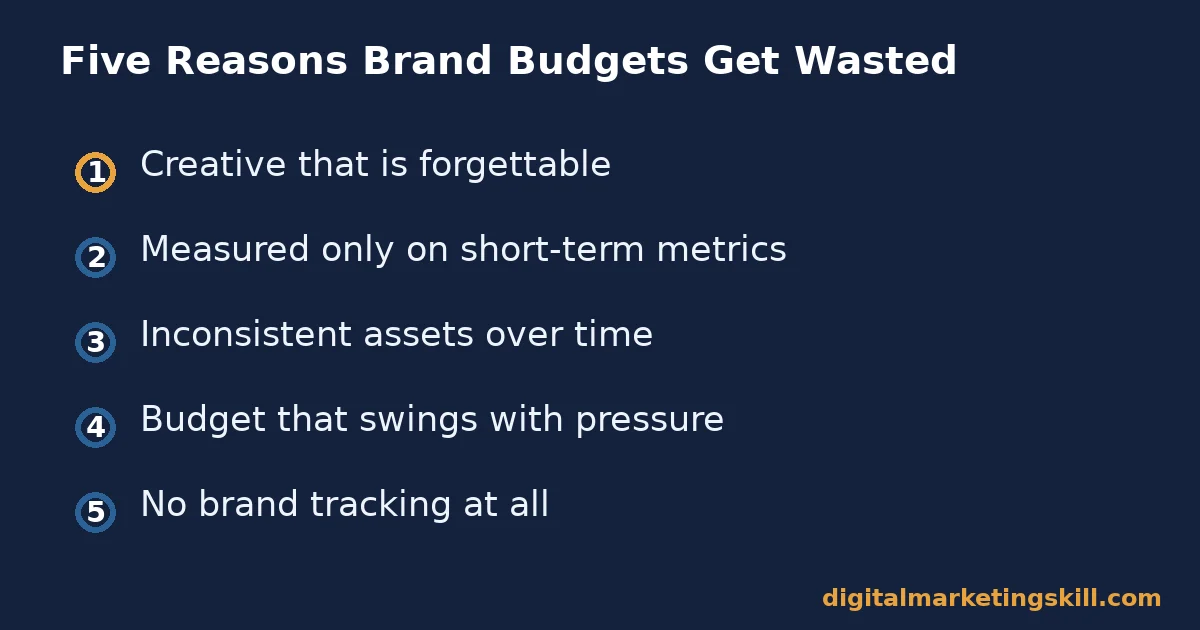
When brand advertising fails to show a return, the cause is almost always one of five problems. Check your own plan against each one before the next budget cycle.
None of these five problems are exotic. They are common, well-documented traps that show up across categories and budget sizes, which is exactly why they are worth checking deliberately rather than assuming your plan avoids them.
Creative that is forgettable. Competent but generic advertising rarely builds the distinctive memory structures that drive the Nielsen-reported creative effect above. It fills the media slot without earning the recall.
Measured only on short-term metrics. Judging a brand campaign purely on last-click conversions misses almost all of its real effect. That effect shows up in consideration and search volume weeks or months later, well outside most reporting windows.
Inconsistent assets over time. Changing logos, colours or sounds too often forces audiences to relearn the brand instead of reinforcing what they already recognise. Each reset costs more than most teams expect.
Budget that swings with quarterly pressure. Brand spend cut in a tight quarter and restored later never compounds the way steady, patient investment does. The gaps undo progress the previous spend already bought.
No brand tracking at all. Without a baseline for awareness and consideration, there is no way to tell whether brand spend is actually moving the numbers it exists to move. Teams end up guessing instead of measuring.
Which Problem to Fix First
Fix the measurement problem first. Every other mistake on this list is hard to catch or correct if you cannot see the brand metrics that would reveal it.
Once tracking exists, revisit the other four in order of how long they take to fix: creative quality first, since it compounds fastest, then consistency, then budget stability, then message focus.
How to Measure Whether Brand Advertising Is Working
Track brand metrics on their own timeline, not the short reporting cycle built for performance ads. The five measures below move at different speeds, so review them together over a full quarter, not week to week.
Unprompted and prompted awareness. The share of your target audience who name your brand unprompted, and the larger share who recognise it when shown a list. Track both, since they move at different speeds.
Share of voice versus share of market. Compare your share of category advertising spend to your share of category sales. A share of voice above your share of market is a well-documented predictor of future share growth.
Branded search volume. The number of people searching your brand name directly. This is one of the clearest, lowest-cost signals that brand advertising is building real recall.
Consideration. The share of category buyers who say they would consider your brand next time they buy. This sits between awareness and an actual purchase.
Price elasticity. How much sales volume changes when you adjust price. Strong brands typically lose fewer sales per point of price increase than weak ones, a sign of real pricing power built by brand equity.
Spontaneous mentions in research. How often your brand comes up unprompted in customer interviews, reviews or social listening. This is slower to collect but harder to fake than a tracked survey score.
How to Read These Numbers Together
Rising awareness with flat consideration usually means the brand is getting seen but not getting chosen. That points back to the message, not the media plan, so a bigger budget behind the same creative will not fix it.
A high share of voice with a falling share of market usually means the newer investment has not had time to compound yet. Give it more than one quarter before judging it.
The One Rule: Fund Brand Building Like It Compounds, Not Like a Campaign
If you fix only one thing, make it this: treat brand advertising as a standing, protected line of the budget. It is not a campaign you can pause and resume without cost.
The 60:40 evidence above only holds if the brand-building share stays reasonably steady over time. A budget that swings wildly between quarters never gets the chance to compound.
Illustrative example, invented numbers: a brand cuts its brand-building spend in half for two quarters to fund a short-term promotion. Sales hold during the promotion.
Then sales slide for several quarters after, as awareness and consideration quietly decay. The short-term win cost more than it appeared to, just on a delay nobody tracked back to the original decision.
A Real Case: John Lewis and a Single Memorable Idea
John Lewis built its “bear and hare” Christmas advert around one simple, repeatable emotional idea rather than a product message. The campaign, reported by Marketing Week, drew more than 11.5 million YouTube views. Soft toy versions of the bear and hare characters sold out.
John Lewis reported 6.9% overall sales growth across the Christmas trading period the advert ran in. That figure covers all trading activity, not the advert in isolation.
Treat it as context for how the campaign was received, not proof the advert alone caused every point of growth. The honest reading is still useful: a distinctive, well-loved idea coincided with a strong trading period.
The pattern still holds as a model worth copying. A single, repeatable idea, built around an emotional moment rather than a feature list, is what memory structures are made of.
Frequently Asked Questions About Brand Advertising
What is the difference between brand advertising and performance advertising?
Performance advertising asks for an immediate action, like a click or a purchase, and is judged on short-term, trackable metrics. Brand advertising builds recognition and trust over a longer timeline, and its effect shows up in later sales and pricing power rather than an immediate click.
Can a small business afford brand advertising?
Yes, at a smaller, local scale. A small business can apply the same principles, consistent assets, a distinctive idea, repeated over time, within a local or niche audience rather than a national one.
How long does brand advertising take to show results?
Meaningful shifts in awareness and consideration usually take months, not days. Reported effectiveness research generally shows brand-building effects compounding over a year or more, well past a typical short campaign window. Judging it after a few weeks almost always underestimates it.
Should brand advertising stop during a slow sales period?
Generally no. Reported case evidence suggests brands that hold their brand-building investment steady through a downturn tend to recover share faster than those that cut it. Competitors who do cut leave an opening in share of voice that a steady spender can fill at a lower relative cost.
What makes brand advertising memorable?
Consistent, distinctive assets, colours, sounds, characters or a consistent tone, repeated across every execution, make a brand easier to recognise and recall. The Ehrenberg-Bass Institute for Marketing Science has published extensively on this idea under the term mental availability.
Does good brand advertising need a big budget?
A bigger budget buys more reach, but reach alone does not make advertising memorable. A smaller, consistent budget behind one distinctive idea often outperforms a larger budget spread across several forgettable ones. Focus matters more than raw spend here.
How is brand advertising different from digital advertising?
Digital advertising describes the channel; brand advertising describes the goal. A single digital campaign can be built for brand goals, performance goals, or a mix of both. Our guide on digital advertising covers channel choice, while this guide focuses on what the advertising is trying to achieve.
Turn Brand Advertising Into a Skill You Can Prove
Planning brand advertising well means working across creative, paid media and measurement at once. Few people build that full range by accident.
The Master Diploma in Digital & AI Marketing at Digital Marketing Skill Institute is built around four AI-powered tracks, totalling ten courses, so you can build that range deliberately instead of piecing it together from scattered reading.
The four tracks are AI-Powered Social Media Management and Advertising, AI-Powered Lead Generation and Email Automation, AI-Powered Google Specialist, and AI-Powered WordPress and SEO Specialist, with a Full Stack option for completing all four.
What Comes With Each Track
Each track includes a U.S. Project Internship with a verified U.S. Work Reference Letter, so you leave with real, attributable campaign work, not just theory. That is exactly the kind of evidence a brand advertising portfolio needs.
Every track also includes unlimited 1-on-1 coaching and mentoring throughout. The diploma is dual US and UK accredited and recognised in more than 100 countries, and runs 100% online, so you can build and prove brand advertising skills from anywhere in your country.
Read more about the Master Diploma program and its four tracks, browse real outcomes on the reviews page, or explore more guides on the digital marketing blog. When you are ready, you can apply here. Wherever you live, build your skills with digitalmarketingskill.com, and let the team at digitalmarketingskill.com help you turn brand advertising from a definition into a skill you can show.
Every figure in this guide was checked against its original source before publication. Figures marked as illustrative are invented examples, not real results.
