
Getting your first digital marketing clients comes down to proof, not luck. You need a narrow niche, a visible track record, and a channel that matches how fast you need income. This guide shows where digital marketing clients actually come from. It covers how to measure your pipeline and the one decision rule for picking your first channel.
Key Takeaways
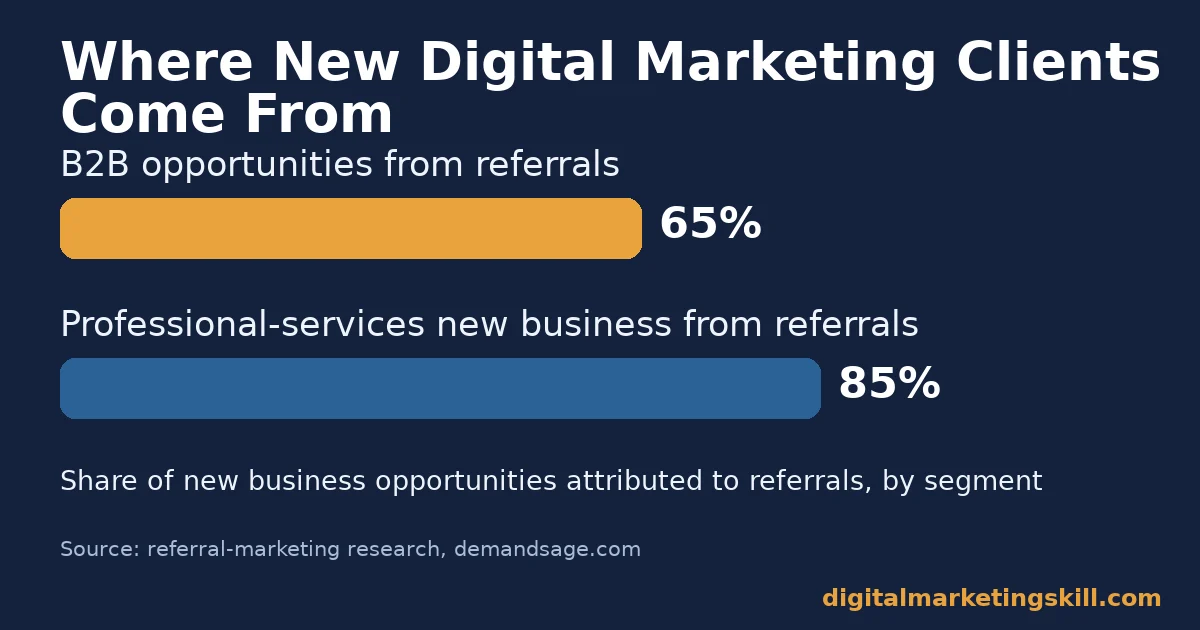
- Referrals still generate the majority of new professional-services business. A widely cited referral-marketing analysis puts referrals behind 65% of new B2B opportunities. The same research found referrals behind 85% of new work at professional-services firms.
- Cold outreach has gotten harder, not easier. The average cold email reply rate across industries is about 3.4%. Only the top quarter of senders clear 5.5%, according to a large-scale analysis of over 30 million cold emails.
- Personalisation still moves the number that matters. Emails with a genuinely personalised opening line see roughly 32% higher reply rates than generic templates, per the same cold-email benchmark data.
- Upwork alone now lists more than 18 million registered freelancers across 180 countries. That scale is exactly why a visible niche beats a generic profile on any marketplace.
- LinkedIn profiles with every section completed get about 30% more views than incomplete ones. Posting three to five times a week also outperforms daily posting for most individual accounts.
In this guide
- Why Finding Digital Marketing Clients Feels Harder Than It Should
- How Client Acquisition Actually Works
- What Differs By Channel
- How To Lead With Each Channel
- How To Measure Your Client Pipeline
- The One Decision Rule: Choose Your Primary Channel By Runway
- A Real Case: Turning A $500 Service Into Recurring Revenue
- Frequently Asked Questions About Digital Marketing Clients
- Where To Build These Skills
Why Finding Digital Marketing Clients Feels Harder Than It Should
Most advice about getting digital marketing clients lists channels: LinkedIn, marketplaces, cold email, referrals. What that advice skips is simple. Each channel solves a different problem. Using the wrong one for your situation is why the effort feels wasted.
If you need income in the next two weeks, a content strategy that pays off in three months is the wrong tool. It may still be excellent advice, just not for you right now.
This is an informed framework built from publicly verifiable data, not a settled formula. Client acquisition changes by niche, region and the state of the market. Treat the numbers below as a snapshot of general behaviour, not a guarantee for your specific case.
Two mistakes show up again and again in people struggling to land digital marketing clients. The first is running every channel at once, thinly, instead of running one or two properly. A profile gets updated once a month. Cold emails go out only sporadically. A LinkedIn post appears every few weeks. None of that generates enough signal to be noticed.
The second mistake is underpricing out of fear of rejection. Low prices attract clients who value you the least. They also leave no room to invest time in the proof-building work that earns better digital marketing clients later.
Fixing both starts with the same move: narrow your focus to fewer channels and a smaller niche, then let the data in this guide tell you where to put the effort you do have.
How Client Acquisition Actually Works
Every client relationship starts the same way. A stranger decides you are less risky to hire than the alternative, which is doing nothing or hiring someone else.
Everything you do before a sales conversation is really just risk reduction. It gets shown through one of three signals: proof that you have done this before and it worked, familiarity because someone the buyer trusts vouches for you, or urgency because the buyer already needs this done now and you are the fastest credible option.
Most freelancers try to compensate for a weak signal with more volume: more cold emails, more applications, more posts. Volume helps, but only once at least one signal is present. Twenty generic messages with no proof and no familiarity usually convert worse than five specific messages. Send those five to people who already recognise your name from a comment, a mutual connection, or a piece of content they read.
Inbound Versus Outbound, Defined Plainly
Inbound means the prospect finds you, through a LinkedIn post, a marketplace profile, a referral, or a piece of content that answers their question. Outbound means you find the prospect, through cold email, cold DMs or direct applications. Inbound takes longer to build but costs less per client once it compounds. Outbound works faster but needs constant new effort, because each message only reaches the people you personally contacted.
The Trust Ladder
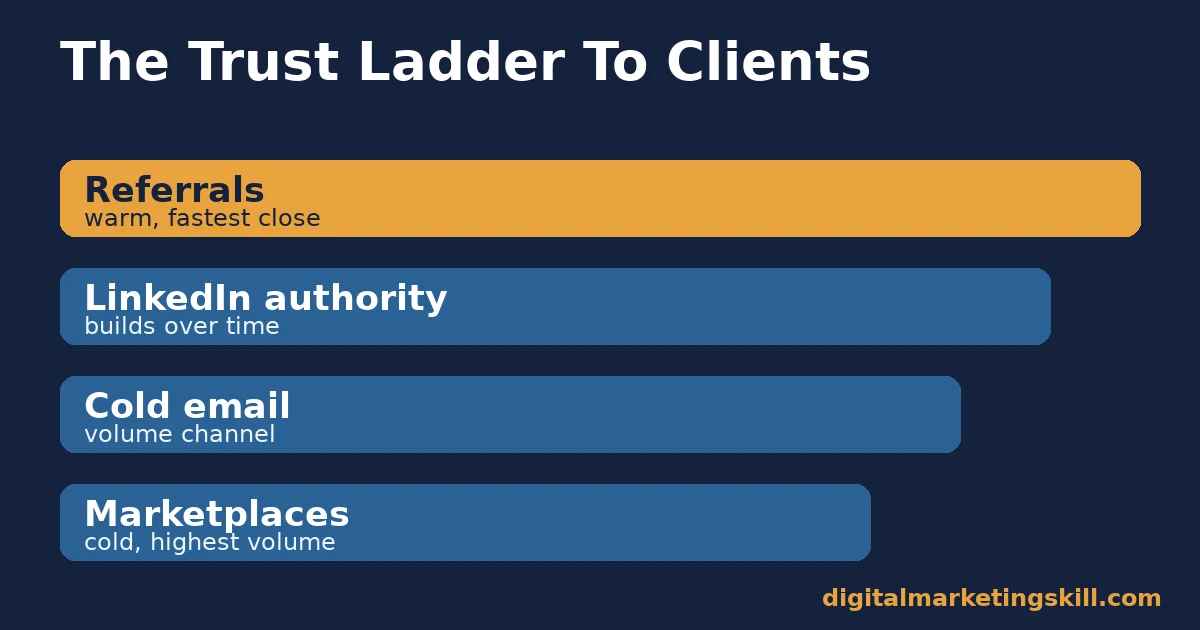
Picture every acquisition channel sitting on a ladder of trust. Cold sits at the bottom, where a stranger finds you on a marketplace. Warm sits at the top, where a referral comes from someone the buyer already trusts. The higher the trust you start with, the shorter your sales cycle and the less you need to discount.
Referrals sit near the top of that ladder. That is exactly why the professional-services referral share noted above is so high: the buyer has already outsourced their due diligence to someone they trust.
A cold marketplace proposal has to prove everything from zero. A referral walks in already partway up the ladder, which is why referred prospects typically take fewer calls to close than a cold lead found through a generic application.
What Differs By Channel
LinkedIn: Built For Authority, Not Quick Wins
LinkedIn rewards consistency over time. A single post rarely produces a client. A sustained pattern of useful posts, comments and direct outreach to people who engaged with your content does. Research on current posting behaviour found that creators posting three to five times a week, rather than daily, got the strongest reach without diluting engagement.
It also found that fully completed profiles earned around 30% more views. The channel is built for authority. It compounds slowly and rewards patience, not speed.
Freelance Marketplaces: Built For Volume, Not Loyalty
Upwork, Fiverr and similar platforms exist to match volume: millions of buyers searching against millions of sellers. That scale is the appeal and the problem. With over 18 million freelancers registered on Upwork alone, a generic profile is invisible.
Marketplaces are built for volume, not loyalty. Clients found there compare you on price and specificity first. A buyer you win on a marketplace has a weaker reason to stay loyal to you than a buyer who found you through a personal referral, so marketplace-sourced digital marketing clients need more deliberate follow-up to become repeat business.
Referrals: Built For Trust, Not Speed
Referrals convert faster and at higher rates because the trust work is already done. The tradeoff is speed of volume. You cannot manufacture ten referrals on demand the way you can send ten cold emails. Referrals are built for trust, not for filling a pipeline quickly from zero. That is why they work best as your highest-converting channel rather than your only channel.
Content And SEO: Built For Compounding Reach, Not Immediate Clients
A blog post, a short video series or a how-to guide works differently from the three channels above. It keeps earning attention from search engines and social feeds long after you publish it, without any extra outreach on your part.
The tradeoff is time for digital marketing clients found through content. A piece of content rarely produces a client in its first week. It produces clients steadily, months after publication, once it has had time to rank or circulate. Content is built for compounding reach, not for anyone who needs income this month.
How To Lead With Each Channel
LinkedIn: Lead With Proof, Not Pitches
Instead of announcing that you offer digital marketing services, publish the work. Share a before-and-after metric, a short breakdown of a campaign decision, or a lesson from a mistake. Comment on posts from people in your target industry before you ever message them cold.
This is the same groundwork that works when you use social media to land a role rather than a client. By the time you send a direct message, you are a familiar name, not a stranger pitching into an inbox.
Marketplaces: Lead With A Narrow Niche
Instead of listing “digital marketing services,” list the single outcome you deliver for one specific audience. An example is setting up welcome and abandoned-cart email flows for small e-commerce stores. A narrow, specific profile converts better on a crowded marketplace, because it answers the buyer’s exact question faster than a generalist profile can. Add one portfolio piece with a real, verifiable number rather than five vague ones.
Referrals: Lead With Asking, Not Waiting
Referrals rarely happen on their own. They happen because someone asked. After finishing work with a client, ask directly whether they know one other person who could use the same service. Pair that ask with a testimonial request at the same time, while the result is fresh and the client is pleased. Waiting for referrals to appear on their own is the single biggest reason freelancers underuse their highest-converting channel.
Content And SEO: Lead With Answering Real Questions
Instead of writing generic advice that every competitor has already published, answer the exact questions your past clients actually asked you during a project. Those real, specific questions are the ones people search for too. A direct, well-sourced answer to a specific question outperforms a broad, generic post. Publish consistently rather than in one large burst, since steady publishing is what builds the compounding reach described above.
How To Measure Your Client Pipeline
A pipeline you cannot measure is a pipeline you cannot fix. Track four numbers every week.
- Outreach volume: the number of new, personalised contacts you make in a week. Count messages, applications and comments that start a conversation. This is the input you fully control.
- Reply rate: replies divided by outreach volume. A healthy personalised cold-email reply rate sits above the roughly 3.4% industry average noted earlier. A rate far below that signals a messaging or targeting problem before you send more volume.
- Conversion rate: discovery calls or proposals divided by replies. This tells you whether your pitch, not just your outreach, is working.
- Close rate: signed clients divided by proposals. A low close rate paired with a healthy conversion rate usually points to a pricing or positioning problem. It often shows up at the same stage as a leaky digital marketing sales funnel.
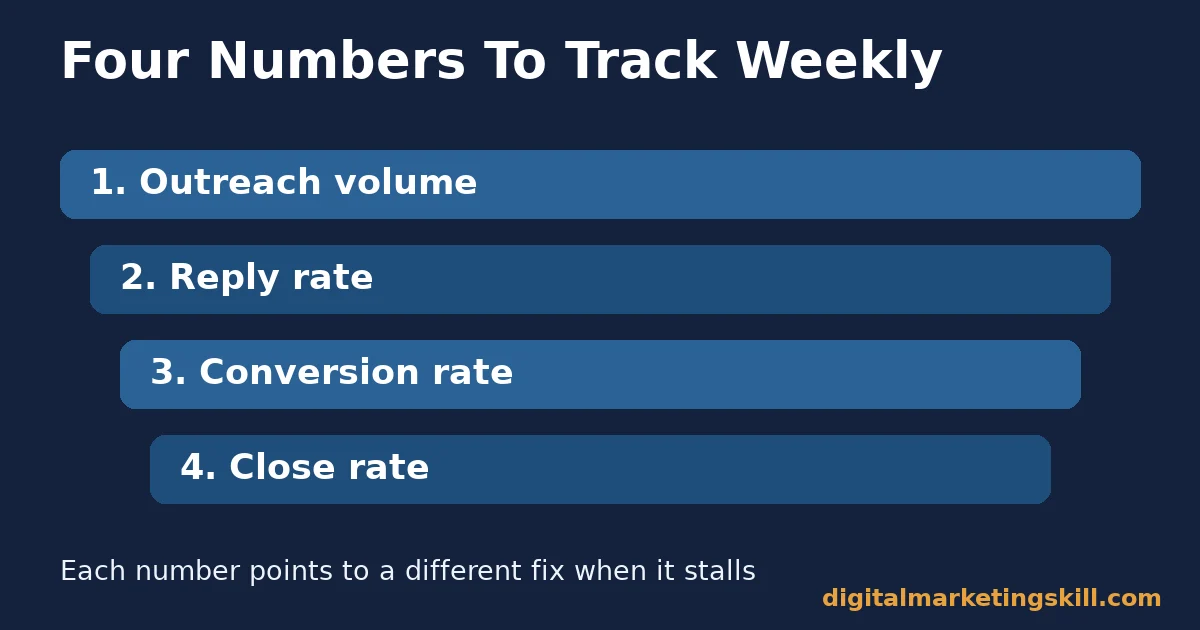
Review these four numbers every week rather than monthly. A weekly cadence catches a broken message or a dead channel while there is still time to fix it, instead of after a month of wasted effort.
When a number looks wrong, diagnose before you change anything. If outreach volume is healthy but reply rate is low, the message or targeting needs work, not more sending. If reply rate is healthy but conversion rate is low, the discovery call or proposal is losing people who were already interested. That usually means the offer is unclear, not the outreach.
If conversion rate is healthy but close rate is low, price or scope is the likely sticking point, not your marketing. Treating every stalled number as an outreach problem, and sending more messages because of it, is the most common way freelancers waste effort without improving their actual pipeline.
The One Decision Rule: Choose Your Primary Channel By Runway
Pick your primary channel based on how much financial runway you have, not which channel sounds most professional.
If you need a client within two to four weeks, lead with marketplaces and direct outreach. They are the fastest path to a first paid project, even at a lower rate. If you have two to three months of runway, lead with LinkedIn and referrals instead. They are slower to start, but they produce better-paying, more loyal digital marketing clients once they compound.
Illustrative, invented numbers: a freelancer with no runway who sends twenty personalised marketplace proposals a week might land a first client in roughly three to four weeks. A freelancer building LinkedIn authority alongside referral asks might not land a first client from that channel for six to ten weeks. Each client after that first one, though, costs less effort to acquire.
Run the fast channel for income and the slow channel for compounding growth at the same time, rather than choosing only one forever.
Revisit this decision every few months, not just once. Someone who started with no runway on marketplaces often has enough stability after a few paid projects to shift their primary effort toward LinkedIn and referrals.
That trade swaps a slightly slower channel for better-paying, more loyal clients. The decision rule is about where you put your limited hours first. It is not about which channel you are allowed to use forever.
A Real Case: Turning A $500 Service Into Recurring Revenue
Olajire Jacob, a graduate of the Digital Marketing Skill Institute, described the start of his client work in a published review. He said he began by charging an average of $500 to set up email marketing flows for clients in the US, UK and Canada.
Using the templates and ongoing support available to him after training, he said he scaled that single service into roughly $5,000 a month in recurring work.
The limit on this case matters. It is one published, named result, not a typical or guaranteed outcome. The exact timeline and client mix were not detailed in the published review.
Treat it as evidence that a narrow, well-delivered service can scale with repeat and referred clients, not as a promise of a specific income. Results vary by niche, experience and market. See the Institute’s earnings disclaimer for the full context behind any student income figure.
What the case does support, consistently with the data cited earlier in this guide, is the pattern rather than the specific number. A narrow, clearly defined service, delivered well for a first few clients, led to referral and repeat work from satisfied buyers rather than a constant hunt for new cold leads.
That pattern, not any single dollar figure, is the part worth copying when you are building your own base of digital marketing clients.
Frequently Asked Questions About Digital Marketing Clients
How do I get my very first digital marketing client with no experience?
Offer a small, specific service to someone in your existing network first. Audit a friend’s social media page, or write one email sequence, even at a discounted or symbolic rate. The goal is one real result and one honest testimonial. You then use that as proof for the first paid client you find through a marketplace or cold outreach.
Which platform is best for finding digital marketing clients?
There is no single best platform; the right one depends on your runway and niche. Marketplaces like Upwork and Fiverr are fastest for a first paid project. LinkedIn works best for building longer-term authority in a specific industry. Referrals convert best of all, but they need existing happy clients to generate.
How many outreach messages should I send per week?
Send enough to get a statistically meaningful read on your reply rate. Fifteen to twenty-five well-personalised messages a week usually beats hundreds of generic ones. Benchmark data consistently shows that smaller, targeted lists outperform large, generic ones on reply rate, which matters when every reply is a potential one of your next digital marketing clients.
Should I specialise in one niche or stay general when looking for clients?
Specialise. A narrow niche lets a buyer recognise instantly that you solve their exact problem, which shortens the sales conversation. You can expand into a second niche once the first one is generating steady referrals.
How do I ask a past client for a referral without sounding awkward?
Ask right after delivering a result you are both pleased with. Be specific: ask whether there is one other business owner they know who might need this same service. A specific ask is easier to answer than a vague request to pass your name along if they happen to hear of anyone.
Is cold email still worth it for getting digital marketing clients?
Yes, but your expectations need to match current benchmarks. Average reply rates have fallen industry-wide to roughly 3.4%. Cold email now works best as a volume channel paired with genuine personalisation, not as a channel you expect to convert on the first few sends.
How long does it typically take to build a stable client base?
There is no fixed timeline, and anyone promising a specific number of weeks for your exact situation is guessing. Expect your fastest channel, marketplaces or direct outreach, to produce a first client within weeks. Expect your slowest, highest-converting channel, referrals, to take months to start compounding.
Can I run several client-acquisition channels at once, or should I focus on one?
Run at most two at a time: one fast, one slow. Trying to maintain marketplace proposals, LinkedIn posting, cold outreach and referral asks all at once from the start usually spreads your effort too thin to work. Pick the fast channel that fits your runway and the slow channel you want compounding in the background. Add a third channel only once the first two run smoothly.
What should I charge my first digital marketing clients?
Price slightly below what you believe you are worth for your first two or three projects. Do this in exchange for a usable case study and an honest testimonial, then raise your rate once you have that proof.
Pricing too low for too long is the more common mistake. Once a client is used to your lower rate, raising it later is harder than starting fairly and adjusting up with evidence behind you.
Where To Build These Skills
Every channel above, from LinkedIn authority-building to niche positioning to referral systems, is faster to execute well once you upskill in digital marketing with current, practical training behind it.
The Master Diploma in Digital & AI Marketing at the Digital Marketing Skill Institute is built around four AI-powered tracks, drawn from ten execution-first courses in total. The tracks are AI-Powered Social Media Management and Advertising, AI-Powered Lead Generation and Email Automation, AI-Powered Google Specialist, and AI-Powered WordPress and SEO Specialist, with a Full Stack option for completing all four.
Every track includes unlimited one-on-one coaching and mentoring, a U.S. Project Internship with a verified U.S. Work Reference Letter, and dual US and UK accreditation recognised in more than 100 countries. The whole program runs 100% online, so you can study and work with digital marketing clients anywhere in your country or beyond.
Explore the full program on the Master Diploma page, or browse more guides on the digital marketing blog. Read real outcomes on the reviews page, or go straight to the application page when you are ready to start. Digital Marketing Skill Institute trains students wherever they live, and you can learn more any time at digitalmarketingskill.com.
Every figure in this guide was checked against its original source before publication. Figures marked as illustrative are invented examples, not real results.
