
Digital advertising means paying to place a message on a search engine, social platform, website or app. The placement gets targeted at a specific audience. It differs from free organic reach in one key way: you buy the placement and the audience, not just the content. Skipping that targeting step is what wastes most of the budget.
Key Takeaways
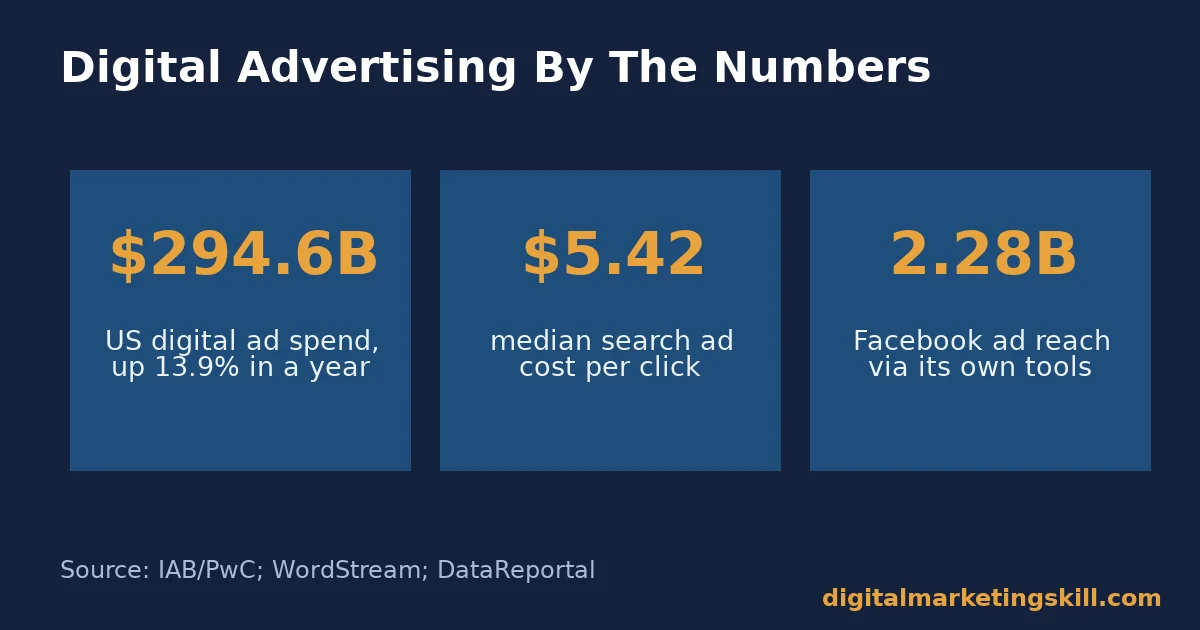
- US digital ad spend reached $294.6 billion, up 13.9% in a year, with social and search together making up close to 79% of that spend (IAB/PwC Internet Advertising Revenue Report, US-only).
- The median cost per click for search ads across industries sits around $5.42, with a median click-through rate near 6.64% (WordStream Google Ads Benchmark report, US-only).
- Facebook’s own ad tools report reach of roughly 2.28 billion users, a reminder that ad reach numbers measure audience size, not engagement (DataReportal, via Meta’s ad planning tools).
- Email-sourced traffic converts far higher than paid social or paid search traffic, even though paid channels often get the larger share of budget (Unbounce Conversion Benchmark Report).
- Measuring return on investment is marketers’ top reported challenge, which is exactly where most wasted digital advertising budget hides (HubSpot State of Marketing research).
In this guide
- Why Digital Advertising Budgets Get Wasted
- How Digital Advertising Actually Works
- What Differs By Advertising Channel
- How To Lead With Each Advertising Channel
- Common Mistakes That Waste Ad Spend
- How To Measure A Digital Advertising Campaign
- The One Decision Rule For Choosing A Channel
- A Real Case: Topic Clustering Outperforming Paid Reach Alone
- Where To Learn Digital Advertising Properly
Why Digital Advertising Budgets Get Wasted
Most small businesses do not waste ad budget because the platform is bad. They waste it because they skip a step. They launch an ad before they define who it should reach, and before they decide how to measure success.
This guide is a practical framework, not a guarantee. Ad platforms update their targeting tools often, and costs shift by industry and season. Treat every benchmark here as a snapshot, not a fixed number for your market. No platform or agency can promise a specific result in advance.
The real gap is simple. Businesses pick a platform first and a goal second. Fixing that order, goal first, platform second, is most of what separates a wasted budget from a working one.
This gap often shows up most clearly in a report nobody reads until the campaign is already over. Check your numbers while a campaign is still running, not just after it ends, so there is still time to fix what is not working.
How Digital Advertising Actually Works
Every major digital advertising platform runs on the same basic mechanism: an auction. Advertisers bid for a placement in front of a specific audience. The platform decides which ad wins the placement using a mix of bid amount and predicted relevance to the viewer.
That relevance score matters as much as the bid itself. A more relevant ad, one people actually click and engage with, can win a placement over a higher bid with weaker relevance.
A more relevant ad also tends to cost the business less over time, since platforms reward relevance with a lower effective price per result.
This is why audience targeting and ad quality both affect cost, not just budget size.
Audience targeting tools keep changing, especially as privacy rules limit what platforms can track. A strategy that leaned entirely on one targeting method a few years ago may need a different mix today. Treat targeting as something to revisit every few months, not something you set once and forget.
Three inputs drive almost every digital advertising campaign: the audience you target, the creative you show them, and the budget you commit. Get the audience wrong, and no amount of creative or budget fixes it. Get the audience right, and even a modest budget can perform well.
Of the three inputs, audience targeting usually matters most early on, before a campaign has much data to learn from. Creative quality grows in importance once targeting is set correctly. Budget only amplifies whatever the first two inputs already produce, for better or worse.
What Differs By Advertising Channel
Search, social, display and video ads are not interchangeable. Each one wins a different kind of attention, at a different point in the buying decision.
Search Ads: Built For Existing Intent
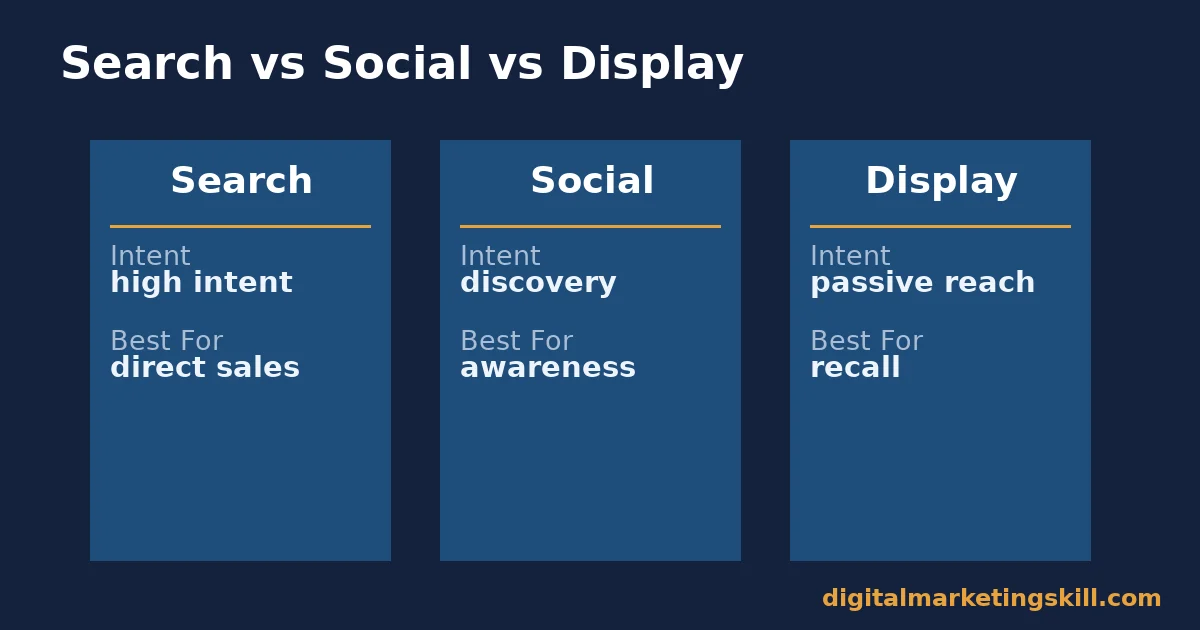
Search ads appear when someone is already typing a relevant query. That person already has intent, they are looking for something. Search ads convert well because they meet a need that already exists, not because they create one.
Because that intent already exists, search ads tend to cost more per click than social ads do. You are paying to meet demand at the exact moment it appears, and that moment is valuable.
Search ads typically cost more, but that cost often buys a higher conversion rate, which can still make them the cheaper option per customer acquired. Judge channels on cost per result, not on cost per click alone.
Social Ads: Built For Discovery
Social ads interrupt a scroll rather than answer a search. Most people on social media are not actively shopping, so social ads work by creating interest, not just capturing it. This makes social ads better for building awareness than for closing a sale on the first view.
Display And Video Ads: Built For Reach And Recall
Display and video ads run across large networks of sites and apps. They reach a wide audience at a low cost per impression, which makes them useful for staying visible to people who are not ready to buy yet. They rarely convert as directly as search ads, and that is by design, not failure.
How To Lead With Each Advertising Channel
Once you know what each channel is built for, match your campaign goal to the channel instead of running the same ad everywhere.
Search Ads: Lead With Tightly Matched Keywords
Build search campaigns around keywords that match real buying intent, not broad or vague terms. Group closely related keywords into tight ad groups, and write ad copy that mirrors the exact words a searcher used. Build each ad group around a clear buyer persona, not a guess at who might be interested. A specific, matched ad almost always beats a generic one on both cost and conversion.
Social Ads: Lead With Scroll-Stopping Creative
On social platforms, the creative carries more weight than the targeting alone, which is why a clear social media advertising strategy matters as much as the budget behind it. Lead with a clear visual hook in the first second, and keep the message simple enough to understand without sound. Test two or three creative variations against each other before scaling spend on any single one.
Display And Video Ads: Lead With Frequency Control
Set a frequency cap so the same person does not see your ad dozens of times a week. A capped, well-targeted display campaign builds recall without wasting budget on repetition. Pair display with a retargeting segment for people who already visited your site, since that smaller audience usually converts at a meaningfully higher rate than a cold one.
Three to five impressions a week is a reasonable starting cap for most display campaigns. Raise or lower it based on your own CTR trend, not a fixed industry rule, since the right number varies by audience size and campaign length.
Common Mistakes That Waste Ad Spend
A handful of avoidable habits account for most wasted digital advertising budget. Naming each one makes it fixable.
These habits show up across almost every industry and budget size, from a small local business to a larger brand. Expect the exact mix of mistakes to evolve as ad formats change, but the underlying logic, goal before platform, rarely changes.
Review this list once a quarter, and add your own recurring mistakes to it as you learn what tends to trip up your specific campaigns.
Running A Campaign Without One Clear Goal
An ad trying to build awareness, generate leads and drive sales all at once usually does none of them well. Pick one primary goal per campaign. A campaign built around one goal is easier to measure and easier to improve.
The same rule applies in reverse. A campaign with a single, narrow goal is far easier to hand off, report on, and defend in a budget review than one trying to do everything at once.
Targeting Too Broad An Audience
Broad audiences feel safer, but they usually cost more per result. A narrower, well-defined audience almost always returns a lower cost per result than a broad one, because the platform wastes fewer impressions on people who were never going to convert.
Sending Clicks To A Page That Does Not Match The Ad
An ad promising one thing that lands on a generic homepage loses most of its visitors immediately. Match the landing page message to the ad’s exact promise. A few well-chosen landing page examples can show what that match should look like before you build your own. Mismatched landing pages are one of the fastest ways to turn a paid click into a wasted one.
Letting The Same Ad Run Until It Goes Stale
Every ad eventually wears out. People start scrolling past it without registering it, a pattern sometimes called ad fatigue. Watch your click-through rate over time. A steady decline on an unchanged ad usually means the creative needs refreshing, not that the audience disappeared.
How To Measure A Digital Advertising Campaign
A few core metrics tell you whether a campaign is working. Learn these, and most ad platform dashboards stop feeling confusing.
- Cost per click (CPC): what you pay, on average, each time someone clicks your ad. Compare this across campaigns, not just against an industry average, since your own history is the most relevant benchmark.
- Click-through rate (CTR): the share of people who see your ad and click it. A low CTR usually points to weak targeting, weak creative, or both.
- Cost per thousand impressions (CPM): what you pay for every thousand times your ad gets shown. This matters most for awareness campaigns, where being seen is the goal, not an immediate click.
- Conversion rate: the share of clicks that complete your goal action, such as a purchase or a signup. This number, more than any other, shows whether your landing page and offer actually work.
- Return on ad spend (ROAS): the revenue you earn back for every dollar spent on ads. A ROAS above 1 means the campaign earned back more than it cost, before accounting for other business costs.
Check these numbers on a fixed schedule, weekly for an active campaign, and compare each one against your own past campaigns first. A tool like Google Analytics makes this tracking straightforward once it is set up correctly. An industry benchmark is a starting reference, not a target you must hit exactly.
This same logic should shape how you choose a primary metric for each campaign type. Judge a search campaign aimed at direct sales mostly on conversion rate and ROAS. Judge an awareness campaign on social or display mostly on CPM and reach, since conversion was never the immediate goal.
The One Decision Rule For Choosing A Channel
Decision rule: match the channel to where the buyer already is in their decision. If someone is actively searching for what you sell, meet them with search ads. If they do not yet know they have the problem you solve, meet them with social or video ads instead, where discovery happens before intent does.
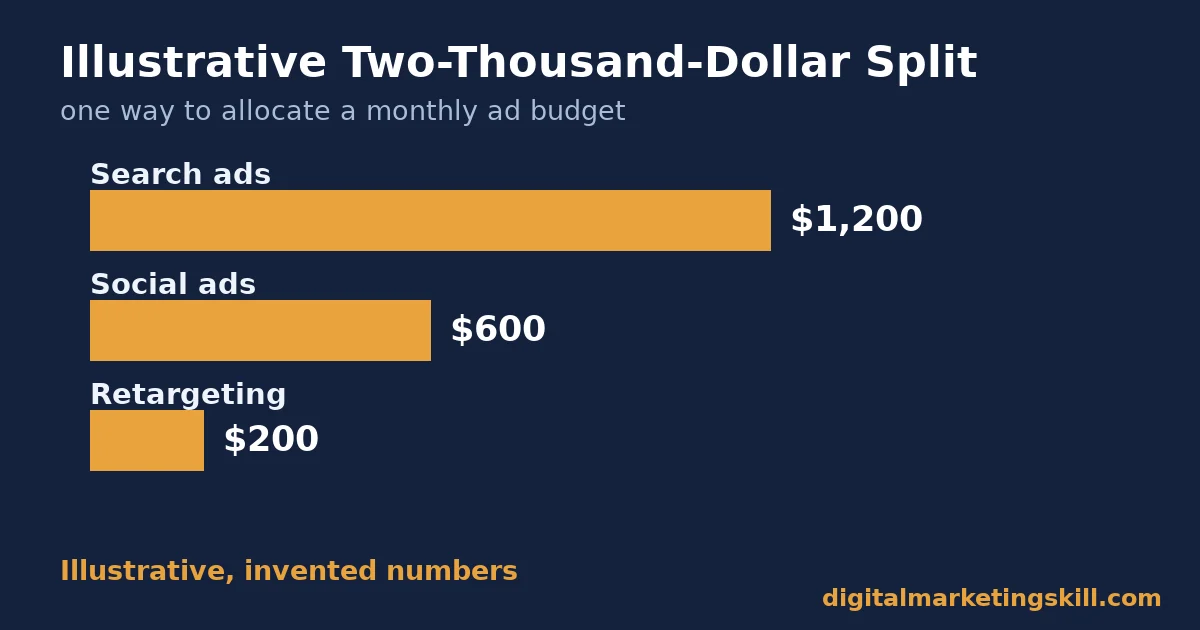
Illustrative, invented numbers: picture a $2,000 monthly ad budget for a new product. A business might send $1,200 to search ads for people already looking for a solution. It might send $600 to social ads to build awareness with a cold audience. The remaining $200 could go to retargeting people who visited but did not buy. As search traffic grows from the awareness work, that split can shift toward more search spend over time.
A well-run $2,000 campaign and a well-run $20,000 campaign follow the same logic. Only the scale changes, not the underlying decisions about audience, creative and measurement.
A Real Case: Topic Clustering Outperforming Paid Reach Alone
As published on G2’s own Learning Hub case study, a topic-clustering and hub-and-spoke content strategy changed its results. G2’s Learning Hub grew to roughly one million monthly organic visitors within a year. That growth reduced its reliance on paid traffic alone. Most readers can relate to this gap directly, wherever they are: a campaign that performs well in one city or country rarely performs identically in another, even on the same platform. Test locally before assuming a result will travel. This is a single, published case study, not an audited universal result, and most businesses will not see the same scale. What it shows is relevant here: digital advertising works best paired with a strong landing page and content strategy, not run in isolation from everything else a business does online.
Frequently Asked Questions About Digital Advertising
Is digital advertising the same thing as online advertising?
Yes, the two terms are generally used interchangeably. Both describe paid promotion delivered through internet-connected channels, such as search engines, social platforms, websites and apps, as opposed to traditional offline channels like print, television or radio.
What is ad fatigue, and how do I know if it is happening?
Ad fatigue happens when an audience sees the same ad so often that they stop responding to it. Watch for a falling click-through rate on a creative that used to perform well, with no change in targeting. That pattern usually means it is time for new creative, not a bigger budget.
Can digital advertising and organic marketing work together?
Yes, and they usually work better together than either does alone. Paid ads can drive fast traffic to content that was built for organic search, while that same organic content can lower the cost of future ad campaigns by improving a landing page’s relevance score.
This pairing matters most for a small budget, where every dollar needs to work twice: once to drive a click, and once to build an asset, like a landing page or a piece of content, that keeps earning after the ad budget runs out.
What is digital advertising?
Digital advertising is paid promotion placed on digital channels such as search engines, social media, websites and apps, targeted at a specific audience rather than shown to everyone. It differs from free, organic reach because you pay for both the placement and the audience.
Which digital advertising channel should a small business start with?
Start with search ads if people are already searching for what you sell, since that intent makes conversion easier to earn. Start with social ads instead if your product solves a problem people do not yet know they have, since that requires building awareness first.
How much should a small business budget for digital advertising?
There is no universal number, since cost per click and cost per result vary widely by industry. A more reliable approach is to start with a modest, fixed test budget. Measure cost per result after two or three weeks. Scale spend only once a channel shows a result worth repeating.
What is the difference between search ads and social ads?
Search ads target people actively searching for something, so they capture existing demand. Social ads interrupt a feed to create interest in something a person was not actively looking for, so they are better suited to building awareness than to closing an immediate sale.
What is retargeting, and is it worth using?
Retargeting shows ads specifically to people who already visited your website or app but did not convert. It usually costs less and converts better than targeting a completely cold audience, because the audience already knows your brand.
Should a business choose organic marketing or digital advertising?
Most businesses benefit from both, not one or the other. Paid digital advertising produces faster results but stops the moment spend stops. Organic channels, such as search and content, take longer to build but keep producing results without ongoing spend.
What counts as a good return on ad spend?
A good ROAS depends on your margins, not a single universal number. A business with thin margins may need a ROAS well above 1 to be profitable, while a business with high margins can profit at a lower ROAS. Calculate your own break-even ROAS before judging a campaign against an industry rule of thumb.
A good ROAS also shifts as a business scales, since fixed costs get spread across more sales. Recalculate your break-even point whenever your margins or overhead change meaningfully.
Where To Learn Digital Advertising Properly
Running a profitable digital advertising campaign takes more than picking a platform and setting a budget.
Learning this well also means learning to read a dashboard without panicking at every daily swing. Daily numbers move around for reasons that have nothing to do with campaign quality, such as the day of the week or a platform-wide glitch. Weekly and monthly trends tell the real story.
The Master Diploma in Digital & AI Marketing at Digital Marketing Skill Institute is built around four AI-powered tracks. They are AI-Powered Social Media Management and Advertising, AI-Powered Lead Generation and Email Automation, AI-Powered Google Specialist, and AI-Powered WordPress and SEO Specialist. All four draw on ten execution-first courses in total, with a Full Stack option for completing all four.
Every track pairs theory with practice, so you leave with real campaigns you built and measured yourself, not just a certificate.
Every track includes unlimited 1-on-1 coaching and mentoring, a U.S. Project Internship with a verified U.S. Work Reference Letter, and dual US and UK accreditation recognised in more than 100 countries. The program runs 100% online, so you can learn to run and measure real ad campaigns from anywhere in your country.
See the full program details and apply directly, browse more guides on the Digital Marketing Skill Institute blog, or read more student reviews before deciding. Wherever you live, the online format and global accreditation are built to travel with you. Learn more at digitalmarketingskill.com, or start an application directly on the Digital Marketing Skill Institute homepage.
Every figure in this guide was checked against its original source before publication. Figures marked as illustrative are invented examples, not real results.
