
Organic reach is the number of unique people who see your social media content without you paying to promote it. It includes followers and non-followers who come across your post in their feed, on Explore pages, in search or through shares. It matters because it shows how far your content travels on its own merit, and it builds awareness without an ad budget.
Key Takeaways
- This metric counts unique people who saw your content without paid promotion.
- Platform algorithms, not your follower count alone, decide who sees each post.
- Signals such as engagement and recency help a post travel further.
- Hootsuite reports that the average free reach of a Facebook post has fallen from about 16% to around 1–2%.
- The strongest strategies combine organic and paid: organic builds trust, while paid scales what works.
What Is Organic Reach?
Hootsuite defines it as “the number of people who see your social media content without paid promotion.” It measures how far your posts travel to both followers and non-followers.
Imagine a small bakery with 2,000 Instagram followers. It posts a short video of bread coming out of the oven. Over the next few days, 1,400 unique accounts see it. Some are followers. Others find it on Explore or because a friend shared it. So the post reached 1,400 people, even though the bakery spent nothing.
In other words, this metric tells you how many people your content reached for free. It doesn’t tell you how many cared, so you read it alongside engagement.
How Organic Reach Works
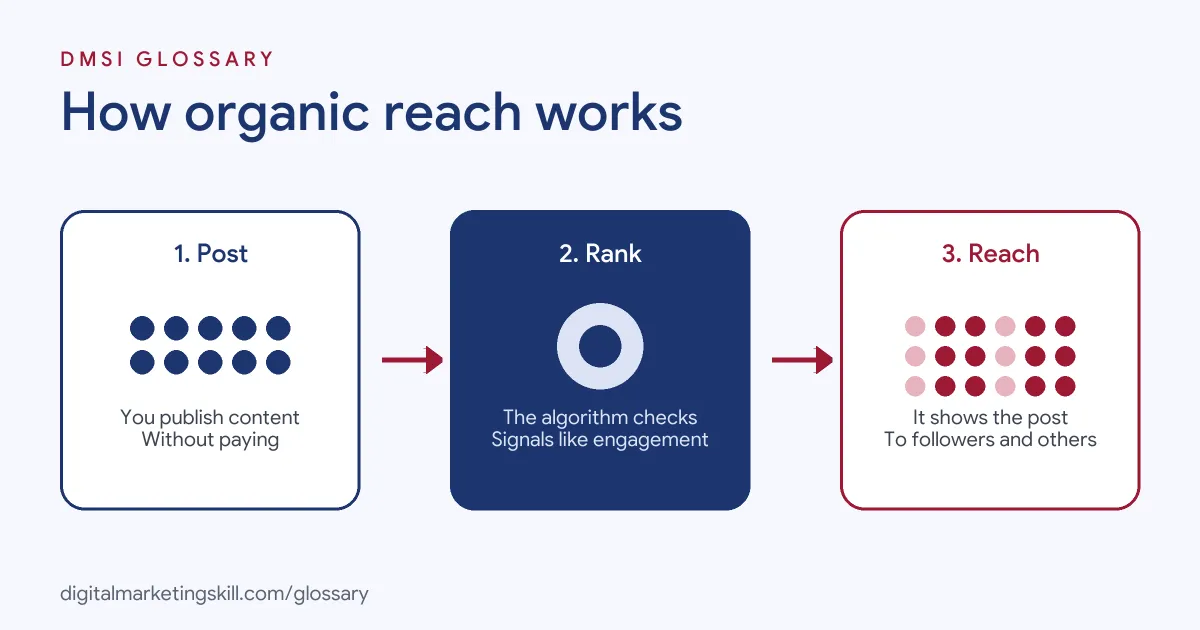
Every post goes through three steps. First, you publish it. Next, the platform’s algorithm checks signals, such as early engagement and how recent the post is. Then it decides how widely to show the post, to followers and sometimes to new people.
The Role of Algorithms
In the early days of social media, your posts simply appeared in your followers’ feeds. Today, Hootsuite explains, “platform algorithms decide who sees your content.” Each platform has its own system. However, they share one goal: to keep people scrolling for longer.
To do that, algorithms look at many signals. Hootsuite names engagement and recency as two of them. Sprout Social adds that genuine engagement, such as likes, comments, shares and saves, “tells algorithms your content is valuable.” As a result, posts that spark a reaction tend to travel further.
Why It Has Fallen
Feeds are crowded, and Hootsuite points to algorithm changes and pressure to “pay-to-play.” So brands often see less free reach than they used to. Hootsuite reports that Facebook’s average figure was once around 16%, but it has since dropped to between 1% and 2%. The good news is that relevant content still gets seen. It just has to earn its place.
How to Measure It
Most platforms show reach in their built-in insights, for each post and for your account as a whole. Look for the figure for unpaid or “organic” content, since many dashboards mix it with ad results. Then compare posts over the same time window, such as the first seven days after publishing. To make fair comparisons between accounts or months, some teams divide reach by follower count. Either way, keep the method the same every time you report.
Reach vs Impressions
Reach counts unique people. Impressions, by contrast, count every time the content was displayed, including repeat views by the same person. So a post can have 1,400 reach and 2,000 impressions. Both numbers are useful, but they answer different questions.
Organic Reach Examples
Here are three common situations:
- Local café: A café posts a behind-the-scenes Reel of its barista making latte art. Many viewers share it with friends, so it reaches far beyond its followers.
- B2B consultant: A consultant posts a practical checklist on LinkedIn. Comments from peers push it into more feeds over several days.
- Online shop: A clothing brand notices that its carousel posts reach fewer people than its short videos. Therefore, it shifts more effort into video.
In each case, the content that people reacted to went furthest. That is the pattern to look for in your own data. Notice, too, that none of these posts was a hard sales pitch. Instead, each one gave viewers something to enjoy, learn or share.
Organic Reach vs Paid Reach
These two work together, so it helps to know how they differ:
| Type | How you get it | Main strength | Main limit |
|---|---|---|---|
| Organic reach | Publishing content that the algorithm chooses to show | Builds trust and costs no ad spend | Hard to predict or scale |
| Paid reach | Spending on ads to target specific audiences | Fast, targeted and scalable | Stops when the budget stops |
Hootsuite sums it up well: “Organic builds credibility over time, while paid helps you scale what’s already working.” So many teams promote their best organic posts as ads.
How to Increase Organic Reach
Hootsuite and Sprout Social suggest a similar set of steps:
- Post when your audience is online. Early engagement matters to most algorithms, so timing counts.
- Find the right frequency. Post often enough to stay visible, but not so often that quality drops.
- Tailor content to each platform. Posting the same thing everywhere limits reach, according to Hootsuite.
- Use formats that perform. For example, Hootsuite notes that Instagram Reels get more reach than static or carousel posts.
- Encourage interaction. Ask questions and reply to comments quickly.
- Offer real, original value. Useful or entertaining posts get saved and shared.
- Check your analytics. After that, double down on the posts that reached the most people.
Best Practices for Organic Reach
- Measure reach per post. To compare fairly, some teams divide reach by follower count.
- Watch engagement too. Above all, reach without reactions rarely helps the business.
- Stay flexible. Algorithms change, so test new formats regularly.
- Build a community. Reply to comments and messages, since conversations keep posts active.
- Repurpose what works. Turn a high-reach post into a Story, a carousel or a short video for another platform.
- Use paid to boost winners. Put budget behind posts that already perform well organically.
Common Mistakes to Avoid
Many beginners judge success on follower count alone. However, Hootsuite notes that a large audience no longer guarantees visibility. Another mistake is posting the same content on every platform without changes. Some brands also post only sales messages, which people rarely engage with. Others ignore their comments section. When a brand never replies, people stop commenting, and the post loses one of its strongest signals. Finally, many give up when reach drops after an algorithm change. Instead, look at your data, adjust your formats and keep testing.
Where You’ll Use Organic Reach at Work
Social media and growth roles often track this metric. For example, recent remote job listings ask candidates to:
- “Review organic reach and engagement metrics to continuously inform future creative direction” (Creative Director).
- Deliver “Stronger organic reach and inbound demand” as a sign of success (Growth Marketing Manager, Paid and Organic Acquisition).
So if you want to work as a Social Media Manager, Paid Social Specialist or Content Creator, you will report on reach every week. More importantly, you will turn those numbers into better content.
A typical week might include planning posts, checking which ones reached the most people and spotting why. Then you share the lessons with the team, adjust the content calendar and choose which winning posts to boost with a small ad budget.
Learn It in the Social Media Track
You can learn to grow and measure organic reach in the AI-Powered Social Media Management and Advertising track. It covers content creation, including graphics and video, plus social media marketing and analytics. For your portfolio, you plan, create and run a paid social campaign for a real brand. You also join a U.S. Project Internship from day one, with unlimited 1-on-1 mentoring.
To go further, read how to grow reach, not just fans on Facebook, and our guide to paid vs organic traffic. You can also read our glossary entry on impressions.
Frequently Asked Questions
What is organic reach in simple terms?
It is the number of different people who saw your post without you paying to promote it.
What is the difference between organic and paid reach?
Organic reach comes from unpaid posts that the platform chooses to show. Paid reach comes from ads that you pay to show to a chosen audience.
Why are my posts reaching fewer people?
Feeds are crowded and algorithms favour content that sparks engagement. Try new formats, post when your audience is online and reply to comments.
Does follower count affect organic reach?
It helps, but it is not enough. Algorithms decide who sees each post, so engagement and relevance matter more than size alone.
Is organic reach the same as impressions?
No. Reach counts unique people. Impressions count every time the content was shown, including repeat views.
Sources: Hootsuite: Organic reach on social media; Sprout Social: Organic reach; Hootsuite: Reach vs impressions; remote job listings on Himalayas.