
Social listening is the practice of tracking what people say online about your brand, your competitors and your industry, then analysing those conversations to guide decisions. It goes beyond replying to mentions. Instead, it looks for patterns in how people feel, what they talk about and what is changing. It matters because it shows you what customers really think, often before those views show up in sales or surveys.
Key Takeaways
- Monitoring is reactive: you respond to direct mentions. Listening is proactive: you study patterns to plan ahead.
- Good listening covers social platforms and also websites, forums and even podcasts.
- The process runs in four stages: monitoring, analysis, insights and action.
- Key measures include mention volume, share of voice and sentiment.
- Boolean queries help you include misspellings and filter out noise.
What Is Social Listening?
Hootsuite defines it as “the practice of tracking social media platforms, websites, forums, and even podcasts to understand what people say about your brand name, competitors, or industry.” In short, it is market research that happens in real time. You learn from talks people are already having.
It is often confused with social media monitoring. Sprout Social explains that monitoring “involves tracking social media messages, comments and conversations directly related to your brand and responding to those engagements.” Listening goes further. It helps you work out “why, where and how these conversations are happening and what people think”, not just when people tag you.
For example, a running shoe brand notices a rise in mentions. Monitoring would flag each post so the team can reply. Listening, on the other hand, would reveal that most posts praise a new colour but complain about sizing. That insight could shape the next product update and the next ad campaign. It might also change how the brand answers sizing questions in its own replies and FAQs.
How Social Listening Works
Hootsuite describes four stages. Together, they turn raw posts into decisions.
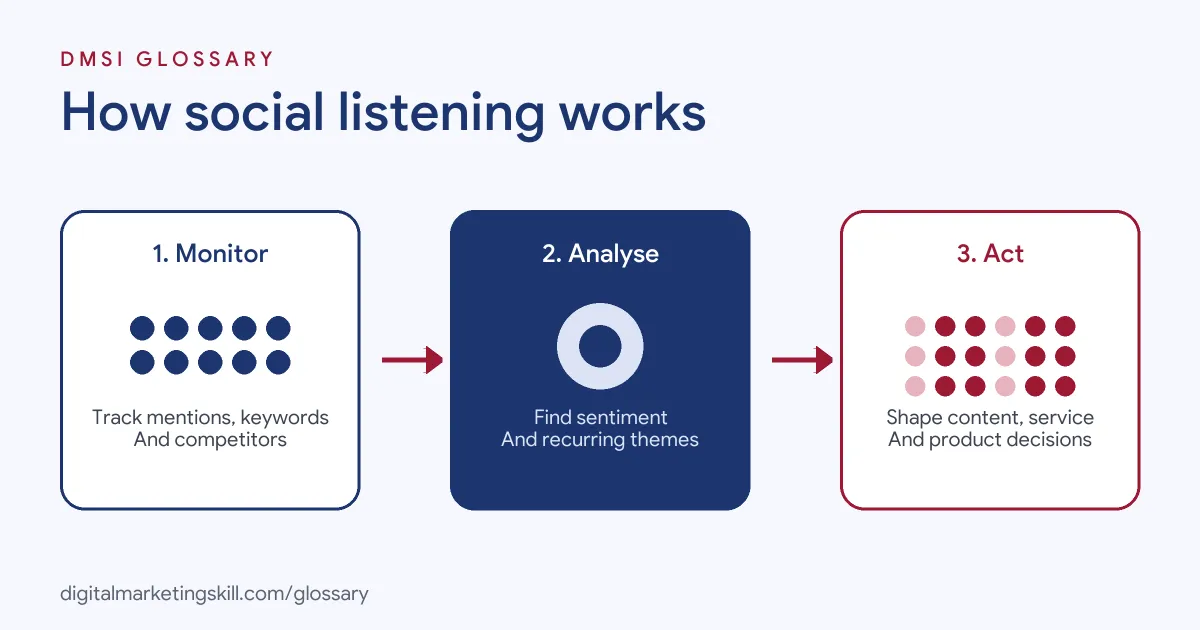
The Four Stages of Social Listening
- Monitoring: tracking relevant conversations, including brand mentions, keywords and competitors.
- Analysis: looking at the data to understand sentiment, whether positive, negative or neutral, and recurring themes.
- Insights: pulling out trends, customer pain points and unmet needs.
- Action: using those insights to shape messaging, customer experience and product decisions.
Setting Up Queries
Listening tools track keywords you choose, such as your brand name, product names and industry terms. To get more precise, Hootsuite suggests Boolean logic. For instance, “brand name” OR “brandname” catches misspellings. Meanwhile, “competitor name” AND “issue” helps you spot problems your rivals’ customers are having.
The Metrics That Matter
Sprout Social highlights metrics such as volume, share of voice and sentiment. Volume tells you how much people are talking. Share of voice shows how much of the talk in your market is about you, not your rivals. Sentiment shows how people feel. Together, they show what your audience cares about.
Free Ways to Start Social Listening
You can begin with no budget at all. Search each platform for your brand name and your main product names. Save those searches and check them each week. You can also use Google Alerts. Google says you “can get emails when new results for a topic show up in Google Search”, such as mentions of a name. You can pick how often you get emails, the types of sites and the part of the world. It won’t catch every post. Still, it is a good way to learn what people say before you pay for a tool.
Social Listening Examples
Here are three made-up examples of listening in action:
- Product feedback: A skincare brand sees repeated complaints that a pump bottle breaks. It changes supplier and posts an update thanking customers for the feedback.
- Content ideas: A budgeting app notices people asking the same questions about saving for a house deposit. It turns those questions into a video series.
- Early warning: A restaurant chain spots a sudden spike in negative posts about one branch. Managers fix the problem before it spreads to reviews and the press.
Social Listening vs Social Media Monitoring
The two work best together, but they answer different questions. Think of monitoring as your inbox and listening as your research team:
| Feature | Social media monitoring | Social listening |
|---|---|---|
| Approach | Reactive | Proactive |
| Focus | Direct mentions, tags and messages | Wider conversations about your brand, rivals and industry |
| Main question | What do we need to reply to? | What does this tell us, and what should we do? |
| Typical output | Replies and support tickets | Reports, insights and strategy changes |
As Sprout Social puts it, monitoring “is reactive” while listening “is proactive” and “provides deeper insights that help you strategize and plan.”
How to Start Social Listening
- Set a goal, such as improving sentiment, growing share of voice or catching problems early.
- List your keywords: brand and product names, common misspellings, competitors and industry terms.
- Choose a tool. Some social media tools include listening features.
- Build queries with Boolean logic to include what matters and exclude noise.
- Check results weekly at first, and tag recurring themes.
- Share a short summary with product, sales and support teams, so the insights reach the people who can act.
- Act on one insight at a time, then track whether sentiment or volume changes.
A Simple Monthly Report
You don’t need a long deck. A one-page report can cover four things. First, total mentions and how they compare with last month. Second, sentiment split, such as the share of positive, neutral and negative posts. Third, the top three themes people raised. Finally, one or two recommended actions. Short, regular reports get read and acted on. Long ones tend to sit in inboxes.
Best Practices for Social Listening
- Tie it to a business goal. Hootsuite recommends linking listening to goals like better sentiment or catching crises early.
- Listen beyond your own name. Track competitors and wider industry terms too.
- Check the mood by hand. Jokes and slang can fool tools.
- Share insights widely. Product and support teams often benefit most.
- Act, then measure. Listening only pays off when it changes what you do.
- Start small. Track a handful of terms well before you add more. You can widen your net once you know what is useful.
Common Social Listening Mistakes
Many teams only track their brand name and miss conversations that don’t tag them. Others set up queries that are too broad, so real insights drown in noise. Some collect data but never share it beyond the social team. Another mistake is treating every spike as a crisis. Always check the context first. Finally, many mix up listening and replying, so they respond to posts but never step back to see the bigger pattern.
Where You’ll Use Social Listening at Work
Listening skills appear in community, social and analytics roles. For example, recent remote job listings ask candidates to:
- “Monitor brand conversations, sentiment, and industry trends using social listening tools such as Brandwatch, Sprinklr, Meltwater, or similar platforms” (Community Manager).
- “Use media and social listening to identify conversation trends, audience behaviors, white space opportunities, reputational considerations, and emerging issues” (Vice President, Analytics).
So if you want to work as a Social Media Manager, Paid Social Specialist or Content Creator, expect to track conversations, spot trends and turn them into content and campaign ideas.
Learn It in the Social Media Track
You can learn to analyse social conversations in the AI-Powered Social Media Management and Advertising track. It covers AI fundamentals, content creation with graphics and video, social media marketing and analytics, and social media advertising. Your portfolio project is a paid social campaign that you plan, create and run for a real brand. You also get unlimited 1-on-1 mentoring and a U.S. Project Internship from day one.
Next, read our in-depth guide to social listening and our social media marketing checklist. You may also like our glossary entry on engagement rate.
Frequently Asked Questions
What is social listening in simple terms?
It is tracking what people say online about your brand, competitors and industry, then using those insights to make better decisions.
What is the difference between listening and monitoring?
Monitoring tracks and responds to direct mentions. Listening analyses wider conversations to find patterns and plan ahead.
What can you learn from social listening?
You can learn how people feel about your brand, which topics they care about, what frustrates them and how you compare with competitors.
Do I need a paid tool?
Not to start. You can search platforms by hand and set up free Google Alerts for your brand name. However, paid tools save time and make it easier to track how people feel at scale.
How often should I review listening data?
Weekly is a good start, with a short monthly summary for wider teams. During a launch or a crisis, check daily, since things can move fast.
Sources: Hootsuite: What is social listening?; Sprout Social: Social media monitoring vs social listening; Google Search Help: Create an alert; remote job listings on Himalayas.