
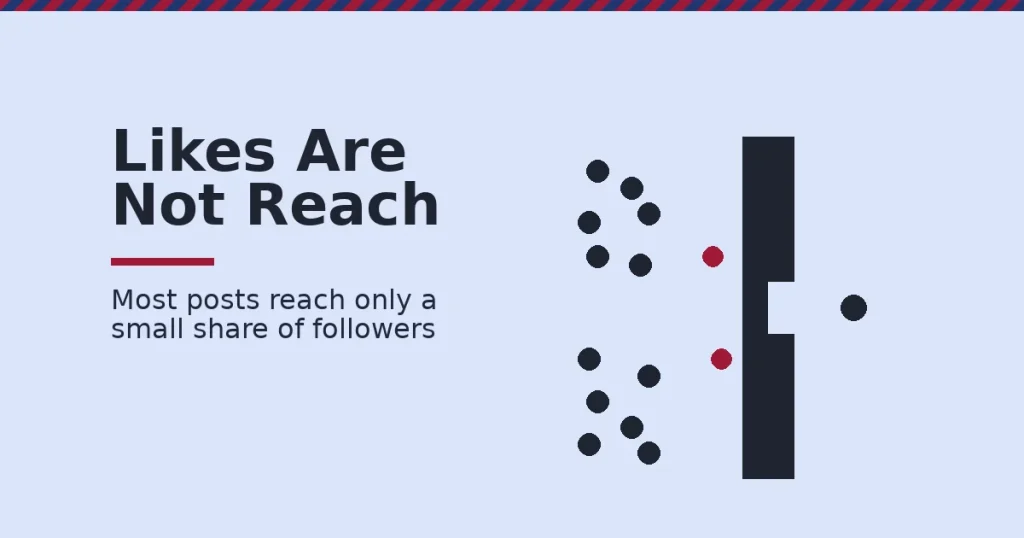
A facebook page like is not the same as reach. Most posts now reach only a small slice of followers. So chasing facebook page likes without a reach plan just inflates a number nobody sees. This guide swaps that vanity number for a method: the right content mix, a steady posting rhythm, and one small paid boost rule that actually moves reach.
Key Takeaways
- Average organic reach on Facebook pages sits near 1.25% of followers. Facebook page likes alone tell you almost nothing about who sees your posts.
- Reels and photo albums out-engage plain links by 3 to 4 times. Format choice matters more than posting volume.
- Pages that post less, but post more consistently, have grown. Tracked posting volume fell by almost half in recent years as quality replaced quantity.
- A small boost behind a post that is already working can lift the reach of posts that follow it. One documented test case shows this clearly.
- A Facebook Group built around the same audience usually reaches a far larger share of members than a Page does. That is why many brands run both.
In this guide
- Why Chasing Facebook Page Likes Misses the Point
- How Facebook Decides Who Sees Your Post
- What Differs by Content Format
- How to Lead With Each Format
- Running a Contest Without Breaking the Rules
- Measuring Growth: Define Every Number Before You Chase It
- The One Decision Rule: Boost Proof, Not Hope
- A Real Case: What a Small, Targeted Boost Did Next
- Frequently Asked Questions About Facebook Page Likes
- Turn Page Growth Into a Marketable Skill
Why Chasing Facebook Page Likes Misses the Point
Search “how to increase facebook page likes” and you will find contest templates, bots and buy-likes services. None of them fix the real problem. Facebook’s algorithm ranks a post by predicted engagement, not by fan count. A Page with ten thousand facebook page likes can reach fewer people than a Page with a thousand likes and an active audience.
Buying likes makes this worse. Purchased accounts rarely engage. That drags your engagement rate down and tells the algorithm your content is weak.
Two ground rules first. This is a worldwide playbook. The numbers below come from global or US data, and any regional figure is labelled. This is also an informed method, not a settled formula. Facebook changes its ranking signals often. Treat each tactic here as a hypothesis to test on your own page, not a guarantee.
Facebook’s own leadership says the platform still serves more than two billion people a day. According to DataReportal’s global digital report, roughly 56% of the world’s internet users aged 16 and over used Facebook in the past month. That audience has not shrunk.
In fact, Pew Research Center’s survey of US adults still ranks Facebook as the second most-used platform, behind only YouTube. What changed is how much of that attention one Page post reaches for free. That is the gap this guide closes.
How Facebook Decides Who Sees Your Post
Every time you publish, Facebook’s ranking system scores the post. It checks how this audience usually treats video versus photos. It checks how long people watch. Did the same users comment on your last few posts? How much other content is competing for the same feed space right now?
The system then ranks a shortlist for each person. Most Page posts sit far down that list, below friends, Groups and ads.
That is why reach benchmarks run so low. Independent tracking of more than 870,000 brand posts puts average Page reach at roughly 1.25% of followers. That drops to about 0.5% on pages with 100,000 to 1 million followers. It rises to around 4.35% on small pages under 5,000 followers, according to SocialInsider’s social media benchmark study.
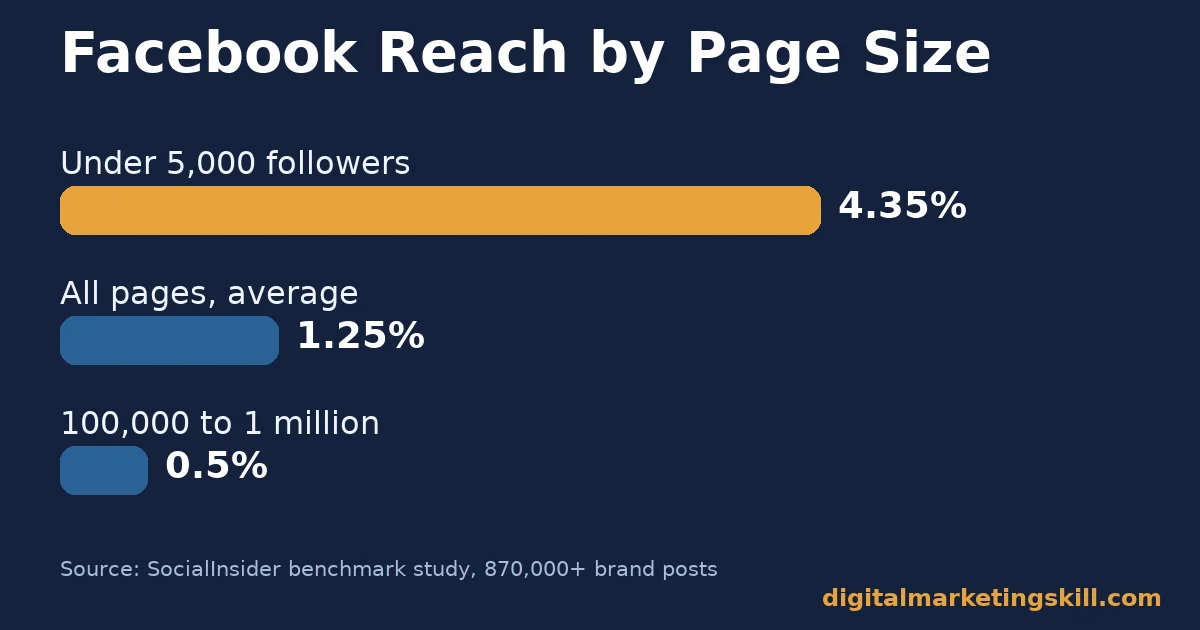
A bigger fan count does not buy a bigger share of attention. It often buys a smaller one, because the algorithm spreads a fixed pool of feed space across more posts from more pages.
The practical lesson: facebook page likes are a vanity number until you pair them with a content plan that earns a ranking score. A Facebook marketing strategy built around that scoring logic, not around the fan counter, is what the rest of this guide builds.
What Differs by Content Format
Not every post format earns the same reach. Facebook’s ranking system scores video, photos, links and groups differently, based on how people usually behave inside each one. Knowing the gap between formats tells you where to put your limited time first.
Video and Reels: Built for Attention
Meta has told investors that video, including Reels, now takes up most of the time people spend on Facebook and Instagram. Facebook video watch time kept growing year over year in its most recent reported quarter, per Meta’s own quarterly earnings materials. Reels also get placement on a dedicated surface beyond the main feed. A static photo never gets that extra distribution.
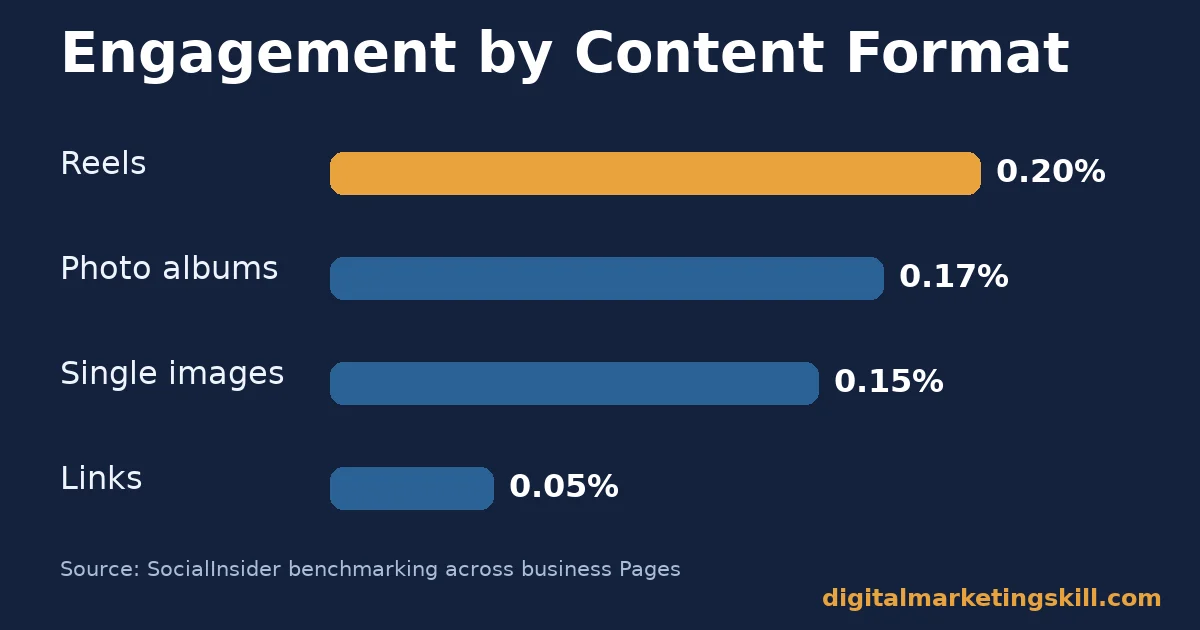
SocialInsider’s benchmarking puts Reels engagement at roughly 0.20%, the highest of any common format tracked, with brands posting them about seven times a month on average.
Photos and Albums: Built for Consistency
Single images and photo albums are the easiest format to produce at a steady pace. Albums benchmark close to Reels, at around 0.17% engagement. Single images sit near 0.15%. A Page without video resources can still win here.
A steady rhythm of well-captioned photo posts beats sporadic, high-production content that only shows up now and then. Albums work well for process shots, before-and-after sequences and behind-the-scenes sets. Each extra image gives a follower one more reason to pause and tap through.
Plain Links: Built for Traffic, Not Reach
Links out to your own website benchmark lowest of the common formats, around 0.05% engagement. The ranking system treats an exit from Facebook as a weaker signal than something people interact with inside the app. Links still do a job: they drive traffic you own and can measure on your own site. But they should not be the format you lean on to grow reach or facebook page likes.
Facebook Groups: Built for Depth, Not Breadth
A Page broadcasts one-to-many. A Group feels closer to a community. Community posts reach a much larger share of members, because Facebook treats group membership as an active interest signal, not a passive follow.
Several independent analyses of Group versus Page performance put Group reach per post well above typical Page reach. None publish one clean, large sample with a precise multiplier, so treat this as a strong pattern, not an exact ratio. What stays consistent is the direction: a member chose to join a Group. That choice carries more weight in ranking than a follow made once and forgotten.
How to Lead With Each Format
Knowing the gap is step one. Step two is a concrete weekly habit for each format, so the plan survives a busy week instead of staying a good idea.
Lead With Video: One Planned Reel a Week
Pick one repeatable Reel format tied to your niche: a before/after, a short tip, a behind-the-scenes clip. Publish it on the same day each week. Write the first caption line as a hook, not a fragment. Facebook shows the caption before a tap, and most people decide whether to watch within the first second or two.
Consistency beats production value here. A plain-filmed Reel posted every week usually out-reaches a polished one posted only now and then, because the algorithm rewards a predictable pattern over a single spike.
Lead With Photos: A Caption-First Habit
Write the caption before you pick the photo. A caption that asks a direct, answerable question earns comments. Comments carry more ranking weight than reactions, because they take more effort to write.
Post photo albums of three to ten images instead of single shots, whenever you have a real sequence to show. Extra images give people a reason to keep scrolling inside the post, and Facebook reads that as engagement, not a quick scroll past.
Lead With Links: Post Native First, Link Second
When you have an article or offer to promote, publish a native photo or short video post first. Add the link as a comment, or in a follow-up post a day later. This keeps your main post’s engagement signal intact. It still gets the link in front of the same audience, without the reach penalty the system applies to posts whose main job is sending people away from the app.
Lead With Groups: Pair a Page With a Group
Use the Page as your public storefront and search presence. Run a smaller, invite-only or approval-based Group for your most engaged followers.
Cross-promote both ways: announce new Group discussions on the Page, and turn the Group’s best questions into Page content. This pairing grows facebook page likes on the Page. It also gives your most active audience a higher-reach home in the Group, and a steady stream of real questions to answer as future posts.
Running a Contest Without Breaking the Rules
A well-run contest can still move facebook page likes faster than any single organic post. But it only works if it follows the platform’s own promotion rules and attracts people who stay engaged after the prize is gone.
Meta’s promotions guidelines ban requiring people to share on their personal timeline, tag friends to enter, or tag themselves in photos they are not actually in. You must also state that the promotion is not sponsored, endorsed or run by Meta.
Within those rules, four formats work well. A “comment to enter” post, built around a genuinely relevant prize. Try a photo-caption contest, where the audience supplies the creativity. A skill-testing question works well too, filtering for people who actually care about your niche. Or run a crowdsourcing call, such as naming an idea, which also doubles as content you can reuse later.
Pick the prize to match your audience, not the broadest possible appeal. A niche prize that only your real audience wants turns entrants into people who stay, instead of people who unfollow once the contest ends.
Measuring Growth: Define Every Number Before You Chase It
Facebook page likes are a vanity metric unless you track them next to reach and engagement, as part of ongoing social media management. Here is what each term means, and how to read it.
- Organic reach: unique people who saw a post without paid promotion, shown in Page Insights. Read it as a percentage of your follower count, not a raw number, so weeks stay comparable as your page grows.
- Engagement rate: reactions, comments, shares and clicks, divided by reach or followers, shown as a percentage. A rising rate on flat reach usually means better content. A falling rate on rising reach usually means the audience grew faster than the content connects with it.
- Follower growth rate: new facebook page likes gained in a period, divided by your starting follower count. Track this monthly. A spike after one giveaway, with no lasting engagement, means the new followers were prize-seekers, not a real audience.
- Cost per result (if boosting): ad spend divided by the result you boosted for, such as reach, engagement or clicks. Compare this across formats, so you boost posts that already work, not posts that need the most help.
Check these numbers weekly for the first month of any new format or schedule. Move to monthly once your baseline looks stable. Meta’s own Business Help Center explains exactly how Page Insights calculates each metric. Read it once, so you know what you are actually comparing, rather than trusting a third-party tool’s own definition of “engagement.”
The One Decision Rule: Boost Proof, Not Hope
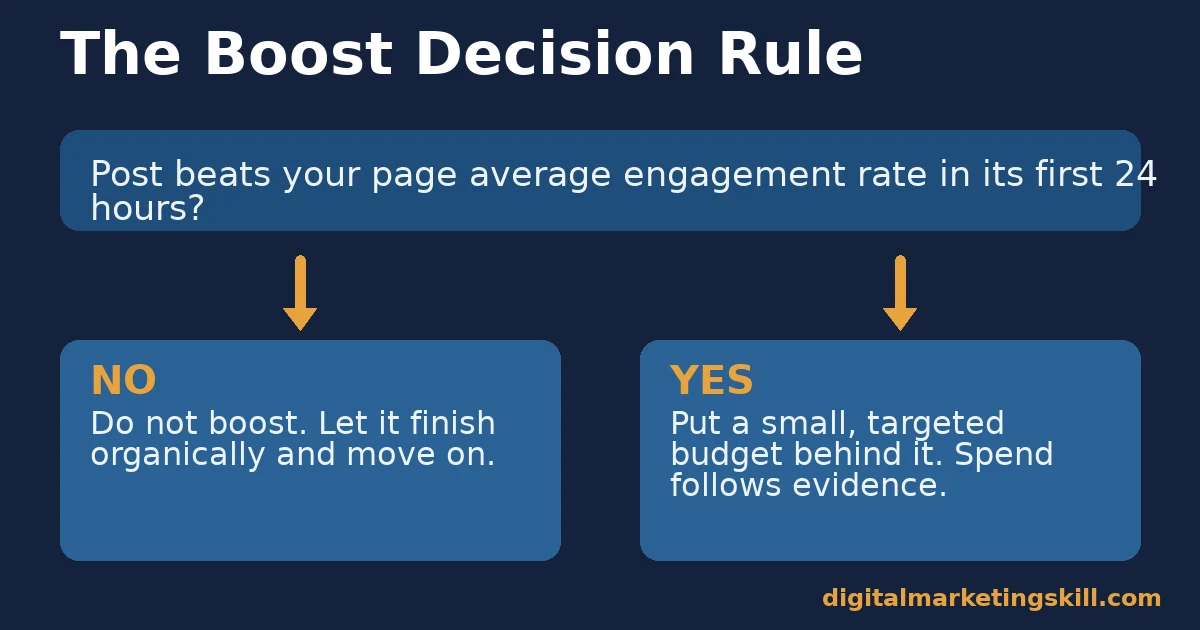
Decision rule: only spend on a post that has already beaten your page’s average organic engagement rate in its first 24 hours. Boosting a weak post rarely fixes it. You would be paying to show people content the algorithm already judged weak.
Boosting a post that already beats your average tells Facebook’s system you want more of that exact signal. That is cheaper per result, and more likely to carry over into the posts that follow.
This is also where Facebook retargeting becomes useful, once you have enough engaged visitors to build a custom audience.
Illustrative, invented numbers to show the rule at work: a page averaging 0.15% engagement posts a Reel that hits 0.40% in six hours. Under the rule, that Reel qualifies for a small boost. A text update from the same day, sitting at 0.08%, does not, no matter how important the message feels. Spend follows evidence, not urgency.
A Real Case: What a Small, Targeted Boost Did Next
A US-based business-software company published a case study on boosting one of its Facebook posts. The post already had solid organic engagement from existing followers before they boosted it. After the boost, the company reports its reach “expanded significantly, surpassing its organic reach,” and the extra visibility drove more website traffic and more conversions.
The limits matter here. The company did not publish exact budget, reach or percentage figures, so treat the result as directionally real rather than precisely measured. It is one published case from one company’s own page, not a controlled test across many pages.
Results depend on the post, the audience, and the ranking model active at the time. Treat it as a reason to test the pattern on your own Page, not as a promised outcome, and always disclose boosted content under your region’s advertising rules.
What makes the case worth noting is the mechanism, not the exact percentage. A boosted post does not just reach more people while the budget runs. It generates extra comments, shares and video views that the algorithm reads as fresh evidence about your whole Page. That evidence carries forward, briefly, into how the system treats your next few organic posts.
The takeaway: treat a small, well-targeted boost as an investment in your Page’s standing with the algorithm, not a one-off reach purchase.
Frequently Asked Questions About Facebook Page Likes
Do facebook page likes still matter if reach is so low?
Yes, but as a floor, not a goal. A larger, genuinely interested follower base gives the algorithm a bigger pool of people who might engage. That supports reach over time. The mistake is optimising for the like count itself, instead of the content and consistency that earn real engagement from those followers.
How fast can I grow facebook page likes without paying for ads?
There is no universal timeline. It depends on your niche, your posting consistency, and how much existing audience, such as an email list or website traffic, you can point at the Page. A realistic worldwide pattern is steady, single-digit weekly growth from consistent native content, with occasional larger jumps around a well-run contest or a widely shared post.
Are contests and giveaways still worth running?
They can grow facebook page likes quickly. But only if you follow Facebook’s own promotion rules, and pick a prize relevant to your niche rather than a generic gift card that attracts prize-seekers who never engage again. Check your page’s engagement rate 30 days after the contest, not just the like count on the day it ends.
What is a good engagement rate to aim for?
Independent benchmarking across business pages puts the average around 0.15%, with top formats like Reels and albums running higher. Use your own page’s trailing 90-day average as the real benchmark. Audience size, niche and region all shift what is realistic for any single page.
Should I post more often to get more facebook page likes?
Not necessarily. Tracked posting volume across business pages has fallen by close to half in recent years, as pages shifted toward fewer, better posts. That shift tracks the industry’s move toward engagement-based ranking. A content calendar built around one strong post a day usually beats five mediocre ones spread across the same week.
Is a Facebook Group better than a Page for growth?
They solve different problems. A Page is public, searchable, and necessary for ads and your business presence. A Group typically reaches a larger share of its members per post, but is harder to discover and manage at scale. Most growing brands eventually run both: the Page to attract, the Group to deepen the relationship.
Can I turn facebook page likes into actual revenue?
Only indirectly, and only once your engagement, not your like count, is strong enough to support a sales, service or ad-partnership offer. A related guide on how to monetize a Facebook page walks through the real income paths once you reach that stage.
Turn Page Growth Into a Marketable Skill
Growing facebook page likes into a real, engaged audience is one small part of a bigger discipline. That discipline is planning content, reading performance data, and adjusting a paid budget based on evidence, not guesswork.
It is what separates a hobbyist page from someone who can manage social media professionally, for their own business or for a client anywhere in the world. It is exactly the hands-on skill the Master Diploma in Digital & AI Marketing at Digital Marketing Skill Institute is built around.
What the Social Media Track Covers
The AI-Powered Social Media Management and Advertising track covers organic content strategy, paid boosting and reporting, on real accounts. It includes unlimited 1-on-1 coaching and mentoring, plus a U.S. Project Internship with a verified U.S. Work Reference Letter, built in from day one.
It is one of four AI-powered tracks, alongside lead generation and email automation, Google advertising and analytics, and WordPress and SEO. Together they make up a ten-course Master Diploma, with a Full Stack option covering all four.
The program is dual US and UK accredited, recognised in more than 100 countries, and runs 100% online. You can study it anywhere in your country, and carry the result wherever you go next.
Where to Go Next
See the full track breakdown on the Master Diploma program page. Read real outcomes on the student reviews page. Browse more practical guides on the digital marketing blog.
When you are ready, apply here. Whether you run a small page from home or manage social for a growing team, you can build this skill from wherever you live.
The results travel with you, and so does Digital Marketing Skill Institute itself, built to work the same way no matter where you study from.
Every figure in this guide was checked against its original source before publication. Figures marked as illustrative are invented examples, not real results.
![9 Amazing Digital Marketing Skills to Make Money Online [With Proof]](https://digitalmarketingskill.com/wp-content/uploads/2019/07/9-Amazing-Digital-Marketing-Skills-to-Make-Money-Online-With-Proof-17.png)






