
A unique selling proposition (USP) is the one clear benefit that makes your product, service or brand stand out from its competitors. It answers the customer’s question, “Why should I buy from you and not them?” It matters because when buyers can’t see a real difference, they tend to choose on price alone.
Key Takeaways
- A USP is a specific benefit that rivals cannot or do not offer.
- Advertising pioneer Rosser Reeves coined the term at the Ted Bates agency.
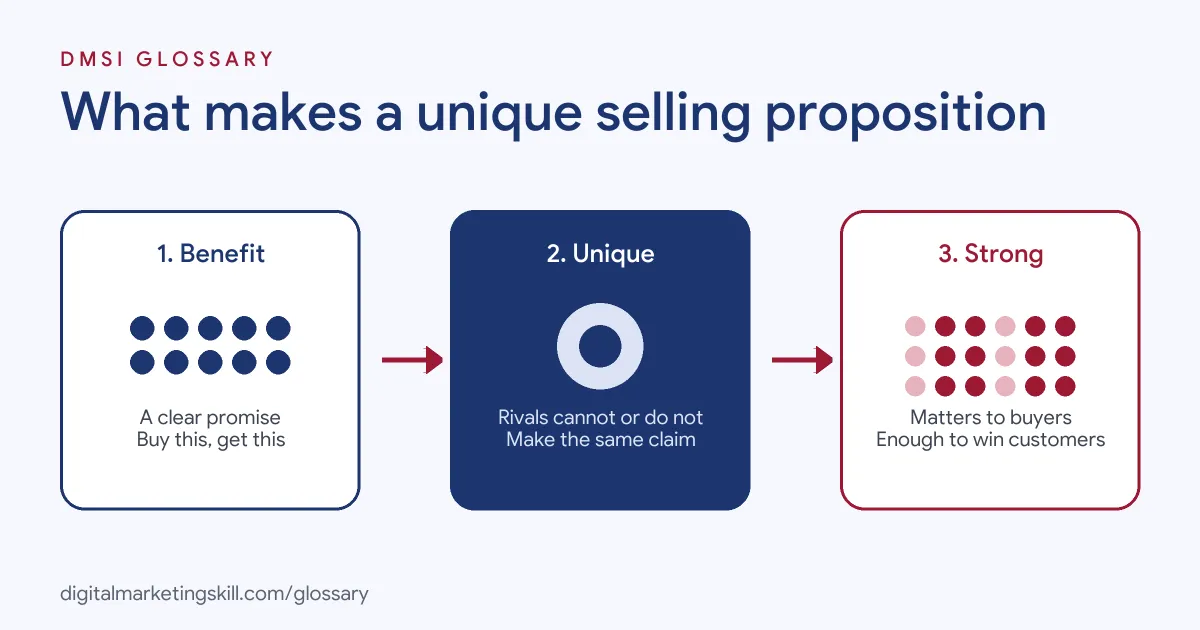
- Reeves set three rules: make a proposition, make it unique, and make it strong enough to win customers.
- A USP must matter to the buyer. As copywriter Bob Bly puts it, “the differentiation cannot be trivial.”
- Famous examples include M&M’s “melts in your mouth, not in your hand.”
What Is a Unique Selling Proposition?
Wikipedia describes a USP as “the unique benefit exhibited by a company, service, product or brand that enables it to stand out from competitors.” In other words, it is the reason your offer is the better choice for a particular buyer.
It is not a slogan for its own sake. A slogan can be catchy and still say nothing. A USP makes a clear promise that a customer can check. For example, “fresh bread” is not unique, because every bakery says it. However, “bread baked every two hours, so it’s always warm when you buy it” is specific and different.
You may also hear it called a unique selling point, or a unique value proposition. These names mean much the same thing in everyday marketing. Whatever you call it, the test is the same. Could a customer explain, in one sentence, why your offer is different? If not, you don’t have a unique selling proposition yet, just a description of what you do.
How a Unique Selling Proposition Works
Rosser Reeves, who led the Ted Bates agency, set out three tests for a USP. First, there must be a clear benefit. Next, it must be unique. Finally, it must be strong enough to move people to buy.
A Clear Benefit
Reeves said each ad must make a proposition to the consumer. According to Branding Strategy Insider, the message is: “Buy this product and you will get this specific benefit.” So a USP talks about what the customer gets, not just what the product has.
Something Rivals Don’t Offer
Next, the proposition must be one that competitors “either cannot, or does not, offer.” That second part is important. Your claim doesn’t have to be impossible to copy. It can simply be a claim nobody else in your market is making. Reeves called this “a claim not otherwise made in that particular form of advertising.”
Strong Enough to Sell
Finally, the proposition must be strong enough to “move the mass millions,” as Reeves put it. In plain terms, it has to matter enough to bring in new customers. A difference that buyers don’t care about won’t help you sell.
What the Customer Takes Away
There is a subtle point in Reeves’s thinking. Branding Strategy Insider notes that he saw the USP as something the consumer takes away from the ad, not something the copywriter puts into it. In other words, it only counts if buyers notice it and remember it.
That is why clarity matters so much. Harvard Business School professor Theodore Levitt, quoted on Wikipedia, stressed that “differentiation is one of the most important strategic and tactical activities” a company can pursue. So a USP is not just an advertising line. It also shapes what you build, how you price and which customers you chase.
Unique Selling Proposition Examples
- M&M’s: “Melts in your mouth, not in your hand.” Wikipedia notes that the claim rests on the sweets’ hard sugar coating.
- Domino’s Pizza: “You get fresh, hot pizza delivered to your door in 30 minutes or less—or it’s free.” Wikipedia links this promise to the systems the company built for fast production.
- A steam-washed beer bottle: Bly recalls a famous beer ad by Claude Hopkins that said the bottles were “washed in live steam.” Other brewers did the same, but nobody else said so.
Each one makes a specific promise. As a result, customers can remember it and repeat it. Notice, too, that each claim rests on something real, such as a coating, a kitchen system or a cleaning process. A promise without that support soon falls apart.
USP vs Value Proposition vs Slogan
| Term | What it is | Example |
|---|---|---|
| USP | The one benefit that sets you apart from rivals | “Hot pizza in 30 minutes or less, or it’s free” |
| Value proposition | The full set of benefits and value a customer gets | Fast delivery, fair prices and easy online ordering |
| Slogan or tagline | A short, memorable phrase for the brand | A catchy line that may or may not state a benefit |
In short, a value proposition explains all the value you offer, while a USP picks the single point of difference. A slogan is simply how you say it.
How to Write a Unique Selling Proposition
- Know who you are selling to. Start from your buyer persona and their biggest problem.
- List every benefit your product gives that customer.
- Check what your main competitors claim on their websites and ads.
- Cross out any benefit that a rival already promises clearly.
- From what is left, pick the benefit your buyer cares about most.
- Write it as one plain sentence: “We help [customer] get [benefit], unlike [alternative].”
- Make sure you can prove it. Then test it in an ad, a headline or an email subject line.
Bly suggests three useful angles if you’re stuck. You can lead with a unique feature that has a strong benefit. You can show the job your product does best. Or you can make a claim that rivals could make but don’t.
Best Practices for a Unique Selling Proposition
- Be specific. Numbers, times and clear outcomes beat vague words like “quality”.
- Focus on one point. A list of five benefits is harder to remember than one.
- Keep it true. Only promise what you can deliver every time.
- Use it everywhere. Put it on your home page, ads, emails and sales calls.
- Review it. If a competitor copies your claim, find a sharper angle.
For ideas on turning your USP into a full brand, read our guide to brand identity strategy.
Common Mistakes to Avoid
Many businesses claim “the best service” or “the highest quality”. These phrases are puffery, which means they sound good but promise nothing specific. Others pick a difference that buyers don’t care about. Bly warns against features that are different but unimportant to customers. Some write a USP and then never use it. Finally, many try to appeal to everyone, so the message ends up appealing to no one. The fix is to choose one buyer, one benefit and one clear sentence, then repeat it everywhere.
Where You’ll Use a Unique Selling Proposition at Work
Job listings rarely use the letters USP. Instead, they ask for the same skill under names like value propositions and differentiation. For example, recent remote listings ask for:
- “Demonstrated ability to translate clinical and technical capabilities into financially grounded, compelling value propositions” (Head of Product and Partner Marketing).
- “Value positioning and competitive differentiation for each product area” (Senior Segment Marketing Manager).
So whether you aim to be a Digital Marketing Manager, Growth Marketer or Freelance Digital Marketer, you will need to find what makes an offer different and say it clearly in ads, pages and emails.
Learn It in the Full Stack Programme
A strong USP shapes every channel, so it fits the Full Stack (all four tracks) option. It covers all ten courses, with one portfolio project from each track, from paid social to Google Ads, email and SEO. You also join a U.S. Project Internship from day one, with unlimited 1-on-1 mentoring.
To find out who your USP should speak to, see our glossary entry on the buyer persona.
Frequently Asked Questions
What is a USP in simple terms?
It is the one clear benefit that makes your product different from its competitors and gives customers a good reason to choose you over them.
Who invented the unique selling proposition?
Rosser Reeves, an advertising pioneer at the Ted Bates agency, coined the term and set out its three rules.
What is the difference between a USP and a value proposition?
A value proposition covers all the value you offer. A USP focuses on the single benefit that sets you apart.
Can a service business have a USP?
Yes. For example, a cleaning firm might promise the same named cleaner every visit, if local rivals don’t offer that.
How long should a USP be?
Short enough to say in one breath. One clear sentence is usually enough for customers to remember.
Sources: Wikipedia: Unique selling proposition; Branding Strategy Insider: The unique selling proposition defined; Bob Bly: Reality in Advertising; remote job listings on Himalayas.