
Customer retention is a business’s ability to keep existing customers buying from it over time, rather than losing them to competitors or to doing nothing. You measure it with a retention rate, which shows what share of customers you kept over a period. It matters because keeping a customer is usually far cheaper than winning a new one, and loyal customers tend to be worth more.
Key Takeaways
- Shopify describes customer retention as “the ability to bring back first-time customers to make repeat purchases.”
- The retention rate formula is: (customers at end minus new customers) divided by customers at start, times 100.
- Harvard Business Review reports that acquiring a new customer can cost five to 25 times more than keeping one.
- Research by Frederick Reichheld of Bain & Company found that a 5% rise in retention can lift profits by 25% to 95%.
- Retention is the opposite side of churn, so improving one usually improves the other.
What Is Customer Retention?
Most businesses spend a lot of time and money winning new customers. Retention is about what happens next. Do those people buy again, renew their subscription or stay with you for years? Or do they buy once and disappear?
Think of a local café. If the coffee is good and the staff know your name, you keep going back. If not, you try the place next door. Online, the same rule holds.
Shopify puts it simply. It calls customer retention “the ability to bring back first-time customers to make repeat purchases.” For a subscription business, the same idea applies to renewals rather than repeat orders.
Retention is closely linked to two other measures. The first is churn rate, which tracks the share of customers you lose. The second is customer lifetime value, which estimates how much a customer is worth over the whole relationship. When retention goes up, churn falls and lifetime value usually rises.
How Customer Retention Works
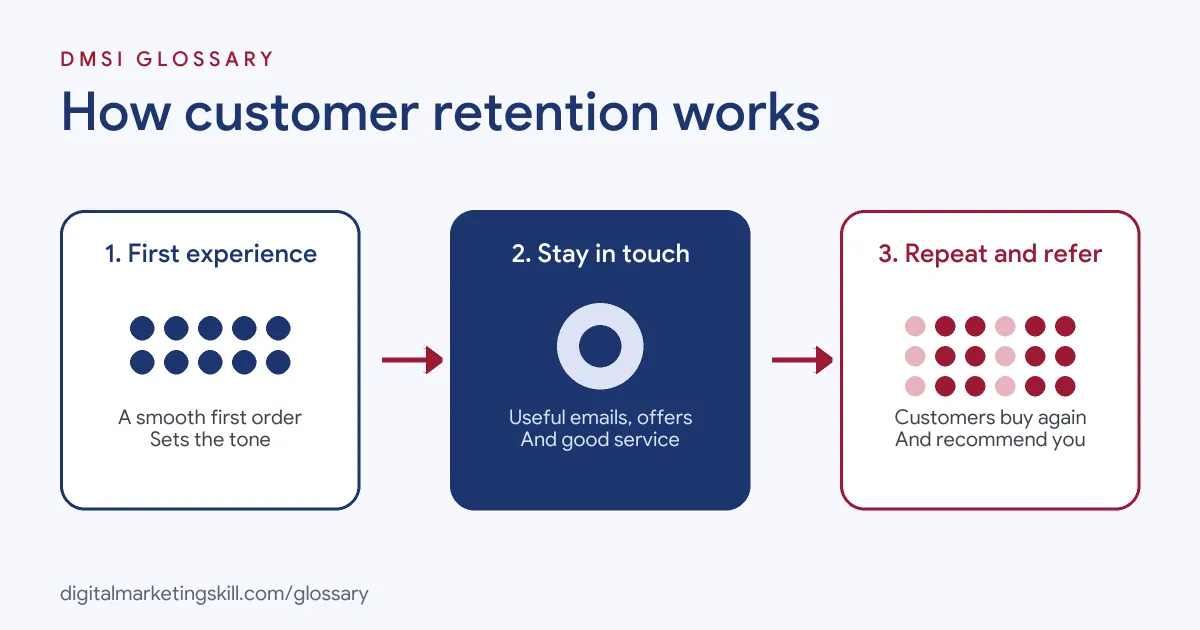
Retention builds in three stages. First, a customer has a good first experience with the product and the service. Next, you keep in touch with useful, relevant messages and offers. Finally, the customer comes back, buys again and, ideally, recommends you to others.
Why It Pays
The economics are hard to ignore. Writing in Harvard Business Review, Amy Gallo notes that “acquiring a new customer is anywhere from five to 25 times more expensive than retaining an existing one.” She adds that the exact figure depends on the study and the industry.
The same article cites research by Frederick Reichheld of Bain & Company. It found that “increasing customer retention rates by 5% increases profits by 25% to 95%.” In other words, small gains in loyalty can have a big effect on profit.
How to Calculate It
Shopify gives a simple formula for the rate:
Retention rate = (Customers at end of period minus New customers acquired) divided by Customers at start of period, times 100.
Here’s a made-up worked example. You start a quarter with 500 customers. During the quarter, you gain 100 new customers and end with 520. So (520 minus 100) divided by 500 is 0.84. That gives a retention rate of 84%.
Why Customers Leave
People stop buying for many simple reasons. Some had a poor first order, such as a late delivery or a product that didn’t match the photos. Others had a problem and found it hard to get help. Many just forget about you, because nobody reminded them. A few find a cheaper or better option. The good news is that most of these reasons are things you can fix. So when you look at your own data, try to sort lost customers by the reason they left. Then tackle the biggest group first.
Customer Retention Examples
Here are three made-up examples of retention in action:
- Online shop: A skincare brand sends a reminder email when a customer’s moisturiser is likely to be running low. As a result, more customers reorder on time.
- Software company: A start-up notices users who stop logging in after two weeks. It sends them a short tutorial and offers a quick call, so fewer cancel.
- Local gym: A gym checks in with new members after their first month. It offers a free session with a trainer to anyone who has stopped visiting.
Each one spots a moment when customers might drift away, then acts before they leave.
Keeping Customers vs Winning New Ones
Both matter, but they do different jobs:
| Area | Winning new customers | Keeping customers |
|---|---|---|
| Goal | Win new customers | Keep existing customers buying |
| Typical channels | Paid ads, SEO, social media and partnerships | Email, loyalty schemes, service and onboarding |
| Key metrics | Customer acquisition cost and conversion rate | Retention rate, churn rate and repeat purchase rate |
| Relative cost | Higher; HBR cites five to 25 times more | Lower per customer kept |
In short, acquisition fills the bucket, while retention fixes the holes in it.
How to Improve Customer Retention
- Measure your starting point. Work out your retention rate and churn rate for a set period, such as a quarter.
- Find where people leave. Look at when customers stop buying or cancel. For example, after the first order or the first month.
- Improve onboarding. Help new customers get value quickly, with welcome emails, guides or a short call.
- Stay in touch. Send useful emails, such as tips, reminders and relevant offers, rather than constant discounts.
- Win back quiet customers. Run a re-engagement campaign for people who have stopped buying. As Mailchimp puts it, “it’s often less expensive to target a current contact than it is to find a new one.”
- Reward loyalty. Consider a points scheme, early access or member perks for repeat customers.
- Listen and fix. Finally, collect feedback, solve common complaints and tell customers what you changed.
Metrics to Track
Track a small set of numbers together. Start with the retention rate and churn rate each month or quarter. Then add the repeat purchase rate, which shows the share of customers who bought more than once. Next, watch average order value and lifetime value for returning customers. Finally, compare these by group, such as customers from different channels. That way, you’ll see which sources bring people who stay.
Best Practices for Customer Retention
- Make the first experience great. A smooth first order sets the tone for everything after.
- Personalise your messages. Use what people bought to suggest what they might like next.
- Don’t rely only on discounts. Constant offers can teach customers to wait for a sale.
- Make service easy. Quick answers and simple returns remove common reasons to leave.
- Work across teams. Marketing, sales and support all shape whether customers stay.
Common Mistakes to Avoid
A common mistake is spending almost the whole budget on acquisition and ignoring existing customers. Another is measuring retention once a year, which is too late to act. Some businesses also send the same generic emails to everyone. Others make cancelling or returning hard, which damages trust. Lastly, many never ask customers why they left, so the same problems keep happening.
Where You’ll Use Customer Retention at Work
Retention appears in lifecycle, growth and ecommerce roles. For example, remote job listings mention:
- The need to “Design, build, and optimize multi-channel lifecycle campaigns (email, in-app, SMS) across the full customer journey: onboarding, activation, engagement, retention, win-back, and expansion” (Lifecycle Marketing Specialist).
- Building “a scalable engine across developer recruitment, freemium conversion, and customer retention” (Director, Product-Led Growth).
- The task to “Plan and run email campaigns that support retention, promotions, and new product launches” (Shopify Store Specialist).
So whether you aim to be a Digital Marketing Manager, Growth Marketer or Freelance Digital Marketer, you’ll need to measure and improve how many customers stay.
Learn It in the Full Stack Programme
You can learn the channels that keep customers coming back in the Full Stack (all four tracks) programme. It covers all ten courses, with one portfolio project from each track. You also get unlimited 1-on-1 mentoring and a U.S. Project Internship from day one.
For practical ideas, read our guide to customer retention strategies and our article on the customer retention rate.
Frequently Asked Questions
What is customer retention in simple terms?
It is how well a business keeps its existing customers buying, renewing or using its service over time.
How do you work out the retention rate?
Take customers at the end of a period, subtract new customers gained, divide by customers at the start, then multiply by 100.
Why is customer retention important?
Keeping customers usually costs less than finding new ones. Harvard Business Review cites a range of five to 25 times more for acquisition.
What is a good retention rate?
It varies widely by industry and business model. The most useful benchmark is your own rate over time, plus a comparison by channel.
What is the difference between retention and churn?
Retention measures the customers you keep. Churn measures the customers you lose over the same period.
Sources: Harvard Business Review: The value of keeping the right customers; Shopify: Customer retention strategies; Mailchimp Help: Re-engage inactive subscribed contacts; remote job listings on Himalayas.