
A brand identity strategy turns a name, a logo and a set of values into one system customers recognise everywhere. Most small businesses skip the strategy and design a logo instead. That is why brands look consistent on a slide and chaotic everywhere else. This guide covers the mechanism, the trade-offs by stage, and how to measure your brand identity strategy.
Key Takeaways
- Companies that present their brand consistently report revenue gains of 10-20%, says a survey of more than 400 brand management professionals by Marq (formerly Lucidpress). The same survey found 85% of organisations have written brand guidelines, but only 30% enforce them.
- In a Stanford University study of 2,684 participants, “design look” (layout, typography, colour, white space) was the top factor people named when judging a website’s credibility, cited in 46.1% of all comments.
- A federal trademark registration gives a business a legal presumption of ownership, nationwide rights, and the right to sue in federal court, per the USPTO.
- Businesses worldwide filed an estimated 11.63 million trademark applications covering 15.23 million classes in the most recent year the World Intellectual Property Organization tracked. China’s applicants alone filed around 7.4 million of those classes.
- The real gap is enforcement, not guidelines. That is what a working brand identity strategy closes.
In this guide
- Most Brand Advice Skips The Enforcement Problem
- How A Brand Identity Strategy Actually Works
- What Changes By Business Stage
- Common Mistakes That Undo A Brand Identity Strategy
- Protecting The Identity You Build
- Keeping One Identity Across Every Channel
- Measuring Whether Your Brand Identity Strategy Is Working
- The One Decision Rule That Matters Most
- What Doing This Right Looks Like
- Frequently Asked Questions About Brand Identity Strategy
- Turning A Brand Identity Strategy Into A Habit
Most Brand Advice Skips The Enforcement Problem
Search for brand identity strategy and you find hundreds of articles about colours, fonts and slogans. Almost none name what actually breaks brand consistency. It is not a missing logo file. It is a guideline nobody checks.
Marq’s survey of brand professionals found that 85% of organisations already have written brand guidelines. Yet only around 30% enforce them. That gap, not weak design, separates brands that build trust over time from brands that confuse customers with a different voice on every channel.
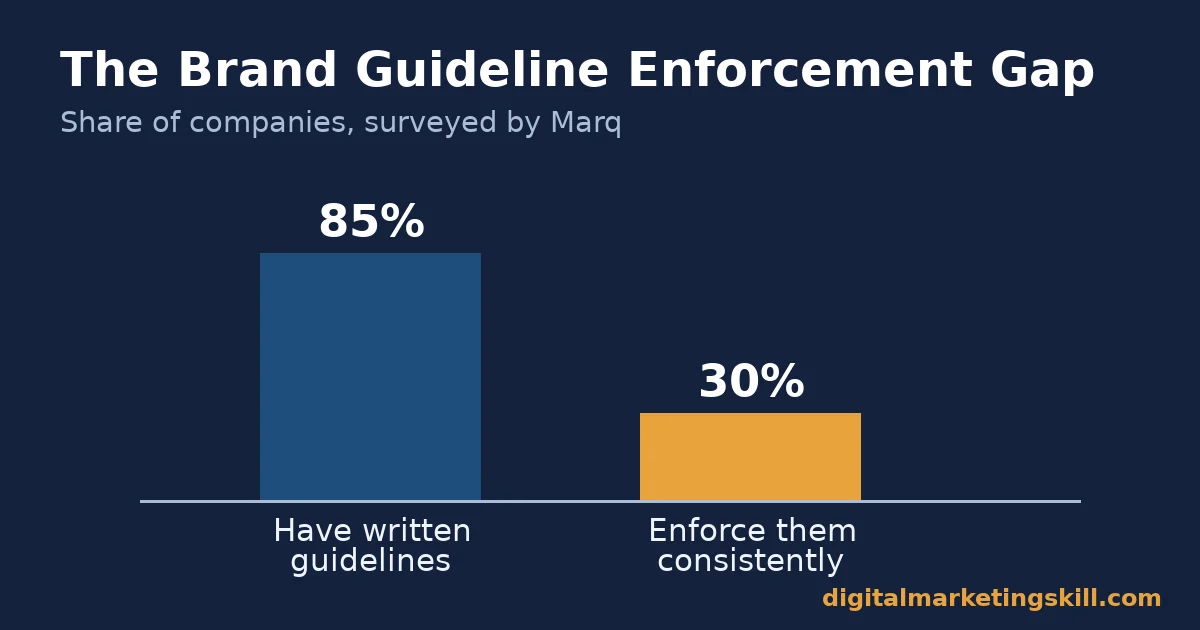
Treat the figures here as an informed framework, not a guaranteed formula. A brand identity strategy lowers the odds that your name, visuals and message drift apart as your team grows. But no study can promise a specific revenue outcome for your business. The 10-20% figure above is a range companies reported, not a fixed law of marketing.
How A Brand Identity Strategy Actually Works
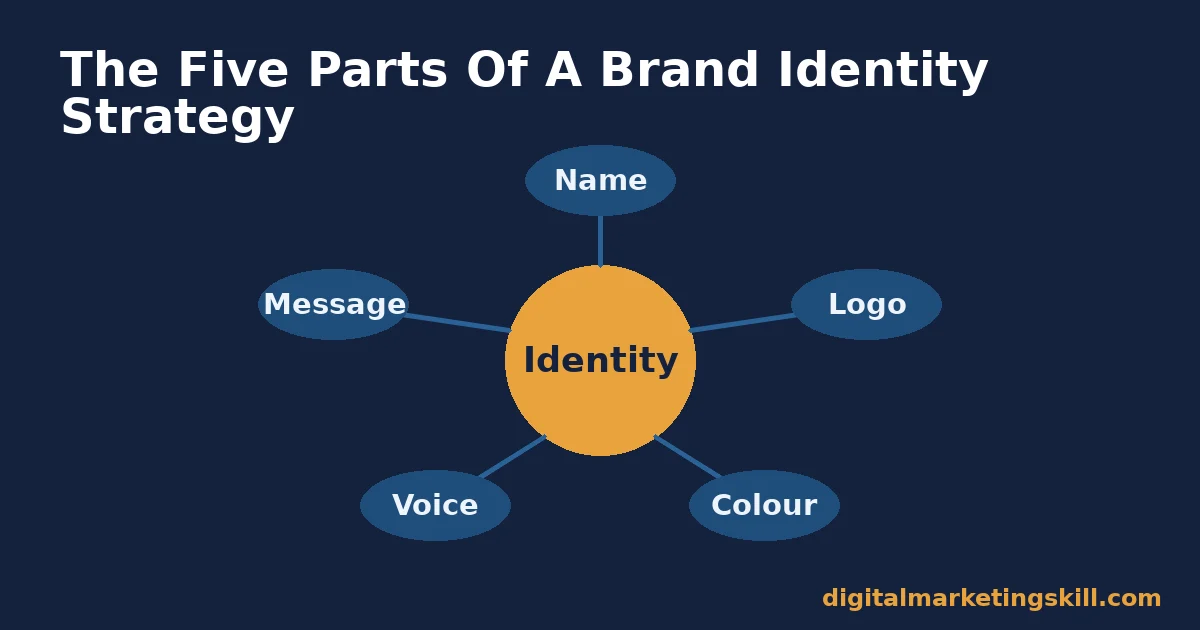
A brand identity strategy is the documented set of rules behind your brand: name, logo, colours, fonts, voice and message. It tells everyone inside and outside your company what your brand looks and sounds like, and why.
The mechanism is repetition. The more times a customer sees the same mark, the same colours and the same tone, the faster their brain files your business as one recognisable thing. Researchers call this the mere-exposure effect. It is also why Stanford’s web credibility study found “design look” in 46.1% of comments people made when judging a site’s trustworthiness, more than any other factor the 2,684-person study measured.
The mechanism breaks in one of two places. Either nobody wrote the rules down clearly enough to repeat. Or somebody wrote them once, then a new designer or employee quietly shipped their own version of the logo, the tagline or the “brand voice.”
Marq’s finding, 85% have guidelines but only 30% enforce them, points at the second failure far more than the first. A brand identity strategy fixes this three ways: write the rules down, name an owner to enforce them, and review output against them on a schedule.
What Changes By Business Stage
A brand identity strategy is not one exercise for every business. Launching fresh, fixing an inconsistent identity, and scaling across many people each carry a different risk. So each needs a different first move.
New Business: Built For Speed Over Perfection
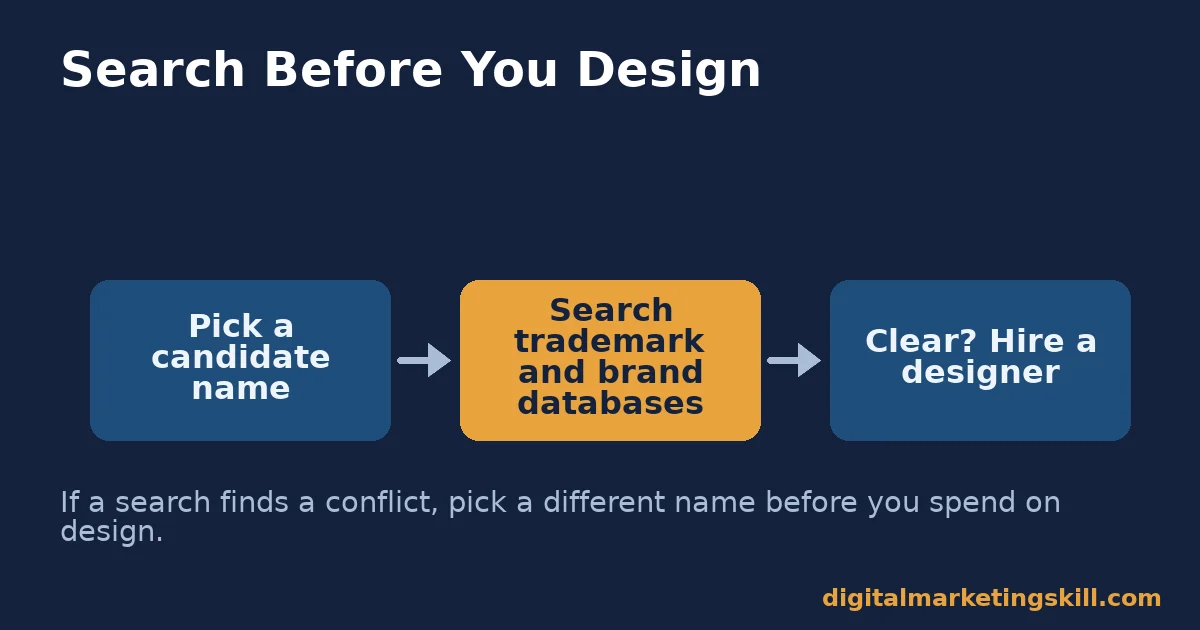
If you have no identity yet, the trap is perfecting a logo for weeks before you check whether your name is even free to use. Search the USPTO’s trademark database and the WIPO Global Brand Database first. A name that collides with a registered mark can force an expensive rename later.
Write down three things before you hire a designer: who the brand serves, the one sentence that explains what you do differently, and the two or three colours you will use everywhere. Keep the system simple enough to apply correctly without a brand manual longer than one page.
A new business does not need a full brand identity strategy document on day one. It needs enough structure that the first fifty customer touchpoints, a website, a few social posts, an email signature, all look like they came from the same company. Add detail to the guide as you grow, instead of waiting for a perfect version before you launch anything.
Inconsistent Business: Lead With An Audit, Not A Redesign
If your business already exists, but your identity looks different on your website, your social profiles and your invoices, the trap is jumping straight to a redesign. Audit first. Collect every place your name, logo, colours and voice appear today. List where they contradict each other.
Most inconsistency comes from small, fixable mistakes: an old logo file still live on one page, a tagline nobody updated in the footer. Fix the contradictions before you consider a full redesign. A redesign without enforcement just restarts the same drift.
Scaling Business: Lead With Documentation And Ownership
If you are adding people and channels faster than one person can review every asset, the trap is assuming everyone already understands “the brand” the way you do. Write the rules down: logo usage, colour codes, approved fonts, and voice guidelines with example sentences.
Then name an owner whose job includes checking new material against those rules. Marq’s research shows the guidelines are not the real bottleneck. Enforcement is. Review a sample of customer-facing material against the guide on a fixed schedule, not only when something looks wrong.
Common Mistakes That Undo A Brand Identity Strategy
Most failures trace back to a handful of repeat mistakes. Knowing them in advance is cheaper than fixing them later.
Choosing a name before checking it is free to use. A memorable name that collides with an existing trademark is not an asset. It is a liability waiting for a lawyer’s letter. Search first, name second.
Treating colour as decoration instead of a rule. Stanford’s credibility research found that “design look,” which includes colour choice, was the single most cited factor in how people judged a site’s trustworthiness. A colour palette is not a style preference. It is part of how strangers decide whether to trust you in the first few seconds on your page.
Writing guidelines nobody reads. A fifty-page brand bible sitting unopened in a shared drive protects nothing. Marq’s data makes this concrete: 85% of companies already have guidelines, so writing one is not the hard part. Getting people to check their work against it, every time, is.
Letting every new hire interpret the brand their own way. Without a named owner, a brand identity strategy degrades one small decision at a time. None of it looks wrong alone. All of it adds up to a brand that looks like several businesses.
Redesigning before auditing. Teams jump to a new logo when the real problem is three old logo versions still live on different pages. A redesign does not fix enforcement. It just gives the next person three versions to ignore instead of one.
Protecting The Identity You Build
Once a brand identity strategy works, it becomes worth defending. The USPTO states that a registered trademark gives you a legal presumption that you own the name or logo, the right to sue in federal court, and the right to use the registration symbol publicly.
Registration also creates nationwide rights, unlike the patchwork protection an unregistered mark relies on. It can also serve as the basis for registering the same mark abroad. None of this arrives overnight, and none of it is automatic.
Businesses worldwide filed an estimated 11.63 million trademark applications covering 15.23 million classes in the most recent year WIPO reported. China’s applicants alone filed around 7.4 million of those classes. So searching for conflicts before you commit to a name is not optional paperwork. It is risk management.
Trademarks also register against specific classes of goods or services, not a name in the abstract. A bakery and a software company can sometimes share a similar name without conflict, because they operate in different classes. That detail matters when you search: a clear result in one class does not guarantee a clear result in yours, so check the class that actually matches your business.
Keeping One Identity Across Every Channel
A brand identity strategy only proves itself once it survives contact with every channel you actually use: a website, two or three social platforms, email, and maybe print materials or packaging. Each channel tempts you to bend the rules a little. Resist that.
Website: The Visual Standard Everything Else Matches
Your homepage sets the visual standard everything else should match. Keep the same logo file, the same colour codes and the same voice on every page, not just the homepage. A visitor who lands on an internal page should not wonder if they left your site.
Social Platforms: Where Drift Happens Fastest
Profile photos, cover images and bios drift out of sync faster than almost anything else, because each platform has different size requirements and different teams often manage different accounts. Keep one source file for your logo at the right dimensions for each platform, and check all of them together, side by side, at least once a quarter.
Email: An Easy Touchpoint To Forget
Your email signature, your newsletter header and your automated reply messages are brand touchpoints too, even though teams often treat them as an afterthought. The same logo and the same tone that appear on your website should appear here.
Print And Packaging: Built To Last Longer Than A Browser Tab
If you still produce anything physical, a business card, a flyer, a shipping box, treat it with the same rules as your digital channels. A printed item that contradicts your digital identity confuses customers just as much as a mismatched web page, and it often lasts longer in someone’s hands or on their desk.
The common thread is a single source file and a single owner, not a separate decision for each channel. A brand identity strategy that only lives on your website is not really a strategy. It is a style guide for one page.
Measuring Whether Your Brand Identity Strategy Is Working
A brand identity strategy is not finished when you write the guidelines. Measure it against what customers actually experience. Track these alongside the metrics you already watch:
- Consistency audit score: the share of customer-facing assets (web pages, social profiles, invoices, email signatures, packaging) that match your written guidelines exactly. Score it quarterly against a fixed checklist, not from memory.
- Unprompted brand recall: in a short survey, the share of customers who describe your name, colours or tagline without seeing them first. Rising recall means repetition works; flat recall means the identity is not consistent enough to stick.
- Guideline enforcement rate: the share of new material (ads, posts, decks, print) someone checked against your brand guide before publishing, not after. This is the metric Marq’s research suggests most companies miss entirely.
- Direct and branded search share: the share of your website traffic from people typing your name directly, instead of generic category terms. A rising share shows people recognise your name well enough to seek it out.
Read these together, not alone. A high consistency score paired with flat brand recall usually means an identity that is tidy but forgettable. A low enforcement rate paired with falling recall usually means drift, not weak original design.
None of these four numbers replaces the sales and traffic metrics you already track. They sit alongside them, explaining some of the “why” behind a change in conversion rate or repeat purchase rate that a sales dashboard alone cannot show you.
The One Decision Rule That Matters Most
If you can only fix one thing, fix enforcement before design. A beautifully designed identity nobody checks will drift within a year. A simple identity someone checks every month will compound instead.
Before approving a new design element, ask who will check every future use of it, and on what schedule. If nobody can answer, the identity will not hold.
Illustrative, invented numbers: picture two small businesses that spend the same amount on a new identity. Business A assigns nobody to review future material. By month twelve, a quick check finds six different logo versions in active use.
Business B assigns one person to check new material every month against a one-page guide. By month twelve, the same check finds the identity applied correctly on 95% of assets reviewed. Both started with a similar design brief. Enforcement was the only real difference, which matches Marq’s actual survey data: 85% have guidelines, but only 30% enforce them.
What Doing This Right Looks Like
DMSI graduate Eunice Bolaji, as published on the Institute’s reviews page, describes building “a full blown Ecommerce site from the scratch while still learning” during her course. That meant defining a visual identity, layout, colours and product presentation, then applying it consistently across a live storefront, not just one design file.
That is the real test of a brand identity strategy. Not whether the first page looks right, but whether the identity still holds once someone applies it across many pages while still learning the tools. Individual results vary and are not typical for every learner; see the Institute’s earnings disclaimer for the limits of any student outcome shared publicly.
Frequently Asked Questions About Brand Identity Strategy
What is the difference between a brand identity strategy and a logo?
A logo is one visual asset. A brand identity strategy is the full written system behind it: name, colours, fonts, voice, message, and the rules for using all of them consistently. That system is why a logo, a social post and an invoice clearly belong to the same business.
How long should a brand identity strategy document be?
Short enough that your team will actually read it. A one-to-two page guide with logo rules, colours, fonts, voice and a few example sentences gets followed more than a fifty-page manual nobody opens. Enforcement, not length, is what the research above shows is missing most often.
Do I need a registered trademark before I launch?
Not necessarily before launch, but search for conflicts before you commit to a name or logo. You can register later. But federal registration only grants its legal presumption of ownership, nationwide rights and right to sue in federal court, per the USPTO, from the point you register forward, not before.
How often should I audit my brand for consistency?
Quarterly works well for a small or scaling business. That is often enough to catch drift before it spreads across a full year of content, and rare enough that the audit does not become a box-ticking exercise nobody takes seriously.
Can a brand identity strategy change over time?
Yes, and it should when your business genuinely changes. But a planned update applied consistently differs from drift. Update the written guide first. Tell everyone producing customer-facing material about the change. Then measure your consistency audit score afterward to confirm the new version took hold.
What is the biggest mistake businesses make with brand identity?
Treating the guidelines as a one-time deliverable instead of an ongoing standard. The research above is specific on this point. Most companies that struggle with brand consistency already have written guidelines. They simply are not checking new material against them.
Does brand identity matter more online or offline?
It matters in both, but online it compounds faster. The same inconsistency that might pass unnoticed on one printed flyer shows up at once across a website and several social profiles. That holds true wherever your audience browses from, anywhere in your country.
Who should own a brand identity strategy inside a small team?
One named person, even if that person wears several other hats. Shared ownership with nobody clearly in charge is how the Marq survey’s enforcement gap happens in the first place. The owner does not have to design anything. Their job is to check new material against the written guide and flag anything that does not match.
What should go in a one-page brand identity guide?
Your logo files and the minimum clear space around them, your two or three core colours with their exact codes, your approved fonts, three to five words that describe your tone, and two or three example sentences written in that tone. That is enough structure for most small businesses to stay consistent without the guide itself becoming a project nobody finishes.
Turning A Brand Identity Strategy Into A Habit
A brand identity strategy only works as an ongoing habit, not a one-time project. Define the rules. Name an owner. Check new material against them on a schedule. Measure consistency the way you measure any other part of your business. Start with one audit of everything you publish today, fix the contradictions you find, then build the habit before you spend more on new design.
Want structured help building and defending a brand? The Digital Marketing Skill Institute’s Master Diploma in Digital & AI Marketing covers brand and content strategy alongside SEO, paid media and analytics across nine practical courses. It includes unlimited one-on-one coaching and mentoring, plus real project work inside a U.S. company.
The program is dual US and UK accredited and recognised in more than 100 countries, delivered 100% online, so you can build these skills anywhere in your country. Visit digitalmarketingskill.com to explore the curriculum, browse student reviews, or go straight to the application page to start your own project. The same enforcement habit described above is what the Institute’s coaching helps you install, wherever you live, at digitalmarketingskill.com.
Every figure in this guide was checked against its original source before publication. Figures marked as illustrative are invented examples, not real results.
![9 Amazing Digital Marketing Skills to Make Money Online [With Proof]](https://digitalmarketingskill.com/wp-content/uploads/2019/07/9-Amazing-Digital-Marketing-Skills-to-Make-Money-Online-With-Proof-17.png)