
Multichannel marketing is the approach of reaching customers through several channels at once, such as search, social media, email, your website and physical shops. Each channel does its own job, and customers choose the one that suits them. It matters because a business that shows up in more of the right places gives customers more ways to find it, and more chances to buy.
Key Takeaways
- Multichannel marketing uses two or more channels to reach and sell to customers.
- The aim is to get the best from each channel, tailored to the people who use it.
- Google Analytics sorts traffic into default channels, such as Organic Search, Paid Social, Email and Referral.
- UTM tags on your links tell analytics which channel and campaign each visit came from.
- Attribution models decide how much credit each channel gets for a sale.
What Is Multichannel Marketing?
IONOS defines it as “a communication approach that companies use with the aim of reaching potential customers on several communication channels simultaneously.” As a result, customers can choose their preferred channel to learn about a company, buy from it and contact it.
The opposite is single-channel marketing, where a business relies on one route, such as a shop or a single social platform. According to IONOS, the main aim of a multichannel approach is to make each channel perform as well as possible for its own audience. For instance, shop visitors may want personal advice, while online shoppers may care more about speed and price.
For example, a small coffee roaster might sell in its own café, run an online store, post on Instagram and send a monthly email. Each channel reaches different people, and together they grow the business.
How Multichannel Marketing Works
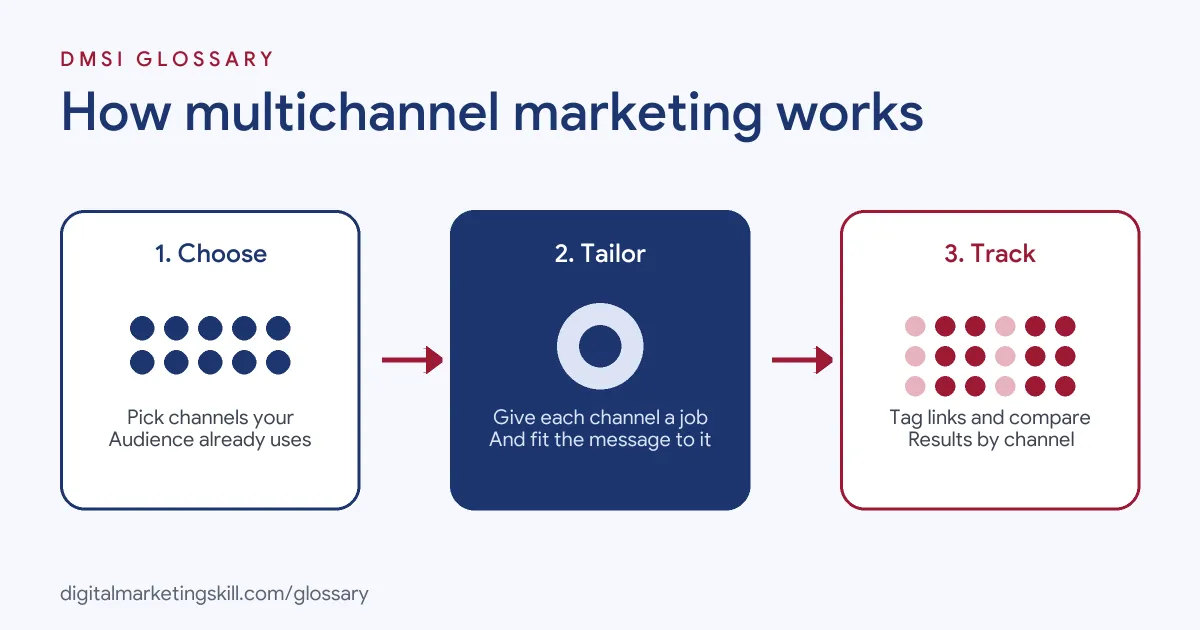
A multichannel plan has three parts. First, you pick the channels your audience actually uses. Next, you create content and offers that fit each one. Then you track results by channel, so you know where to invest more.
Choosing Channels
Start with your audience, not the channel. Where do your customers search, scroll and read? A business-to-business software firm may lean on LinkedIn, search ads and email. Meanwhile, a fashion brand may focus on Instagram, TikTok and its online store. Our guide to digital marketing channels covers the main options.
Tracking Each Channel
Google Analytics groups your traffic into default channels. These include Organic Search, Paid Search, Organic Social, Paid Social, Email, Referral, Display, Direct, Affiliates and SMS, among others. It also has an AI Assistant channel for visits from tools such as ChatGPT and Gemini. Google says these default channel groups can’t be edited, but you can create custom channel groups.
To make the grouping work, tag your campaign links. Google advises that “you should always use utm_source, utm_medium, and utm_campaign” when you add parameters to a URL. For example, a link in a sale email might carry utm_source=newsletter, utm_medium=email and utm_campaign=summer-sale.
Giving Credit
Customers often touch several channels before they buy. So who gets credit? Google Analytics offers three attribution models: data-driven, paid and organic last click, and Google paid channels last click. Data-driven attribution, Google explains, “distributes credit for the key event based on data for each key event.” In other words, it looks at real paths to decide which touchpoints mattered most.
Multichannel Marketing Examples
Here are three made-up examples of how businesses combine channels:
- Local gym: It runs Google search ads for “gym near me”, posts class videos on Instagram and emails members a weekly timetable.
- Online course provider: It publishes blog posts for search traffic, runs Meta ads to a free guide and follows up by email.
- Furniture retailer: It sells in shops and online, runs shopping ads and sends text messages about delivery slots.
In each case, every channel has a clear role. That’s what turns a list of channels into a plan.
Benefits and Challenges
IONOS lists several benefits of a multichannel approach. It makes a company more flexible, it can improve customer satisfaction, and it can strengthen loyalty. In addition, extra channels let you reach groups that a single channel would miss.
However, more channels also mean more work. Here are the main challenges to plan for:
- Time and skills: each channel needs its own content, settings and reporting.
- Budget: spreading money across many channels can leave each one too small to learn from.
- Measurement: without consistent tags, it is hard to see which channel really drove a sale.
- Consistency: different teams can drift into different messages and offers.
So the best plans grow one channel at a time and add the next only when the first is working.
Multichannel vs Omnichannel vs Single-Channel
These terms are close, so here is a simple comparison:
| Approach | How channels work | Customer experience |
|---|---|---|
| Single-channel | One channel only, such as a shop or one website | Customers must come to that one place |
| Multichannel | Several channels, each managed for its own audience | Customers choose the channel that suits them |
| Omnichannel | Several channels joined up around the customer | One connected experience as people move between channels |
In short, multichannel is about being present in many places. Omnichannel goes a step further and links those places together. To learn more, read our guide to omnichannel marketing.
How to Build a Multichannel Marketing Plan
Follow these steps to plan your channels with purpose:
- Define your goal. For example, more leads, more online sales or more shop visits.
- Know your audience. Find out where they spend time and how they like to buy.
- Pick two or three channels. Start with the ones most likely to reach your audience.
- Give each channel a job. For instance, social for discovery, search for intent and email for follow-up.
- Keep your message consistent. Use the same brand voice and offer, adapted to each format.
- Tag and track. Add UTM parameters and set up conversions in your analytics.
- Review and shift budget. Move spend towards the channels that bring results.
Best Practices
- Start small. Doing two channels well beats doing six badly.
- Use one naming system. Google advises one unique utm_source for each platform, so your reports stay clean.
- Match content to the channel. A long blog post won’t work as a TikTok video without changes.
- Watch the full path. Look at attribution reports, not just last-click results.
- Share data between teams. Social, email and paid teams should see the same numbers.
Common Mistakes to Avoid
Teams new to this approach often make the same errors. First, they join every platform at once and spread themselves thin. Second, they post the same content everywhere without adapting it. Third, they skip UTM tags, so traffic lands in the wrong channel in reports. Finally, they judge each channel only on last-click sales and cut channels that actually start the journey. Each mistake is easy to avoid with a clear plan.
Where You’ll Use Multichannel Marketing at Work
Multichannel skills show up across marketing and sales roles. For example, recent remote job listings ask for:
- A “Deep understanding of multichannel marketing strategies and the full marketing mix” (B2B Marketing Manager).
- The ability to “Lead cross-functional launches, including beta programs, community announcements, educational content, and multichannel campaigns” (Staff Community Product Marketing Manager).
- “Experience developing and optimizing multichannel outreach sequences” (Sales Development Representative).
So if you want to work as a Digital Marketing Manager, Growth Marketer or Freelance Digital Marketer, employers and clients will expect you to plan across channels, track each one and explain where the results come from.
Learn It in the Full Stack Track
You can learn multichannel marketing in the Full Stack (all four tracks) programme. It covers all ten courses, with one portfolio project from each track: paid social, lead generation and email, Google Ads and SEO. As a result, you practise running several channels, not just one. Every track is about 90% hands-on, with unlimited 1-on-1 mentoring and a U.S. Project Internship from day one.
Frequently Asked Questions
What is multichannel marketing in simple terms?
It means using several channels, such as email, social media, search and shops, to reach customers and let them buy in the way they prefer.
What is the difference between multichannel and omnichannel marketing?
Multichannel runs several channels, each on its own terms. Omnichannel connects them, so the customer gets one joined-up experience.
How many channels should a small business use?
There’s no fixed number. A sensible start is two or three channels you can run well, then add more once those work.
How do you measure multichannel marketing?
Tag links with UTM parameters, track conversions in analytics and compare channels in reports. Attribution models then show how each channel contributed.
Is email a channel in multichannel marketing?
Yes. Google Analytics even lists Email as one of its default channels, alongside search, social, display and others.
Sources: IONOS Digital Guide: Multichannel marketing; Google Analytics Help: Default channel group; Google Analytics Help: URL builders and UTM parameters; Google Analytics Help: Attribution models; remote job listings on Himalayas.