Digital marketing channels work best in combination, not alone. Most small businesses succeed by putting budget into two or three channels that match their sales cycle. Spreading thin across every option at once rarely works. Pick based on how fast you genuinely need results, and how much cash you can commit before real revenue arrives.
Key Takeaways
- Real concentration beats spreading thin quickly. Research on small business marketing budgets found that putting real effort into two or three proven digital marketing channels tends to work better than spreading budget across six or more channels at once.
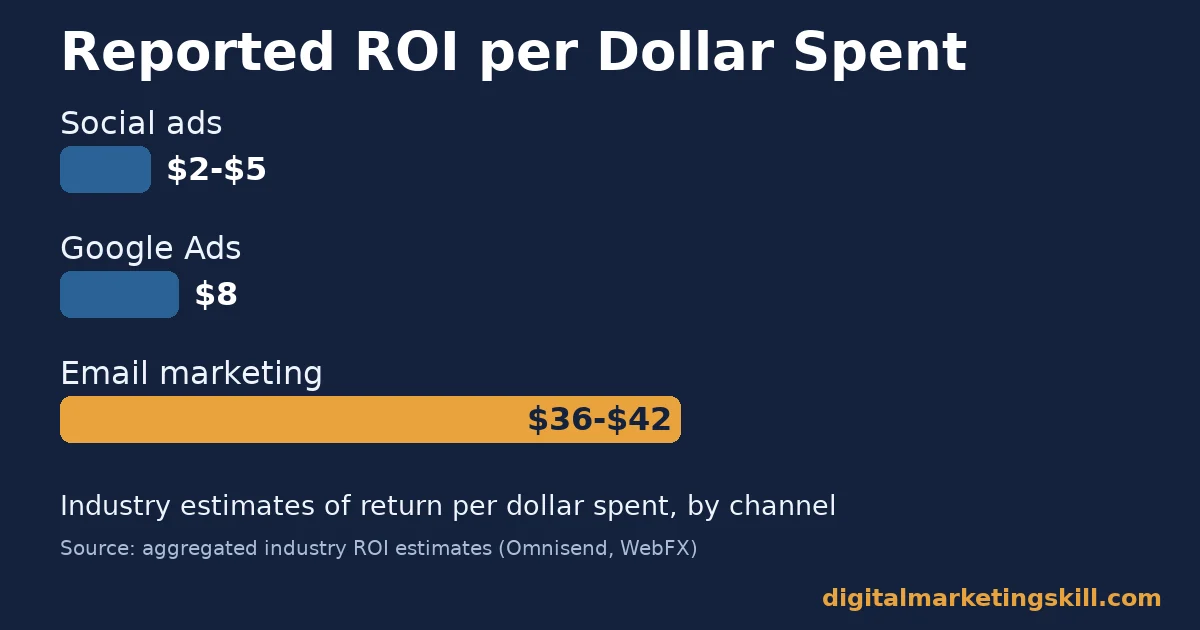
- Email keeps outperforming on ROI. Industry estimates put email marketing ROI around $36 to $42 per dollar spent, well above the roughly $8 commonly cited for Google Ads and $2 to $5 for social ads.
- Paid search cost varies enormously by category. WebFX’s analysis of its own US Google Ads accounts puts average search cost per click at $2 to $4, rising past $50 in competitive categories like legal and insurance.
- Organic search is not immune to paid search growth. A Similarweb analysis of product search queries found organic click share falling by 11 to 23 percentage points year over year in several retail categories, as paid results gained ground.
- Most small business budgets already lean digital. Industry estimates put roughly 72% of small business marketing budgets in digital channels, though the exact mix across individual channels varies by source.
In this guide
- Why “Which Channel Is Best” Is the Wrong Question
- How Digital Marketing Channels Actually Differ
- What Differs by Channel
- How to Lead With Each Channel
- How to Measure Digital Marketing Channels
- The One Decision Rule: Match Channel Speed to Cash Runway
- A Real Case: Turning One Channel Skill Into Recurring Revenue
- Frequently Asked Questions About Digital Marketing Channels
- Choosing Digital Marketing Channels That Fit the Business
Why “Which Channel Is Best” Is the Wrong Question
Most articles on digital marketing channels rank them, as if one answer fit every business. SEO is best for the long term. Paid search is best for speed. Social is best for awareness. Ranking channels in the abstract skips the one thing that actually decides the right answer. That is how long a specific business can wait for a channel to pay back its cost.
Treat every benchmark in this guide as an informed snapshot, not a settled ranking. ROI figures for email, search and social come from different reports, with different methods and time periods. Your own numbers, once you have a few months of data, matter more than any industry average.
Our guide to building an online marketing strategy covers how to set that measurement up from the start, before committing serious budget to any single digital marketing channel. None of the channels below require a large team to test. A small, tracked budget on one channel will tell you more in a month than a vague plan covering five channels at once.
How Digital Marketing Channels Actually Differ
Many small business owners pick digital marketing channels the way they picked them years ago. They choose whichever channel a competitor uses, or whichever one a sales rep calls about first. That approach ignores the real differences between channels, which show up clearly once you look at speed and cost side by side instead of reputation alone.
Every digital marketing channel sits somewhere on two axes: how fast it can produce a result, and how much it costs before that result arrives. Picture these as two dials rather than a single scale. A channel can be slow and cheap, fast and expensive, or any combination in between.
Confusing a slow, cheap channel with a fast, expensive one is a common reason small business marketing budgets get wasted.
Speed and Upfront Cost Move in Opposite Directions
Paid search can send qualified visitors within hours of launching a campaign. But every one of those visitors costs money the moment they click. Organic search can eventually send visitors for free. It usually takes months of consistent content and technical work before it sends meaningful traffic at all.
Email marketing sits apart from both. Once a list exists, sending to it costs very little. That is part of why its reported ROI runs so far ahead of paid channels. The catch is that email needs an existing audience to work. It rarely helps a business with no website visitors or customer list yet.
Organic Search Is Not as Stable as Older Advice Assumes
Older advice often treats organic search as a free, stable channel that stays put once it is built and never needs revisiting. A Similarweb analysis of product search queries complicates that picture.
It found organic click share falling across several retail categories, as paid results captured a growing share of the same searches. Headphone queries saw organic share drop from 73% to 50% in a year, while combined paid results roughly doubled.
None of this makes organic search a bad channel to invest in. It means a business relying on it alone should expect its share of clicks to erode over time in competitive product categories. It will not stay fixed once the work is done.
What Differs by Channel
None of the three channels below need a large team or a big budget to start testing. A single person can launch a small paid search test, publish a first batch of organic content, or send a first email campaign within a week, using free or low-cost tools.
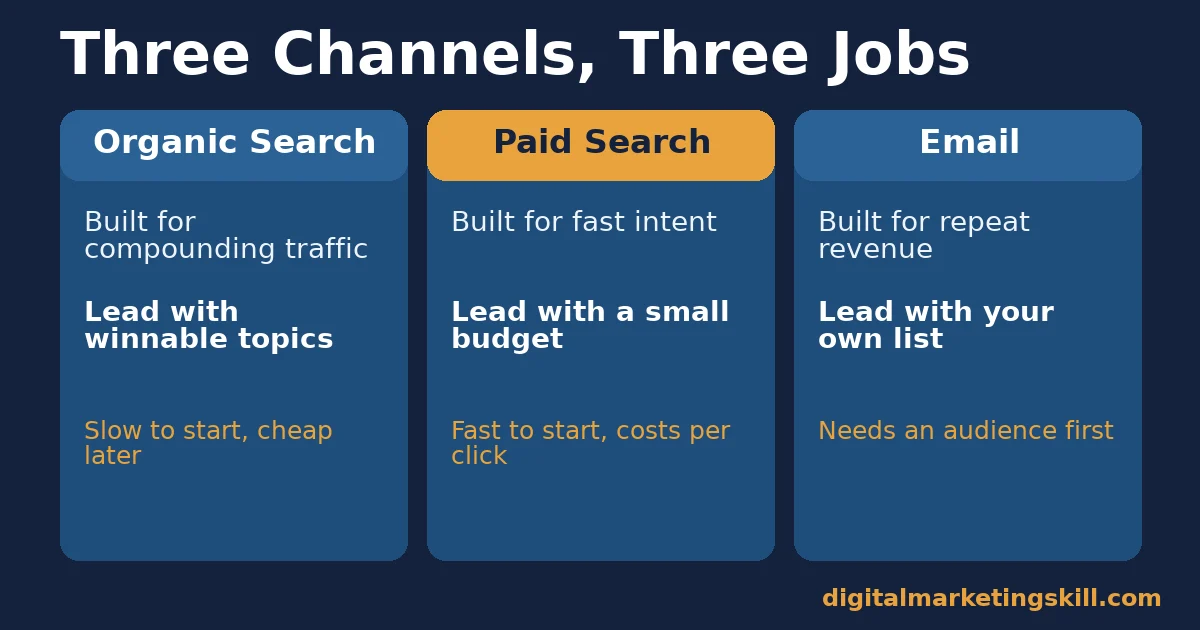
Three channels illustrate the trade-off clearly: organic search, paid search, and email. Each is built for a different combination of speed, cost and audience ownership.
Social media often supports all three digital marketing channels rather than standing alone. Hootsuite data cited by Sociallybuzz found that 90% of social media users have already interacted with a brand on their favourite platform. That is one reason social fits well as a supporting channel. It rarely works best as the lead channel on its own for most small businesses.
Organic Search: Built for Compounding, Low-Cost Traffic
Think of organic search as planting rather than renting. A paid campaign is rented attention: it stops the moment payment stops. A well-built page is closer to planting, since it can keep sending visitors for years with only occasional updates.
Organic search rewards consistency over time. Content and technical SEO work builds up. A page published a year ago can still send free visitors today, something paid channels cannot do once spending stops. The trade-off is patience: meaningful organic traffic rarely arrives in the first few months.
Organic search also depends on choosing topics people actually search for, not just topics a business wants to talk about. Our guide to search engine optimization covers that keyword-matching process in more depth. Without that match, months of content work can produce very little traffic.
Paid Search: Built for Fast, Measurable Intent
If organic search is planting, paid search is closer to renting a storefront on the busiest street in town for exactly as long as you keep paying the rent. The location is excellent, and the traffic is real, but it disappears the day the payments stop.
Paid search captures people actively searching for a solution right now. WebFX’s own account data puts average US search cost per click at $2 to $4 in most categories. Competitive, high-value categories like legal and insurance can run past $50 per click, because the value of a single new client justifies it.
Because paid search stops the moment spending stops, it is built to be measured and adjusted constantly. Our beginner’s guide to pay-per-click advertising walks through setting that tracking up. It rewards a business that can track which keywords and ads actually lead to revenue, not just clicks.
Email Marketing: Built for Repeat Revenue From an Owned Audience
Of the three, email marketing is the only one built on an owned relationship rather than rented or borrowed attention.
Email marketing works on people who already know a business. That includes past customers, newsletter subscribers, and people who abandoned a cart. Industry estimates put its ROI around $36 to $42 per dollar spent, well ahead of paid search and social ads, largely because sending cost stays low once a list exists.
The limitation is obvious once stated plainly: email needs a list. Our guide to email marketing strategies covers how to grow that list once another channel has brought in the first visitors or customers. A new business with no website traffic and no customers yet has nothing to email. This channel usually follows, rather than leads, the first stage of growth for that kind of business.
How to Lead With Each Channel
Matching the right first move to each channel is what turns a list of digital marketing channels into an actual plan. Without that match, good intentions end up spread too thin to measure.
Organic Search: Lead With a Narrow Set of Winnable Topics
Start with topics where competition is light enough that a small site can really rank. Avoid the broadest, most competitive terms in the industry at first. A handful of well-targeted pages beats a large volume of thin content aimed at the wrong keywords.
Paid Search: Lead With a Small, Tightly Tracked Budget
Launch with a modest daily budget. Track cost per lead or cost per sale from day one, not just clicks. Once a keyword or ad proves it pays back more than it costs, scale that specific campaign rather than the account as a whole.
Email Marketing: Lead With Your Existing List, Not a Purchased One
Start emailing the customers and website visitors a business already has, before investing heavily in growing the list further. A small, engaged list that opens and clicks consistently is worth more than a large, cold one that mostly goes unread.
How to Measure Digital Marketing Channels
Comparing digital marketing channels fairly means tracking the same handful of numbers for each one, not judging each by a different yardstick. A channel that looks expensive on cost per click can still be the cheapest one overall, once it is measured the same way as the others.
Four Numbers Worth Comparing Across Channels
- Customer acquisition cost (CAC). The total cost of a channel divided by the customers it produced. This is the number that makes channels comparable, since a cheap click that never converts is not actually cheap.
- Time to payback. How long it takes a channel’s spend to be recovered in revenue. Paid search often pays back fast; organic search usually takes longer but costs less per visitor once it is working.
- Channel-assisted conversions. Many sales involve more than one channel before a purchase happens. Google Analytics’ own attribution documentation explains how credit can be split across the channels in that path, not just given to the last click. Tracking assists avoids undervaluing channels like content and email that often start the journey.
- List or audience growth rate. For organic search and email specifically, how fast an owned audience is growing. That audience is what makes future campaigns cheaper.
How to Read Them Together
Start with customer acquisition cost, since it is the figure most directly tied to profit. Our guide to building a marketing budget uses this same number to decide where new spend should go.
If CAC is acceptable but growth feels slow, look at time to payback next. A channel can be efficient and still be too slow for a cash-constrained business right now.
Check channel-assisted conversions before cutting a channel that looks weak on its own. Content and email often support sales credited to paid search or direct traffic. Removing them can quietly hurt channels that look unrelated on the surface.
A quarterly review of all four numbers together gives a clearer picture than reacting to any single week. That steadier view is what tells you which digital marketing channels are actually carrying the business, rather than which one simply had a lucky few days.
The One Decision Rule: Match Channel Speed to Cash Runway
If a business has limited cash and needs revenue within weeks, paid search or paid social should lead. Their cost per result is higher, but waiting for organic search to mature is not a realistic option. If a business can wait several months and wants to lower cost per customer over time, organic search and email should lead instead, with paid channels used sparingly to fill gaps.
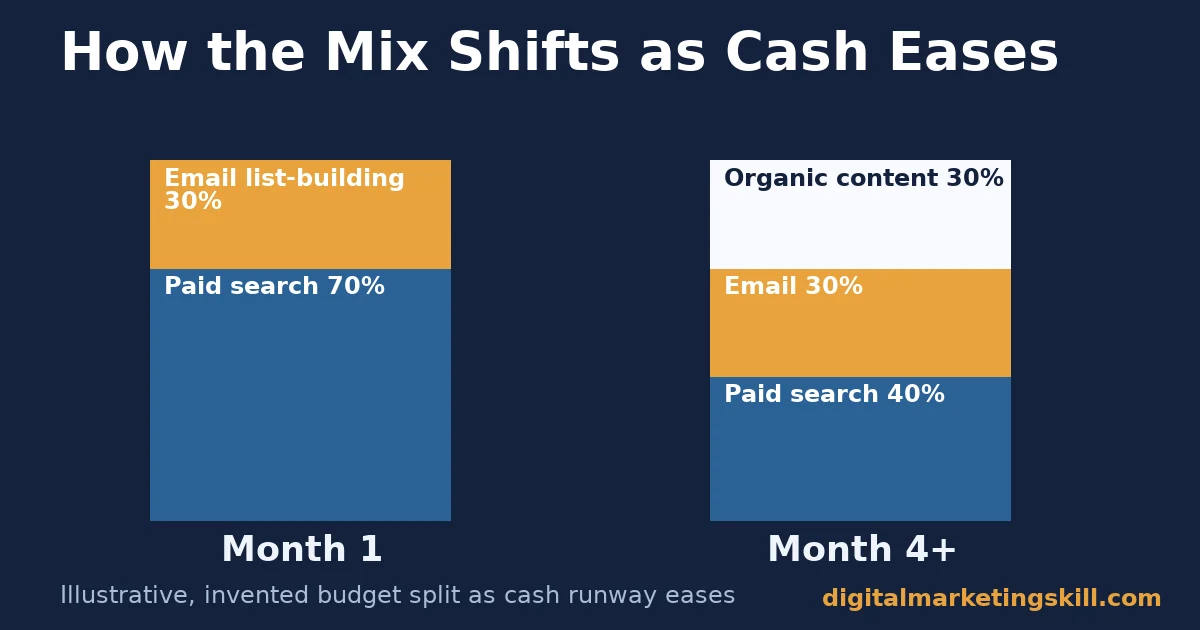
Here is an illustrative example, with invented numbers, to show how the mix can shift as circumstances change. A business with three months of cash runway puts 70% of its budget into paid search and 30% into building an email list from day-one customers.
By month four, paid search has produced predictable revenue. The email list is also large enough by then to start sending its own campaigns.
From that point, the business shifts new budget toward organic content and leans on the email list for repeat sales. It keeps a smaller, proven paid search budget running alongside both.
The channel mix changes as the cash constraint eases, rather than staying fixed from day one. Nothing about the underlying business changed between month one and month four except the runway pressure. Yet the right channel mix for it changed completely, simply because the constraint that shaped the first decision had eased.
A Real Case: Turning One Channel Skill Into Recurring Revenue
The decision rule above is easier to accept in theory than in practice. Most people feel pressure to look active on every channel at once, even when the data says otherwise. The case below shows what choosing depth over breadth can look like in practice.
According to a story published on the Digital Marketing Skill Institute’s own reviews page, one graduate, Olajire Jacob, began by charging around $500 to set up email marketing flows for clients. That single-channel skill grew into a broader digital marketing service that scaled to $5,000 a month.
Treat this as one published account, not a formula, in the same way the illustrative budget example above is a model to reason from rather than a plan to copy exactly. The story does not detail how many clients or months it took to reach that figure.
Outcomes like this depend on the market, pricing and effort in ways a single case cannot fully prove. DMSI’s own earnings disclaimer applies here too: individual results vary, and no income or outcome is promised.
The useful lesson is about depth before breadth. Going deep on one well-understood channel is what built the service into something clients paid for repeatedly. A shallow version of every channel at once would not have done the same job. The same logic applies to choosing digital marketing channels for your own business, not just for clients.
Frequently Asked Questions About Digital Marketing Channels
Which digital marketing channel should a small business start with?
It depends on cash runway. A business that needs revenue within weeks should lead with paid search or paid social. A business that can wait several months should lead with organic search, and start building an email list right away from whatever early traffic it gets.
How many digital marketing channels should a small business use?
Two or three, chosen on purpose, usually beats five or six channels used thinly across the same stretched budget. Putting real budget and time into fewer channels lets each one be measured and improved properly.
Is email marketing still worth it for small businesses?
Industry estimates put email marketing ROI around $36 to $42 per dollar spent, among the highest of any digital marketing channel. That figure assumes a business already has a decent list of customers or subscribers to send to.
Is organic search still reliable, given rising paid search competition?
Organic search still sends free traffic, but a Similarweb analysis found its click share falling in several retail search categories as paid formats grow. Treat it as a channel that needs ongoing investment and regular content, not a one-time project you finish and forget.
How much does paid search cost for a small business?
WebFX’s own account data puts average US search cost per click at $2 to $4 in most categories. Competitive categories such as legal and insurance can run well past $50 per click.
Should a new business with no website traffic start with email marketing?
Not yet, however tempting it is to set one up on day one. Email marketing depends on an existing list. A brand-new business usually needs to build initial traffic or customers through another channel first, then layer email on top once that audience exists.
What is the biggest mistake small businesses make with digital marketing channels?
Running too many channels at once, each with too little budget to properly test. A channel that never gets a fair, measured attempt cannot tell you whether it actually works for your business. That uncertainty tends to repeat every year, since nothing was ever tested long enough to produce a clear answer.
Choosing Digital Marketing Channels That Fit the Business
Digital marketing channels work best as a deliberate combination, matched to how much cash a business has and how fast it needs results. Lead with paid search or social when cash is tight and speed matters.
Lead with organic search and email when there is room to wait and the goal is lower cost per customer over the long run. Measure every channel by customer acquisition cost rather than by reputation alone.
If you want to build this skill properly, across search, social, content and email together, Digital Marketing Skill Institute teaches it hands-on inside the Master Diploma in Digital & AI Marketing. The programme includes nine practical courses, among them AI-powered SEO and content marketing, AI-powered Google advertising, and AI-powered email marketing and automation.
It comes with unlimited 1-on-1 coaching and mentoring, and real project work inside a U.S. partner company. It is dual US and UK accredited, and recognised in more than 100 countries.
The programme is fully online, so you can study from anywhere in your country. Browse more guides on the Digital Marketing Skill Institute blog, or read more student outcomes on the reviews page. When you are ready, apply for the Master Diploma or start from the Digital Marketing Skill Institute homepage.
Every figure in this guide was checked against its original source before publication. Figures marked as illustrative are invented examples, not real results.
![9 Amazing Digital Marketing Skills to Make Money Online [With Proof]](https://digitalmarketingskill.com/wp-content/uploads/2019/07/9-Amazing-Digital-Marketing-Skills-to-Make-Money-Online-With-Proof-17.png)