
Guest posting is writing an article for another website in your field, published under your name, usually with a short bio and a link back to your own site. The host gets free, useful content, and you reach their readers. It matters because, done well, it builds your reputation, brings referral traffic and can earn natural links, but done badly, it can break Google’s spam rules.
Key Takeaways
- A guest post is an article you write for someone else’s site, often with a byline and a link to you.
- The best reasons to do it are reach, trust and referral traffic, not just links.
- Google lists “links with optimized anchor text in articles, guest posts, or press releases distributed on other sites” as an example of link spam.
- Paid or exchanged links should carry a qualifying attribute, such as rel=”sponsored” or rel=”nofollow”.
- Relevance beats volume. One article on a respected site in your niche is worth more than many on unrelated blogs.
What Is Guest Posting?
Many blogs, magazines and industry sites accept articles from outside writers. You pitch an idea, the editor agrees, and you write the piece to their guidelines. Then they publish it with your name and a short author bio.
For example, a freelance bookkeeper might write “Five Tax Mistakes New Freelancers Make” for a popular freelancing blog. The blog gets a helpful article for its readers. Meanwhile, the bookkeeper reaches thousands of potential clients and gets a link to her website in the bio.
The practice is part of off-page SEO and content marketing. However, its real value lies in being seen by the right audience on a site they already trust.
How Guest Posting Works
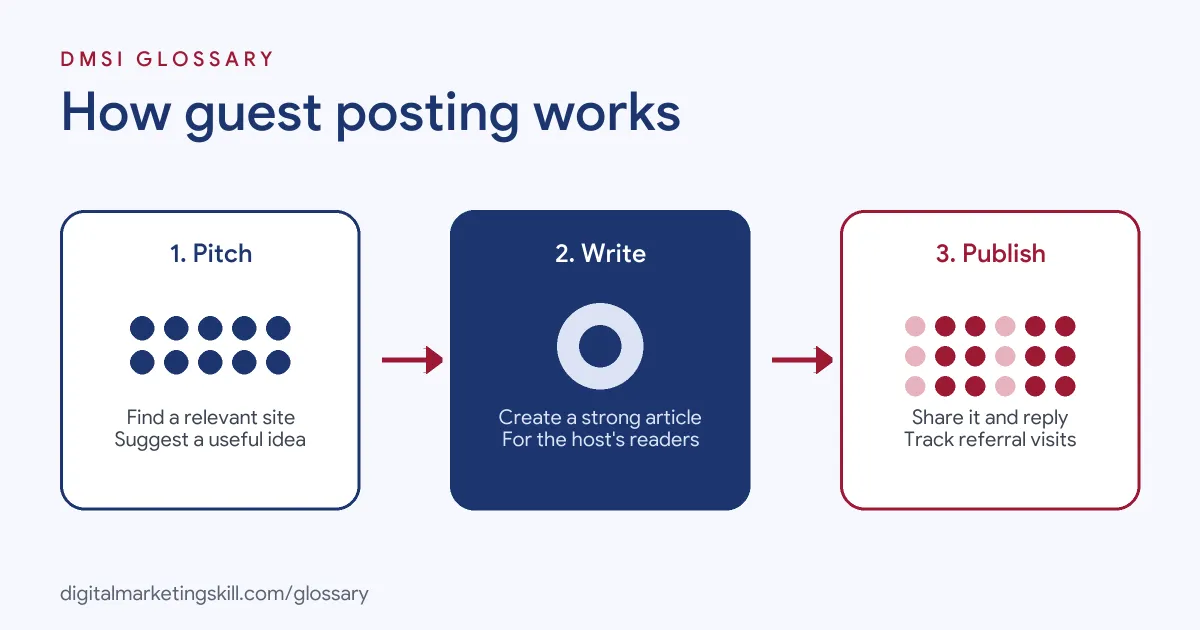
The process follows three steps. First, you find relevant sites and pitch an idea. Next, you write and submit a strong article. Finally, the host publishes it, and you share it and track the results.
Finding the Right Sites
Start with sites your ideal customers already read. Look for a real audience, active comments or shares, and editors who check what they publish. A site that accepts any topic from anyone is a warning sign, not an opportunity.
The Pitch and the Article
Editors get many pitches, so keep yours short and specific. Show that you know their readers, suggest two or three titles, and link to samples of your work. Then write something better than the site’s average article, with clear advice and your own experience.
Links and Google’s Rules
This is where many people go wrong. Google defines link spam as “the practice of creating links to or from a site primarily for the purpose of manipulating search rankings.” Its examples include “exchanging money for links, or posts that contain links” and “links with optimized anchor text in articles, guest posts, or press releases distributed on other sites.”
So if a link was paid for, the host should qualify it. Google says to mark paid placements with rel=”sponsored”. It adds that nofollow “is still an acceptable way to flag them, though sponsored is preferred.” In short, a natural author link is fine, but a link stuffed with keywords for ranking is not.
Guest Posting Examples
Here are three made-up examples of good practice:
- Software start-up (example): The founder writes a practical guide for a well-known industry newsletter’s blog. Her bio links to the company’s free trial page.
- Wedding photographer (example): He writes “How to Plan Your Day Around the Best Light” for a regional wedding magazine site, with sample photos and a link to his portfolio.
- Online course (example): A tutor shares a step-by-step lesson on a respected marketing blog. As a result, readers sign up for her free mini-course.
In each case, the article stands on its own. The link is a bonus for readers who want more.
Good vs Risky Guest Posting
Here is a quick way to tell the two apart:
| Factor | Good practice | Risky practice |
|---|---|---|
| Site choice | Relevant, edited site with a real audience | Any site that accepts any topic |
| Content | Original, useful and written for the readers | Thin or spun text written for links |
| Links | Natural author or reference links | Keyword-rich anchor text aimed at rankings |
| Payment | None, or paid links marked rel=”sponsored” | Paid links passed off as editorial |
In other words, write for the host’s readers first. If the article would still be worth writing without a link, you are on the right track.
How to Start Guest Posting
- Set a goal. For example, reach a new audience, win clients or support a product launch.
- List 20 target sites. Choose ones your customers read, then check that they publish outside writers.
- Read their guidelines. Note the length, tone and link rules each site sets.
- Pitch a specific idea. Write a short, personal email with two or three title options.
- Write the best article you can. Add examples, data you can cite and your own experience.
- Use clear anchor text. Google says good anchor text is “descriptive, reasonably concise, and relevant.”
- Share and track. Promote the post, answer comments and track referral visits in your analytics.
Best Practices
- Build relationships. Treat editors as long-term partners, not one-off link sources.
- Link where it helps the reader. One useful link in the bio is often enough.
- Keep your best ideas for strong sites. A great article deserves a respected home.
- Measure more than links. Track referral visits, sign-ups and enquiries.
- Turn posts into proof. Add “as featured on” links to your own site and portfolio.
Common Mistakes to Avoid
A common mistake is sending the same generic pitch to hundreds of sites. As a result, editors ignore it. Another is paying for posts on sites that exist only to sell links. Some writers stuff keywords into their anchor text, which matches Google’s own example of link spam. Others reuse the same article on several sites. Finally, many people stop at publishing, instead of sharing the post and replying to readers.
How to Measure Guest Posting
Results take time, so track a few simple numbers for each article:
- Referral visits: how many people came to your site from the post, as shown in your analytics.
- Conversions: how many of those visitors signed up, enquired or bought.
- Engagement on the host site: comments, shares and questions from readers.
- Follow-up offers: invitations to write again, speak or collaborate.
Keep a simple sheet with the site, the date it went live and these numbers. After a few articles, you will see which sites send real readers. Then focus your next pitches there.
A short bio helps too. Here is a made-up example: “Sam Patel is a bookkeeper who helps freelancers stay tax-ready. Get her free checklist at her website.” It is clear, human and gives readers one next step.
Where You’ll Use Guest Posting at Work
Outreach and guest articles are part of many SEO and content roles. For example, real remote job listings ask candidates to:
- “Identify and build relationships with relevant websites, bloggers, publishers, and industry partners for guest posting, mentions, and backlinks” (SEO Specialist).
- Show “You know the full toolkit: outreach, guest posts, digital PR” (Link Building Specialist).
So if you want to work as an SEO Specialist or Website Manager, you will need to find sites, pitch editors and write strong articles. Employers will also look for examples of posts you have placed and the traffic they brought.
Learn It in the WordPress and SEO Track
You can learn outreach and content skills in the AI-Powered WordPress and SEO Specialist track. It covers WordPress website and eCommerce development, search engine optimisation and content marketing. Your portfolio project is a WordPress site or store that you build and rank with an SEO content plan. You also get unlimited 1-on-1 mentoring and a U.S. Project Internship from day one.
Next, read our guides on how to earn quality backlinks without buying links and on link building strategies.
Frequently Asked Questions
Is guest posting still worth it?
Yes, when the goal is reach and trust. Writing for respected sites your customers read can bring visitors, leads and natural links. However, posts made only for links carry risk.
Does Google penalise guest posts?
Google doesn’t ban guest articles. Instead, its spam policies target links made to manipulate rankings, such as keyword-rich anchor text in guest posts or paid links that pass ranking credit.
Should a guest post link be nofollow?
If the link was paid for or exchanged, it should carry rel=”sponsored” or rel=”nofollow”. A natural author link that the editor chose freely doesn’t need one.
How do I find sites that accept guest posts?
Start with blogs and publications your customers already read. Then check their “write for us” or contributor pages and read their rules before you pitch.
How long should a guest post be?
Follow the host’s guidelines. Most important, make it long enough to fully answer the topic and no longer.
Sources: Google Search Central: Spam policies for Google web search; Google Search Central: Qualify your outbound links; Google Search Central: Link best practices; remote job listings on Himalayas.