
Quality backlinks still move rankings, but most link-building advice skips the part that matters: which links are worth the effort. This guide shows how backlinks actually affect rankings, which methods earn quality backlinks without risking a penalty, and the one rule for judging any link opportunity before you chase it.
Key Takeaways
- Referring domains predict rankings more than raw link counts. Ahrefs tracked 200,000 pages and found a positive correlation between newly earned referring domains and ranking position.
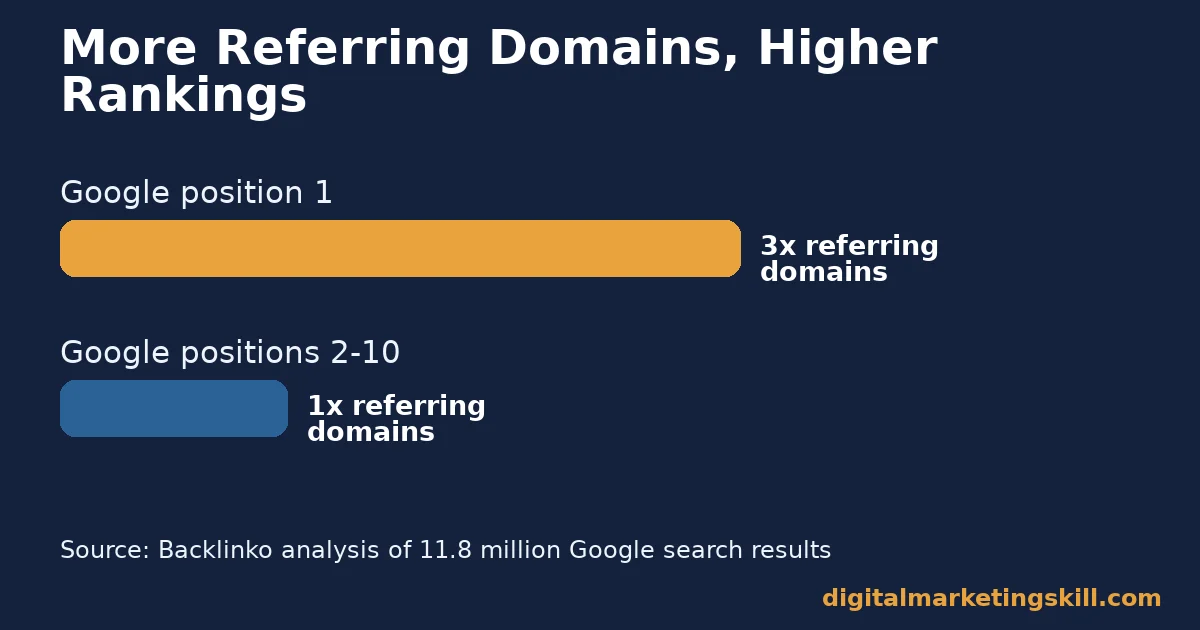
- The number one Google result carries 3x more referring domains than positions 2 to 10, according to Backlinko’s analysis of 11.8 million search results.
- Outreach rarely works on the first try. Backlinko and Pitchbox analyzed 12 million outreach emails and found only 8.5% get a response.
- Personalization changes that math. The same study found personalized subject lines lifted response rates by 30.5%, and personalized email bodies by 32.7%.
- Google treats nofollow as a hint, not a block. Its own guidance on the topic added rel=”sponsored” and rel=”ugc” alongside nofollow, and said it may still weigh all three in ranking.
In this guide
- The Gap in Most Quality Backlinks Advice
- How Quality Backlinks Actually Affect Rankings
- What Differs by Link-Building Method
- How to Run Each Method
- Measuring Quality Backlinks Progress
- The One Decision Rule for Any Link Opportunity
- Common Mistakes That Waste Link-Building Effort
- A Real Case: What Compounding Links Look Like
- Frequently Asked Questions About Quality Backlinks
- Where to Build the Skills Behind Quality Backlinks
The Gap in Most Quality Backlinks Advice
Most link-building guides list twelve tactics and call it done. They skip the part that actually determines whether a link helps you: relevance and authority. A link from an unrelated directory counts as a backlink. It rarely moves rankings.
This guide treats quality backlinks as a filter, not a tally. Every tactic below gets judged on whether it earns links from sites that already rank for related topics. If you are new to the basics first, start with our search engine optimization guide before tackling link building on its own.
Google’s own documentation on link spam changes over time. Treat the specific policy language here as a snapshot, not a permanent rule. Always check Google’s current guidance before running a large link-building campaign of any kind.
Quality backlinks also compound with everything else you do in SEO. A page with strong internal links, clear headings, and fast load times converts an incoming backlink into more ranking value than the same link pointing at a thin, slow page. Link building works best as the last step in a content process, not the first.
How Quality Backlinks Actually Affect Rankings
Search engines treat a backlink as a vote of confidence from one site to another. Not every vote counts the same. A link from a site that already ranks for your topic carries more weight than a link from an unrelated blog. Relevance is part of how the algorithm reads the link.
Referring domains matter more than total links. Ahrefs tracked 200,000 ranking pages over three months. It found a clear link between newly acquired referring domains and ranking position. Ten links from ten different domains usually outweigh fifty links from one domain. Each new domain is a separate signal of trust. Fifty links from one site still count as closer to a single vote in most algorithms’ eyes.
Anchor text still plays a role, but it is a risk, not a shortcut. Google’s spam policies flag large-scale guest posts that use keyword-optimized anchor text across many sites as a link scheme. A natural link profile mixes branded anchors, generic phrases like “this guide,” and exact-match anchors in a small minority. If your anchor text is mostly your target keyword, that pattern looks engineered rather than earned. It is one of the easier signals for an algorithm to catch.
Link placement on the page matters too. A link inside the main body of an article passes more trust than a link buried in a sidebar widget or a footer. Context tells the algorithm what the link is actually about. That is part of why a single in-content mention from a relevant blog often outperforms a dozen footer links from unrelated sites.
The age of the linking domain matters less than most link-building guides suggest. A brand-new blog with genuinely relevant, well-researched content can pass meaningful trust, even without years of history. What matters more is whether the site itself looks real: real authorship, real traffic, and content that reads like it was written for people rather than for search engines.
What Differs by Link-Building Method
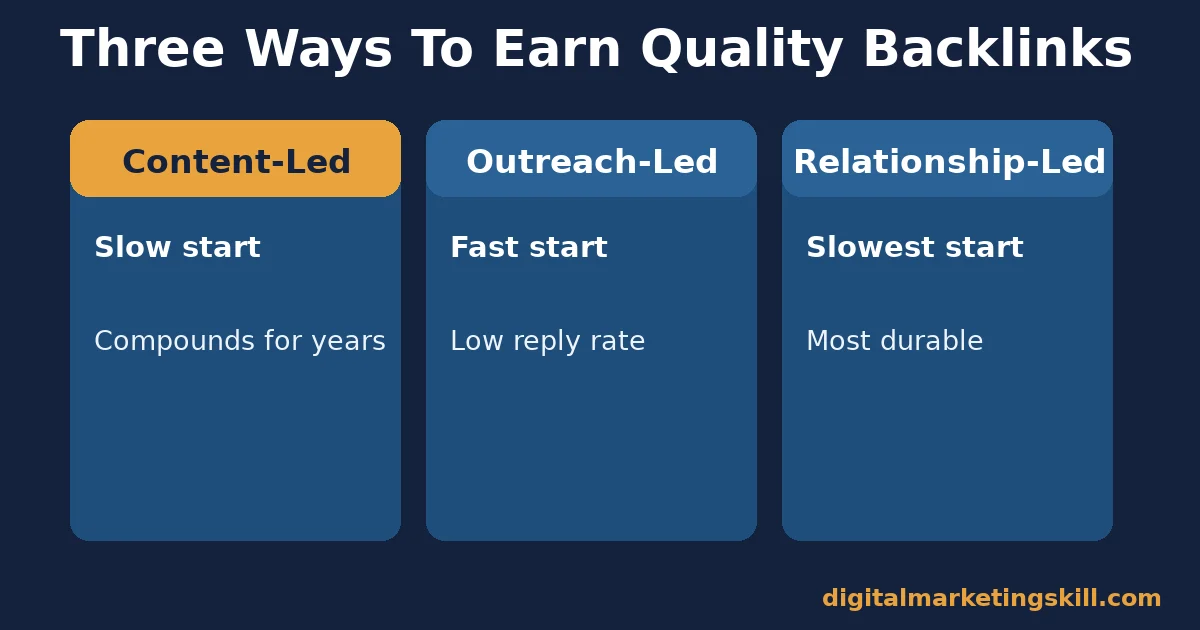
Every reliable method for earning quality backlinks falls into one of three categories. Each one trades effort for speed differently, so picking the wrong one for your resources wastes months.
Content-Led Links: Built For Compounding, Not Speed
Content-led links come from publishing something worth referencing: original data, a genuinely complete guide, or a free tool. Nobody has to say yes to anything. People just link to it because it answers their question.
This is the method behind most genuinely quality backlinks, because nobody links to a page out of obligation. It is slow to start and fast to compound. A single well-researched page can earn new links for years after publication. The top-ranking pages in Ahrefs’s study kept gaining referring domains months after their first ranking push the same way. The upfront cost is real research or real development time. That is why most sites skip it in favor of faster, weaker tactics.
Outreach-Led Links: Built For Control, Not Volume
Outreach-led links come from asking for a placement directly: broken link building, guest posts, or quote requests. You control the timing, but the reply rate is low. Backlinko and Pitchbox found only 8.5% of 12 million outreach emails got any response at all. That means most of the work in this method is sending enough well-targeted emails to make the 8.5% add up to a meaningful number of quality backlinks.
This method rewards precision over volume. A short list of genuinely relevant sites beats a mass email blast every time, as long as each pitch gives a specific reason the link helps that site’s reader. Sending the same generic template to five hundred sites usually produces worse results than a hand-written note to twenty.
Relationship-Led Links: Built For Durability, Not Scale
Relationship-led links come from people who already know you: past clients, partners, or journalists you have helped before. They convert at a far higher rate than cold outreach, because trust already exists before you ever ask for anything.
This method does not scale quickly. It compounds over years as your network grows. That makes it the slowest method to start and often the most durable once it is running. A single strong relationship with an active journalist or editor can produce more links over five years than any single outreach campaign. Digital PR campaigns that pitch real data to journalists show what is possible at scale: a Digitaloft analysis of over 500 live campaigns found the average campaign earns links from 42 unique referring domains, far more than a typical cold outreach push.
How to Run Each Method
Understanding a method is not the same as earning links from it. Here is how to execute each one without wasting the effort.
Content-Led Links: Lead With Original Data
Publish something nobody else has: a survey of your own customers, a breakdown of a public dataset, or a tool that solves one narrow problem. This is the surest route to quality backlinks because the content earns its links on merit, not on a favor. Cite every figure with its source and sample size, because that specificity is exactly what makes other writers trust it enough to link to it. Pick keywords for that content using the checks in our guide to effective SEO keywords so the asset also ranks on its own and earns organic traffic while it waits for links to accumulate.
Outreach-Led Links: Lead With Broken Link Replacement
Find a page with a dead outbound link in your niche, using one of these free SEO tools, then email the site owner a working replacement: your own page, if it genuinely covers the same ground. This converts better than a cold guest post pitch. You are solving a problem the site owner already has, not asking them for a favor they get nothing back from.
Relationship-Led Links: Lead With Genuine Value First
Help someone before you ask for anything: answer a journalist’s question, write an honest testimonial for a tool you actually use, or mention a partner’s work in your own content first. Ask for the link only after the relationship already has some value in it. It should never be the opening move of a cold conversation.
Journalist request platforms work the same way at a larger scale. A reporter asks for sources on a story, you answer with a genuinely useful quote or data point, and the resulting article links back to you if the editor chooses to use it. This only works when the answer is specific and quotable, not a generic pitch for your business, since editors skip anything that reads like an advertisement.
Measuring Quality Backlinks Progress
Four numbers tell you whether your link-building effort is working. Track them monthly, not weekly. New links take time to appear in crawl data, so a weekly check mostly measures noise. A free backlink checker or a paid SEO toolkit can pull all four numbers in one report, so you do not need to track each metric by hand.
- Referring domains: the count of distinct sites linking to you, not total links. This is the number most strongly tied to ranking movement in Ahrefs’s data. Prioritize it over raw link count every time the two disagree.
- Topical relevance: the share of new links coming from sites that cover your niche or an adjacent one. A spike in unrelated links is a warning sign, not a win. It can point to a spam attack rather than a genuine mention.
- Anchor text mix: the split between branded, generic, and exact-match anchors. A natural profile leans heavily branded and generic, with exact-match anchors a small minority of the total.
- Response rate: replies divided by outreach emails sent. Backlinko’s data puts the baseline at 8.5%, so track your own rate against that benchmark, not against zero, before judging a campaign a failure.
The One Decision Rule for Any Link Opportunity
Before chasing any link opportunity, ask one question: would this site’s own readers find my page useful, on a page actually related to my topic? If the honest answer is no, the link will not move rankings even if you get it. It may also carry risk if the placement looks purchased or engineered.
Illustrative, invented numbers: imagine two link opportunities. Site A is an unrelated directory with a Domain Rating of 70 that will list any business for a fee. Site B is a smaller, relevant blog with a Domain Rating of 30. It covers your exact topic and will link to you in a genuine article. Site B is very likely the better link, despite the lower score. Relevance carries more weight in how the algorithm reads it than the raw authority number does. Chasing the higher score alone, without checking relevance first, is the single most common mistake in link building. It also wastes the most money, since high-authority directories and link networks often charge the most for the links that help the least.
Common Mistakes That Waste Link-Building Effort
Three mistakes account for most wasted link-building effort. The first is chasing volume: adding fifty low-relevance links a month feels productive but rarely moves rankings, and it can trigger a manual review if the pattern looks unnatural.
The second is ignoring anchor text diversity. A profile stuffed with exact-match keyword anchors looks engineered, even if every individual link came from a genuine source. The third is treating link building as a one-time project instead of an ongoing habit tied to new content, so the link profile goes stale the moment the campaign ends.
A fourth, quieter mistake is skipping the audit step entirely. Most sites accumulate a handful of low-quality or spammy links over time, often without the owner’s knowledge, through scraper sites or old directory submissions. Reviewing your referring domains list twice a year and disavowing anything genuinely harmful keeps a strong link profile from being dragged down by a small number of bad signals.
A Real Case: What Compounding Links Look Like
Illustrative, invented numbers, not a real result: picture a site that publishes one original data study. In month one, it earns three links from small blogs that cite the numbers. By month six, a larger industry publication references the same study. Five more sites then link to that article instead of the original source.
The compounding keeps running without new outreach, because the asset itself keeps attracting citations long after publication. That mirrors the pattern Ahrefs observed in top-ranking pages. They kept gaining referring domains for months after their first ranking push, not just in the week they were published.
Frequently Asked Questions About Quality Backlinks
How many quality backlinks does a page need to rank?
There is no fixed number. Ahrefs found that the exact referring-domain count needed varies by keyword competitiveness. Pages ranking in the top 3 consistently had more referring domains than pages ranking lower for the same term. Compare your page against competitors actually ranking for your target keyword instead of chasing a generic number from a different niche. Checking five actual competitors takes less time than it sounds, and it gives you a realistic target instead of a guess.
Do nofollow links still help SEO?
Google treats nofollow as a hint it may still consider, not a link it fully ignores. A nofollow link from a highly relevant, high-traffic site can still send referral visitors and brand signals. Its direct ranking effect is usually smaller than a followed link from the same site, but it is not zero.
Is buying backlinks worth the risk?
No. Google’s spam policies explicitly prohibit exchanging money, products, or services for links that pass ranking credit. Paid links must carry rel=”sponsored” to stay compliant. A manual penalty can erase years of organic growth. That makes earned links the safer long-term strategy, even though they take longer to build.
How long does it take to see results from link building?
Expect months, not weeks. New backlinks need to be crawled, indexed, and weighed against your existing link profile first. Only then does any ranking movement show up. Ahrefs’s data shows top-ranking pages keep accumulating links well past their first ranking push, so judge a campaign over a full quarter, not a few weeks.
Should I focus on domain authority or page-level links?
Both, but page-level relevance usually matters more for a specific keyword. A link to the exact page you want to rank, from a site covering a related topic, typically helps more. A general link to your homepage from the same site spreads that value more thinly. Pair link building with the channels in our guide to increasing website traffic so you are not relying on links alone.
Are guest posts still a safe way to build links?
Occasional, genuinely written guest posts on relevant sites are fine. Large-scale guest posting campaigns built purely for keyword-optimized anchor text links are flagged directly in Google’s spam policies. Keep volume low. Write each post as if it were going on your own site, and it stays a safe source of quality backlinks rather than a liability.
What is the fastest way to lose quality backlinks?
Letting old content die. Pages get deleted. URLs change without redirects. Once-useful pages go stale, so the sites linking to them eventually remove the link or let it rot. Keep your highest-linked pages updated. Redirect old URLs instead of deleting them outright, and you keep the links those pages already earned.
Can internal links substitute for external backlinks?
No, but they help. Internal links spread authority from a page with many backlinks to pages that have fewer, which is why a well-linked old post can lift a brand-new page that targets a related keyword. They cannot replace the trust signal an external link from a different domain provides.
Where to Build the Skills Behind Quality Backlinks
Earning quality backlinks is one part of a wider SEO skill set that also includes technical SEO, content strategy, and measurement. The Digital Marketing Skill Institute’s Master Diploma in Digital & AI Marketing covers this directly through its AI-Powered WordPress and SEO Specialist track, or through the Full Stack option covering all four AI-powered tracks and ten courses.
Every track includes unlimited 1-on-1 coaching and mentoring, plus a U.S. Project Internship with a verified U.S. Work Reference Letter. The diploma is dual US and UK accredited, recognised in more than 100 countries, and studied 100% online wherever you live in your country. If you want a structured path instead of testing link-building tactics alone, apply to the Master Diploma program. You can also review the full program structure, browse more guides on the digital marketing blog, or read real outcomes on the reviews page. Learn more at digitalmarketingskill.com, or start your application at digitalmarketingskill.com today.
Every figure in this guide was checked against its original source before publication. Figures marked as illustrative are invented examples, not real results.
![9 Amazing Digital Marketing Skills to Make Money Online [With Proof]](https://digitalmarketingskill.com/wp-content/uploads/2019/07/9-Amazing-Digital-Marketing-Skills-to-Make-Money-Online-With-Proof-17.png)






