
Performance marketing is online advertising that aims to drive a specific action, such as a click, a lead or a sale, and measures every result so you can see what each one cost. In many cases, the advertiser pays only when that action happens. It matters because it lets businesses track return on spend closely and move budget to whatever works best.
Key Takeaways
- It focuses on actions, such as leads and sales, rather than awareness.
- The IAB, the digital advertising trade body, says the link between the ad and the action must be “clearly measured”.
- Campaigns are optimised in real or near real time, based on the data that comes in.
- Payment often depends on results, for example cost per click, cost per lead or cost per sale.
- Common channels include search ads, paid social, display, email, lead generation and affiliate marketing.
What Is Performance Marketing?
Think of performance marketing as advertising with a receipt. You set a goal, track every result and know what each one cost. If an ad doesn’t deliver, you change it or switch it off.
The IAB lists four signs of a performance campaign. First, it aims “to drive consumer action, as opposed to raise awareness.” Second, the cause and effect between ad and action “can be clearly measured.” Third, the buyer can optimise in real or near real time. Fourth, “in many cases payment is made based on consumer action”, although that part is not essential.
Salesforce gives a simpler version. It describes a model where advertisers pay “only when a specific action is completed”, such as a click, lead or sale. In practice, many teams use the term more loosely for any paid campaign judged on measurable results.
How Performance Marketing Works
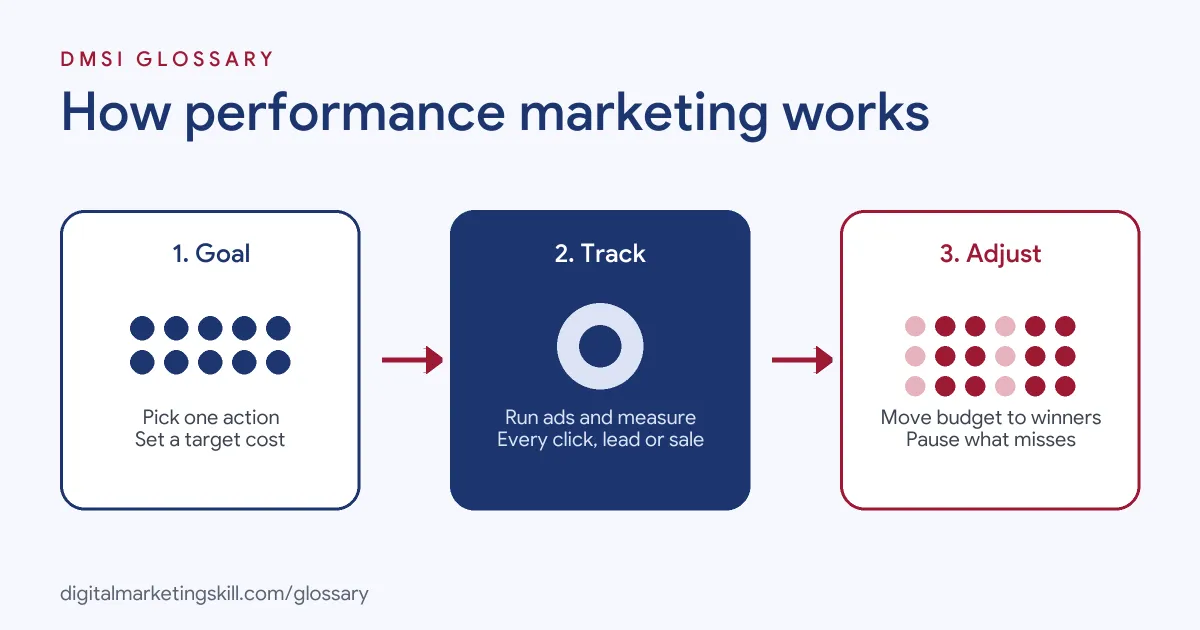
Every campaign runs through the same loop. First, you set a goal and a target cost. Next, you run ads and track each action. Finally, you shift budget towards the ads, audiences and channels that hit the target.
Tracking and Measurement
None of this works without tracking. On Google Ads, for example, conversion tracking records actions such as website purchases, app installs and phone calls. Google says conversions “provide insights into your campaign performance.” Meta and other ad platforms offer similar tools, such as a pixel or a server connection.
Without reliable tracking, you can’t see which ad led to which sale. So setting it up correctly is the first job in any performance campaign.
Two Types of Performance Campaign
The IAB splits this work into two types. With performance optimisation, you may still buy on a cost per thousand impressions basis, but you optimise towards actions. With pay-for-performance, you pay only when the action happens. According to the IAB, “Pay-For-Performance can reduce advertiser’s risk.” The IAB also notes that this model “aligns the incentives of advertiser and publisher”, because both earn more when results improve.
Pricing Models
Performance campaigns use a few common pricing models. Cost per click (CPC) means you pay when someone clicks. With cost per lead (CPL), you pay for each sign-up or enquiry. And with cost per acquisition (CPA), you pay for each sale or other chosen action. Many affiliate programmes pay a commission on each sale.
A Worked Example
Here is a made-up example of setting a target cost. Say a shop’s average order is £60, and it keeps £24 after product and delivery costs. If it pays more than £24 in ads to win one sale, it loses money on that order. So the team sets a target cost per sale of £15, which leaves room for profit. Then it judges every ad against that number. Ads that win sales for under £15 get more budget, while the rest get fixed or paused.
Performance Marketing Examples
These made-up examples show how it looks day to day:
- Online shop: A homeware brand runs Google Shopping and Meta ads. Each week, it moves budget to the products with the best return on ad spend.
- Training provider: A college runs lead ads with a target cost per lead. When one audience gets too expensive, the team pauses it and tests a new one.
- Affiliate partner: A software company pays bloggers a commission only when a reader signs up through their link.
In each case, the team judges spend on results, not on reach alone.
Performance Marketing vs Brand Marketing
The two often work together, but they aim at different things:
| Area | Performance marketing | Brand marketing |
|---|---|---|
| Main goal | Clicks, leads, sales and other actions | Awareness and long-term perception |
| Timeframe | Short term, often days or weeks | Long term, often months or years |
| Typical measures | Cost per lead, cost per sale, return on ad spend | Reach, recall, brand searches |
| How you pay | Often per click, lead or sale | Often per impression or sponsorship |
Salesforce notes that performance campaigns often build on effective brand marketing to succeed. Put simply, people are more likely to click on an ad from a brand they already recognise.
How to Run a Performance Marketing Campaign
Follow these steps for a first campaign:
- Choose one action to optimise for, such as a purchase or a lead form submission.
- Work out a target cost. For example, decide the most you can pay for a lead and still make a profit.
- Set up conversion tracking on your website or app, then test it.
- Pick one or two channels that match your audience, such as Google Search or Meta.
- Launch with a modest budget and a few ad variations.
- Review results often. Pause what misses the target and add budget to what hits it.
- Report on cost per result and return on ad spend, not just clicks.
Once one channel works, test a second one. That way, you avoid relying on a single platform.
Best Practices for Performance Marketing
- Measure the real goal. A cheap click that never converts is not a good result.
- Know your numbers. Track customer acquisition cost and lifetime value, so you know what a customer is worth.
- Test creative often. New headlines, images and offers keep results from slipping.
- Watch for fraud and tracking errors. The IAB lists tracking issues and fraud among the main risks for performance programmes.
- Don’t drop brand work. Brand activity can make your performance ads cheaper over time.
Common Mistakes to Avoid
Beginners often make the same errors. First, they launch ads before tracking works, so they can’t tell what drove sales. Second, they optimise for clicks when the real goal is revenue. Third, they make changes every day before the data settles. Finally, they cut all brand spend and then wonder why costs rise. A clear goal and patient testing prevent most of these problems.
Where You’ll Use Performance Marketing at Work
Performance skills appear in many paid media and marketing roles. For example, remote job listings ask candidates to:
- “Plan, execute, and optimize paid campaigns across Google and Meta” (Digital Marketing Manager).
- Bring “Strong performance marketing capability combined with good product judgement” and a “Deep understanding of CAC, LTV, funnels, cohorts, retention and experimentation” (VP, Marketing).
- Join “a performance marketing function with good bones, clear measurement, and meaningful results already behind it” (Manager, Performance Marketing).
So if you want to work as a Digital Marketing Manager, Growth Marketer or Freelance Digital Marketer, employers will expect you to run paid campaigns, track results and explain where the money went.
Learn It in the Full Stack Track
This work spans Google, social and email, so the best fit is the Full Stack option, which covers all four tracks. You take all ten courses and complete one portfolio project from each track, including a Google Ads campaign with conversion tracking and a paid social campaign. You also work on a U.S. Project Internship from day one, with unlimited 1-on-1 mentoring.
To compare paid and organic options, read our guide to traffic generation. You can also learn how to measure return on investment, or see how growth marketing extends this work across the whole funnel.
Frequently Asked Questions
What is performance marketing in simple terms?
It is advertising focused on actions, such as clicks, leads or sales, where every result is tracked. Often, you pay only when the action happens.
Is performance marketing the same as paid advertising?
Not exactly. Paid ads can aim at awareness too. Performance campaigns are paid ads judged on measurable actions and cost per result.
Is affiliate marketing a type of performance marketing?
Yes. Salesforce describes affiliate marketing as a subset of it, because affiliates earn money only when a sale or other action happens.
Which metrics matter most?
Cost per lead, cost per acquisition and return on ad spend are the usual core measures. Lifetime value shows whether those costs make sense.
Do I need a big budget to start?
No. You can start small with one channel and one goal. Then you can scale the campaigns that hit your target cost.
Sources: IAB: Defining results-based advertising; Salesforce: What is performance marketing; Google Ads Help: About conversion measurement; remote job listings on Himalayas.