
Growth marketing is an approach that uses testing and data across the whole customer journey, from first visit to repeat purchase, to find repeatable ways to grow a business. Instead of running one big campaign and hoping, growth marketers run many small experiments and keep the ones that work. It matters because it ties marketing to results that last, such as active users, retention and revenue, not just clicks.
Key Takeaways
- It covers the full funnel, not just the top. Keeping and growing customers counts as much as finding new ones.
- It runs on experiments. Each test starts with a hypothesis and a metric that decides success.
- Many teams use the AARRR framework: Acquisition, Activation, Retention, Referral and Revenue.
- The idea grew out of “growth hacking”, a term popularised by Sean Ellis to describe a marketer “whose true north is growth”.
- Growth marketers work with product, sales and data teams, because growth levers sit across the whole business.
What Is Growth Marketing?
Traditional marketing often focuses on awareness. It asks how many people saw the brand or how many leads came in. A growth approach asks a wider question: at each stage where a customer could buy, stay or leave, what test could move the numbers?
Sean Ellis, who helped popularise the idea, wrote that after a product finds its market, the next step is “finding scalable, repeatable and sustainable ways to grow the business.” In other words, growth work starts once people already want the product. It then looks for the levers that bring in more of the right customers and keep them.
That’s why this work often feels close to product work. A change to an onboarding email, a sign-up form or a pricing page can matter as much as a new ad.
How Growth Marketing Works
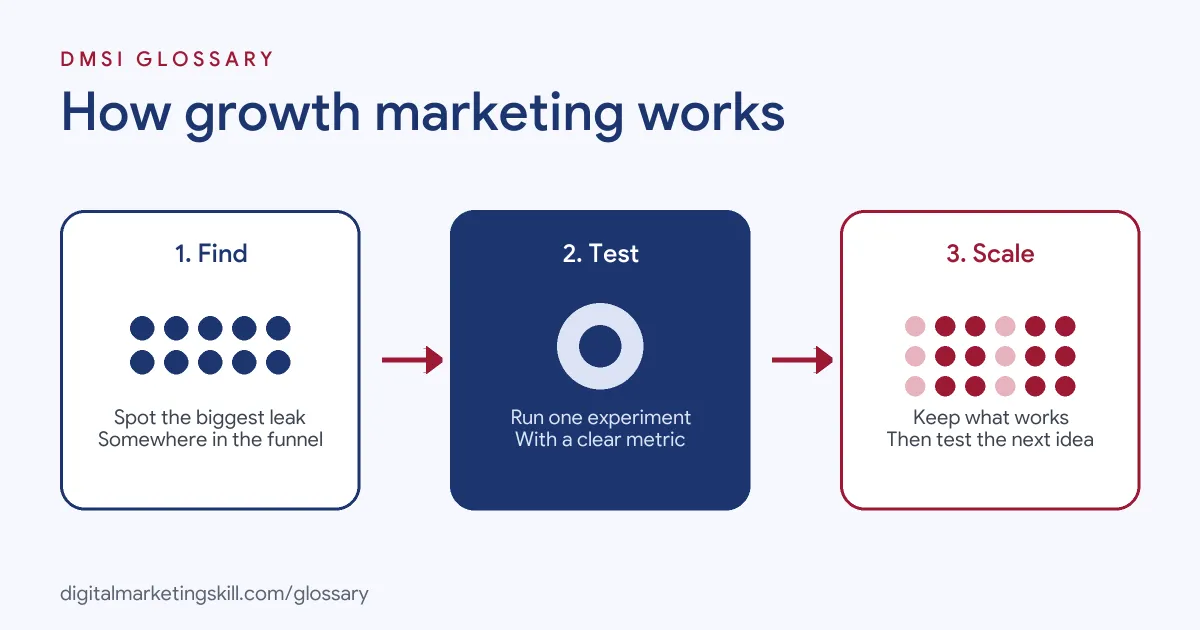
Most growth teams follow the same loop. First, they find a problem in the funnel. Next, they run a test to fix it. Finally, they measure the result, keep what works and move on to the next idea.
The AARRR Framework
Many teams map their funnel with five stages, often called “pirate metrics” because the letters spell AARRR:
- Acquisition: how people first find you, such as through search, social or ads.
- Activation: the first meaningful action, such as a booked call or a finished trial.
- Retention: whether people keep coming back or keep paying.
- Referral: whether happy customers bring in others.
- Revenue: how much money each customer brings in over time.
Mapping the stages shows where the biggest leak is. So if many people sign up but few activate, the next test should focus on activation, not on more ads.
The Experiment Loop
HubSpot describes growth experimentation as “a structured approach to testing ideas across the full customer journey to discover what drives measurable business growth.” Each experiment starts with a hypothesis. Then the team decides which metric will decide success, runs the test for a chosen audience and records the result.
HubSpot also says growth teams should rank tests by how much they expect to learn and how valuable that learning is. For example, a test of which value proposition gets users to activate teaches more than a test of button colours.
Cross-Team Work
Growth rarely sits in one team. HubSpot warns that experiments break when teams run them in isolation. For instance, demand generation may raise traffic while lifecycle marketing fails to activate those new users. So growth, lifecycle, product marketing and demand teams need to agree on shared goals before they test.
Growth Marketing Examples
These made-up examples show how growth work looks in practice:
- Mobile app: Many users download the app but never finish setup. The team tests a shorter sign-up form. Then it tracks how many users reach their first key action.
- Online shop: Most buyers order once and never return. The team tests a post-purchase email series with a reason to come back, then measures repeat orders.
- Software company: Happy customers rarely tell others about the product. The team tests a referral reward and tracks how many new sign-ups come from it.
In each case, the team picks one stage, runs one test and judges it on one clear number.
Growth Marketing vs Traditional Marketing vs Performance Marketing
These approaches overlap, but they focus on different things:
| Approach | Main focus | Typical measures |
|---|---|---|
| Traditional marketing | Awareness and brand campaigns | Reach, impressions, lead volume |
| Performance marketing | Paid campaigns tied to actions | Cost per lead, cost per sale, return on ad spend |
| Growth marketing | Testing across the whole funnel | Activation, retention, revenue per customer |
In short, growth teams often use performance channels and brand work. However, it judges them by their effect on the whole customer journey.
How to Start Growth Marketing
You can apply growth thinking to almost any business with these steps:
- Map your funnel with the AARRR stages and add a number to each one.
- Find the biggest drop-off, such as many visitors but few sign-ups.
- Write a hypothesis. For example: “If we cut the form to two fields, more visitors will sign up.”
- Pick one success metric and a test period before you start.
- Run the test, ideally against a control group, so you can see the real effect.
- Record the result, even if the test fails, so the team learns from it.
- Scale the winners. Then move to the next biggest leak.
Keep a simple log of every test. Note the idea, the metric, the result and what you will try next. Over time, it becomes a record of what your customers respond to, and new team members can learn from it on their first day.
Best Practices for Growth Marketing
- Start with product fit. Ellis argues growth work pays off once people already want the product. Testing can’t fix a product nobody needs.
- Measure the full journey. A cheap sign-up that never activates is not growth.
- Test one change at a time. Otherwise, you won’t know which change made the difference.
- Share results widely. A finding from email can help the ads team, and the other way round.
- Use AI to speed up the work. For instance, AI tools can draft test variants, but people should still check them.
Common Mistakes to Avoid
Beginners often make the same errors. First, they treat growth as a bag of tricks rather than a process. Second, they focus only on acquisition and ignore retention. Third, they stop tests too early, before the data means anything. Finally, they copy tactics from other companies without checking whether those tactics fit their own customers. Each of these wastes time that a clear test plan would save.
Where You’ll Use Growth Marketing at Work
Growth roles appear across start-ups, software firms and online brands. For example, remote job listings ask for:
- “5+ years of experience in digital, social media, performance or growth marketing” (Growth Marketing Manager).
- Someone to “own and scale customer acquisition across paid and organic channels” (Growth Marketing Manager, Paid and Organic Acquisition).
- A marketer to “build and execute a paid acquisition strategy for an early-stage SaaS company” (SaaS Growth Marketing Specialist).
So if you want to work as a Growth Marketer or Digital Marketing Manager, employers will expect you to run tests across channels and report on results. They will also want proof, such as campaigns where you moved a clear number.
Learn It in the Full Stack Track
Growth work draws on every channel, so the best fit is the Full Stack option, which covers all four tracks. You take all ten courses and complete one portfolio project from each track, from paid social to Google Ads, email and SEO. You also work on a U.S. Project Internship from day one, with unlimited 1-on-1 mentoring.
Want to compare channels before you test them? Read our guide to traffic generation, or see how email marketing growth turns customers into repeat buyers. It also helps to know your customer acquisition cost before you scale.
Frequently Asked Questions
What is growth marketing in simple terms?
It is a way of marketing that runs small tests across the whole customer journey to find what grows the business. Then it scales the tests that work.
Is growth marketing the same as growth hacking?
They are closely linked. Growth hacking was the earlier term, made popular by Sean Ellis. Today, most job titles use the newer name for the same test-and-learn approach.
What does a growth marketer do day to day?
They study funnel data, plan experiments, launch campaigns and report on results. They also work with product, sales and data teams to act on what they learn.
What is the AARRR framework?
It is a five-stage funnel: Acquisition, Activation, Retention, Referral and Revenue. It helps teams see where customers drop off.
Do you need coding skills for growth roles?
Not usually. Most growth work uses analytics, ad platforms and email tools. Still, comfort with spreadsheets and data helps a lot.
Sources: Sean Ellis: Find a Growth Hacker for Your Startup; HubSpot: Growth experimentation guide; Apollo: What is growth marketing; remote job listings on Himalayas.