
Semantic search is a way of searching that tries to understand what a query means, not just which words it contains. It returns results that match the searcher’s intent, even when those results don’t use the exact same words. For marketers, this changes how you write content, because pages now need to answer the real question, not just repeat a keyword.
Key Takeaways
- Semantic search matches meaning and intent, while keyword search matches words.
- Many of these systems turn text into embeddings, which are lists of numbers, and then find the closest matches.
- Context, such as the searcher’s location or the order of words, can change the results.
- Google uses language models such as BERT to understand how the words in a query relate to each other.
- For SEO, this means writing clear pages that fully answer a topic, rather than stuffing in keywords.
What Is Semantic Search?
Elastic, a search software company, describes it as “a search engine technology that interprets the meaning of words and phrases.” It adds that the results “will return content matching the meaning of a query, as opposed to content that literally matches words in the query.”
Here is a simple way to picture it. Imagine you type “shoes for standing all day at work.” An old keyword system looks for pages with those exact words. By contrast, a meaning-based system understands that you want comfortable work shoes. So it can show a page called “best supportive shoes for nurses,” even though the wording is different.
You meet this every day. Search engines, online shops, help centres and AI chat tools all use some form of it to find the most useful answer.
How Semantic Search Works
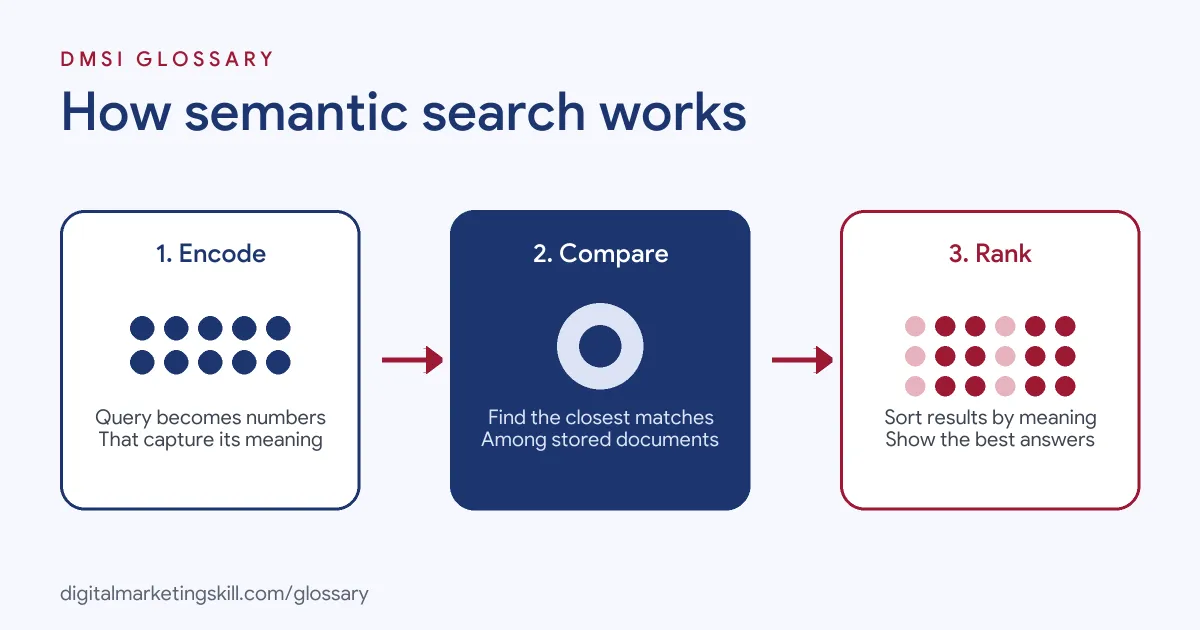
Most modern systems follow three steps. First, the system turns your query into numbers that capture its meaning. Next, it compares those numbers with the numbers for every document it holds. Finally, it ranks the closest matches and shows them to you.
Embeddings and Vectors
The numbers are called embeddings. OpenAI explains that “an embedding is a vector (list) of floating point numbers,” and that the distance between two vectors measures how related they are. Small distances suggest high relatedness, while large distances suggest low relatedness.
So two pieces of text about the same idea end up close together, even if they share no words. OpenAI also lists search as a main use, “where results are ranked by relevance to a query string.”
Finding the Nearest Match
Once everything is in number form, the system needs to find the nearest neighbours. Elastic says a common method is the k-nearest neighbour (kNN) algorithm, which matches document vectors to the query vector. Then the search ranks results “based on conceptual relevance.”
Measuring Similarity
How does a system decide which vectors are “close”? OpenAI recommends a measure called cosine similarity. It explains that its embeddings are normalised to length 1, so cosine similarity and Euclidean distance give the same rankings. In other words, the choice of distance measure usually matters less than the quality of the embeddings.
The vectors are also long. By default, OpenAI’s text-embedding-3-small model returns 1,536 numbers for each piece of text, and text-embedding-3-large returns 3,072. Each number captures a small part of the meaning.
Here is a made-up example to make this concrete. Say you store three sentences: “How do I reset my password?”, “I forgot my login details” and “Our office opens at nine.” A user then asks, “I can’t sign in.” The first two sentences sit close to the query in meaning, so they rank high. The third sits far away, so it drops to the bottom, even though none of the sentences share the words “sign in.”
Context and Intent
Context matters too. According to Elastic, it can include the searcher’s location, the other words in the query and their search history. For example, Elastic notes that “football” means different sports to people in the US and the UK, so the best results depend on where you are.
Word order counts as well. Elastic points out that a meaning-based engine can tell “chocolate milk” apart from “milk chocolate,” even though the words are the same.
Semantic Search Examples
Here are three examples. The first comes from Google; the other two are made up to show common uses:
- Google Search: Google says that, for the query “do estheticians stand a lot at work,” older systems matched the word “stand-alone.” With BERT, it understood that “stand” related to the physical demands of the job.
- Online shop (example): A customer types “something warm for winter walks.” The shop’s search returns fleece jackets and thermal gloves, not just items with “winter” in the title.
- Help centre (example): A user asks “why can’t I log in?” and gets the article titled “Reset your password.”
Semantic Search vs Keyword Search
| Feature | Keyword search | Semantic search |
|---|---|---|
| What it matches | Words, synonyms and similar words | The meaning and intent of the query |
| Main technique | Text matching, typo tolerance and synonyms | Embeddings and vector search |
| Handles word order | Often poorly | Yes, for example “chocolate milk” vs “milk chocolate” |
| Best at | Exact names, codes and product numbers | Natural questions and vague queries |
In practice, many systems combine both. Keyword matching catches exact terms, while semantic matching catches meaning.
How to Optimise Content for Semantic Search
You can’t control a search engine’s model. However, you can make your content easy to understand and match to real questions:
- Start with intent. Work out what the searcher actually wants: to learn, compare or buy.
- Answer the question early. Give a clear, direct answer near the top of the page.
- Cover the topic fully. Next, add the related questions people ask, so the page covers the whole subject.
- Use natural language. Write the way people speak, and use related terms where they fit.
- Structure the page. Use clear headings, short paragraphs and lists.
- Link related pages. Finally, connect pages on the same topic so readers and crawlers see the relationship.
Best Practices
- Write for people first. If a page reads well to a human, it is usually easier for a model to understand too.
- Be specific. For instance, “waterproof hiking boots for wide feet” is clearer than “great boots.”
- Keep exact terms where they matter. Product names and model numbers still need to appear in full.
- Test your own site search. Type real customer questions and see what comes back.
Common Mistakes
The most common mistake is keyword stuffing, which makes pages harder to read and adds no meaning. Another is writing thin pages that target one phrase but don’t answer the question. Some teams also forget that search engines read context, so a vague page about “solutions” is hard to match to anything. Finally, many people assume exact keywords no longer matter at all. They still do for names, brands and codes.
Where You’ll Use Semantic Search at Work
This skill shows up in both marketing and AI roles. On the technical side, real remote job listings ask for skills like these:
- “Implement semantic search, embeddings, knowledge retrieval, and vector database solutions” (Senior AI Engineer).
- “Familiarity with RAG, semantic search, text-to-SQL, and agentic patterns” (Architect, Snowflake Cortex).
As a marketer, you are more likely to use the idea than build it. For example, an SEO Specialist or Website Manager plans content around intent and topics, because search engines read meaning. Knowing how the technology works helps you explain those choices to clients and teams.
Learn It in the WordPress and SEO Track
You can learn to write and structure content for intent in the AI-Powered WordPress and SEO Specialist track. There, you build a WordPress site or store and rank it with an SEO content plan. AI fundamentals are part of every track, so you also learn how AI tools fit into your work. You get unlimited 1-on-1 mentoring and a U.S. Project Internship from day one.
To go further, read our glossary entries on search intent and natural language processing, or see our guide to SEO writing.
Frequently Asked Questions
What is semantic search in simple terms?
It is search that understands what you mean, not just the words you type. As a result, it can show useful pages that use different wording.
How is semantic search different from keyword search?
Keyword search matches words and synonyms. The newer approach matches the meaning and intent behind the query.
Does Google use semantic search?
Google uses language models such as BERT to understand how words in a query relate to each other. That helps it match results to what people mean.
What are embeddings in semantic search?
They are lists of numbers that represent the meaning of text. Texts with similar meanings have embeddings that sit close together.
Do keywords still matter?
Yes, especially for names, brands and product codes. However, you should use them naturally within content that fully answers the question.
Sources: Elastic: What is semantic search?; OpenAI: Vector embeddings guide; Google: Understanding searches better than ever before; remote job listings on Himalayas.