
SEO writing means structuring content so search engines, readers and AI systems can all find the answer fast. It is not about stuffing keywords. Most guides focus only on keyword placement and skip structure, depth and AI answer engines. This guide covers all three, with the checks to run before you publish.
Key Takeaways
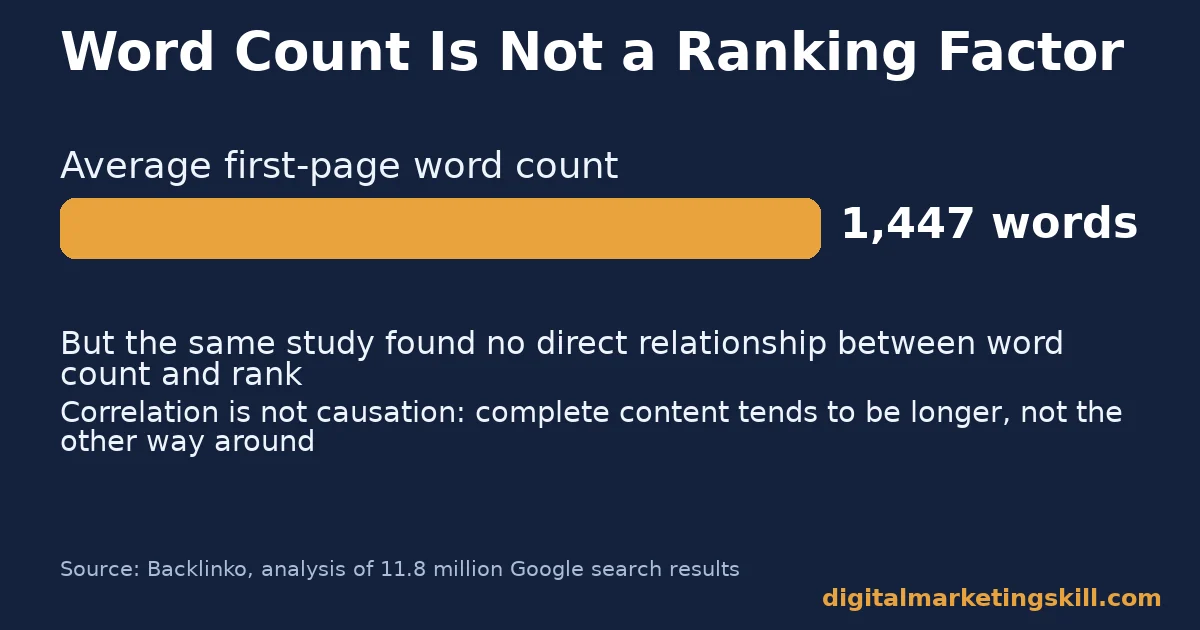
- Word count is not a ranking factor on its own. Backlinko’s analysis of 11.8 million search results found an average of 1,447 words on first-page results, but found no direct relationship between word count and rank.
- Readers scan; they rarely read in full. Nielsen Norman Group eye-tracked 232 users and found people read at most 28% of the words on an average page, often closer to 20%.
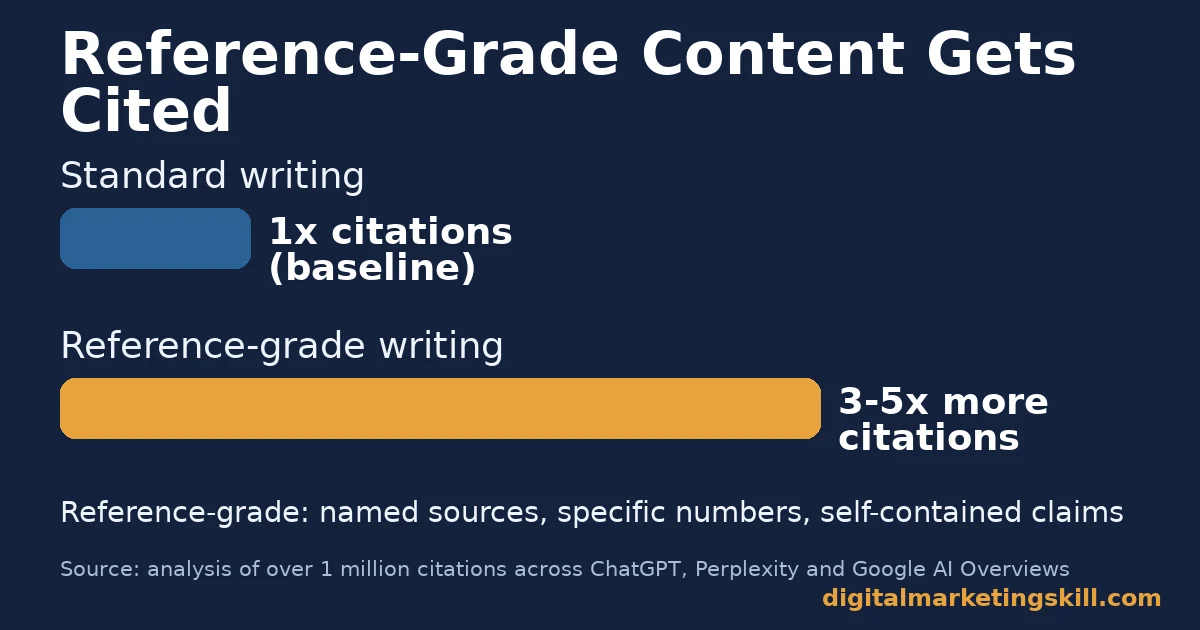
- AI answer engines cite content too now. An analysis of over 1 million AI citations found reference-grade content, with named sources and clear structure, earns 3-5x more citations than standard content.
- Google states plainly that helpful content should leave readers feeling they learned enough to reach their goal, per its own Search Central documentation. That single standard outlasts every algorithm update.
- Structure beats length. Short paragraphs, clear subheadings and one idea per section help both the 20% of words a human reads and the sentences an AI system quotes, which is why structure is the cheapest fix with the widest payoff.
In this guide
- What Most SEO Writing Advice Still Gets Wrong
- How SEO Writing Actually Works
- SEO Writing Results Differ by What You Optimize
- How to Lead With Each Layer’s Strength
- How to Measure SEO Writing
- The One Decision Rule for Where to Fix Your Writing First
- A Real Case: SEO Writing That Actually Ranked
- Frequently Asked Questions About SEO Writing
- Turn SEO Writing Into a Career Skill
What Most SEO Writing Advice Still Gets Wrong
Most SEO writing guides treat keyword placement as the whole job. Put the keyword in the title, the URL, the first paragraph, done. That advice is not wrong, but it is incomplete. It was written for an older, simpler search engine.
It skips two things that matter just as much today. First, structure: how a scanning reader actually finds the answer. Second, AI readiness: whether a language model can lift one of your sentences and quote it correctly. This guide covers both, alongside the keyword basics most writers already know.
Ground rules: the Backlinko and AI citation figures below come from named analyses of real pages, not lab tests. Treat them as a snapshot of current behavior, not a permanent ranking. Word count correlates with ranking; it does not cause it.
There is also a checklist trap worth naming early. A page can pass every item on a keyword checklist and still fail a reader. Checking boxes is not the same as writing something worth reading, and search engines increasingly reward the second thing over the first. SEO writing that chases the checklist alone eventually stalls.
How SEO Writing Actually Works
SEO writing works in three layers, and skipping any one weakens the others. The first layer is relevance: does the page actually answer the query the keyword represents? Structure is the second layer: can a scanning reader find that answer fast?
Machine-readability is the third: can a search engine or an AI system extract the answer cleanly.
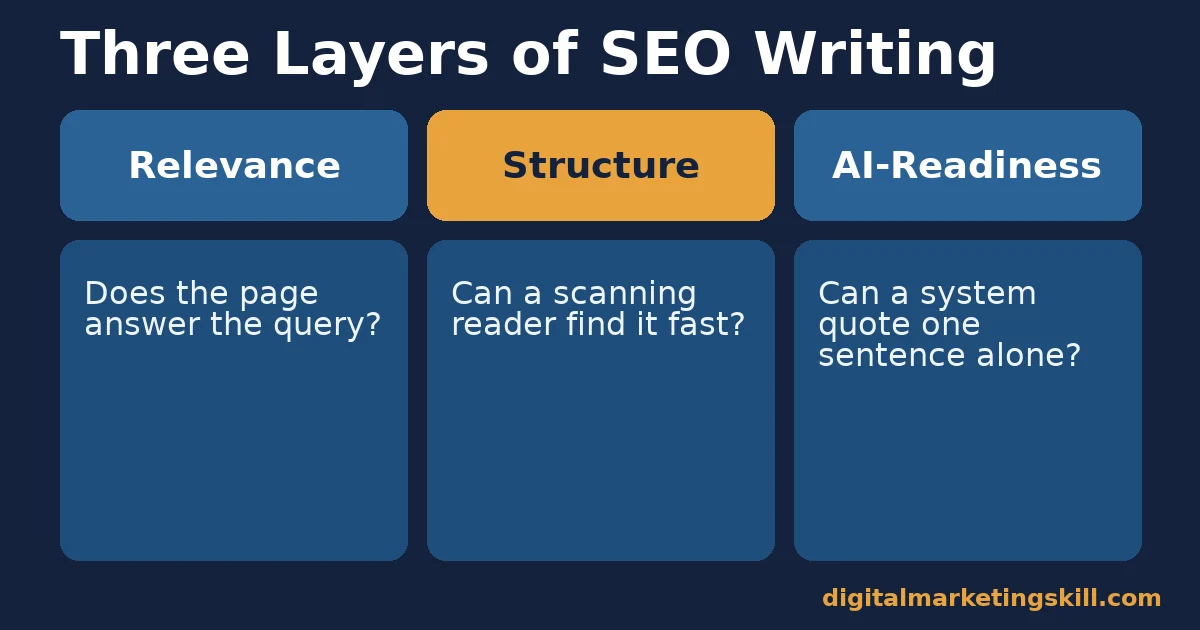
Search engines used to grade mostly on the first layer. They now weigh all three together, which is why old single-factor advice falls short.
Relevance alone used to be enough. Google’s own guidance on helpful content asks a direct question: will a reader leave feeling they learned enough to reach their goal? That single question is a better content checklist than any keyword density target. Run every draft through it once before you publish.
Structure decides whether that relevance ever gets noticed. Nielsen Norman Group’s eye-tracking research found readers move in an F-shaped pattern: across the top, partway across a second line, then down the left edge. A wall of text hides your answer from that scan pattern entirely.
Machine-readability is the newest layer, and it borrows from the other two. A search engine or an AI system still needs relevance and structure to find your answer. What it adds is a preference for sentences that make sense on their own, without needing the paragraph around them for context. That is a new discipline for most writers, trained for years to lean on context instead of repeating themselves.
SEO Writing Results Differ by What You Optimize
Good, effective SEO writing is not one single skill. It is three separate skills, applied together to the same page. A writer strong in one layer often assumes the others will follow automatically. They rarely do.
Three things get optimized under the label “SEO writing,” and each has its own ceiling: depth, structure, and AI-readiness. Most writers only work on one. The best pages work on all three at once, which is rarer than it should be given how little extra effort the other two actually take.
Depth: Built For Completeness, Not Length
Depth means covering a topic well enough that a reader has no reason to go back to search for a better answer. Backlinko’s analysis of 11.8 million results found first-page content averaging 1,447 words, but explicitly found no direct causal link between word count and ranking.
Longer content tends to be more complete, not inherently more rankable. Completeness is the actual goal; length is only a side effect of reaching it honestly.
Write until every sub-question a reader would naturally ask has an answer on the page, then stop. List those sub-questions before you start, so you know when the draft is actually finished.
A 600-word page that fully answers a narrow question can outperform a padded 2,000-word page that never quite gets there. Padding is easy to spot: a sentence that repeats an earlier point in different words is padding, not depth.
Structure: Built For Scanning, Not Reading Start to Finish
Structure means subheadings, short paragraphs and lists that let a scanning eye find the right section. Since readers absorb at most 28% of a page’s words, the subheadings often carry more weight than the sentences underneath them. Write them as if a reader will see only those, and nothing else on the page.
Short paragraphs matter for the same reason. A paragraph over about 70 words starts to look like a wall of text, and a scanning reader skips past it rather than reading it closely. Break it at the first natural pause instead of forcing it to fit on one breath.
AI-Readiness: Built For Extraction, Not Just Ranking
AI-readiness means writing sentences that survive being lifted out of context, which matters more every month as more search sessions end inside an AI answer instead of a list of blue links.
Reference-grade content, with named sources and self-contained claims, earns 3-5x more AI citations than generic writing, based on an analysis of over 1 million citations across major AI answer engines. Named sources and specific numbers give an AI system something solid to quote, instead of a vague claim it has to paraphrase or skip.
A sentence that says “it improved significantly” fails this test, because “it” depends on a sentence an AI system might not quote alongside it. A sentence that names the subject and the number survives being lifted out on its own.
How to Lead With Each Layer’s Strength
Once you know what each layer does, write to its strength instead of chasing a single keyword density number. A keyword density target treats every word the same. These three fixes do not; each targets a specific reason good SEO writing fails to connect. Run through them in order, since structure makes the other two fixes easier to apply.
Depth: Lead With Full Coverage, Not a Word Target
Write until the topic is covered, then stop. Use SEO fundamentals and a keyword research tool to confirm you are targeting a real, searched topic before you write a single word, so depth goes toward a question people actually ask. Writing deeply on a topic nobody searches for wastes the effort, no matter how thorough the page ends up.
Structure: Lead With Headings That Make a Claim
Write subheadings that state a claim, not just a label. “Depth Beats Length” tells a scanning reader more than “Content Length” does, because it answers a question instead of naming a topic. Keep paragraphs under about 70 words. Give each short section exactly one idea. Two separate ideas per section usually means the section needs to split in two parts.
A few smaller habits support the same goal. Use an active voice; it reads faster than passive. Cite a source for any number you quote, both for trust and because a named source is more quotable.
Place the keyword naturally in the opening, a few subheadings, and the meta description, without forcing it where it does not fit. If a sentence reads awkwardly because of the keyword, rewrite the sentence, not the keyword.
AI-Readiness: Lead With Self-Contained Sentences
Write each key sentence so it names its subject, states the fact, and could stand alone if quoted. Avoid leaning on “this” or “it” to carry meaning from a previous sentence, since an AI system often lifts just the one sentence. Name the subject every time, even if it feels repetitive to a human reader.
Compare two versions of the same claim, illustrative wording only: “It found a big jump” tells an AI system nothing on its own. “Backlinko’s study found an 11.8-million-result sample” names the subject and survives being quoted alone.
None of this requires new tools. A word processor covers all three layers. So does a willingness to delete filler sentences. Most writers already have both tools ready.
How to Measure SEO Writing
Four numbers tell you whether your SEO writing is working, each pulled from free tools you likely already have. Check all four together, not one in isolation.
- Average position is the ranking Search Console reports for your target keyword. Track it over weeks, not days. A single day’s movement is usually noise.
- Organic click-through rate is the share of people who click your result after seeing it; a low CTR at a good position often means the title or meta description needs work, not the content itself. Test a new title before you rewrite the whole page.
Two more numbers show whether readers actually use what you wrote. Neither needs a paid tool. GA4 and Search Console cover both already, which is why there is no excuse for skipping this check before you move on to the next piece.
- Scroll depth or time on page shows whether readers get past the opening before leaving; a sharp drop near the top usually points to a weak opening answer. Fix the first two sentences before you touch anything else on the page. Most abandoned pages fail there, not further down.
- AI citation appearances, checked by searching your own brand and topic terms inside ChatGPT, Perplexity or Google’s AI Overview, shows whether your content is reference-grade enough to get quoted.
The same measurement habits apply once you have a page worth linking to. See this guide to link building analytics for how to prove a link’s value the same way.
The One Decision Rule for Where to Fix Your Writing First
If you only have time to fix one layer this month, fix structure. It is the cheapest layer to improve, and it helps the other two: a well-structured page is easier for both scanning readers and AI systems to extract an answer from.
Here is an illustrative, invented example. A 2,000-word article with no subheadings and dense paragraphs converts few readers into finishers.
Breaking the same 2,000 words into eight sections, each with a claim-based heading and short paragraphs, could plausibly lift average scroll depth and time on page meaningfully, without adding or removing a single fact. That is an estimate to show the mechanism, not a guaranteed outcome for any specific page or topic.
The most common mistake is editing for keyword count instead of editing for structure. A page can hit every keyword target in a checklist and still lose readers at the second paragraph because nothing breaks up the dense text on the screen.
A second common mistake is writing the subheadings last, as an afterthought. Write them first instead, as a claim-based outline. Then fill in the body beneath each one. This forces structure before content, not after it.
A third mistake is rewriting an entire page when only the opening fails. Check scroll depth before you start a rewrite. If readers drop off in the first two paragraphs, fix those two paragraphs first, measure again, and only then decide whether the rest needs work.
A Real Case: SEO Writing That Actually Ranked
Abimbola Fafiolu, a Digital Marketing Skill Institute graduate, describes building a website that ranks in Google using skills from the program, naming the SEO module as the course’s standout lecture, as published on the Institute’s reviews page. No specific keyword or traffic figure is published alongside that case, so treat it as a directional example, not a benchmark number to copy exactly.
The case shows the actual goal of SEO writing: content that search engines can rank and readers can use, not content optimized for a checklist alone. Ranking was the outcome, not the starting metric; the underlying page had to earn it first.
Depth and structure came before any ranking number did, and that order rarely reverses in practice. Once that content ranks, email list building is a natural next step for turning readers into subscribers.
Results are self-reported and vary by market and effort; see the Institute’s earnings disclaimer before treating any single case as typical. The mechanics in this guide are what made that outcome possible, not a shortcut around them.
Depth, structure and AI-readiness are the actual mechanics, not three extra steps bolted onto a finished draft. Build them in from the start, and the checklist items take care of themselves. Treat the checklist as a final check, not the plan you write from.
Frequently Asked Questions About SEO Writing
Does longer content always rank better?
No. Backlinko’s analysis of 11.8 million results found longer content on the first page, but explicitly found no direct relationship between word count and ranking. Write to cover the topic fully, not to hit a number. A shorter page that fully answers the question usually beats a longer one that circles it.
How many times should I use my keyword?
Use it naturally where it fits: the title, the opening paragraph, a few subheadings, and scattered naturally through the body text. There is no fixed count that guarantees ranking; unnatural repetition can hurt readability more than it helps SEO. If counting the keyword starts to shape your sentences, stop and read the page aloud instead to hear where it sounds forced.
What is the difference between SEO writing and content writing?
SEO writing is built to be found by search engines and AI systems, targeting a specific query. Content writing is built to engage a reader who already arrived. Strong SEO writing does both at once, since a page that nobody finds cannot engage anyone either.
How do I know if my content is structured well?
Read only the subheadings in order. If they alone explain the article’s argument, the structure works. If they are generic labels like “Overview” or “Tips,” rewrite them as claims. This test takes under a minute and catches most structural problems before a reader ever does.
Does AI search change how I should write?
Yes, somewhat. Write self-contained sentences that name their subject and source, since AI answer engines often quote one sentence out of context. Reference-grade writing of this kind earns measurably more AI citations. The habit costs little, and it pays off in traditional search too.
Should I write for Google or for ChatGPT-style AI search?
Write for the reader first; both systems reward the same underlying qualities, clear structure, real depth and named sources. Content built that way tends to perform in both search and AI answers. Chasing one system at the expense of the other usually weakens both results.
How long should an SEO article be?
Long enough to cover the topic completely and no longer. Use the 1,447-word first-page average, from Backlinko’s study, as a loose reference point, not a target to hit artificially.
What should I check right before I publish?
Read only the subheadings in order and confirm they tell the article’s story. Check that your target keyword appears in the title, the opening, and at least one subheading. Confirm every key claim names its subject instead of relying on “this” or “it.” Then read the opening paragraph alone and ask whether it answers the query by itself, with nothing else on the page to help it.
Turn SEO Writing Into a Career Skill
SEO writing is one piece of a larger AI-powered marketing skill set. Employers now pay for this skill set directly.
The Digital Marketing Skill Institute’s Master Diploma in Digital & AI Marketing is built around four AI-powered tracks across ten courses. One of them, the AI-Powered WordPress and SEO Specialist track, covers exactly the SEO writing and structure skills in this guide. A Full Stack option covers all four tracks together, for anyone who wants the full curriculum rather than one specialty focus.
Every track includes unlimited 1-on-1 coaching and mentoring, plus a real U.S. Project Internship with a verified U.S. Work Reference Letter. The program carries dual US and UK accreditation, recognised in more than 100 countries worldwide. You study 100% online, from anywhere in your country or beyond.
Review the full Master Diploma program for the complete curriculum, and browse more guides on the digital marketing blog. When you are ready, apply here.
Start with the structure fixes from this SEO writing guide. Measure the result against the benchmarks above. Then work on depth and AI-readiness next, one layer at a time, checking the benchmarks again after each change. Learn more at digitalmarketingskill.com, wherever in your country you are working from, and come back to digitalmarketingskill.com for the next guide in this series.
Every figure in this guide was checked against its original source before publication. Figures marked as illustrative are invented examples, not real results.
![9 Amazing Digital Marketing Skills to Make Money Online [With Proof]](https://digitalmarketingskill.com/wp-content/uploads/2019/07/9-Amazing-Digital-Marketing-Skills-to-Make-Money-Online-With-Proof-17.png)






