
In advertising, frequency is the average number of times each person sees your ad over a given period. You work it out by dividing impressions by reach. It matters because too little repetition means people forget your message, while too much wastes budget and can make your audience tired of your ads.
Key Takeaways
- The basic formula is impressions ÷ reach. For example, 30,000 impressions across 10,000 people means each person saw it 3 times on average.
- Meta defines it as “the average number of times each Accounts Center account saw your ad.”
- Google Ads lets you set a frequency cap per day, week or month on Display and Video campaigns.
- TikTok’s Reach & Frequency buying lets you set a cap or a target frequency in advance.
- There is no perfect number. The right level depends on your goal, audience size and creative.
What Is Frequency?
Two numbers describe who saw an ad. Reach counts how many different people saw it. Impressions count how many times it was shown in total. This metric connects the two by showing how often, on average, each person saw it.
Google describes it as “the number of times a user sees ads in your Display or Video campaign over a given time period.” Meta reports it as “the average number of times each Accounts Center account saw your ad,” and defines reach as the number of accounts “that saw your ads at least once.”
For example, a local gym runs an ad that reaches 5,000 people and gets 15,000 impressions in a week. So the figure is 3, and the average person saw the ad three times. These numbers are an example only.
How Frequency Works
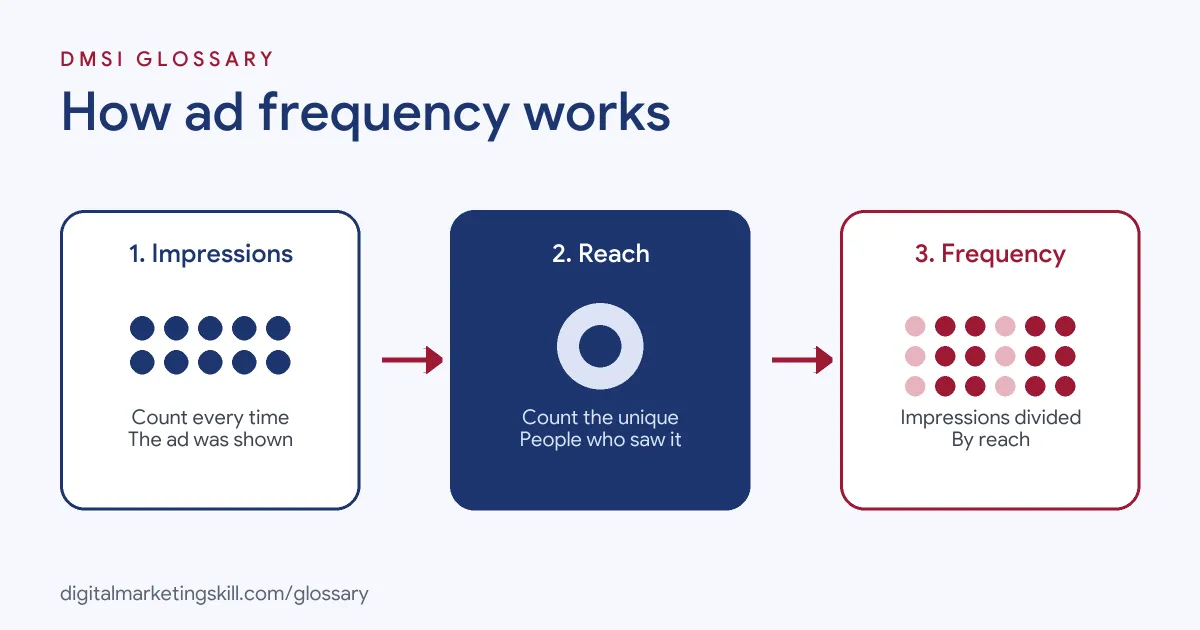
The metric builds up in three steps. First, the platform counts every impression. Next, it counts the unique people who saw the ad. Finally, it divides impressions by people to get the average.
Averages Hide Detail
An average of 3 does not mean everyone saw the ad three times. Some people may have seen it once and others ten times. That’s why Google Ads also shows a frequency distribution, with buckets such as 1+, 2+, 3+, 4+, 5+ and 10+. It also reports “Avg. impr. freq. per user” over seven and 30 days for Display, Demand Gen, Video and App campaigns.
Frequency Caps
A frequency cap limits how often one person sees your ads. In Google Ads Display campaigns, you can “manage the number of impressions you will allow an individual user to have on the campaign per day, week, or month.” You can set it on the campaign, ad group or ad.
Video campaigns work a little differently. There, the cap can limit impressions and/or views per day, week or month, and it can only be set at campaign level. Google adds that “When a user reaches this cap, Google will stop showing them that specific campaign’s ads.”
Aiming for a Set Number
Some platforms let you aim for a number, not just a limit. TikTok’s Reach & Frequency buying type offers frequency control “by maximum (frequency capping) or by desired number of times to optimize for (target frequency).” These campaigns “optimize for a pre-determined quantity of reach, impressions, and average frequency.”
Frequency Examples
Here are three made-up examples of repetition decisions:
- Brand launch: A new snack brand wants people to remember its name. So it aims for a few views per person over two weeks, using a target setting.
- Retargeting: An online shop shows ads to recent visitors. It sets a daily cap, so people are reminded without being followed all day.
- Tired creative: A course provider sees the average climb above 6 with falling clicks. As a result, it adds new ads and widens the audience.
Reach vs Impressions vs Frequency
These three metrics are reported together. This table shows how they differ:
| Metric | What it counts | What it tells you |
|---|---|---|
| Reach | Unique people who saw the ad | How far the message spread |
| Impressions | Total times the ad was shown | The total volume of delivery |
| Frequency | Impressions ÷ reach | How often the average person saw it |
In short, reach is breadth, impressions are volume, and this metric is repetition. A good plan balances all three.
Planning Repetition for a Campaign
Before you launch, decide how often you want people to see your message. Start with the goal. A new brand may need several views before people remember its name. By contrast, a simple reminder to existing customers may only need one or two.
Next, think about the audience size and budget together. A small audience with a large budget will see the same ads many times. A large audience with a small budget may see them only once. So if you want more views per person, you can narrow the audience or raise the budget. If you want fewer, do the opposite.
Here is a made-up example. A theatre has a small budget and wants locals to remember a new show. It targets people within ten miles, sets a weekly cap of three and prepares three different ads. As a result, people see the show a few times, in a few different ways, without feeling chased.
How to Measure and Manage Frequency
Follow these steps:
- Set the goal first. Awareness campaigns often need some repetition, while sales campaigns may need less.
- Add the right columns. Show reach, impressions and average frequency in your reports.
- Look at the distribution. Check how many people saw the ad once and how many saw it many times.
- Set a cap where needed. Use daily or weekly caps on Display, Video and retargeting campaigns.
- Watch performance as it rises. Compare click-through rate and cost per result as repetition grows.
- Refresh creative. Rotate new ad creative so repeat viewers see something new.
- Widen the audience. After that, if the number stays high, add more people so the budget spreads further.
Best Practices for Ad Frequency
- Match repetition to the goal. A launch may need more repetition than a simple reminder.
- Pair it with reach. High repetition with low reach means a small group sees the ad again and again.
- Use caps on small audiences. Retargeting lists are small, so they can tire quickly.
- Plan creative in sets. Several versions of an ad let you keep showing up without boring people.
- Review weekly. The number builds over time, so check it regularly during a campaign.
Common Mistakes to Avoid
Several errors waste budget. First, advertisers ignore the metric and keep showing one tired ad to the same people. Second, they set caps so low that the message never sticks. Third, they read the average without looking at the distribution. Finally, they blame the platform for rising costs, when the real issue is a small audience and a single ad. A quick weekly check of reach, repetition and results avoids all four.
Where You’ll Use Frequency at Work
Media and paid social roles manage this metric every week. For example, one recent remote job listing for a TV, Video, Audio and Display Senior Specialist asks the hire to “Identify and recommend changes (budget, pacing, frequency cap adjustments, network mix) within guardrails.” The same role lists a goal to “reduce unmanaged frequency and overlap.”
So as a Paid Social Specialist, Social Media Manager or Content Creator, you will plan how often people see your ads, set caps and refresh creative before audiences tire.
Learn It in the Social Media Track
You can learn to plan reach, repetition and creative rotation in the AI-Powered Social Media Management and Advertising track. There, you plan, create and run a paid social campaign for a real brand, so you can show real results. You also work on a U.S. Project Internship from day one, with unlimited 1-on-1 mentoring.
For more ideas on running ads well, read our Facebook advertising tips.
Frequently Asked Questions
What is frequency in advertising?
It is the average number of times each person saw your ad in a period. You find it by dividing impressions by reach.
What is a good ad frequency?
There is no single right number. It depends on your goal, audience size and creative. Watch performance as the number rises, and act when results start to fall.
What is a frequency cap?
It is a limit on how often one person sees your ads. In Google Ads, you can set caps per day, week or month on Display and Video campaigns.
Why are people seeing my ad so often?
Usually because your audience is small or your budget is large for that audience. Widen targeting or add new creative to help.
What is target frequency?
It is a setting that aims for a chosen number of views per person, rather than only capping them. TikTok’s Reach & Frequency buying offers this.
Sources: Google Ads Help: Frequency capping; Google Ads Help: About reach and frequency; TikTok Ads Help: About Reach & Frequency; Jon Loomer: Meta ads metric update; remote job listings on Himalayas.