
Personal branding is the work of shaping how people see you professionally, through what you share, what you are known for and the proof you show of your skills. It covers your online profiles, your content and the results you can point to. It matters because clients and employers often look you up before they talk to you, so what they find can open or close doors.
Key Takeaways
- Your personal brand already exists. Personal branding is about shaping it on purpose.
- It rests on three things: a clear focus, consistent content and real proof of your work.
- LinkedIn’s Featured section lets you show posts, articles, links and media as evidence of your skills.
- Search your own name regularly, since that is what a recruiter or client will do.
- Proof beats polish. A small portfolio of real results is worth more than a clever slogan.
What Is Personal Branding?
A company brand tells customers what a business stands for. In the same way, a personal brand tells people what you stand for at work. It is the short answer to the question, “What is this person good at?”
Everyone has a reputation, whether they plan it or not. Personal branding simply means taking control of it. You choose a focus, share useful work and make your best results easy to find.
For example, a freelance email marketer might post short case studies each week. Over time, people in her network start to think of her when someone asks, “Who knows email automation?” That link between her name and a skill is her personal brand at work. In other words, her reputation now does some of her selling for her, even when she is not in the room.
How Personal Branding Works
Strong personal branding follows three steps. First, you pick a clear focus. Next, you share content that shows how you think. Finally, you collect proof, such as results and samples, so people can trust what you say.
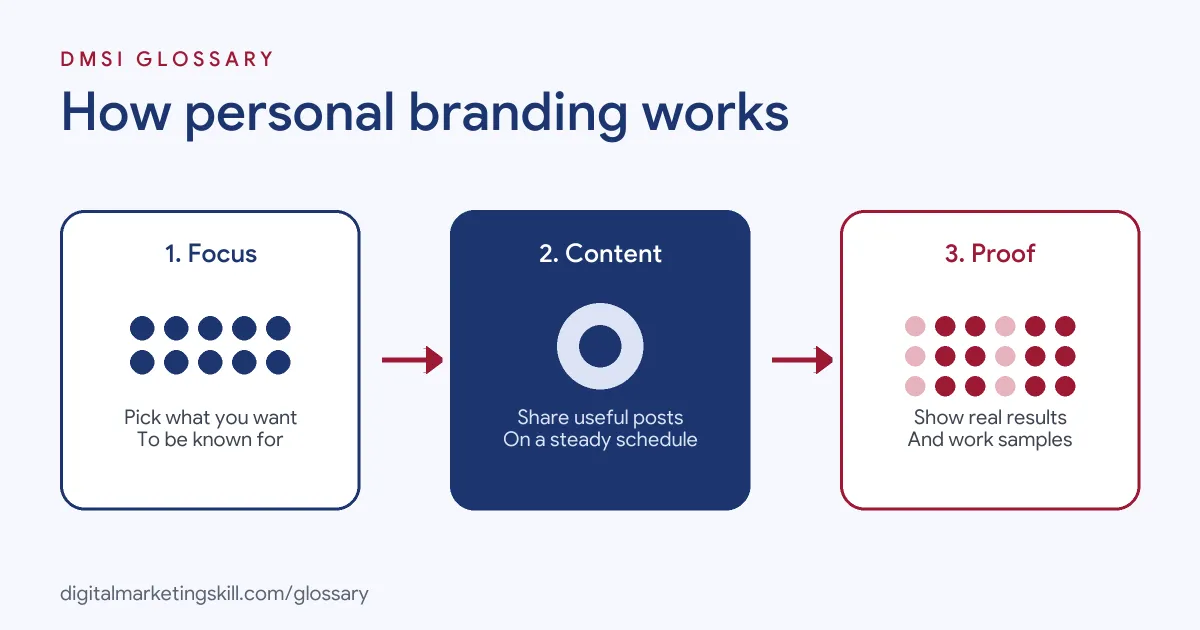
Choose a Focus
You cannot be known for everything. So pick one or two areas, such as paid social for online shops or SEO for local firms. A clear focus makes you easier to remember and easier to recommend.
Share Useful Content
Content shows how you think. It can be a short post about a test you ran, a breakdown of a campaign or a lesson from a mistake. One remote job listing even asks new hires to “Share what you’re learning, document your thinking, and show up consistently.” That habit is the heart of the process.
Show Proof
Claims are cheap, so proof does the heavy lifting. On LinkedIn, the Featured section lets you “showcase samples of your work”. LinkedIn says it is “a great way to provide evidence of your skills and experience”. You can feature posts, articles, links to outside sites and uploaded media such as documents and videos.
Personal Branding Examples
Here are three made-up examples of personal branding in marketing:
- The specialist: A Google Ads freelancer posts one short case study each week, with the before and after numbers. Her Featured section links to her three best results.
- The teacher: A social media manager shares simple tips for small shops. Because his posts are useful, local business owners start to message him for help.
- The career changer: A former teacher learning SEO documents each project she completes. As a result, her profile shows real progress, not just a new job title.
In each case, the person is known for one thing and backs it up with evidence.
Personal Branding Channels Compared
You do not need every platform. Here is how the main options compare:
| Channel | Best for | What to share |
|---|---|---|
| B2B work, jobs and client leads | Case studies, lessons and Featured work samples | |
| Personal website or portfolio | Showing full projects in one place | Detailed results, services and contact details |
| Instagram or TikTok | Creative and consumer-brand work | Short videos, before and after visuals |
| Newsletter | Building a loyal audience | Regular insights sent straight to subscribers |
Most marketers start with LinkedIn and a simple portfolio. Then they add other channels once they have a steady habit. That way, you build depth in one place before you spread your time thinly.
How to Start Personal Branding
These steps will help you build a brand people can trust:
- Search your own name. See what a recruiter or client would find today.
- Pick your focus. Write one sentence that says who you help and how.
- Fix your profile. Update your headline, photo and summary so they match that focus.
- Claim a custom profile URL. LinkedIn says a custom URL helps “members and recruiters identify your profile easily”. These are available on a first come, first served basis.
- Add work samples. Put your best results in the Featured section or a portfolio.
- Post on a schedule. Share one useful idea, result or lesson each week.
- Engage with others. Comment thoughtfully on posts in your field.
After that, review what works every month. Keep the topics that start conversations and drop the ones that do not.
How to Measure Your Progress
A brand is hard to measure directly, but its effects are not. So track a few simple signs each month:
- Inbound messages: how many people contact you about work without being asked.
- The right connections: whether requests come from the clients or employers you want.
- Engagement on useful posts: comments and shares, not just likes.
- Search results for your name: whether your profile, portfolio and best work appear first.
- Referrals: how often people recommend you to others.
If these numbers stay flat, look again at your focus. Usually, the message is too broad or the proof is too thin.
Best Practices
- Be consistent. Use the same name, photo and focus across your profiles.
- Lead with results. Numbers, screenshots and short stories build trust fast.
- Stay honest. Only share results you can stand behind.
- Protect your privacy. Google’s “Results about you” tool lets you check whether your home address, phone number or email appears in search results. You can then ask Google to remove some of those results.
- Help first. Useful posts attract the right people better than self-promotion.
Common Mistakes to Avoid
A common mistake is trying to appeal to everyone. As a result, nobody remembers what you do. Another is posting in bursts, then going quiet for months. Some people also share opinions with no proof, which weakens trust. Finally, many forget that clients will search their name. If old or messy content shows up first, it shapes their view before you even speak. One more trap is copying someone else’s style too closely. People follow you for your own view, so borrow formats if you like, but keep your own voice and examples.
Where You’ll Use Personal Branding at Work
Personal branding is now a job skill in its own right. For example, remote job listings mention:
- “Build and maintain your own presence on LinkedIn. Share what you’re learning, document your thinking, and show up consistently.” (Brand Outreach Specialist).
- A strategy “that grows the CEO/Founder’s personal brand” (Personal Brand Strategist / Manager).
- Helping “turn a high-growth personal brand into one of the most influential voices in business education” (Instagram Viral Content Copywriter).
So you may build your own brand to win work, and also build brands for founders and clients. Freelance Digital Marketers and Agency Owners rely on it most, because their name is their shop window.
Learn It in the Full Stack Programme
A strong brand needs real results behind it. The Full Stack (all four tracks) programme covers all ten courses and gives you one portfolio project from each track, so you have proof to share. It is about 90% hands-on, with unlimited 1-on-1 mentoring and a U.S. Project Internship from day one.
For practical ideas, read our guides on building a personal brand on social media and how to get freelance clients. You can also learn about portfolio marketing.
Frequently Asked Questions
What is personal branding in simple terms?
It is shaping how people see you at work, through a clear focus, useful content and proof of your results.
Why does personal branding matter for marketers?
Clients and employers often look you up first. A clear, consistent profile with real results helps them trust you before you meet.
Which platform is best for a personal brand?
For most marketers, LinkedIn is the best start, plus a simple portfolio. Add Instagram, TikTok or a newsletter if your audience is there.
How long does it take to build a personal brand?
There is no fixed time. It grows as you share useful work consistently, so steady effort matters more than speed.
Can I build a personal brand without much experience?
Yes. Share what you are learning and the projects you complete. Honest progress can be as convincing as a long track record.
Sources: LinkedIn Help: Featured samples of your work; LinkedIn Help: Manage your public profile URL; Google Search Help: Results about you; remote job listings on Himalayas.