
Zero-party data is information that customers choose to share with a brand on purpose, such as their preferences, plans and how they want to be contacted. Instead of guessing from clicks, you simply ask, and people tell you. It matters because it is clear, willingly given and often more accurate than data you infer from behaviour.
Key Takeaways
- The research firm Forrester coined the term. It defines it as data a customer “intentionally and proactively shares with a brand”.
- Common sources are quizzes, surveys, preference centres and sign-up forms.
- It differs from first-party data, which you mostly observe from what people do.
- It is still personal data in most cases, so privacy and consent rules apply.
- People share it in exchange for value, so you must use it to improve their experience.
What Is Zero-Party Data?
Imagine a skincare brand that asks new visitors, “What is your skin type?” A visitor picks “dry” and adds that they want a fragrance-free product. That answer is zero-party data. The visitor gave it freely, and it tells the brand exactly what to show them.
Salesforce quotes Forrester’s full definition. It says this data can include preference centre data, purchase intentions, personal context and how the person wants the brand to recognise them. A Forrester analyst also notes that when customers share it, the brand “doesn’t have to go off and infer” what they want.
In other words, you skip the guesswork. Rather than reading signals from page views, you have a direct answer from the person.
How Zero-Party Data Works
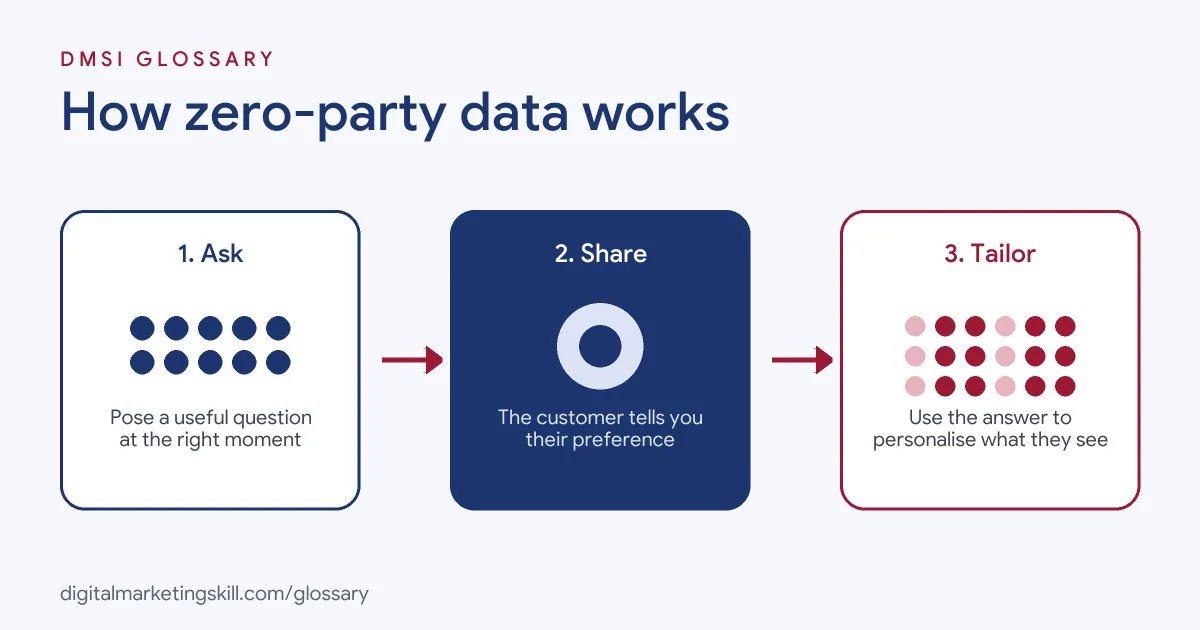
The process is a simple exchange. First, you ask a useful question at the right moment. Next, the customer answers because they expect something better in return. Finally, you use the answer to tailor what they see, from emails to product suggestions.
Where It Comes From
Popular ways to collect it include:
- Quizzes: “Find your perfect running shoe” style tools.
- Preference centres: pages where subscribers choose topics and how often they hear from you.
- Surveys and polls: short questions after a purchase or in an email.
- Sign-up forms: an extra optional question, such as “What are you shopping for?”
- Account profiles: sizes, birthdays or interests that customers add themselves.
The Value Exchange
People rarely share for nothing. Salesforce stresses that when customers give you data, you need to provide value right away in return. It also warns against letting the data “fall into the void”. For instance, if someone says they prefer red, don’t show them blue.
In practice, the value might be a discount, a tailored product list or simply fewer, more relevant emails. Whatever you offer, deliver it straight after they answer.
Privacy Rules Still Apply
Because people volunteer it, this data can feel low risk. However, it is usually still personal data. The UK’s Information Commissioner’s Office defines valid consent as freely given, specific, informed and unambiguous. So tell people clearly what you will do with their answers, and make it easy to change their mind.
Zero-Party Data Examples
Here are three made-up examples:
- Beauty brand quiz (example): A five-question quiz asks about skin type and goals. The brand then emails each person a routine built from their answers.
- Newsletter preference centre (example): A news site lets readers choose sport, business or culture, and daily or weekly. Unsubscribes fall because people only get what they asked for.
- Travel company survey (example): After a booking, a tour operator asks, “Where would you like to go next?” It uses the answers to plan offers for the following season.
In each case, the customer told the brand what they wanted, and the brand acted on it.
A Simple Worked Example
Here is a made-up case. A pet shop adds a short quiz to its home page: “Do you have a dog, a cat or both?” Over a month, 2,000 people answer. The shop tags each one in its email tool.
Before the quiz, it sent the same offer to everyone. Dog owners got cat food deals, and the other way round. After the quiz, each group gets offers that match its pet. Clicks rise, and fewer people unsubscribe. Nothing about the offers changed. The shop simply sent the right one to the right person, because they told it what they needed.
Good Questions to Ask
The best questions are short, easy to answer and clearly useful to the customer. Here are some ideas you can adapt:
- “What are you shopping for today?”
- “Which topics would you like to hear about?”
- “How often would you like our emails?”
- “What is your biggest challenge with this?”
- “When is your birthday? We’ll send a small treat.”
Each one gives the customer a clear reason to answer, and each answer changes what you send next.
Zero-Party Data vs First-Party and Third-Party Data
These terms describe where data comes from and how you get it:
| Type | How you get it | Example |
|---|---|---|
| Zero-party data | The customer tells you on purpose | “I’m shopping for a gift for my dad” |
| First-party data | You observe it on your own channels | Pages viewed, purchases, email clicks |
| Third-party data | Bought or obtained from outside sources | Demographic or buying-signal segments |
Some marketers treat zero-party data as a special kind of first-party data. Either way, the key difference is intent. With zero-party data, the customer chose to tell you.
How to Collect Zero-Party Data
Follow these steps to start:
- Decide what you need to know. Pick two or three answers that would change what you show people.
- Choose the right moment. Ask during sign-up, after a purchase or inside a quiz, not as a pop-up the second someone lands.
- Keep it short. Fewer questions mean more answers.
- Explain the benefit. Say why you are asking, such as “so we only send offers you’ll like”.
- Store answers in your CRM or email tool. Save each answer as a field or tag against the contact.
- Use the answers quickly. Send a tailored welcome email or show matching products straight away.
- Let people update them. Add a preference centre link to every email.
Best Practices
A few habits help you get honest, useful answers:
- Make questions optional. Forced answers are often careless.
- Check answers against behaviour. Salesforce notes that not everyone self-reports accurately. For example, many visitors pick the first option in a drop-down menu.
- Keep your promise. If you ask about preferences, act on them.
- Ask only what you will use. Collecting extra data adds risk without value.
Common Mistakes to Avoid
First, many brands ask too many questions at once, so people quit halfway. Second, they collect answers but never use them. Third, they hide how the data will be used, which hurts trust. Finally, they treat volunteered data as outside privacy rules. Each of these wastes the goodwill that made people share in the first place.
Where You’ll Use Zero-Party Data at Work
The term appears in marketing leadership and ad tech roles. For example, one current remote listing asks the candidate to:
- “Make complex and emerging concepts, including Web3, on-chain attribution, and zero-party data, legible and compelling to non-technical buyers” (Director of Marketing).
- Show “Comfort with emerging and technical categories — Web3 and on-chain, identity and zero-party data, ad tech, and loyalty — and the ability to make them legible to non-technical buyers” (Director of Marketing).
Day to day, you will use it to build quizzes, preference centres and segmented emails. So as a Digital Marketing Manager, Growth Marketer or Freelance Digital Marketer, you’ll need to know how to collect it fairly and use it well. It works best alongside your first-party data.
Learn It in the Full Stack Programme
To collect and use customer data across every channel, the Full Stack programme covers all four DMSI tracks and all ten courses, with one portfolio project from each. That includes building a lead magnet and an automated email sequence. You also get unlimited 1-on-1 mentoring and a U.S. Project Internship from day one.
For ideas on tailoring your marketing, read our guide to personalised marketing.
Frequently Asked Questions
What is zero-party data in simple terms?
It is information a customer chooses to tell you, such as their preferences or what they plan to buy.
Who coined the term zero-party data?
The research firm Forrester coined it. Its definition centres on data a customer intentionally and proactively shares with a brand.
What is the difference between zero-party and first-party data?
Zero-party data is told to you on purpose. First-party data is mostly observed, such as clicks and purchases on your own channels.
Is zero-party data covered by GDPR?
Usually, yes. If it relates to an identifiable person, it is personal data, so you need clear consent or another lawful basis.
How do you collect zero-party data?
Common methods are quizzes, surveys, preference centres, account profiles and optional questions on sign-up forms.
Sources: Salesforce: What is zero-party data?; ICO: What is valid consent?; ICO: What is personal information; remote job listings on Himalayas.