
Referral marketing is a way of winning new customers by encouraging your existing customers to recommend you to people they know, often with a reward for one or both sides. Instead of paying only for ads, you turn happy customers into a sales channel. It matters because people trust friends more than adverts, and referred customers can be worth more to a business over time.
Key Takeaways
- Referral marketing turns existing customers into a planned source of new ones, usually through a referral programme.
- Most programmes give a reward, such as a discount, credit or voucher, to the person who refers, the new customer, or both.
- A study of about 10,000 customers at a German bank found referred customers were worth at least 16% more than other customers.
- In the US, the FTC expects incentives to be disclosed, and you can’t make a reward depend on a positive review.
- You measure it with referral links or codes, so you can see who referred whom and what each new customer spends.
What Is Referral Marketing?
Think of referral marketing as word of mouth with a system behind it. People already tell friends about products they like. A referral programme makes that easier, tracks it, and thanks people for doing it.
For example, a meal-kit brand might give each customer a personal link. When a friend signs up through that link, the friend gets a discount on the first box, and the customer gets credit on the next order. Both sides win, and the brand can see exactly which customers bring in new ones.
So referral marketing sits between organic word of mouth and paid advertising. You still spend money on rewards. However, you only pay when a real person brings in a real customer.
How Referral Marketing Works
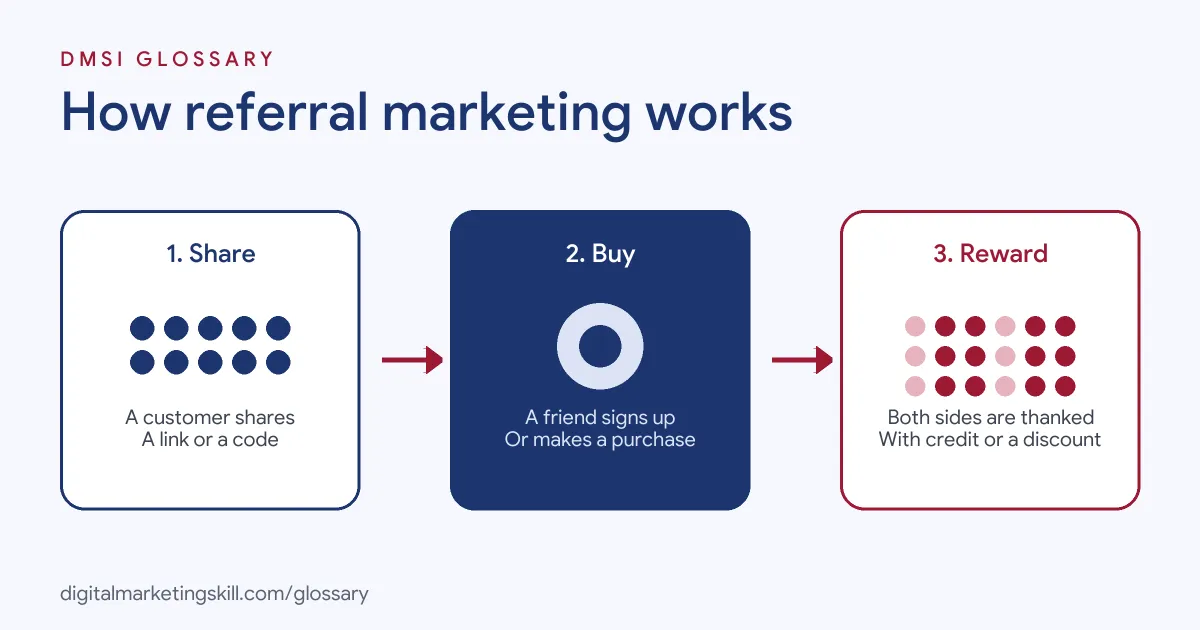
Most programmes follow three steps. First, an existing customer shares a link or code. Next, a friend uses it to sign up or buy. Finally, the business tracks the referral and pays out the reward once the friend completes the agreed action.
The Reward
The reward is the reason many people share. It can be one-sided, where only the referrer gains, or two-sided, where the friend gains too. For instance, in the bank study by Schmitt, Skiera and Van den Bulte, each referrer received “a reward of 25 euros in the form of a voucher.” The researchers noted that this was a standard reward among German banks.
Tracking Referrals
Next, you need a reliable way to link each new customer to the person who sent them. Most businesses use unique links, codes or referral software. As a result, you can see how many friends each customer brings in, and you can check whether those friends stay and spend.
Why It Works
Referrals work because they borrow trust. McKinsey research found that word of mouth “is the primary factor behind 20 to 50 percent of all purchasing decisions.” The same research says its influence is strongest for first-time purchases and for relatively expensive products. In other words, a friend’s tip matters most when the buyer feels unsure.
Referral Marketing Examples
Here are three made-up examples of referral programmes in different businesses:
- Subscription box (example): Each customer gets a link that gives friends 20% off their first box. When a friend orders, the referrer gets one free box.
- Software company (example): A project tool gives both users an extra month free when a referred team upgrades to a paid plan.
- Local gym (example): Members get a free personal training session for every friend who joins and stays for a month.
In each case, the reward suits the product, and it pays out only after the new customer takes real action.
What the Research Shows
The German bank study gives useful numbers. It tracked about 10,000 customers and found that “the average value of a referred customer is at least 16% higher” than that of a customer who was not referred. Referred customers were also about 22% less likely to leave in their first 21 months. Their margins started higher, although the authors estimated that this gap disappeared after about 29 months. So the main long-term gain came from customers who stayed.
Referral Marketing vs Affiliate Marketing vs Word of Mouth
These three ideas overlap, so here is a quick comparison:
| Approach | Who recommends | How they are rewarded |
|---|---|---|
| Referral marketing | Existing customers, sharing with people they know | Discounts, credit, vouchers or gifts |
| Affiliate marketing | Publishers, creators or partners, often to a wide audience | A commission on each tracked sale |
| Organic word of mouth | Anyone who likes the product | Usually no reward at all |
In short, referral programmes reward customers, while affiliate programmes pay partners. For the partner side, see our glossary entry on affiliate marketing.
How to Set Up a Referral Programme
- Know what a customer is worth. Work out your average customer lifetime value, so you know how much you can afford to give away.
- Choose the reward. Decide whether it is one-sided or two-sided, and pick something that suits your product.
- Set the trigger. Pay out only when the friend buys, subscribes or stays for a set period, not just when they click.
- Pick a tracking method. Use unique links or codes, or a referral tool that connects to your shop or CRM.
- Make sharing easy. Add the link to the account page, the order confirmation and a follow-up email.
- Write clear terms. Explain who qualifies, when rewards arrive and what counts as abuse.
- Measure and adjust. Track the number of referrals, the cost per new customer and how long referred customers stay.
Here is a made-up example with simple numbers. A shop gives £10 to the referrer and £10 off for the friend, so each referred customer costs £20 in rewards. If paid ads cost the shop £35 per new customer, referrals are cheaper. However, the shop should also check that referred customers order again, because that is where the real value lies.
Best Practices for Referral Marketing
- Ask at happy moments. For example, invite customers to share right after a good review or a successful delivery.
- Keep it simple. One clear reward beats a complex points table.
- Disclose incentives. The FTC says that when you give people something in return, they “should disclose what they received from you.”
- Reward honest reviews, not only good ones. According to the FTC, “You can’t condition an incentive – for example, a discount – on a review being positive.”
- Judge it on retention. A referral that leaves after one order is worth far less than one who stays.
Common Mistakes to Avoid
Many referral programmes fail for simple reasons. First, the reward is too small or too hard to claim. Second, the programme is hidden, so customers never see it. Third, rewards pay out on sign-up, which invites fake accounts. Some businesses also forget to test the links, so referrals go untracked. Finally, many ask for referrals before the customer has had a good experience, which rarely works.
Where You’ll Use Referral Marketing at Work
Referral programmes appear in growth, lifecycle and retention roles. For example, real remote job listings ask for:
- “Hands-on experience with performance marketing channels, SEO, and referral programs.” (Growth Marketing Lead, Brazil).
- “Experience with referral programs, partner distribution, or App Store optimization.” (Growth Product Leader).
- Someone to “Build successful customer advocacy and loyalty via storytelling, testimonials and referral programs.” (Lifecycle Marketing Manager).
So if you want to work as a Growth Marketer or Digital Marketing Manager, employers will expect you to plan a programme, track it and show what each referral is worth.
Learn It in the Full Stack Programme
Referral marketing draws on email, social, analytics and customer data, so it fits the Full Stack (all four tracks) programme. You take all ten courses and build one portfolio project from each track. Roles it prepares you for include Digital Marketing Manager, Growth Marketer, Freelance Digital Marketer and Agency Owner. You also get unlimited 1-on-1 mentoring and a U.S. Project Internship from day one.
Next, read our guide to customer loyalty programmes, which pair well with referral rewards.
Frequently Asked Questions
What is referral marketing in simple terms?
It is getting customers to recommend you to friends, usually with a reward. You give them a link or code, and you thank them when a friend buys.
Is referral marketing the same as word of mouth?
Not quite. Word of mouth happens on its own. A referral programme adds structure, tracking and usually a reward.
What is a good referral reward?
It depends on what a customer is worth to you. Many businesses use a two-sided reward, such as a discount for the friend and credit for the referrer.
Do I need to disclose referral rewards?
In the US, the FTC says people should disclose what they received when they endorse a product. Check the rules in each country where you sell.
How do you measure referral marketing?
Track referrals, new customers, the cost of rewards and how long referred customers stay. Then compare that cost with other channels.
Sources: Schmitt, Skiera and Van den Bulte: Referral Programs and Customer Value; McKinsey: A new way to measure word-of-mouth marketing; FTC: Endorsement Guides, What People Are Asking; remote job listings on Himalayas.