

Most people who want to get freelance clients make the same error. They try every tactic at once instead of picking the one method that fits where their business is right now. This guide breaks down three channels that work, how to measure them, and one simple rule for choosing where to spend your time next.
Key Takeaways
- Freelance marketplaces host more than 18 million freelancers across over 180 countries. To win there, use a narrow, provable niche, not a broad profile (Upwork data via Demandsage).
- 62% of freelancers get projects from referrals and other passive sources. Referral leads also move faster through the buying process than cold outreach (freelancermap industry study).
- Among freelancers earning more than $100,000 a year, 84% got most of their work through verbal referrals. They did not rely mainly on marketplaces or ads (Harvard Business Review survey, cited by freelancermap).
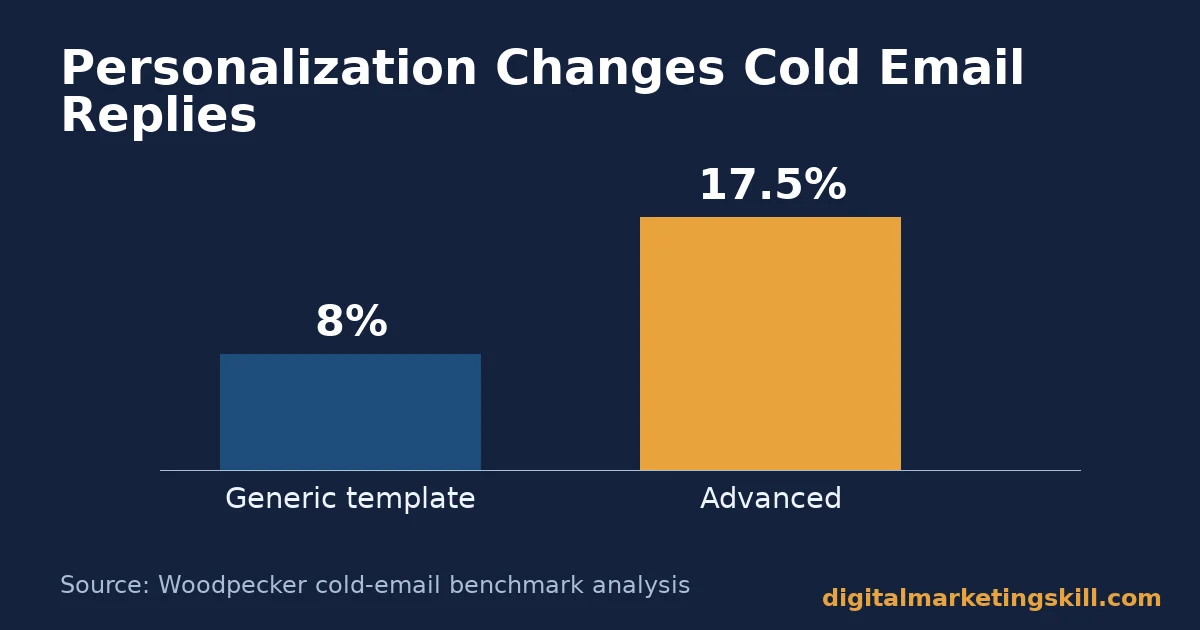
- The average cold email reply rate is 3.43%. Advanced, research-backed personalization lifts replies to roughly 17-18%, against 7-9% for generic templates (Woodpecker analysis of outbound email data).
- One DMSI student, Olajire Jacob, went from charging $500 per email marketing setup to scaling his freelance services to $5,000 a month. He did this by sharpening his niche and outreach (published student story, dollar figures only).
In this guide
- The Real Problem With Trying To Get Freelance Clients
- How Freelancers Actually Win New Clients
- How The Three Main Client Channels Differ
- How To Lead With Each Channel
- How To Measure Which Channel Is Actually Working
- The One Decision Rule: Match Channel Investment To Deal Size
- A Real Case: Specializing Before Scaling
- Common Mistakes That Make It Harder To Get Freelance Clients
- Frequently Asked Questions About How To Get Freelance Clients
- How To Get Freelance Clients Starting Today
The Real Problem With Trying To Get Freelance Clients
Ask ten freelancers how to get freelance clients. You will hear ten answers. Post more on LinkedIn. Join every marketplace. Send cold emails. Network harder. None of that advice is wrong. But used all at once, it produces the opposite of focus.
A new freelancer with four hours a week cannot run a marketplace profile, a referral program, a content calendar, and a cold-email sequence at the same time. Something has to come first.
The real gap is not a shortage of tactics. It is a missing filter for which tactic fits which stage. A freelancer with zero finished projects needs proof fast. That points toward marketplaces. A freelancer with ten happy clients already has proof sitting unused. That points toward referrals. A freelancer selling a complex service needs to reach people who are not yet looking. That points toward content.
There is also a sequencing problem that gets in the way of trying to get freelance clients. Many freelancers try to build a referral engine before they have a single client to refer them. Others try outreach before their portfolio can back up the claim they are making.
Each channel in this guide borrows credibility from the step before it. Marketplaces borrow it from reviews you do not have yet. Referrals borrow it from past delivery. Content borrows it from a track record you can point to. Skipping that earlier step is the most common reason a channel “doesn’t work,” when timing is the real issue.
Two ground rules before the detail. First, this is an informed framework built from current platform and survey data. It is not a settled formula that works the same way for every service or market. Second, nothing here promises a specific income. Results depend on skill, niche demand, and effort. See the Institute’s earnings disclaimer for how to read any income figures in this guide.
How Freelancers Actually Win New Clients
Three steps sit underneath every tactic for getting freelance clients. Get seen by the right person. Prove you can solve their specific problem. Make saying yes feel low-risk.
Marketplaces solve the first step through search and algorithmic matching. Referrals solve the second step by borrowing someone else’s trust. Content and direct outreach work on both steps at once, slowly, by publishing proof before anyone asks for it.
Most freelancers skip straight to tactics. They never name which of the three steps is actually broken for them. If people open your proposals but never reply, the problem is proof, not visibility. If nobody opens your proposals at all, the problem is visibility, not proof. Diagnosing the broken step first saves months spent pulling the wrong lever.
Try this test. List your last ten attempts to win work, on any channel. Label each one “never seen,” “seen but not trusted,” or “trusted but too slow or too costly.” The label that shows up most often tells you which mechanism needs attention first. Knowing your target audience in detail makes all three steps easier to fix.
This diagnostic matters because freelancers who skip it tend to repeat the same channel long after it has stopped working. Running the test every month, not just once, keeps your effort to get freelance clients pointed at whichever mechanism is weakest right now, instead of whichever channel feels most familiar.
How The Three Main Client Channels Differ
Marketplaces, referrals, and content-led outreach are not interchangeable. Each one fits a different stage of growth. Treating them as equally good at every stage wastes effort.
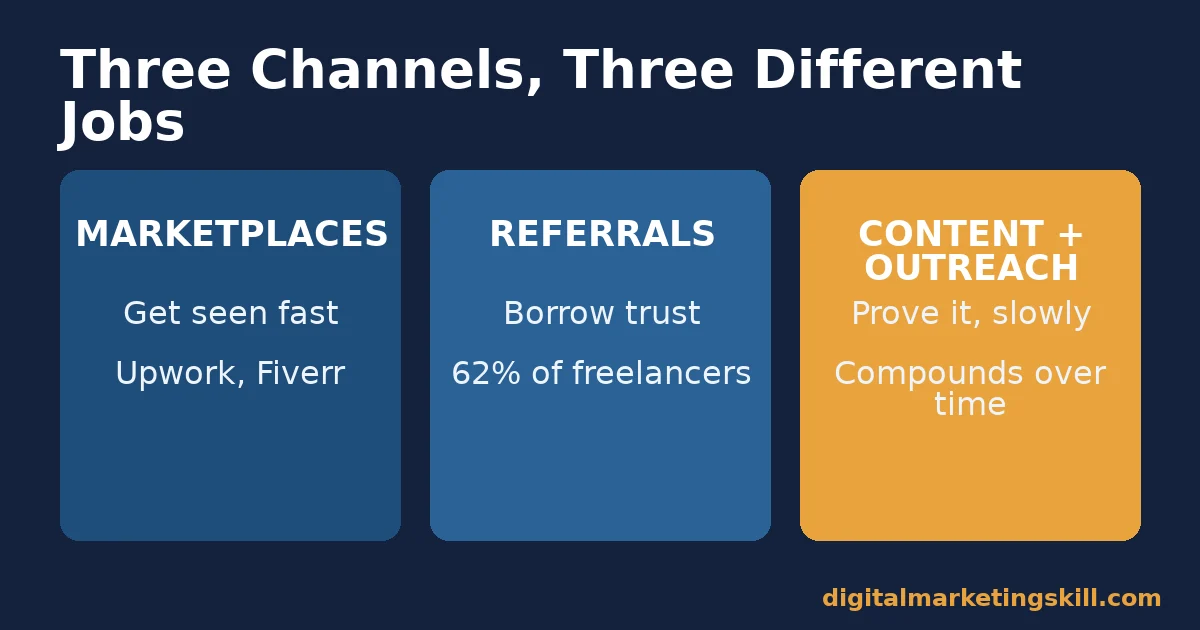
Marketplaces: Built For Fast First Jobs
Platforms such as Upwork, Fiverr, and Freelancer match supply and demand instantly. Upwork alone lists over 18 million registered freelancers and roughly 784,000 active clients trading work in a single quarter, per Demandsage’s Upwork usage data.
That crowd is exactly why marketplaces reward speed, not premium positioning. You are one result among thousands. The platform favors freelancers who prove a narrow claim fast, such as “I build Shopify checkout flows,” over a broad one, such as “I do digital marketing.”
Referrals: Built For High-Trust, High-Value Work
Referrals skip the “get seen” problem almost entirely. Someone the client already trusts has vouched for you. That is why referral and word-of-mouth sources produce work for 62% of freelancers surveyed in freelancermap’s referral research. Referred leads also move faster through a sales conversation than outreach from a stranger.
Referrals fit larger, longer, more relationship-dependent work best. That is also why the highest earners rely on them the most.
Content And Outreach: Built For Compounding Reach
Cold email, social content, and direct pitches reach people who are not searching a marketplace and do not know anyone who could refer them. This channel pays off slowly, but it compounds. A well-researched cold email still averages only a 3.43% reply rate. Advanced personalization lifts that closer to 17-18%, per Woodpecker’s analysis of outbound campaign data. Published content, meanwhile, keeps working long after you stop actively promoting it.
How To Lead With Each Channel
Knowing what each channel is built for only matters if you change how you show up on it. Here is the specific shift for each one.
Marketplaces: Lead With A Narrow, Provable Niche
Choosing a specific niche beats a generic title almost every time. Try “e-commerce email flow specialist” instead of “digital marketer.” A narrow claim is faster to verify, and that is the exact currency marketplaces run on.
Pair your niche with two or three portfolio pieces that show the outcome you claim, not just the deliverable. Keep that portfolio current, so the newest work is what a prospect sees first.
Referrals: Lead With A Specific Ask, Not A Vague One
“Let me know if you hear of anyone who needs help” rarely produces a referral. It gives the listener nothing concrete to repeat. A specific ask works better. Try: “Do you know any ecommerce founders whose email list has gone quiet?” That gives your client an exact shape to scan their network for.
Make the ask right after a project lands well, when satisfaction peaks. Then follow up afterward, whether or not the referral converts. That follow-up is what keeps a client willing to refer you again. Sharing client wins through steady content planning, with permission, also keeps your name visible to the people most likely to refer you.
Content And Outreach: Lead With Proof, Not Promises
Generic cold emails and generic posts fail for the same reason. They promise value instead of showing it. A cold email that names a prospect’s real gap beats a templated pitch, because it proves you did the research first. For example: “Your blog hasn’t published in four months, and here’s the traffic that’s likely costing you.”
The same logic applies to content. A breakdown of one real, specific problem beats a generic “5 tips” post, because it demonstrates the thinking a client would pay for.
How To Measure Which Channel Is Actually Working
Three numbers show whether a channel deserves more of your time. Track them weekly.
Reply rate. This is the share of outreach messages, whether cold emails, marketplace proposals, or pitches, that get any response. Below 5% on cold email means the message or targeting needs work before you send more volume.
Close rate. This is the share of real conversations that turn into paid work. A low reply rate paired with a high close rate means your targeting is too narrow but your pitch is strong. The reverse pattern means the opposite is true.
Repeat-client rate. This is the share of your revenue this quarter that comes from past clients. A rising repeat-client rate eventually lets you spend less time on cold acquisition, since past clients feed your referrals.
Track all three numbers separately for each channel. A channel that looks slow by lead count can still be your best channel, if its close rate makes up the difference.
Check a fourth number monthly: average project value by channel. Freelancers often find that a slower channel, such as referrals, brings higher-value work than a faster one, such as marketplaces. If that pattern holds for two or three months straight, shift more hours toward the higher-value channel, even if it looks slower on a simple lead count.
Write these four numbers down somewhere you will actually check weekly, even a simple spreadsheet. Freelancers who measure channels this way tend to get freelance clients more predictably over time, because they stop guessing which tactic is working and start acting on real numbers instead.
The One Decision Rule: Match Channel Investment To Deal Size
If you take only one rule from this guide, make it this one. Spend marketplace time on small, fast, provable jobs. Spend referral-asking time on your best past clients. Spend content and cold-outreach time on deals too large or too unfamiliar for the other two channels to reach alone.
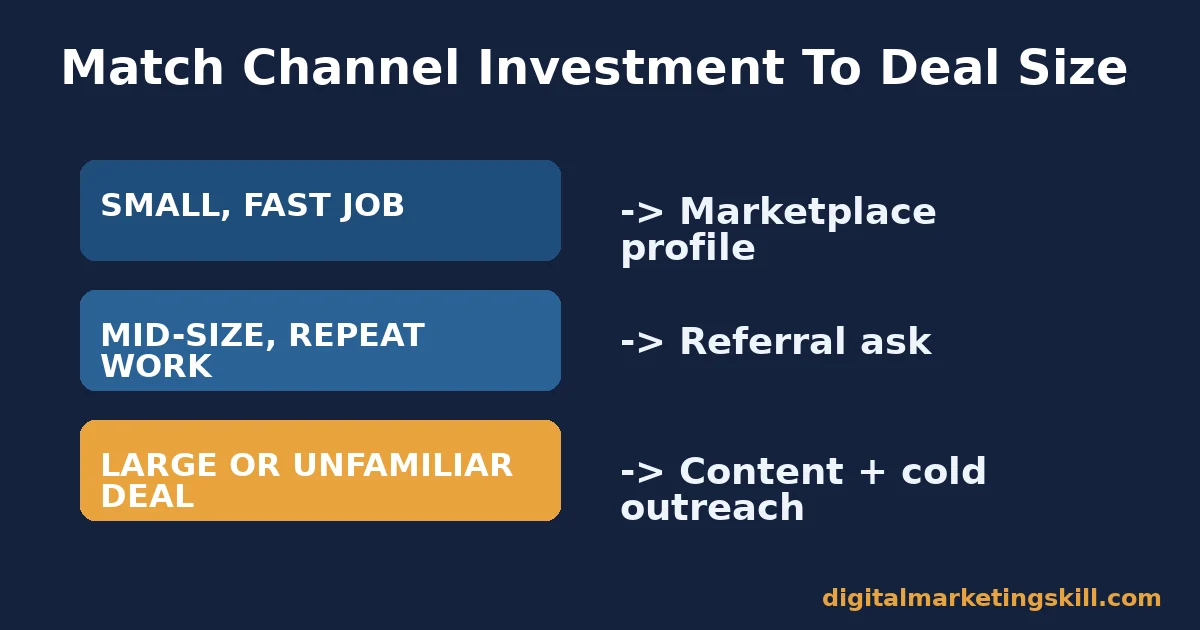
Here is an illustrative example with invented numbers, to show the logic. Picture a freelance copywriter who wants $4,000 a month in new business. If marketplace jobs average $150 each, hitting that target through marketplaces alone would need roughly 27 closed jobs a month. That is not realistic alongside delivery work.
Splitting the target instead across one $1,500 referral project, one $1,000 content-sourced retainer client, and smaller marketplace jobs for the rest is a far more workable mix. It matches channel to deal size, instead of forcing one channel to do everything.
The same rule works in reverse. If marketplace jobs fill every hour but barely cover costs, the fix is not more marketplace clients. Redirect new-business hours toward referrals and outreach instead, where deal sizes run larger, and let marketplace volume shrink as higher-value work replaces it.
A Real Case: Specializing Before Scaling
Olajire Jacob, a graduate of the Digital Marketing Skill Institute’s program, started out charging $500 to set up email marketing automation flows for clients in the US, UK, and Canada. Rather than staying generalist, he narrowed into one repeatable service. He used that focus to grow his client base, eventually scaling his freelance income to $5,000 a month, as published in the Institute’s own student reviews.
His case shows the same pattern this guide argues for. A narrow, provable claim made it easier for new clients to say yes fast. Consistent delivery then turned early clients into the referral base that sustained later growth.
The lesson is not that email automation is the right niche for everyone. It is that a specific, well-delivered service gives every channel in this guide something concrete to work with, whether that channel is a marketplace profile, a referral conversation, or a cold pitch. Results like this depend on the person, the market, and the effort involved. They are not typical for every freelancer (see the earnings disclaimer above).
Common Mistakes That Make It Harder To Get Freelance Clients
Beyond picking the wrong channel for your stage, a few repeated mistakes slow down most freelancers, no matter which channel they use. Fixing these before adding a new channel usually does more to help you get freelance clients than any single new tactic would.
- Pitching a service instead of an outcome. “I write blog posts” describes a service. “I write blog posts that rank and bring in search traffic within 90 days” states an outcome a client can judge against their own goals.
- Treating every channel as equally urgent. Splitting limited weekly hours across five channels usually means none gets enough consistent effort to show results. The decision rule above exists to stop this spread.
- Letting the portfolio go stale. A portfolio showing only year-old work signals inactivity, even when you are busy. Refresh it after every project.
- Going quiet after a “no.” A client who declines now may not decline forever. A short, polite follow-up weeks or months later, especially tied to new work or a new case study, often reopens a closed conversation.
- Underpricing to win the first yes. A client won on price alone tends to attract more clients like them. It is usually better to narrow the service than to drop the price.
Frequently Asked Questions About How To Get Freelance Clients
How long does it take to get freelance clients as a complete beginner?
There is no fixed timeline. It depends on your niche, your existing network, and how much time you can spend on outreach each week. Marketplaces tend to produce a first paid job fastest, because buyer intent is already present. Referrals and content-led outreach usually take longer, but they tend to bring higher-value, more durable client relationships once they start working.
Do I need a website to get freelance clients?
No, a website is not required for your first clients, especially on marketplaces where your profile acts as your storefront. A simple portfolio on a free tool such as Canva, Behance, or a one-page site becomes more useful once you start pitching directly. It gives a prospect something concrete to review before replying.
Is it better to specialize in one niche or stay a generalist?
Specializing makes it easier to get freelance clients through every channel in this guide. A narrow claim is faster to verify on a marketplace. It is easier for a past client to describe in a referral. It is clearer to write a cold pitch around.
Staying a generalist can make sense early on, while you discover what work you enjoy and do best. Most freelancers still benefit from narrowing their focus once they have a handful of finished projects.
How many cold emails should I send before giving up on a lead?
One email rarely gets a response, even when well-targeted, given an average reply rate around 3.43% industry-wide. A short, polite follow-up after a few days, and sometimes a second one after that, is standard practice. It substantially improves total reply rates, as long as each follow-up adds something new rather than just repeating “just checking in.”
What is the biggest mistake freelancers make when asking for referrals?
The most common mistake is asking vaguely, such as “let me know if you hear of anyone.” A specific ask, naming the exact type of person or company you want, is far easier for a satisfied client to act on right away, instead of filing it away and forgetting it.
Can freelancers find clients anywhere in the world, or only locally?
Remote freelancing has made location far less of a limit than it used to be. Marketplaces, cold outreach, and content all work for freelancers anywhere in your country, and increasingly for clients in other countries too. Most of the channels in this guide work the same way, wherever you or your client are based.
What is the single fastest way to get freelance clients?
For most beginners, a sharp marketplace profile produces a first paying job the fastest, because buyer intent already exists on the platform. Speed and long-term value trade off here: a fast first marketplace job is rarely your biggest or best client.
Treat it as proof you can build on, then shift toward referrals and outreach as your portfolio grows. Freelancers who want to get freelance clients consistently, rather than just once, tend to combine a fast first channel with a slower, higher-value one from the start.
How To Get Freelance Clients Starting Today
Getting freelance clients is less about finding one perfect tactic. It is about matching the right channel to where your business actually is right now, then measuring what works before adding anything new.
If you want structured support building the skills behind all three channels, the Digital Marketing Skill Institute can help. That support covers positioning, portfolio work, outreach, and paid acquisition.
The Institute’s Master Diploma in Digital & AI Marketing is built around four AI-powered tracks and ten courses: AI-Powered Social Media Management and Advertising, AI-Powered Lead Generation and Email Automation, AI-Powered Google Specialist, and AI-Powered WordPress and SEO Specialist, with a Full Stack option for completing all four.
The program includes unlimited 1-on-1 coaching and mentoring, plus a U.S. Project Internship with a verified U.S. Work Reference Letter. It is dual US and UK accredited and recognised in more than 100 countries, 100% online, so you can build a freelance-ready skill set anywhere in your country or wherever you live.
Explore the full program on the Master Diploma page, browse more guides on the digital marketing blog, read more student reviews, or go straight to apply when you are ready. Learn more at digitalmarketingskill.com, and start wherever you are at digitalmarketingskill.com.
Every figure in this guide was checked against its original source before publication. Figures marked as illustrative are invented examples, not real results.
![9 Amazing Digital Marketing Skills to Make Money Online [With Proof]](https://digitalmarketingskill.com/wp-content/uploads/2019/07/9-Amazing-Digital-Marketing-Skills-to-Make-Money-Online-With-Proof-17.png)






