
A webinar funnel is a marketing process that uses a free online event to turn strangers into leads and then into customers. People register through a landing page, get reminder emails, watch the live session and then receive follow-up messages with an offer. It matters because a webinar lets you teach, build trust and answer questions at scale, which makes it one of the strongest ways to sell a course, service or software product.
Key Takeaways
- A typical funnel has five stages: promote, register, remind, present and follow up.
- Registration turns a visitor into a lead, because people share their name and email to join.
- Reminders matter. Zoom, for instance, can send reminder emails a week, a day or an hour before the event.
- Follow-up should differ for people who attended and people who missed it.
- Email rules apply. In the UK, you generally need specific consent before you send marketing emails to individuals.
What Is a Webinar Funnel?
A webinar is a live or recorded online presentation. On its own, it is just an event. A webinar funnel wraps that event in a system. First, it attracts the right people. Then it captures their details, gets them to show up and moves them towards a decision.
Think of it as a short sales journey that fits into a few days. A visitor sees an ad, signs up, gets reminders, watches the session and receives an offer. Each step has one job, and each one hands people to the next.
For example, a marketing school might run a free class called “How to land your first remote client”. The class teaches real skills. At the end, it invites viewers to book a call or apply for a programme. People who attend now know the school’s teaching style, so they are far warmer than someone who has only seen an ad.
How a Webinar Funnel Works
Every funnel follows the same simple flow. First, you invite people and get them to register. Next, you remind them and run the live session. Finally, you follow up with a clear next step.
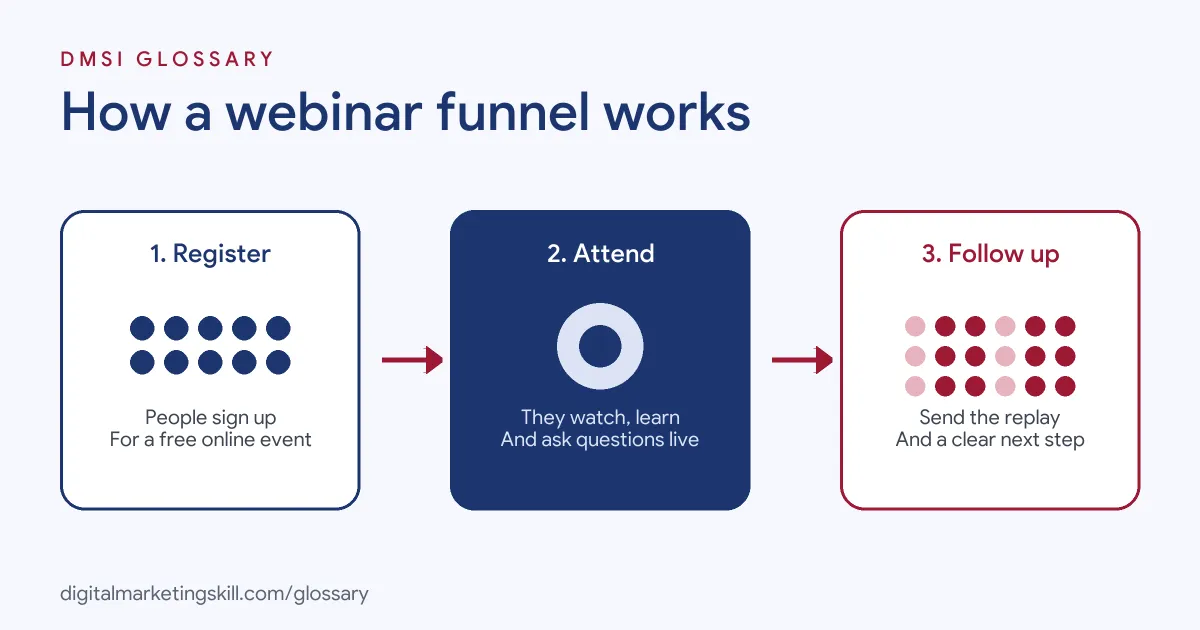
Promotion and Registration
You drive people to a registration page through ads, email, social posts or partners. The page explains what they will learn and asks for a few details. In Zoom, for example, people sign up through a “Registration URL”, and the confirmation email describes “the event your attendees signed up for”. You can also promote the event with in-ad forms. LinkedIn’s Lead Gen Forms, for instance, fill in contact details from the member’s profile.
Reminders
Many people register and forget. So reminders are part of the funnel, not an extra. According to a Zoom training guide, Zoom can send “a brief reminder email to all registrants 1 week, 1 day, and/or 1 hour prior to the event”. You can add your own emails or texts too, as long as people agreed to receive them.
The Live Session
The event itself should teach something useful and lead naturally to your offer. Interaction keeps people watching. Zoom lets you run single choice or multiple choice polls, and a Q&A panel where people can even ask questions without giving their name. Meanwhile, panelists can use their microphone and webcam, while attendees cannot, which keeps the session tidy.
Follow-Up
After the session, you send two kinds of message. Attendees get a thank-you, the replay and the offer. Absentees get the replay and a reason to watch it. In Zoom, both follow-up emails “default to sending one day after the event”, and you can edit them with your own text.
Webinar Funnel Examples
Here are three made-up examples of webinar funnels in different businesses:
- Online course: A design school runs a free class on building a portfolio. At the end, it offers a short consultation. Attendees who stay to the end get a bonus guide by email.
- B2B software: A software company hosts a monthly product demo. LinkedIn ads with a Lead Gen Form fill the seats. The sales team then calls attendees who asked a question in the Q&A.
- Coaching: A coach runs an evergreen recorded session that plays at set times. People who miss it get an email with the replay, plus a deadline to book a call.
In each case, the event gives real value first. The offer then feels like a natural next step rather than a hard sell.
Webinar Funnel Stages at a Glance
Here is what each stage does and what to measure:
| Stage | Goal | What to measure |
|---|---|---|
| Promote | Bring the right people to the page | Clicks and cost per click |
| Register | Turn visitors into leads | Registration rate and cost per registrant |
| Remind | Get registrants to show up | Share of registrants who attend |
| Present | Teach, build trust and make the offer | Watch time, poll answers and questions |
| Follow up | Convert attendees and recover absentees | Replay views, calls booked and sales |
As a result, you can see exactly where people drop out. For instance, a strong registration rate with low attendance points to weak reminders.
How to Build a Webinar Funnel
Follow these steps to build your first one:
- Pick one problem to solve. Choose a topic your ideal customer really wants help with.
- Plan the offer first. Decide what you will invite people to do at the end, then shape the content around it.
- Build the registration page. Keep it short: a clear title, three things they will learn, a date and a simple form.
- Set up the emails. Write a confirmation, two or three reminders and separate follow-ups for attendees and absentees.
- Promote the event. Use your email list, social posts and paid ads that send people to the page.
- Run an engaging session. Use polls and Q&A, and keep the offer clear and honest.
- Follow up quickly. Send the replay and offer while the session is still fresh.
After that, review the numbers for each stage. Then fix the weakest one before your next event.
Best Practices for a Webinar Funnel
- Teach first, sell second. People should leave with something useful even if they never buy.
- Get consent for follow-ups. The UK ICO says you “must not send marketing emails or texts to individuals without specific consent”, apart from a limited exception for existing customers.
- Write for absentees too. Many registrants miss the live event, so treat the replay email as a second chance.
- Keep the funnel connected. Send registrations straight into your email tool or CRM.
- Test one change at a time. For instance, try a new title on the registration page before you change the emails.
Common Mistakes to Avoid
A common mistake is spending all the effort on the slides and none on the funnel. Without reminders, many registrants never show up. Another mistake is sending the same follow-up to everyone, even though attendees and absentees need different messages. Some hosts also hide the offer until the last minute, then rush it. Finally, many teams add people to marketing emails without clear consent. The ICO notes that the “soft opt-in” exception does not cover new contacts or bought-in lists.
Where You’ll Use Webinar Funnels at Work
Webinars appear in many growth and demand generation roles. For example, remote job listings mention:
- “Experience conceptualizing, managing, and executing impactful webinars or virtual events” (Growth and Conversion Specialist, Middle-of-Funnel Marketer).
- Projects that “may include coaching and course launches, webinars, book campaigns, sales funnels, email campaigns” (Senior Marketing Project Manager).
- Running “blogs, webinars, podcast, and other top of funnel programs” that “eventually pull buyers into our sales funnels” (Head of Growth and Online Sales).
So if you want to work as a Lead Generation Specialist, Email Marketing Specialist or Marketing Automation Specialist, expect to build registration pages, set up email sequences and report on each stage of the funnel.
Learn It in the Lead Generation Track
You can learn to plan and automate a webinar funnel in the AI-Powered Lead Generation and Email Automation track. You build a lead magnet and an automated email sequence that converts, which are the core parts of any event funnel. In addition, you get unlimited 1-on-1 mentoring and a U.S. Project Internship from day one.
To go further, read our guides to sales funnel stages and lead conversion strategies. You can also learn how an email sequence keeps leads moving.
Frequently Asked Questions
What is a webinar funnel in simple terms?
It is a process that uses a free online event to collect leads, build trust and then invite people to buy or book a call.
What are the stages of a webinar funnel?
Most funnels have five: promote, register, remind, present and follow up. Each stage hands people to the next one.
How many reminder emails should I send?
Two or three is common. Zoom, for example, can send reminders a week, a day and an hour before the event.
What should I send people who missed the webinar?
Send the replay, a short summary of what they missed and the same offer, ideally with a clear deadline.
Do I need consent to email registrants?
For marketing emails, usually yes. In the UK, the ICO says you need specific consent from individuals, with a limited exception for existing customers.
Sources: University of West Florida: Zoom Webinars training reference guide; UK ICO: Electronic mail marketing; LinkedIn Marketing Solutions Help: Lead Gen Forms; remote job listings on Himalayas.