
Lead nurturing is the process of building a relationship with potential customers who are not ready to buy yet, by sending them useful, well-timed messages until they are. It turns a name on a list into a person who trusts you enough to talk to sales or make a purchase. It matters because many new leads are not ready on day one, so without nurturing, the effort you spent to win them is often wasted.
Key Takeaways
- Lead nurturing starts after someone gives you their details, for example by downloading a guide or joining a list.
- Adobe describes it as building relationships with buyers “at every stage of the sales funnel”.
- Most nurturing runs on automation. A trigger starts a sequence, and time delays space out the messages.
- Good programmes segment leads, score them, and hand the ready ones to sales.
- In the UK, you need specific consent before you send marketing emails to individuals, with a narrow exception for existing customers.
What Is Lead Nurturing?
Think of lead nurturing as the bridge between “interested” and “ready to buy”. A person finds you, signs up for something free, and then goes quiet. Nurturing keeps the conversation going. You answer their questions, show proof and remind them why your offer fits their problem.
Adobe for Business defines it as “the process of developing and reinforcing relationships with buyers at every stage of the sales funnel.” In other words, it is not one email. Instead, it is a planned series of touches across email, ads, content and sometimes calls.
It also changes how you judge marketing. Rather than chasing the biggest list, you focus on how many leads move forward. That’s why nurturing sits right after a lead magnet in most funnels. The magnet wins the contact, and nurturing earns the sale.
How Lead Nurturing Works
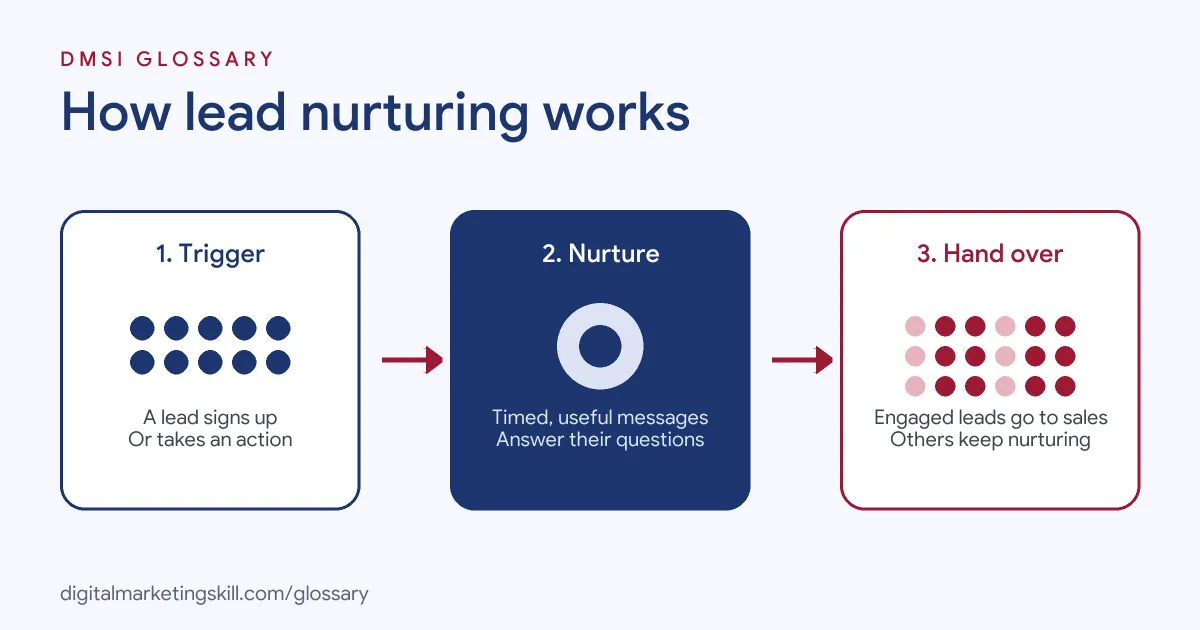
Most programmes follow the same three-part pattern. First, a lead takes an action that starts a sequence. Next, they receive a series of messages, spaced out over days or weeks. Finally, their behaviour decides what happens next, such as a sales call, a different path, or a pause.
Triggers and Sequences
Email tools call these sequences “flows”, “automations” or “drip campaigns”. Klaviyo’s help centre explains that “a flow is a sequence of automated actions (e.g., sending messages) triggered by a behavior or event.” A trigger might be joining a list, placing an order, or reaching a date. Then time delays decide how long to wait between each step.
Flows can also branch. For example, Klaviyo lets you split a flow into several paths based on conditions you set. So a lead who clicks a pricing link can get a different message from one who ignored the last three emails.
Segmenting and Scoring Leads
Not every lead needs the same message. Adobe suggests a scoring model built on four areas: fit (such as job role or company size), interest (pages viewed and content opened), behaviour (signs that they are close to buying) and buying stage. Each action adds points. Once a lead passes an agreed score, the system flags them for sales.
For this to work, sales and marketing must agree on what “ready” means. Adobe recommends writing that agreement down, including how and when marketing hands a lead over.
The Handover to Sales
The last step is the handover. In many teams, a score change automatically creates a task in the CRM for a salesperson. Leads who are not ready yet stay in nurturing. Meanwhile, leads who go cold move to a re-engagement path.
Lead Nurturing Examples
Here are three made-up examples that show how lead nurturing looks in practice:
- Example: online course provider. Someone downloads a free career guide. Over two weeks, they get a welcome email, a student story, a short video lesson and an invitation to book a call. Anyone who books leaves the sequence.
- Example: software company. A visitor signs up for a trial. If they use a key feature, they get tips on the next feature. If they don’t log in for five days, they get a short “need help?” email from the support team.
- Example: local accountancy firm. A small business owner fills in a tax checklist form. They receive a monthly email with deadline reminders and one practical tip. When they reply, the firm calls them.
In each case, the content answers a real question at the right moment. As a result, the lead sees value before anyone asks them to pay.
Types of Lead Nurturing Campaigns
Adobe groups nurture campaigns into four common types. You will often run several of them at once:
| Campaign type | Who it is for | What it does |
|---|---|---|
| Welcome or educational series | New leads after their first sign-up | Introduces the brand and gives immediate value |
| Product or feature nurture | Leads who showed interest in one topic | Focuses on the solution that matches that interest |
| Re-engagement | Leads who have gone quiet | Tries to revive interest, or cleans them off the list |
| Accelerator or sales-ready | Leads with strong buying signals | Moves them quickly to a sales conversation |
Klaviyo adds that a welcome series “introduces subscribers to your brand and converts them into first-time customers.” So if you only build one flow, build that one first.
How to Set Up Lead Nurturing
You can build a simple programme in most email platforms in a day. These steps keep it focused:
- Define a qualified lead. Agree with sales on what makes a lead ready, such as a booked demo or a set score.
- Map your buyer’s questions. List what people ask at each stage, from “what is this?” to “why you?”.
- Segment your list. Start with buying stage plus one key detail, such as industry or the lead magnet they chose.
- Write the sequence. Plan four to six messages. Each one should answer one question and include one clear next step.
- Set triggers and delays. Choose what starts the flow and how long to wait between messages.
- Add exit rules. Remove people who buy or book a call, so they don’t get the wrong message.
- Test and improve. Adobe suggests testing how often you send, what you send and when. Then refine the path and content.
Before you launch, clean your list. Adobe recommends removing duplicates and purging inactive or junk contacts, because bad data skews your results.
How to Measure Lead Nurturing
Opens and clicks show interest, but they don’t prove the programme works. Instead, track how many nurtured leads reach the next stage, such as a booked call or a first purchase. Compare that with leads who did not go through the sequence. Also watch unsubscribes and spam complaints. If either rises after a certain email, rewrite or remove it.
Best Practices for Lead Nurturing
- Lead with help, not offers. Early messages should teach or solve something. Save the hard sell for leads who show buying signals.
- Use more than one channel. Adobe describes nurturing as cross-channel. For instance, pair emails with retargeting ads that show the same message.
- Personalise with what you know. Use the lead’s chosen topic or the page they visited, not just their first name.
- Keep the consent clean. The UK’s ICO says “you must not send marketing emails or texts to individuals without specific consent,” apart from the soft opt-in for existing customers.
- Respect opt-outs. The ICO expects you to keep a “do not contact” list and screen every campaign against it.
Common Lead Nurturing Mistakes
Many beginners send the same sequence to everyone, regardless of what each person signed up for. Others push for a sale in the first email. Some forget exit rules, so a customer who just paid gets a discount offer the next day. Another common error is setting the flow live and never checking it again. Finally, teams often skip the sales agreement, so good leads sit untouched while sales chase cold ones.
Where You’ll Use Lead Nurturing at Work
Nurturing shows up in marketing, sales and automation roles. For example, real remote job listings ask candidates to:
- “Support lead generation and lead nurturing initiatives aligned with sales priorities” (Sales and Marketing Coordinator).
- Bring experience “developing lead nurture, lifecycle, CRM, email, or marketing automation programs” (Lifecycle Marketing Manager).
- “Create and execute email marketing campaigns, newsletters and nurture journeys through HubSpot” (Digital Events and Social Media Executive).
So whether you aim to be an Email Marketing Specialist, a Marketing Automation Specialist or a Lead Generation Specialist, employers will expect you to plan, build and report on nurture sequences.
Learn It in the Lead Generation Track
You can learn to plan and build lead nurturing in the AI-Powered Lead Generation and Email Automation track. There, you build a lead magnet and an automated email sequence that converts, so you finish with a working example to show an employer. You also join a U.S. Project Internship from day one, with unlimited 1-on-1 mentoring.
Want to see how the automation side fits together? Read our guide to building an email automation workflow.
Frequently Asked Questions
What is lead nurturing in simple terms?
It means staying in touch with people who showed interest but are not ready to buy, by sending them helpful messages until they are.
What is the difference between lead generation and lead nurturing?
Lead generation wins a new contact, for example through a form or a free guide. Lead nurturing is what you do afterwards to build trust and move that contact towards a sale.
How long should a nurture sequence be?
There is no fixed rule. Many teams start with four to six messages, then add or remove steps based on how leads respond.
Is lead nurturing only done by email?
No. Email is the most common channel, but nurturing can also use retargeting ads, text messages, content and sales calls.
Do I need consent to nurture leads by email?
In the UK, yes. The ICO says you need specific consent to send marketing emails to individuals. The soft opt-in exception covers only existing customers who bought a similar product from you.
Sources: Adobe for Business: Lead nurturing; Klaviyo Help Center: About flows; ICO: Electronic mail marketing; remote job listings on Himalayas.