
The bottom of funnel (BOFU) is the final stage of the marketing funnel, where people are ready to choose a supplier and make a purchase. At this point, your job is to remove doubt and make the next step as easy as possible. It matters because this is where interest finally turns into revenue, so small improvements here have a direct effect on sales.
Key Takeaways
- BOFU is the decision stage. People know their options and are choosing between them.
- Typical content includes demos, free trials, comparison pages, case studies, pricing pages and consultations.
- The main goal is a conversion, such as a sale, a booked call or a signed contract.
- Proof, a clear offer and low friction matter more than extra information.
- You measure it with conversions, conversion rate and cost per sale, so tracking must be set up properly.
What Is the Bottom of Funnel?
Picture a funnel that is wide at the top and narrow at the bottom. Many people discover you at the top. In the middle, a smaller group researches and compares. At the bottom, the people who remain are close to a decision.
For example, someone has read your guides, joined a webinar and visited your pricing page twice. They are no longer asking “What is this?” Instead, they are asking “Is this the right choice for me, and is now the right time?” That is the bottom of the funnel.
In other words, the job here is reassurance. People need to trust that your offer will work, that the price is fair and that buying is simple. If you want the full picture first, read about the middle of funnel, which comes just before this stage.
How the Bottom of Funnel Works
The final stage has three jobs. First, it helps people make a final choice. Next, it removes the doubts that stop them. Finally, it makes the action itself quick and easy.
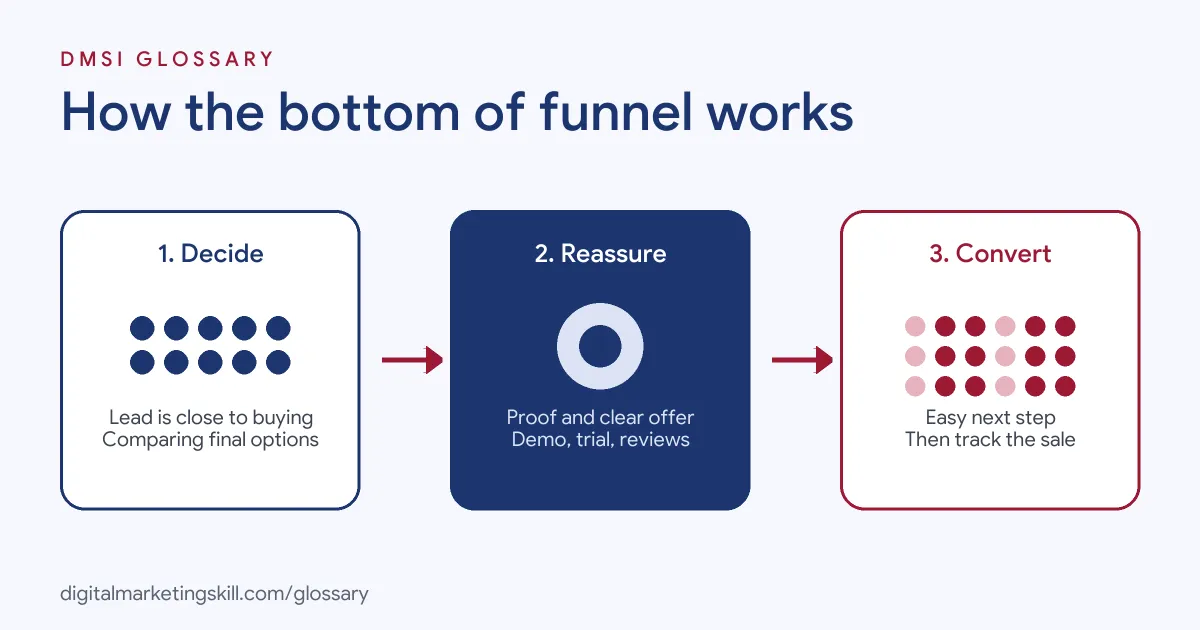
The Final Choice
Google’s research on the “messy middle” shows that people loop between exploring and evaluating before they buy. By the bottom stage, they are mostly evaluating. Google advises brands to “close the gap between trigger and purchase”, so shoppers have fewer chances to drift to a rival.
Remove Doubt
Several of the biases Google describes are strongest here. Social proof, such as reviews, carries real weight. Similarly, the “power of now” matters: “the longer you have to wait for a product, the weaker the proposition becomes.” So fast delivery, quick onboarding or an instant trial can tip a decision. The “power of free”, such as a free extra, can also motivate a purchase.
Hand Over to Sales
For many businesses, a person closes the deal. HubSpot’s lifecycle stages show this step clearly. A sales qualified lead is one “that your sales team has qualified as a potential customer.” Then it becomes an opportunity, and finally a customer with “at least one closed deal.”
Bottom of Funnel Examples
Here are three concrete ways businesses work the final stage:
- Software company: A scheduling app offers a free trial with no card required. Then it sends trial users a short email series with set-up tips and a customer story from their industry.
- Online course: A training school offers a free one-to-one call. During the call, an adviser answers questions about time, workload and outcomes, then explains how to enrol.
- Online shop: A furniture brand shows reviews, delivery times and a clear returns policy on every product page. As a result, shoppers have fewer reasons to leave the checkout.
In each case, the business answers the last questions before they become reasons to wait.
Bottom of Funnel Content and Offers
Different offers suit different businesses. This table shows common options:
| Offer or content | What it does | Works well for |
|---|---|---|
| Free trial or demo | Lets people try the product before paying | Software and apps |
| Consultation or discovery call | Answers personal questions and builds trust | Services, courses, high-value purchases |
| Comparison and “alternative to” pages | Shows how you differ from named options | Crowded markets where buyers compare |
| Case studies and reviews | Provides proof from people like the buyer | Almost every business |
| Clear pricing and guarantees | Removes uncertainty about cost and risk | Online shops and subscriptions |
Google Ads reflects this stage in its Sales objective, which aims to “drive sales or conversions online, in app, by phone, or in store.”
How to Improve the Bottom of Funnel
Use these steps to tighten your final stage:
- Set up conversion tracking. Google Ads can track purchases, sign-ups, phone calls and even offline sales. Without this, you cannot see what works.
- Map the last few steps. List every click between “I’m interested” and “I’ve paid”.
- Find the drop-off. Use a funnel report, such as funnel exploration in Google Analytics, to see where people leave.
- List the final objections. Ask sales and support what stops people buying.
- Answer each objection on the page. Add proof, a guarantee, a clear price or a short FAQ where the doubt appears.
- Cut friction. Remove form fields, extra clicks and surprise costs.
- Follow up. Send reminders to people who started but did not finish, and retarget recent visitors.
How to Measure the Bottom of Funnel
At this stage, the numbers are close to money, so keep them simple. Track three things:
- Conversions: the number of sales, sign-ups or booked calls.
- Conversion rate: conversions divided by the people who reached the offer. For example, if 40 of 1,000 visitors to a pricing page buy, the rate is 4%.
- Cost per sale: what you spent on marketing divided by the sales it brought in.
Then compare these figures before and after every change. If you add reviews to a checkout page and the rate rises from 4% to 5%, that change earned a quarter more sales from the same traffic.
Best Practices for the Bottom of Funnel
- Make one clear call to action. Too many choices can stall a decision.
- Show proof near the button. Reviews and results work best where people hesitate.
- Be honest about fit. Explain who your offer is for and who it is not for. This builds trust and cuts refunds.
- Respond fast. A quick reply to a demo request keeps momentum.
- Feed results back. Google notes that conversion data powers Smart Bidding, so good tracking also improves your ads.
Common Mistakes to Avoid
Many teams lose sales in the same ways. First, they send ready buyers to a general home page instead of a focused landing page. Second, they hide prices or key terms, so people leave to look elsewhere. Third, they ask for too much information in a form. Finally, they stop following up after one email, even though many buyers need a reminder. Each of these leaks is easy to fix once you walk through your own buying process as if you were a customer.
Where You’ll Use the Bottom of Funnel at Work
Final-stage content is a specific skill that employers look for. For example, recent remote listings say:
- “Experience in creating bottom-of-funnel content, including comparison and alternative pages.” (SEO Content Specialist)
- “We do this by creating Bottom of the Funnel content” (Freelance Finance Content Writer).
So if you want to work as an Email Marketing Specialist, Marketing Automation Specialist or Lead Generation Specialist, you will build the offers, emails and pages that turn qualified leads into customers. You will also report on how many of them convert.
Learn It in the Lead Generation Track
You can learn to build the bottom of funnel in the AI-Powered Lead Generation and Email Automation track. There, you build a lead magnet and an automated email sequence that converts, so you can show an employer a working funnel. You also join a U.S. Project Internship from day one, with unlimited 1-on-1 mentoring.
For more ideas on closing the gap, read our guide to lead conversion strategies.
Frequently Asked Questions
What does BOFU mean in marketing?
BOFU stands for bottom of funnel. It is the stage where people are ready to choose a supplier and buy.
What is an example of bottom of funnel content?
Good examples include free trials, demos, comparison pages, case studies, pricing pages and consultation offers.
How is BOFU different from MOFU?
In the middle, people research and compare. At the bottom, they have a shortlist and need a final push, such as proof or a clear offer.
Which metrics matter most at the bottom of the funnel?
Focus on conversions, conversion rate, cost per sale and revenue. These show whether ready buyers are actually buying.
Should every visitor go straight to a BOFU offer?
No. People who have just found you usually need more information first. However, visitors who are already comparing options may welcome a direct offer.
Sources: Think with Google: Navigating purchase behaviour and the messy middle; HubSpot Knowledge Base: Lifecycle stages; Google Ads Help: About conversion tracking; Google Ads Help: About campaign objectives; Google Analytics Help: Funnel exploration; remote job listings on Himalayas.