Sales funnel stages are the steps a stranger moves through on the way to becoming a paying customer. Most businesses lose people at every stage. Benchmark data puts the average visitor-to-lead rate at just 2-5%. Small, stage-by-stage fixes usually beat a bigger ad budget.
Key Takeaways
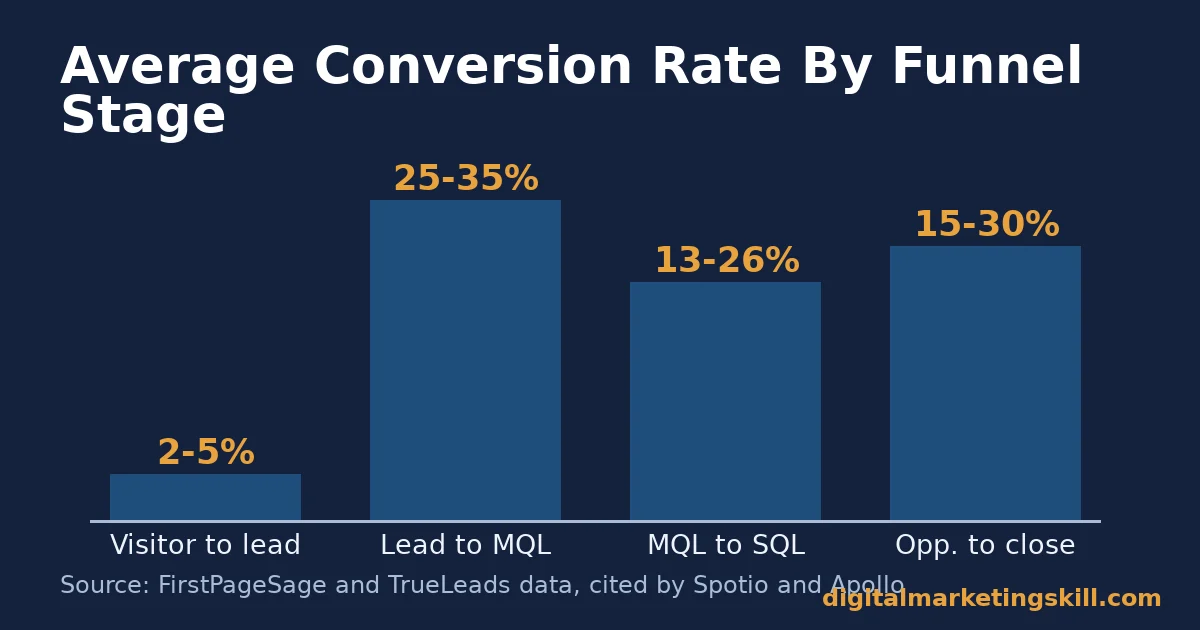
- The average business converts only 2-5% of visitors into leads. Only the top quarter of sites reach 11.7% (TrueLeads data, cited by Apollo). This awareness-to-interest gap is usually the biggest leak.
- Lead-to-MQL conversion averages 25-35%. Top performers exceed 40% (FirstPageSage’s Sales Funnel Report, cited by Spotio). The gap is usually follow-up speed, not traffic volume.
- SEO-sourced leads convert from MQL to SQL at roughly 51%. PPC-sourced leads convert at only 26%, a 25-point gap (First Page Sage data, cited by Outreach). Where a lead comes from predicts how it should be nurtured.
- Opportunity-to-close rates average only 15-30% (FirstPageSage, cited by Spotio). Even a healthy funnel loses most qualified leads at the decision stage.
- Account-based approaches lift MQL-to-opportunity conversion by around 25% (Gartner Digital Markets, cited by Outreach). Targeting the right few leads can beat chasing more of them.
In this guide
- Why Most Funnels Leak Long Before the Sale
- Sales Funnel Stages: How a Sales Funnel Actually Works
- Sales Funnel Stages: What Differs By Business Model
- How to Strengthen Your Sales Funnel Stages, By Business Model
- Which Channels Fit Each Sales Funnel Stage
- How to Measure Sales Funnel Stages
- The One Rule for Deciding What to Fix First
- A Real Case: Turning a Small Ad Spend Into Sales
- Frequently Asked Questions About Sales Funnel Stages
- Build and Run Real Sales Funnel Stages With Expert Support
Why Most Funnels Leak Long Before the Sale
Most guides to sales funnel stages jump straight to tactics. Run ads. Send emails. Add a chatbot. That skips the real question: where is your specific funnel actually losing people? Without that answer, you end up polishing a stage that was never broken.
This is an informed framework, not a guarantee. It is built from publicly reported benchmarks, not your own data. Conversion rates vary by industry, price point, and traffic source. A benchmark is a comparison point, not a target you are owed. Treat every percentage below as a rough signal. Verify it against your own numbers.
With that ground rule in place, this guide covers how a funnel works, what changes by business model, which channels fit which stage, how to measure each stage, and the one rule for deciding what to fix first. If your business sells to other businesses, an overview of broader digital marketing tactics is a useful companion to the funnel-specific advice here.
Sales Funnel Stages: How a Sales Funnel Actually Works
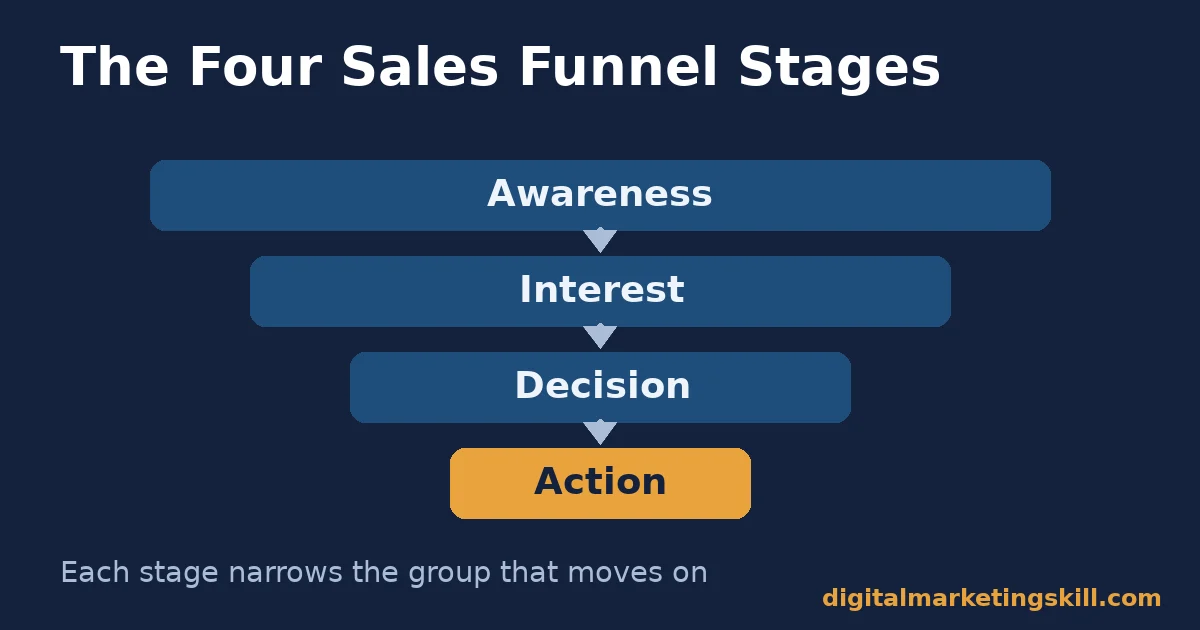
A sales funnel is the buying process a business leads a prospect through. It runs from first contact to purchase. Most frameworks describe it in four stages, and each stage has a different job.
The word “funnel” is a visual shortcut, not a rule. Many real buying journeys loop back on themselves: a lead reads a case study, goes quiet for weeks, then returns and buys. Treat these four sales funnel stages as a map of what a prospect needs at each point, not a straight line everyone follows in order.
Awareness
At the top of the funnel, a stranger learns your business exists. They see a social post, read an article, or click a search result. Your only job here is visibility and relevance. Give them something useful enough to remember, without pushing a sale they are not ready for.
Most awareness content fails for one reason: it talks about the product before the stranger has a reason to care. A short, specific, useful piece of content earns more attention here than a polished pitch, because it asks nothing in return.
Interest
Once someone is aware of you, they move into the interest stage. They are now a lead: a person who has shown real interest in what you offer. Leads want information, not a pitch. Email sequences, blog content, and retargeting ads all belong here. The goal is to keep answering questions until the lead trusts you.
Tracking matters at this stage. Which link a lead clicks, or which page they revisit, tells you what problem they care about most. Let that single signal shape your next message, more than any generic follow-up schedule would.
Decision
At the decision stage, a lead compares you against alternatives, including doing nothing. Pricing clarity, case studies, guarantees, and a clear next step matter most here. A confused or nervous lead will simply stall rather than say no.
A lead at this stage already understands what you offer. What they lack is confidence it will work for them specifically. Naming a close alternative honestly, including a real competitor strength, usually builds more trust than pretending no other option exists.
Action
Action is the purchase itself. But a funnel that ends at checkout wastes the hardest-won part of the relationship. Onboarding, a welcome sequence, and a clear first win all belong in this stage. A customer who succeeds quickly is the one who buys again.
Many businesses treat the funnel as finished once payment clears. Treat the first 7 to 30 days after that moment as part of the funnel instead. Keeping a customer who already trusts you costs far less than replacing them with a new lead.
Sales Funnel Stages: What Differs By Business Model
The four stages above are universal. What you build inside each one should not be identical for a service business, an online store, and a B2B or high-ticket offer. Your funnel’s shape should follow a clearly identified target audience, never the other way around. Here is how that shape typically changes.
Service Businesses: Built For Relationship-Led Decisions
A service business sells trust as much as a deliverable. Prospects usually need one real conversation before they decide. The funnel has to be built around booking a qualified conversation, not a single-click purchase. A clear customer avatar makes that first conversation far easier to earn.
Because the sale depends on a person, not a page, the biggest lever is usually who gets to that conversation. A smaller number of well-matched conversations will outperform a larger number of mismatched ones.
E-Commerce Stores: Built For Speed and Volume
An online store has a far shorter decision window and a far larger number of prospects moving at once. Small friction points, an extra form field, a slow page, an unclear shipping cost, cost real sales at this scale. The funnel is built around removing friction, not deepening a relationship.
Because volume is high, even a one-point gain in conversion rate can matter more in absolute terms than it would for a service business. That is why e-commerce funnels reward constant small testing over one big redesign.
B2B and High-Ticket Offers: Built For Longer Consideration
When the price or risk is high, more than one person is usually involved. The sales cycle stretches to weeks or months. A funnel built for this model has to keep multiple stakeholders warm over time, not just the first person who clicked.
A long sales cycle is not automatically a weak funnel. It is often an accurate reflection of what is at stake for the buyer. The mistake is treating a six-week decision like a six-minute one, with a single hard pitch instead of a paced sequence of proof.
How to Strengthen Your Sales Funnel Stages, By Business Model
The fixes below mirror the three models above. Go straight to the one that matches your business.
Service Businesses: Lead With a Diagnostic Call
Instead of a generic “contact us” form, offer a short, specifically named diagnostic or audit call. Naming the call tells the lead exactly what they get for their time. That raises both the booking rate and the quality of who shows up.
Keep the call itself short and focused on the prospect’s situation, not a slide deck about your business. The goal of the first call is to earn a second one, or a proposal, not to close the sale in one conversation.
E-Commerce Stores: Lead With Fast, Low-Friction Checkout
Cut every unnecessary field from checkout. Show the full cost, including shipping, before the final step. Offer at least one express payment option. Each of these targets the exact point where price-sensitive, time-poor shoppers abandon a cart.
Pair checkout fixes with a short post-purchase sequence. Confirm the order, set a realistic delivery expectation, and suggest one genuinely relevant next product. That turns a single transaction into the start of a repeat-purchase funnel.
B2B and High-Ticket Offers: Lead With Proof Over Multiple Touches
Build a short sequence of proof: a case study, a comparison, a named guarantee. Space it across several emails or touches rather than one page. Account-based approaches that focus this proof on a specific list of target accounts report meaningfully higher conversion than broad outreach, according to Gartner Digital Markets data cited by Outreach.
Identify who else in the buying group needs to see this proof, not just the first contact. A champion inside the account rarely closes a high-ticket deal alone; they usually need material they can forward to a manager or a budget holder.
Which Channels Fit Each Sales Funnel Stage
The same channel can work at two different sales funnel stages, but only if you change what it says. Matching the message to the stage matters more than picking a “best” channel.
Awareness Channels
Organic search, short-form video, and sponsored social posts work best here. Each one should teach or entertain, not sell. The job is to earn a second look, not a purchase. A single genuinely useful post often earns more trust than ten posts that quietly plug the same offer.
Interest Channels
Email sequences, retargeting ads, and webinars suit the interest stage. They can reference your product directly, but should spend most of the message answering a real question the lead already has.
Decision Channels
Case studies, comparison pages, and a short call or demo work well once a lead reaches the decision stage. This is the one place where price, guarantees, and a specific next step belong front and centre. Save your strongest proof for here; showing it too early, back at the awareness stage, usually wastes it on someone not yet ready to act on it.
Action Channels
A welcome sequence, an onboarding call, and a simple check-in message carry the action stage. Each one should help the new customer reach a first real result, not just confirm the sale went through.
How to Measure Sales Funnel Stages
You cannot fix a stage you have not measured. Ongoing conversion optimization only works once you know which stage to test. These are the core KPIs, each defined in one sentence.
- Stage conversion rate: the percentage of people who move from one stage to the next. Read it against your own history first, and a published benchmark second.
- Drop-off rate: the percentage of people who leave at a specific stage instead of advancing. A sudden spike at one stage usually points to a single fixable cause.
- Cost per lead and cost per customer: what you spend, across all channels, to produce one lead or one paying customer. A rising cost per customer alongside flat conversion usually means a traffic-quality problem.
- Sales cycle length: the average time between first contact and purchase. A cycle that keeps stretching out is an early warning for the decision stage.
- Customer lifetime value: the total revenue one customer generates over the relationship, not just the first purchase. It tells you how much you can reasonably spend to acquire a customer.
- Funnel velocity: how quickly, on average, a lead moves through all the stages above to become a customer. A funnel that converts well but moves slowly can still lose to a competitor who simply reaches the buyer faster.
Google Analytics tracks this through “key events,” its term for the specific actions that count as a conversion. You define these yourself, rather than inherit a default template.
Reading the KPIs Together
None of these numbers mean much alone. A falling cost per lead next to a falling conversion rate usually means you are buying cheaper but worse traffic. A rising sales cycle next to a stable close rate usually means the funnel still works, just more slowly. Read the KPIs together, over a few months, rather than reacting to one week.
The One Rule for Deciding What to Fix First
Across all of your sales funnel stages, fix whichever stage has the largest percentage-point gap between your number and a realistic benchmark for your model. Do not fix the stage that merely feels the most broken or gets the most internal complaints.
Illustrative, invented numbers: picture a funnel with 1,000 monthly visitors, 40 leads (a 4% visitor-to-lead rate), 10 marketing-qualified leads (a 25% lead-to-MQL rate), and 2 customers (a 20% opportunity-to-close rate). On paper, every stage looks “average.”
Now say a realistic target for this business is 6% visitor-to-lead and 35% lead-to-MQL. Awareness then has only a 2-point gap, while interest has a 10-point gap. Interest gets fixed first, even though the final close rate looks fine.
Apply the same rule in reverse, too. Imagine a different business that already converts 6% of visitors to leads but closes only 8% of opportunities against a 20% realistic target. Here, the decision stage is the real leak, not the top of the funnel, however much traffic looks like the obvious lever to pull.
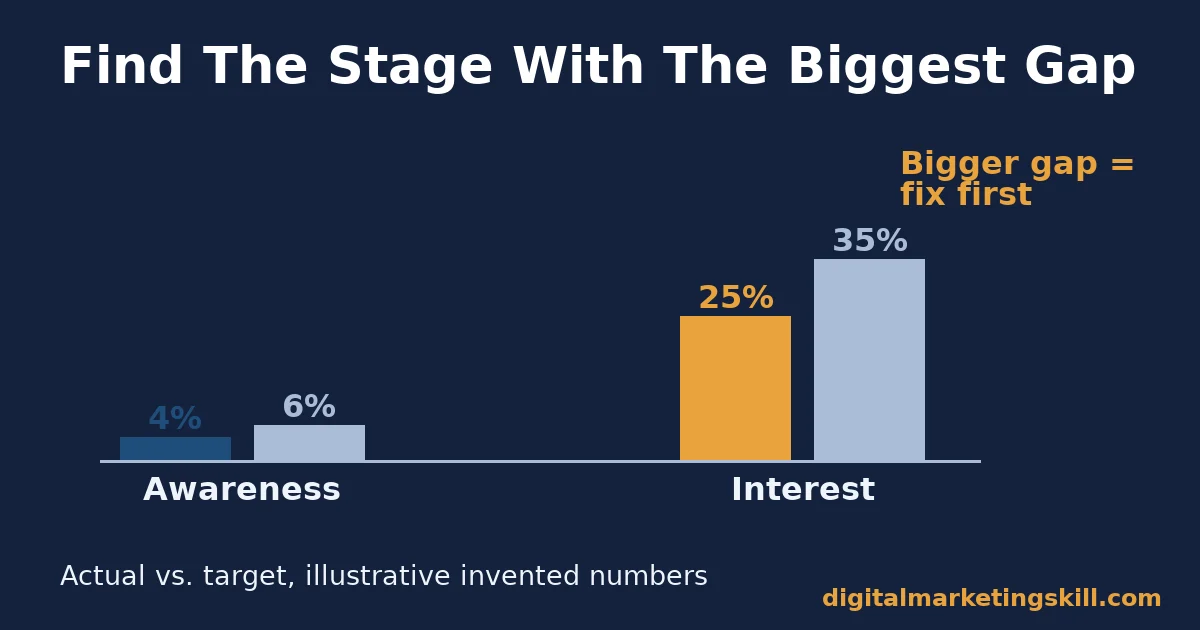
This rule also protects you from a common trap: fixing whatever is easiest to change, such as a homepage redesign, instead of whatever is actually costing you the most leads, such as a slow follow-up email. Pick the stage with the biggest gap, even when it is the less glamorous fix.
A Real Case: Turning a Small Ad Spend Into Sales
Ayooluwa Osemi, a Digital Marketing Skill Institute graduate, spent $14 on Facebook and Instagram ads and generated $878 in returns within a short timeframe, as published on the Institute’s reviews page. The funnel behind it was narrow and specific: a small, targeted audience, one clear offer, and a fast follow-up, rather than a broad campaign trying to serve every stage at once.
This is one published, named result, not a typical outcome. Results like it depend on the product, audience, and effort of the specific marketer; see the earnings disclaimer for the Institute’s full position on income claims. The lesson to take is structural, not financial: a narrow audience and one clear offer usually outperforms a broad audience and a vague one, long before more money changes anything.
Notice how these sales funnel stages actually interacted in this case. The spend itself sat at the awareness stage, but the result came from how tightly the interest and decision stages were matched to that one small audience. A wider audience at the same budget would likely have produced a worse result, not a better one.
Frequently Asked Questions About Sales Funnel Stages
How many sales funnel stages are there?
Most frameworks use four: awareness, interest, decision, and action. Some add a fifth stage for retention or referral, since a repeat buyer costs less than a new customer.
What is the difference between a sales funnel and a marketing funnel?
They describe the same journey from two angles. A marketing funnel usually ends at “lead.” A sales funnel continues through the decision and action stages to a closed sale.
Why do leads drop out of the funnel?
The common reasons are a mismatch between the traffic source and the offer, a confusing or slow next step, unclear pricing, and slow follow-up once a lead shows interest. Most of these are fixable within days once you know which sales funnel stage is losing the most people.
How long should a sales funnel take?
It depends on the price and complexity of what you sell. A low-cost product can move someone from awareness to purchase in minutes. A high-ticket or B2B offer can reasonably take weeks or months.
Do small businesses need a formal sales funnel?
Yes. Every business that gets customers through more than one step already has a funnel, mapped out or not. Making it explicit just makes it measurable, and a measurable funnel is one you can actually improve instead of guessing at.
What is the biggest mistake businesses make with their funnel?
Treating every stage the same way. A message built for a cold stranger at the awareness stage is usually wrong for a lead already comparing prices at the decision stage, and using it there slows the sale down.
Can a sales funnel work without paid ads?
Yes. Content, search visibility, referrals, and email can fill every stage. Paid ads simply add volume to a funnel that already converts; they rarely fix one that does not.
How do I know which sales funnel stage to track first?
Start wherever you already have data. If you have website analytics but no CRM, start by measuring visitor-to-lead. If you have a CRM but no clear ad tracking, start with lead-to-customer instead. Add the other stages once the first one is reliable.
Build and Run Real Sales Funnel Stages With Expert Support
Learning the theory of sales funnel stages is one thing. Building, running, and fixing a real one under guidance is another.
The Master Diploma in Digital & AI Marketing at Digital Marketing Skill Institute is built around four AI-powered tracks: social media management and advertising, lead generation and email automation, Google specialism, and WordPress and SEO. The tracks are drawn from ten execution-first courses in total, with a Full Stack option covering all four.
Every track includes unlimited one-on-one coaching and mentoring, a U.S. Project Internship with a verified U.S. Work Reference Letter, and a dual US and UK accredited diploma recognised in more than 100 countries. The program runs 100% online, so you can build and test a real sales funnel for a real project anywhere in your country.
If you are ready to put these sales funnel stages into practice, wherever you live, you can apply here, browse more guides on the blog, read more student results, or start from the Digital Marketing Skill Institute homepage.
Every figure in this guide was checked against its original source before publication. Figures marked as illustrative are invented examples, not real results.