
Landing page experience is Google Ads’ estimate of how relevant and useful your landing page will be to people who click your ad. It is one of the three parts of Quality Score, alongside expected click-through rate and ad relevance, and each keyword gets a status of above average, average or below average. It matters because a page that matches the search and is easy to use helps your ads perform better and turns more clicks into leads or sales.
Key Takeaways
- Google defines it as “a measure that Google Ads uses to estimate how relevant and useful your website’s landing page will be to people who click your ad.”
- It is one of three Quality Score components, with expected click-through rate and ad relevance.
- Each keyword gets a status: above average, average or below average.
- Google says pages with higher ratings “are usually well organised and have text that relates to a person’s search terms.”
- Quality Score is a diagnostic tool, not a key performance indicator and not an input in the ad auction.
What Is Landing Page Experience?
When someone clicks your ad, they land on a page. If that page answers their search quickly and clearly, they are more likely to stay and act. But if it doesn’t, they leave. Google tries to estimate this in advance, and the result is a status for each keyword.
Think of it as a promise test. Your keyword and ad make a promise, such as “same-day boiler repair.” Then the landing page either keeps that promise or breaks it. For example, a page about boiler repair with a clear phone number keeps it. By contrast, a general home page with no mention of boilers breaks it.
For more on building pages that convert, see our glossary entry on the landing page.
How Landing Page Experience Works
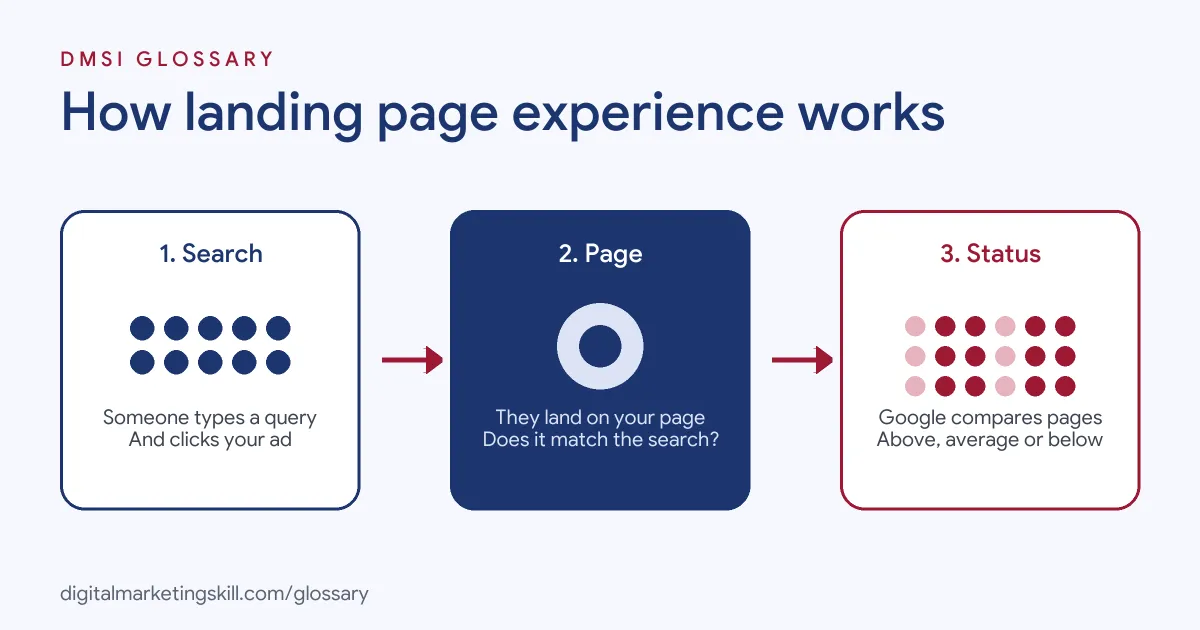
Google looks at the link between three things. First, the keyword someone searched. Next, the ad they clicked. Finally, the page they reached and how useful it is. It then compares your page with those of other advertisers and gives the keyword a status.
Part of Quality Score
Google’s Quality Score page lists three components in total. Expected click-through rate is “the likelihood that your ad will be clicked when shown.” Ad relevance is “how closely your ad matches the intent behind a user’s search.” Landing page experience is “how relevant and useful your landing page is to people who click your ad.”
Quality Score itself “is measured on a scale from 1–10 and available at the keyword level.” To learn the full picture, read our glossary entry on Quality Score.
The Three Statuses
Each component gets a status of “Above average,” “Average” or “Below average.” Google says this evaluation “is based on a comparison with other advertisers whose ads showed for the exact same search over the last 90 days.” So your status is relative. In other words, it shows how you compare, not a fixed score.
What It Is Not
First, it helps to be clear about limits. Google says Quality Score “isn’t a key performance indicator and shouldn’t be optimised or aggregated with the rest of your data.” It also says Quality Score “isn’t an input in the ad auction.” Instead, it is a diagnostic tool that shows where your ads, landing pages or keywords could improve.
Landing Page Experience Examples
Here are three made-up examples of good and poor matches:
- Good match: A search for “women’s waterproof hiking boots” leads to a page of women’s waterproof hiking boots, with filters, sizes and prices. The page keeps the ad’s promise.
- Poor match: A search for “accounting software for freelancers” leads to a general home page about enterprise finance. As a result, the visitor has to hunt for the right product.
- Fixed match: A driving school sends “intensive driving course” ads to a new page about intensive courses, with dates, prices and a booking form. The status then has a better chance of improving.
In each case, the question is simple: does the page give the searcher what they came for?
The Three Quality Score Components
Here is how it fits alongside the other two parts:
| Component | What Google measures | What you control |
|---|---|---|
| Expected click-through rate | The likelihood that your ad will be clicked when shown | Ad copy, assets and keyword choice |
| Ad relevance | How closely your ad matches the intent behind the search | Tight ad groups and matching headlines |
| Landing page experience | How relevant and useful your page is to people who click | Page content, layout, speed and clarity |
How to Improve Landing Page Experience
- Check the status. In the Keywords table, add the “Landing Page Exp.” column from the Quality score section.
- Find keywords with a “Below average” status, starting with those that spend the most.
- Compare each keyword, ad and page. Ask whether the page clearly matches the search.
- Send each ad group to the most specific page you have, or build a new one.
- Put the main answer near the top, using words that echo the search.
- Organise the page clearly, with a simple layout and an obvious next step.
- Make the page fast and easy to use on a phone, then check the status again over time.
How to Measure the Impact
A better status is only useful if it leads to better results. So track a few numbers before and after you change a page:
- Conversion rate: the share of clicks that turn into a lead or sale. This is the main sign that the page works.
- Cost per conversion: what you pay for each lead or sale. If the page improves, this usually falls.
- Bounce or engagement rate: in your analytics tool, check whether visitors stay and scroll.
- The status itself: check it again after a few weeks, since it compares results over time.
For example, imagine a page converts 2% of clicks before a rewrite and 4% after it. In that case, you have doubled the leads from the same budget, whatever the status says.
Best Practices
- Match the message. Use the same offer and wording in the keyword, the ad and the page headline.
- Be specific. A page about one product or service usually beats a general page.
- Keep it organised. Google notes that higher-rated pages are usually well organised.
- Make the next step clear. One main call to action helps visitors know what to do.
- Use it as a clue. Treat the status as a diagnostic, and judge success on conversions.
Common Mistakes to Avoid
Many advertisers send every ad to the home page, which rarely matches a specific search. Others chase a higher Quality Score as a goal in itself, even though Google says it isn’t a key performance indicator. Some change match types hoping to fix the score, but Google notes that changing match types won’t affect Quality Score. Finally, many ignore phone users, even though a page that is hard to use on mobile frustrates visitors.
Where You’ll Use Landing Page Experience at Work
Improving landing pages is a regular part of PPC and digital experience roles. For example, recent remote job listings ask candidates to:
- “Understand differences in customer intent, keywords, campaigns and traffic sources, and use those insights to shape landing page experiences.” (Digital Experience Lead).
- “Continuously improve Quality Score and Ad Rank to lower costs and win more valuable impressions.” (PPC Specialist).
- The ability to “maintain Quality Score, impression share, and other essential metrics” (Marketplace PPC Freelancer).
So as a Google Ads Specialist or PPC Specialist, you will check these statuses and work with web teams to fix weak pages.
Learn It in the Google Specialist Track
You can practise matching keywords, ads and pages in the AI-Powered Google Specialist track. It covers Google Ads (Search, Display, Discovery, Gmail and YouTube) and Google Analytics. Your portfolio project is to launch and measure a Google Ads campaign with conversion tracking. You also get unlimited 1-on-1 mentoring and a U.S. Project Internship from day one.
For practical page tips, read our guide to landing page optimisation.
Frequently Asked Questions
What is landing page experience in Google Ads?
It is Google’s estimate of how relevant and useful your landing page will be to people who click your ad. It is one of three Quality Score components.
Where do I see my landing page experience status?
Add the “Landing Page Exp.” column to your Keywords table from the Quality score section of the column options.
What does “below average” mean?
It means your page compares poorly with other advertisers whose ads showed for the same search. It is a sign the page may need changes.
Does landing page experience affect the ad auction?
Google says Quality Score itself isn’t an input in the auction. Even so, a more relevant and useful page tends to help your ads and conversions.
How do I improve it quickly?
Send ads to the most specific page you have, match the page headline to the search, and make the next step clear.
Sources: Google Ads Help: Landing page experience definition; Google Ads Help: About Quality Score for search campaigns; remote job listings on Himalayas and Himalayas.