
Mobile marketing is any marketing designed to reach people on their smartphones and tablets, through mobile websites, apps, text messages, social feeds, mobile search and in-app ads. It means planning every message for small screens, short attention spans and on-the-go use. It matters because most web browsing now happens on mobile devices, so a brand that works poorly on a phone loses customers before they even read the offer.
Key Takeaways
- Statcounter’s figures show that mobile devices account for more than half of web traffic worldwide.
- Google uses the mobile version of a site’s content for indexing and ranking, a system called mobile-first indexing.
- Google recommends responsive web design as the easiest mobile set-up to build and maintain.
- Apple requires apps on iOS 14.5 and later to ask permission before tracking users across other companies’ apps and websites.
- Text messages follow the same UK consent rules as marketing emails.
What Is Mobile Marketing?
Mobile marketing is not one channel. Instead, it is a way of thinking about every channel from the phone screen first. A social ad, a search result, a checkout page and a text message all count, as long as they are built for mobile users.
The reason is simple. People carry their phones everywhere. They search on the bus, scroll social feeds in a queue and buy from bed. Statcounter, which tracks web traffic worldwide, reports that mobile now makes up more than half of global web traffic, ahead of desktop.
For example, a café chain might send a lunchtime offer by text, run Instagram Stories ads and make sure its menu page loads fast on a phone. Each piece is a part of its mobile marketing.
How Mobile Marketing Works
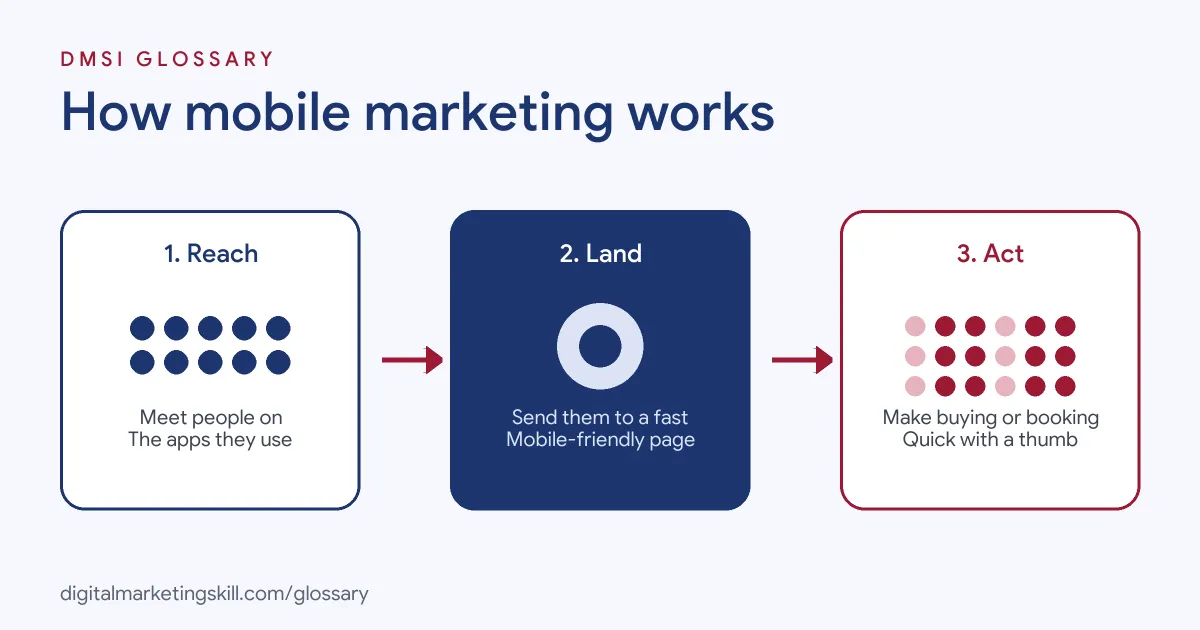
Most mobile campaigns follow three steps. First, you reach people on the channels they use on their phones. Next, you send them to a fast, mobile-friendly page or app. Finally, you make the action, such as buying, booking or calling, quick to complete with a thumb.
Mobile Search and Websites
Google says it “uses the mobile version of a site’s content, crawled with the smartphone agent, for indexing and ranking”. It adds that a mobile version is not required to appear in results, but it is “very strongly recommended”. So your mobile pages need the same content as your desktop pages.
Mobile Site Set-Ups
Google describes three ways to build a mobile-friendly site. Responsive design serves the same HTML on the same URL to every device. Dynamic serving uses the same URL but sends different HTML by device. Separate URLs serve different pages on different addresses. Google recommends responsive design “because it’s the easiest design pattern to implement and maintain”.
Apps and Privacy
Apps are a big part of mobile marketing, and privacy rules shape how you measure them. Apple says that on iOS 14.5 and later, apps “need to receive the user’s permission” through App Tracking Transparency to track users or access the device’s advertising identifier. As a result, app marketers must plan for less detailed data from users who opt out.
Messaging and Consent
Phones are also where people get personal messages, so the rules are strict. The UK ICO says the same consent rule applies to “emails, texts, picture messages, video messages, voicemails, direct messages via social media” and similar stored messages. In addition, you “must not disguise or conceal your identity”, and you must give a valid contact address so people can opt out. So before you add texts or direct messages to your plan, check that your list is built on clear consent.
Mobile Marketing Examples
Here are three made-up examples of mobile marketing in practice:
- Local restaurant: A pizza shop runs mobile search ads with a call button. Hungry people tap once to phone an order through.
- Online shop: A fashion brand sends a text to subscribers who agreed to receive offers. The link opens a fast, mobile-first product page with one-tap checkout.
- App: A fitness app runs short video ads on social feeds. Then it sends in-app messages to help new users complete their first workout.
In each case, every step happens on the phone. The less typing and waiting, the better the results.
Mobile Marketing Channels Compared
Here is how the main channels compare:
| Channel | Best for | Key rule or tip |
|---|---|---|
| Mobile website | Search traffic and sales | Google indexes the mobile version first |
| Social media ads | Reach and awareness | Use vertical video and short copy |
| SMS and messaging | Timely offers and reminders | In the UK, you need consent, as with emails |
| Mobile apps | Loyal, repeat customers | On iOS, ask permission before tracking |
| Mobile search ads | High-intent local customers | Make calling or booking one tap away |
Most brands use several of these together. The key is that each one leads smoothly to the next step. For instance, a social ad might lead to a mobile page, which then invites people to join a text list.
How to Start Mobile Marketing
Follow these steps to build a mobile-first plan:
- Test your site on a phone. Check speed, text size, buttons and forms.
- Use responsive design. Google recommends it as the simplest option.
- Keep content the same on mobile. Mobile-first indexing means missing content can hurt rankings.
- Shorten your forms. Ask only for what you need, since typing on a phone is slow.
- Pick your mobile channels. Choose from social, search, SMS and apps based on your audience.
- Get consent for messages. The UK ICO says its rules cover emails, texts and direct messages via social media.
- Track results by device. Compare mobile and desktop conversion rates in your analytics.
After that, fix the biggest drop-off first. Often, it is a slow page or a long checkout.
Best Practices for Mobile Marketing
- Design for thumbs. Make buttons big and easy to tap.
- Write short. Get to the point in the first line.
- Keep pages fast. Every extra second on a phone is a chance to lose someone.
- Respect privacy choices. Plan measurement for users who decline tracking on iOS.
- Make contact easy. Add tap-to-call, maps and short booking forms.
Common Mistakes to Avoid
A common mistake is designing on a large screen and only checking the phone version at the end. Another is hiding content on mobile to save space, which can hurt rankings under mobile-first indexing. Some brands also send texts to people who never agreed to them, which breaks consent rules. Finally, many forget that mobile users are often busy. Long forms and slow pages lose them fast.
How to Measure Mobile Results
Start by splitting your reports by device. Then compare mobile and desktop on the same measures: conversion rate, average order value and the share of visitors who leave without acting. If mobile traffic is high but conversions are low, the problem is usually the page or the form, not the ad. Next, check app results separately, and remember that iOS data may be limited for users who opt out of tracking. Over time, these numbers show where the mobile journey needs work.
Where You’ll Use Mobile Marketing at Work
Mobile skills appear across many marketing roles. For example, remote job listings mention:
- A “Demonstrated understanding of the digital and mobile marketing ecosystem” (Senior Account Executive).
- Keeping “event tracking, postbacks and attribution windows accurate across all partners” (Mobile App Growth Manager).
So whether you aim to be a Digital Marketing Manager, Growth Marketer or Freelance Digital Marketer, you will need to plan campaigns that work on a phone first.
Learn It in the Full Stack Programme
Mobile touches every channel, so it fits the Full Stack (all four tracks) programme. It covers all ten courses, including social media, Google Ads, email and WordPress, with one portfolio project from each track. In addition, you get unlimited 1-on-1 mentoring and a U.S. Project Internship from day one.
For practical tips, read our guides to mobile marketing strategy and building a mobile-friendly website. You can also learn about mobile-first indexing.
Frequently Asked Questions
What is mobile marketing in simple terms?
It is marketing built to reach people on their phones and tablets, through mobile sites, apps, texts, social media and search.
Why is mobile marketing important?
Mobile devices make up more than half of web traffic worldwide, according to Statcounter. So many customers first meet your brand on a phone.
What is mobile-first indexing?
It means Google uses the mobile version of your site’s content, crawled with a smartphone agent, for indexing and ranking.
Do I need consent to send marketing texts?
In the UK, yes. The ICO says you must not send marketing texts to individuals without specific consent, with a limited exception for existing customers.
Which mobile site design does Google recommend?
Google recommends responsive web design, because it is the easiest pattern to build and maintain.
Sources: Google Search Central: Mobile-first indexing best practices; Statcounter: Desktop vs mobile vs tablet market share; Apple Developer: User privacy and data use; UK ICO: Electronic mail marketing; remote job listings on Himalayas.