
A mobile marketing strategy matches each tactic, SMS, app, mobile search or mobile web, to how people actually hold and use their phones. Mobile now carries most of the world’s web traffic. A slow page or a badly timed text costs more sales than it did a few years ago. This guide shows which channel fits which goal. It shows how to measure real engagement. It ends with one rule for deciding where to invest next.
Key Takeaways
- Mobile is now the majority of web traffic. Statcounter’s global tracking puts mobile at 58.99% of worldwide web traffic, ahead of desktop at 39.26%.
- SMS still out-clicks email by a wide margin. Omnisend’s analysis of more than 246 million SMS sends found a 12.39% average campaign click-through rate, against 0.74% for email campaigns over the same period.
- Most of the world is now mobile-first online. DataReportal counts about 5.78 billion unique mobile internet users worldwide, roughly 70% of the global population.
- Texts get opened fast, in the US at least. An EZ Texting survey of 959 US consumers, cited by Omnisend, found 87% check a new text within 15 minutes of receiving it. This figure is US-only and self-reported.
- Page speed is one signal among many, not a shortcut. Google says plainly that Core Web Vitals “are used by our ranking systems.” It also says strong scores do not guarantee top rankings, since relevance still leads.
In this guide
- What Most Mobile Marketing Strategy Advice Gets Wrong
- How Mobile Behaviour Differs From Desktop
- Four Mobile Channels, Built For Different Jobs
- How To Lead With Each Channel
- How To Measure a Mobile Marketing Strategy
- The One Decision Rule: Fix the Floor Before You Add a Channel
- A Real Case: Starbucks’ Mobile Marketing Strategy
- Frequently Asked Questions About Mobile Marketing Strategy
- Build Your Mobile Marketing Strategy From the Floor Up
What Most Mobile Marketing Strategy Advice Gets Wrong
Most mobile marketing strategy guides list channels: SMS, push notifications, apps, mobile ads. Then they tell you to use all of them. That advice is not wrong, but it skips a harder question. Which channel fits which customer moment, and in what order should you build a mobile marketing strategy that uses them well?
This guide treats a mobile marketing strategy as a set of channels built for different jobs, not a checklist to work through in one go. It names the gap first. Then it explains the mechanism behind mobile behaviour, and gives a decision rule for where to spend your next hour of work on that strategy.
A few ground rules before the detail. The figures below come from named companies and their own published data. Read a vendor’s self-reported figure as a snapshot from that company, not a universal law. The channel-matching framework behind this mobile marketing strategy is an informed inference built from that evidence, not a settled fact. None of these numbers are permanent rankings. Mobile behaviour shifts fast as devices, networks and apps change. Treat every figure as a point-in-time read, not a fixed target, and revisit your own numbers at least once a quarter.
How Mobile Behaviour Differs From Desktop
People hold a phone. They sit in front of a desktop. That one difference changes almost everything about how someone responds to marketing on each device.
Three things follow from it. First, mobile sessions run shorter and interruptions happen more often, so a page or message has less time to make its case. Second, people usually keep a phone within reach, which is why direct channels like SMS and push notifications get noticed fast. Third, the device itself carries location and time data, so a message can match exactly where someone stands right now.
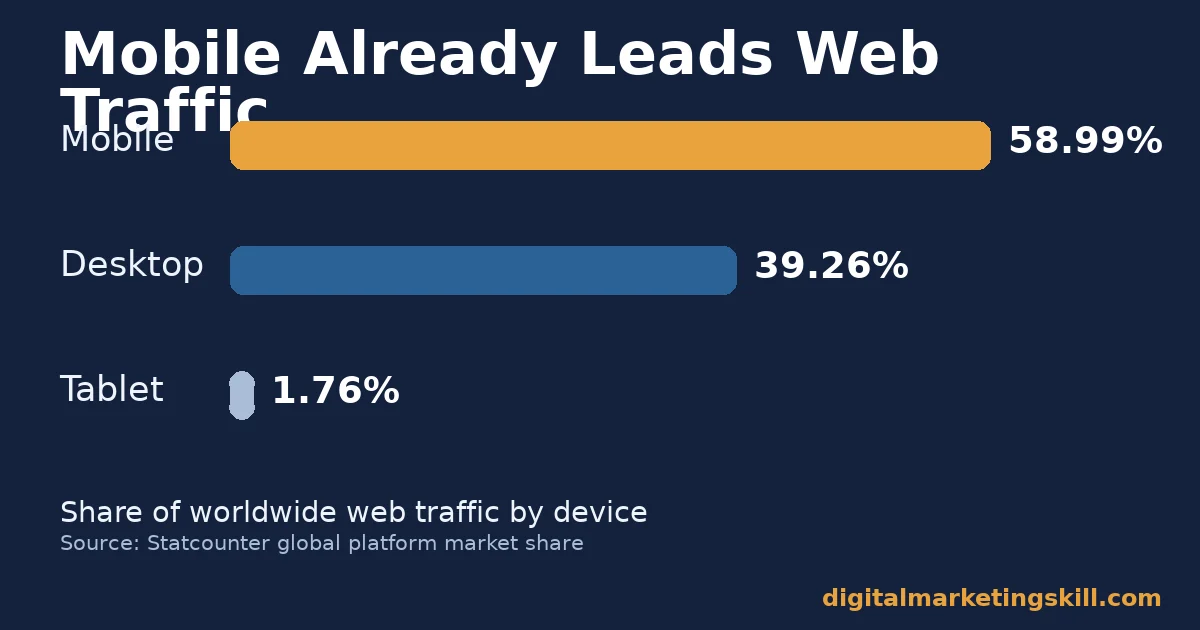
The traffic numbers confirm this shift. Statcounter’s long-running tracker samples billions of page views across millions of sites. It shows mobile devices now account for 58.99% of worldwide web traffic, with desktop at 39.26% and tablets at 1.76%. Read that as a global average. A B2B software site will usually see a different split than a retail store sees.
Why Speed and Friction Matter More on Mobile
Several things make friction costlier on mobile: smaller screens, slower connections in many regions, and one-handed use. A form with too many fields pushes a visitor toward the back button. So does a slow image gallery, or text small enough to need zooming. Desktop visitors tolerate more of this friction than mobile visitors do.
Google’s own page experience documentation confirms that Core Web Vitals “are used by our ranking systems.” It also states clearly that no single signal decides rankings, and that relevance remains the primary driver. In practice, mobile speed removes a ceiling on performance rather than guaranteeing a result. A fast, irrelevant page still will not rank. A slow, relevant page may rank lower than it otherwise could.
Four Mobile Channels, Built For Different Jobs
Mobile channels do not all do the same work. The four below cover most of what a mobile marketing strategy needs. Each one serves a different kind of attention, so picking the right channel for the moment matters more to a mobile marketing strategy than using every channel at once.
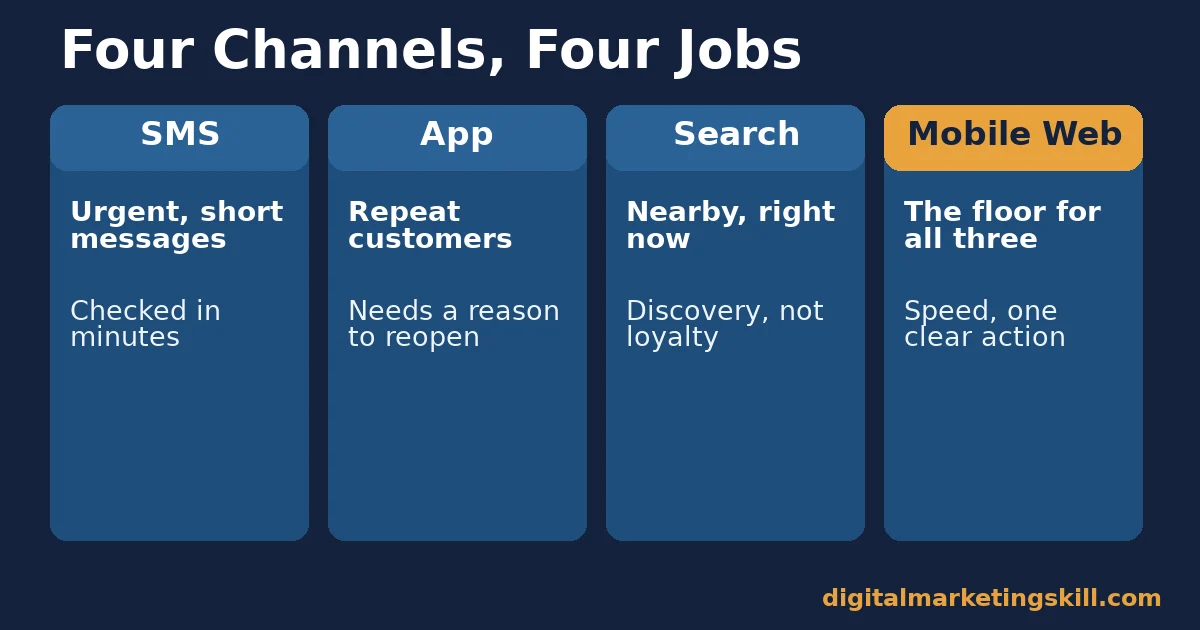
SMS and Texting: Built For Urgent, Short Messages
SMS reaches a channel most people check within minutes. It needs no app download and no social algorithm to show it. Omnisend’s analysis of SMS performance across more than 150,000 brands found a 12.39% average click-through rate on campaign texts. That is far above the 0.74% it recorded for email campaigns in the same study. For messaging platforms beyond plain SMS, our guide to WhatsApp marketing and the 24-hour reply window covers a related channel with its own rules.
That strength has a cost. SMS has no skim-and-ignore mode the way an inbox does. Low-value or too-frequent texts feel intrusive fast. Inside a mobile marketing strategy, SMS suits short, time-sensitive messages. It does not suit lengthy storytelling or soft brand-building content, which fit email or social far better.
A Branded App: Built For Repeat Customers, Not First Contact
An app asks for a download before it delivers anything at all. It only pays off with people who already intend to return. Once someone installs it, the app can hold a loyalty balance, remember preferences, and send push notifications without competing inside an email inbox.
An app rarely reaches new customers well. Almost nobody downloads an app to try a brand once. An app earns its cost with customers who already buy repeatedly. For them, saved details and faster reordering outweigh the hassle of installing something new.
Mobile Search and Maps: Built For “I Need This Now, Nearby”
Mobile search carries a different intent from desktop search. More of it happens while someone is out, close to a decision, and open to visiting somewhere nearby. Google’s own Business Profile guidance recommends accurate hours, location and photos, because that context feeds the signals ranking systems evaluate.
Mobile search is built for discovery and local intent. It does not build relationships on its own. A searcher who finds you once through a map result is not yet a subscriber or an app user. Those relationships still need building afterwards. Our search engine optimization guide covers the on-page basics that make a page eligible to show up there at all.
A Fast Mobile Site: The Floor Under Every Other Channel
Every channel above eventually sends someone to a mobile web page. That page might be a landing page from a text, a profile link from search, or a shared post from social media. A slow or cluttered mobile site quietly undermines all three channels at once, without ever showing up as an obvious “mobile problem” in reports.
A fast, clear mobile site is not really a fourth channel competing with the other three. Think of it closer to a foundation for the whole mobile marketing strategy. Fixing it improves the return on every channel that points traffic toward it, often by more than any single new channel would add on its own.
How To Lead With Each Channel
The sections below mirror the four channels above. Each one names the single change that matters most for that channel.
SMS: Lead With a Clear Reason To Opt In, Then Stay Short
Ask for a phone number by naming the exact benefit someone gets for it. A restock alert, a delivery update, or an early access window all work better than a vague “join our list.” Keep each text to one idea and one link. SMS gives no scroll-past option the way a feed does, so every word has to earn its place.
Cap frequency on purpose. A brand that texts every day trains subscribers to stop reading closely. That habit erodes the click-through advantage SMS starts with, often within a few weeks of over-sending.
App: Lead With a Reason To Reopen It, Not Just Download It
Treat the install as the easy part. The second open is the real goal. Build one clear reason to come back, a saved cart, a loyalty balance, or a faster checkout, and make that benefit visible the moment the app opens.
Send push notifications the way you would send texts: sparingly, and tied to something the person actually cares about. An app that pushes constant promotions gets its notifications muted, or gets deleted outright within the first week.
Mobile Search and Maps: Lead With the Nearby Answer
Keep your business profile, hours and location pages accurate and current. A nearby searcher decides in minutes, not days, so stale information costs you the visit before you even know it happened. Answer the practical questions a mobile searcher actually has. Are you open right now? How far away are you? Put those answers directly on the page they land on.
Do not expect one search visit to build loyalty by itself. Pair it with a reason to opt into SMS or email marketing during that first visit. That way, the relationship continues after the immediate need gets met.
Mobile Web: Lead With Speed and One Clear Action
Trim every mobile page to the smallest version that still does its job: one headline, one image, one action. Test it on a real mid-range phone and a throttled connection, not only on fast office Wi-Fi. That setup is closer to how many visitors actually arrive at your site.
Put the single most important action, buy, book or call, within one thumb’s reach near the bottom of the screen. A visitor who has to hunt for the button loses the exact moment that brought them to your page. Our landing page optimisation guide walks through this in more depth if your mobile pages are the weak point in the chain.
How To Measure a Mobile Marketing Strategy
Clicks and downloads describe activity. They do not describe results. The five metrics below show whether mobile marketing is actually working, rather than just running.
Five Metrics That Show Real Mobile Performance
- Mobile conversion rate. Track mobile visitors who complete the goal action, separate from desktop. Mobile rates usually run lower, so give them their own baseline.
- SMS click-through rate. This is the share of delivered texts that produce a click. Omnisend’s 12.39% figure above is a useful external benchmark, though your list and offer will move it.
- App retention by day. Measure who opens the app again on day 1, day 7 and day 30. This shows whether the app earns a second visit, not just a download.
- Mobile page load time. This tracks how fast the main content becomes usable on a mid-range phone. It feeds directly into the Core Web Vitals signals Google confirms it uses.
- Local action rate. This is the share of profile views that lead to a call, a direction request or a site click. It shows whether a listing produces real visits.
Reading These Metrics Together
Read these five together, not one at a time, since a mobile marketing strategy only makes sense as a whole picture. A high SMS click-through rate paired with a low mobile conversion rate usually points to the mobile landing page, not the text itself. Strong day-1 app retention that collapses by day 30 usually points to a missing reason to return, not an acquisition problem. If social traffic feeds into any of these numbers, our social media marketing strategy guide covers planning content around mobile-first viewing habits.
The One Decision Rule: Fix the Floor Before You Add a Channel
Before adding a new channel to your mobile marketing strategy, check that your mobile site converts at least as well, proportionally, as your desktop site. If it does not, fix the mobile site first. Every channel above eventually sends traffic to a mobile page, so a weak mobile site caps the return on SMS, app and search investment all at once, regardless of how well each individual channel performs on its own.
Here is an illustrative example with invented numbers. Picture a store converting 3.2% of desktop visitors and only 1.1% of mobile visitors, despite mobile sending more traffic overall. Adding an SMS programme on top of that weak mobile site would likely produce plenty of clicks. Those clicks would not turn into matching sales, because the floor under the channel already leaks badly. Close that gap first. Then layer SMS or app efforts on top of a mobile site that already converts well. That way, each new channel’s attention gets used rather than wasted on a broken page.
A Real Case: Starbucks’ Mobile Marketing Strategy
Starbucks’ mobile marketing strategy centres on one app that handles both ordering and rewards. The company has publicly reported, through its own investor disclosures, that mobile orders placed through its app surpassed 30% of US company-operated transactions. The company also says Starbucks Rewards members drive the majority of its US company-operated sales, and that app users visit stores more often than non-users do.
Treat this as one company’s self-reported result, not a universal outcome you should expect to match. Starbucks built its mobile strategy over many years, with a large marketing and engineering budget behind it. It also has a dense store network that makes “order ahead, skip the line” genuinely convenient, plus an existing loyal customer base to migrate onto the app. A smaller business is unlikely to see the same scale. But the underlying mechanism, an app earning repeat visits by removing friction for already-loyal customers, still applies regardless of a brand’s size.
Frequently Asked Questions About Mobile Marketing Strategy
Where should a small business start a mobile marketing strategy?
Start with the mobile site, since every other channel eventually depends on it. Confirm the core pages load quickly and the main action sits within one thumb’s reach. Only then add SMS or local search optimisation on top of that foundation, so each new piece of your mobile marketing strategy builds on something that already converts.
Is SMS marketing better than an app for most businesses?
For most small and mid-sized businesses, SMS tends to be the better first investment. It needs no download, and it reaches people who already chose to hear from you. An app makes more sense once you have a base of repeat customers who would benefit from saved details and loyalty tracking.
What are the disadvantages of mobile marketing?
The main disadvantages include limited screen space for messages and ads, and consumer wariness about sharing location or contact data. Poorly timed messages can feel intrusive, and competition for attention keeps rising as more businesses adopt the same channels.
How often should a business send marketing texts?
There is no single safe number. The practical test asks whether each text carries a clear, individual reason to be sent. Businesses that text only for genuinely useful updates, restocks, order status, meaningful offers, tend to keep higher click-through rates than those on a fixed daily or weekly schedule regardless of news.
Does mobile marketing overlap with local SEO?
Yes, heavily. Most “near me” and location-based searches happen on mobile. That makes an accurate, complete business profile and fast local landing pages mobile marketing tactics, even though teams usually file them under local SEO instead.
How do you measure mobile marketing ROI without an app?
Track mobile conversion rate separately from desktop, SMS click-through rate if you use texting, and local action rate from your business profile. Together, these three numbers show whether mobile traffic turns into results, without needing any app-specific metrics like retention.
What should a limited mobile marketing strategy budget fund first?
Fund the mobile site fix first, even before any new channel. A faster, clearer mobile site raises the ceiling on every channel you already run, SMS, search or social, so it tends to pay back faster than a brand-new app or ad campaign built on top of a weak page. Treat this as the opening move in any mobile marketing strategy, not an optional cleanup task for later.
How long does a mobile marketing strategy take to show results?
Fixes to an existing mobile site can show up in conversion data within a few weeks, since you are improving traffic you already receive. SMS and local search gains often take one to two full cycles of your typical sales period to read clearly, because you need enough sends and searches to trust the numbers. A full app strategy usually takes several months before retention data means much, since day-30 and day-90 figures need that much time to accumulate.
Build Your Mobile Marketing Strategy From the Floor Up
A mobile marketing strategy works best built in order: a fast, clear mobile site first, then the channel, SMS, app or local search, that matches where your customers already are. Running all four at once on a weak mobile foundation usually wastes the attention each channel earns, while building them in sequence lets each new piece of the strategy compound on the last.
If you want structured guidance on building and sequencing a full mobile and digital marketing strategy, the Digital Marketing Skill Institute’s Master Diploma in Digital & AI Marketing covers this inside its AI-Powered Google Specialist and AI-Powered Lead Generation and Email Automation tracks. These are two of the four AI-powered tracks that make up the ten-course programme, with a Full Stack option for completing all four. The programme includes unlimited 1-on-1 coaching and mentoring, a U.S. Project Internship with a verified U.S. Work Reference Letter, and dual US and UK accreditation recognised in more than 100 countries. It runs 100% online, so you can study from anywhere in your country.
Whatever stage you are at, you can review real outcomes on the reviews page, browse more guides on the blog, or go straight to the application page to start. Learn more at digitalmarketingskill.com, wherever you live, or visit digitalmarketingskill.com to see the full Master Diploma structure.
Every figure in this guide was checked against its original source before publication. Figures marked as illustrative are invented examples, not real results.
![9 Amazing Digital Marketing Skills to Make Money Online [With Proof]](https://digitalmarketingskill.com/wp-content/uploads/2019/07/9-Amazing-Digital-Marketing-Skills-to-Make-Money-Online-With-Proof-17.png)






