
In marketing, urgency is the technique of giving people a genuine reason to act now rather than later, usually through a real deadline such as a sale end date or an early-bird price. It turns “I’ll think about it” into a decision. Used honestly, urgency helps interested buyers act in time; used falsely, it breaks advertising rules and trust.
Key Takeaways
- Urgency is about time. Scarcity, a related idea, is about limited quantity or access.
- Common forms include sale end dates, early-bird pricing, launch offers and order-by times for delivery.
- UK law bans falsely saying a product is available only for a limited time to push an immediate decision.
- The ASA says countdown clocks “should not start back up once they have finished.”
- Real deadlines, clear reasons and honest follow-through make urgency work long term.
What Is Urgency in Marketing?
Most people put off decisions. They add an item to the basket, then leave to “think about it”. Often, they never come back. Urgency gives them a fair reason to decide while the offer is in front of them.
Here is a simple example. A conference sells early-bird tickets at a lower price until a set date. After that, the price rises. People who plan to attend have a clear reason to book now. Nobody is tricked, because the deadline is real and stated up front.
Urgency often appears alongside scarcity marketing. For instance, a course might offer an early-bird price for a week, and also cap places at 30. One limit is time, the other is quantity.
How Urgency Works
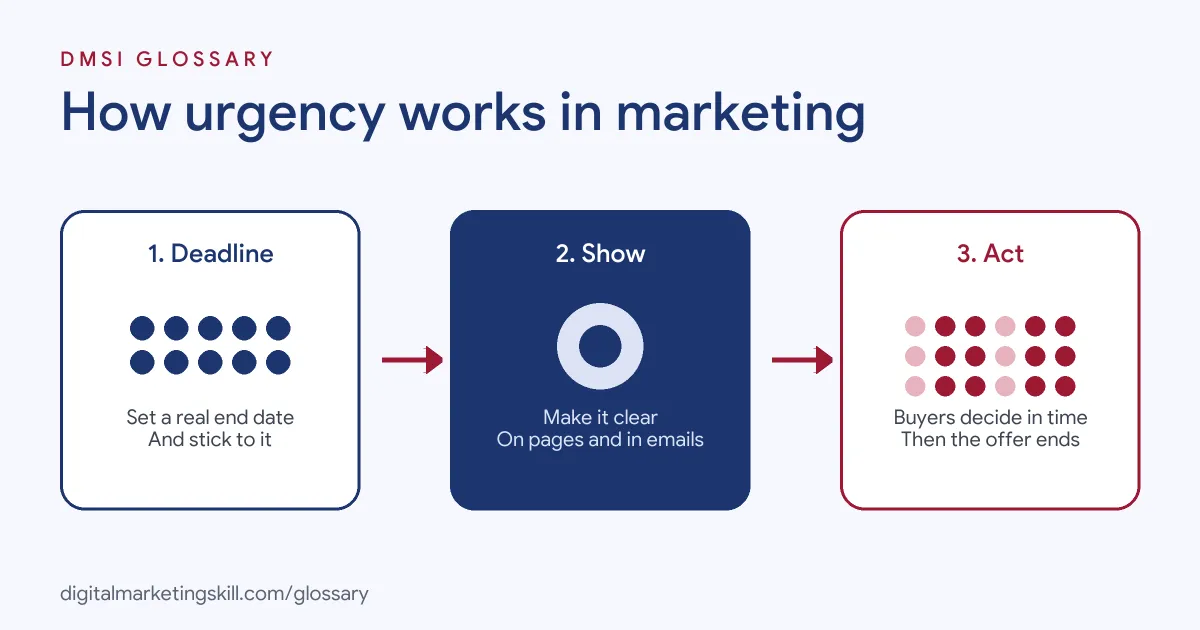
Urgency works in three steps. First, there is a real deadline or time-bound benefit. Next, you make that deadline clear and easy to see. Finally, people who already want the offer act before it ends.
Common Forms of Urgency
- Sale end dates: a discount that ends at a stated time.
- Early-bird pricing: a lower price for those who book before a deadline.
- Order-by times: “Order by 3pm for next-day delivery.”
- Launch offers: a bonus available only during a launch period.
- Enrolment windows: courses or programmes that open for set intakes.
Why It Works
A deadline changes the question in a buyer’s mind. Without one, the question is “Should I buy?” With one, it becomes “Should I buy before the offer ends?” That shift helps people who are already interested to make a choice. However, it does not create real interest where none exists. A weak offer with a deadline is still a weak offer.
The Rules
False urgency is not allowed. In the UK, the Digital Markets, Competition and Consumers Act lists as a banned practice “Falsely stating that a product will only be available for a limited time, or that it will only be available on particular terms for a limited time, in order to elicit an immediate decision.”
The Advertising Standards Authority (ASA) has also explained how this applies to countdown clocks. It says they “can be used responsibly,” but any promotional saving “must be a genuine saving against the price at which an item is usually sold.” It adds that “it is therefore unacceptable following the promotional period to keep the discount running,” and that clocks “should not start back up once they have finished.”
Urgency Examples
Here are three made-up examples of honest urgency:
- Online shop: A gift shop shows “Order by 2pm for delivery tomorrow” on product pages. The time is accurate, and orders after the cut-off ship the next working day.
- Training provider: A course offers an early-bird price until registration closes for the next intake. After the date, the full price applies and the page updates.
- Software launch: A tool offers a founding-member discount for the first week after launch. When the week ends, the offer is removed for good.
In each case, the deadline is real, visible and kept.
Urgency vs Scarcity
| Factor | Urgency | Scarcity |
|---|---|---|
| What is limited | Time | Quantity, access or capacity |
| Typical message | Sale ends tonight | Only 5 places left |
| Common use | Sales, launches, early-bird prices, delivery cut-offs | Limited editions, small classes, waiting lists |
| Main risk | Fake or restarting deadlines | Fake low-stock claims |
The two often work together. However, both depend on the claim being true.
How to Use Urgency Ethically
- Set a real deadline. Choose a date or time you will stick to.
- Give a reason. Explain why the deadline exists, such as a cohort start date or a delivery cut-off.
- Make it visible. Show the end date on the landing page, in emails and in ads.
- Keep the saving genuine. Compare against the price you usually charge, and keep evidence.
- End it when you said you would. Remove the offer, update the page and stop the ads.
- Remind people fairly. A short reminder email before the deadline is helpful; daily pressure is not.
- Track results and complaints. Watch conversions, unsubscribes and refund requests together.
Best Practices for Urgency
- Be specific. “Ends Sunday at midnight” is clearer than “ending soon”.
- Pair it with a clear call to action. Tell people exactly what to do, using a strong call to action.
- Use email wisely. A last-chance subject line works best when the deadline is real.
- Avoid fake timers. Never use a clock that resets for each visitor.
- Do not change closing dates lightly. The ASA notes that CAP Code rule 8.17.4.e says closing dates “should not be changed outside of very specific circumstances.”
Common Mistakes to Avoid
First, brands run “final days” sales that never seem to end. Second, they use countdown timers that restart when the page reloads. Third, they compare against a price they rarely charge. Finally, they push urgency on every email, so subscribers tune out. Each mistake risks complaints, rulings and lost trust.
Writing Honest Urgency Messages
Good wording is calm and specific. Compare two made-up lines for the same offer. The first says: “Hurry!!! Last chance!!! Don’t miss out!!!” The second says: “Early-bird pricing ends Friday at 6pm. After that, the full price applies.” The second is clearer, more believable and easier to act on.
So follow a simple pattern. First, state what ends. Next, say exactly when. Then say what happens afterwards. That’s all most readers need to decide.
Using Deadlines in Email Sequences
Email is where time-limited offers are most often seen. A fair sequence might look like this made-up plan. First, announce the offer and its end date. A few days later, share a customer story or a useful tip linked to the product. Then, the day before it ends, send a short reminder. Finally, on the last day, send one clear last-chance message. After the deadline, stop. Do not send “extended” emails unless something genuinely changed, and remove anyone who has already bought from the reminders.
Why It Matters for Marketing
Delay is one of the biggest reasons people do not buy. Honest deadlines help interested buyers make a choice, which can lift conversion rates on launches, events and sales. At the same time, customers and regulators now spot fake tactics quickly. So the brands that benefit most use urgency only when it is real, and say clearly what will happen when the time is up.
Where You’ll Use Urgency at Work
We did not find remote job listings that name this technique in a marketing sense. However, it is part of the daily work of several roles. A Digital Marketing Manager plans sales and launch calendars with clear deadlines. An Email Marketing Specialist writes reminder sequences before offers end. Meanwhile, a Growth Marketer tests deadline messages on landing pages and checkout. In each role, you will need to balance persuasion with honesty and the rules on misleading claims.
Learn It in the Full Stack Programme
Urgency touches copywriting, landing pages, email automation and paid ads, so the best fit is the Full Stack programme (all four tracks). You take all ten courses and complete one portfolio project from each track. You also get unlimited 1-on-1 mentoring and a U.S. Project Internship from day one.
For more on writing emails that persuade fairly, read our guide to persuasive email marketing.
Frequently Asked Questions
What is urgency in marketing?
It is giving people a genuine reason to act now, usually through a real deadline such as a sale end date or early-bird price.
Are countdown timers allowed?
Yes, if they are genuine. The ASA says the promotion must end when the clock does, and clocks should not restart.
What is the difference between urgency and scarcity?
Urgency limits time. Scarcity limits quantity or access, such as a small number of places.
Is false urgency illegal?
In the UK, falsely saying a product is available only for a limited time to push an immediate decision is a banned practice.
How often should I use urgency?
Sparingly. If every message has a deadline, people stop believing them. Save it for real sales, launches and cut-offs.
Sources: legislation.gov.uk: DMCC Act, Schedule 20 (banned practices); ASA: Countdown clocks; ASA: The CAP Code.